- 352 pages
- English
- ePUB (mobile friendly)
- Available on iOS & Android
eBook - ePub
About this book
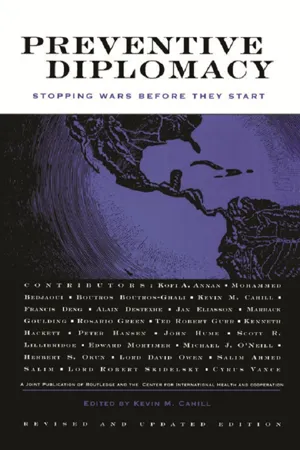
The suppression of war has been the primary objective of the United Nations for almost fifty years, and stopping a war before it starts is easier than ending a war already underway. History, however, has shown that military interventions and economic sanctions often do more harm than good. In Preventive Diplomacy, Nobel prize winners, top officials, and revered thinkers tackle these issues and explore the process of conflict prevention from humanitarian, economic, and political perspectives. This cross-disciplinary reader on global politics demonstrates that when new insights and methodologies on public health are applied to the handling of international disasters, the change in policy perspective is intriguing--even hopeful.
Information
PART 1
OLD CONCEPTS / NEW APPROACHES
Anyone working in public health knows that specific ailments may be caused as much by economic factors as by biologic agents, and that most epidemics have their roots deep in poverty, ignorance, and oppression, in corruption and incompetence. The paths of government and medicine inevitably overlap and intertwine. But most political leaders tend— as do we all—to compartmentalize life, to stay safely within their expected areas of comment, thereby denying society the fullness of their experience and vision. It takes courage, and unusual wisdom, to look beyond predictable solutions and devise imaginative answers to chronic problems. Such creativity and leadership distinguish the statesman from the mere diplomat.
Throughout this book there is an emphasis on the importance of humanitarian issues in preventive diplomacy; that focus obviously reflects my own background and bias. The humanitarian emphasis also reflects my belief that people of all classes, in all societies, all over the world, would better understand the efforts of politicians and diplomats if they could relate them to their own lives. I suggest this can be done by utilizing well-known methods of public health and the common metaphors of medicine. I also suggest that peacekeepers could better appreciate their own potential, and limitations, by comparing their techniques and results with those that have proved satisfactory in the ancient field of disease prevention.
Using this approach, the centrality of health in foreign policy can be better recognized, and the ultimate importance of each individuals physical and mental well-being may finally be accepted as essential ingredients in creating a stable political environment. Humanitarian concerns and crises are, increasingly, the bases for international interventions. Epidemics, starvation, genocide, and gross violations of human rights are no longer considered as merely the internal problems of sovereign nations.
In this section four internationally acclaimed masters—in politics, jurisprudence, and international humanitarian affairs—accepted the challenge to construct from their own experiences the foundations for a new diplomacy.
Lord David Owen opens with an overview drawn from his unique medical and political background. Nobel Peace Prize Laureate John Hume suggests universal lessons from a local conflict. The Chief Justice of the International Court in the Hague, Mohammed Bedjaoui, emphasizes, in an eloquent essay, timeless values and the necessity, especially in the poor countries of the world, that preventive diplomacy be based on development, education, and an evolving acceptance of human rights. Peter Hansen, a former UN Under-Secretary-General for Humanitarian Affairs, demonstrates the significance of humanitarian affairs in modern diplomacy. Finally, Michael J. O’Neill, to whom this volume is dedicated, assesses the terrible power—for good or ill— of the media in a new world order of instant communication.
K. M. C.
1
A CLINICIAN’S CAUTION
RHETORIC AND REALITY
LORD DAVID OWEN
The Greek Physician Herophilus observed some two thousand years ago that illness renders science null, art inglorious, strength effortless, wealth useless, and eloquence powerless. Conflict does much the same to the body politic. Conflict is cancerous in the way it erodes democracy and trust, brutalizes behavior, and destroys civilized values and constraints. Preventing is very different from curing illness, and preventive health has acquired over the centuries particular disciplines and skills. Preventing conflict also requires different skills from resolving conflict, even though they cannot always be separated out. Yet diplomats, unlike physicians, have not fully developed a preventive ethos and a disciplined method of working.
The second half of the nineteenth century and the first half of the twentieth century has seen in the developed world a dramatic fall in mortality rates, mainly attributable to the prevention of deaths from infectious diseases. Preventive public health measures to provide clean water supplies and improved housing have made, though it is not often recognized, a far more dramatic impact than clinical treatment. Prevention continues to do so through immunization programs. The WHO eradication-of-smallpox campaign was a striking success and we hope polio will soon follow. Yet, tuberculosis is returning. Drug therapy, particularly antibiotics, have played their part as have modern surgical techniques and chemotherapy. There has also developed a counter-movement to ill-judged medical interventions seen in the growth of lifestyle adjustments, homeopathic medicines, and a greater readiness to rely on the body’s own defense mechanisms.
Realistic doctors are only too well aware of the inadequacies of their skills when confronting much illness. It is a salutary fact that as the population lives longer the vast bulk of modern illness is not cured but alleviated by the doctor’s skills. The majority of doctors’, nurses’, and therapists’ time is spent in helping patients to accommodate themselves to the facts of their illness. The largest element in all illness in modern society is the aging process itself—a largely irreversible process. Health services and the doctors are cast in the role of the providers of good health, yet, at best, for the bulk of illness all they can do is watch as the body wears itself out. The dramatic cure is the exception rather than the rule.
Much the same limitation affects politicians dealing with conflict within a nation or internationally. Violence is part of daily living; we can deplore its existence but we are not likely to be able to root it out from our diverse societies. The Cold War avoided a set battle between NATO and the Warsaw Pact—but there were surrogate battles between the United States and the Soviet Union, and many other conflicts that resulted in a hideous loss of life. Despite the UN providing a framework for international order and world peace, its first fifty years were sadly characterized by multiple wars. The possibility of the UN intervening in a conflict within a nation-state was virtually excluded after the Korean War. After the collapse of the Berlin Wall the UN authorized humanitarian interventions in Iraq, Somalia, Croatia, Bosnia-Herzegovina, Haiti, Rwanda, and, depending on one’s interpretation of the Security Council Resolutions, Kosovo. Yet the disappointing results mean that even the principle of such interventions is now having to be critically reassessed. It also has become clear that we do not know enough about the multifaceted impact of economic and trade sanctions as well as differing forms of military intervention.
The doctor and the politician are not as different as perhaps both, and in particular the doctor, would like to think. Each is essentially involved in the practice of natural science. The physicist and engineer deal in absolutes. The clinician and the politician can only use science as an aid, and they are both intimately involved in human behavior. Inevitably in their decision making they fuse not only scientific and statistical evidence but also important elements of the behavioral sciences. Both have to relate their decisions to and identify with a multiplicity of human variables. The doctor is primarily involved with the individual, the national politician inevitably predominantly with groups of individuals, the statesman with groupings of nations. The skill of the good politician and the skill of the good clinician come not just from their ability to observe life, to understand and feel a concern for their fellow men and women, but also from knowing when to intervene and when to leave alone. The greatest mistakes in politics and medicine often derive from an inability to comprehend and anticipate the underlying trends and developments affecting individuals.
I have adapted an old prayer of Sir Robert Hutchinson, a nineteenth-century physician at the London Hospital, into a “Politicians Prayer”:
From inability to let well alone, from too much zeal for the new and contempt for what is old, from putting knowledge before wisdom, science before art, and cleverness before common sense, from treating individuals as statistics, and from making change in the body politic more grievous than the endurance of the same, good Lord deliver us.
Just as the wise clinician understands that the body has an ability to heal itself, so the wise politician knows that the body politic, too, has its own correcting mechanisms. If one intervenes to correct one factor, an imbalance will often appear somewhere else. The good clinician can never diagnose or treat any symptom in isolation: the whole man embraces his environment just as much as his ailment. In politics exactly the same factors have to be reckoned with, for an interventionist style of politics is an exposed one, and any action will be clearly related to the change it may introduce—positive or adverse. Inaction and immobility in politics, as in medicine, can exaggerate or perpetuate tendencies that already exist so that they become damaging. Intervention, on the other hand, is capable of wreaking far more havoc than inaction. The interventionist politician, like the interventionist clinician, therefore, has a duty to commission research and pay respect to the results of any such research. An intervention that is not based on as much factual evidence as is available is simply irresponsible.
Yet just as doctors and politicians can work only on the margin of human behavior and existence, society still thinks they have far greater power than in reality they possess. “Do something” remains a common cry. However, the frustration the doctor feels, as does the politician, is that so often the short-term remedy conflicts with the long-term solution. Both have to accept, albeit with resignation, the limitations imposed by the structures on which they operate: the human body and the body politic. In consequence the wisest course is often only a series of patching-up expedients. Careful research and observations can indicate worthwhile initiatives that are capable of ensuring that eventual benefits do accrue, but they may only rarely be dramatic or even directly attributable to their initiator. In an ideal world it would not sound horrifying or cause alarm if politicians and doctors admitted more freely and more openly that their decisions are often influenced and even dominated by the maxims of calculated neglect and masterly inactivity. But although they know that this may be the wisest course, they also know that it may be a course that opens them to bitter criticism and, in a crisis, to almost universal condemnation. Patients and parliaments want activism when faced with crisis.
In international politics calls for action are not new, as any reading of the reports from war correspondents from the Boer War and before will show. What is different today is the “CNN effect.” The TV camera in Sarajevo recording minute by minute, hour by hour, day by day in real time from the battleground conveys an immediacy and has an impact that no newspaper, with its greater number of words qualifying and explaining, or even a radio commentary, carries. Although there is no CNN camera yet in the consulting room or operating theater, medicine is now dramatized on TV and patients’ rights and medical litigation have ensured that doctors no longer agonize in private when facing choices of life and death.
Doctors call this triage, the inescapable three-way choice: who to treat, who will die, who can wait. It is worth examining the qualities of the individual surgeon whom a doctor will choose for themselves or their family. One will invariably find that high up is a known reluctance to wield the scalpel for its own sake. This proper caution over intervening medically or surgically is as much about understanding the natural history of disease as recognizing the dangers of upsetting the restorative nature of the body’s defense mechanisms.
The general public has come to recognize even in the richest industrial nations that no system of public health care will provide wholly adequate resources. Some degree of rationing is accepted as inevitable, and this realization has heightened the question of how such choices should be made. As people realize that there will always be an unsatisfied medical demand, there is more questioning of whether rationing of facilities, or, more seriously, scarce medical and surgical skills, clearly public goods, can be justified on anything other than the basis of need. But who determines that need, the doctors or the politicians? Because these subjective judgments are so complex we are finding it hard to escape from a mixed health care system, part publicly organized providing on the basis of need, part privately organized on the ability to pay.
A similar questioning is occurring within the international community about conflict prevention and resolution as it becomes ever clearer that we will not devote to it the much needed financial resources. We will defend our own state but are wary of involving our troops within another states territory. In the early 1990s the Stockholm International Peace Research Institute showed that of thirty major armed conflicts in the world only one was interstate, and that was between India and Pakistan. All the others were within states. Until the end of the Cold War the Security Council did not intervene in the internal affairs of a Member State. Now politicians and those who practice international diplomacy, after intervening in Iraq, Somalia, and the former Yugoslavia, are better aware of the perils of interventionism. As a result they are exhibiting a newfound sense of caution. In the United States this caution manifested itself after Vietnam with the often repeated message that the United States has no wish to become the world’s policeman.
A new self-disciplined approach to UN intervention was first spelled out by President Clinton in a policy directive in April 1994, shortly after the last US. troops left Somalia. The world was put on notice that the United States believed that the Security Council could not respond to each and every crisis. Unfortunately the Rwanda crisis in the spring of 1994 was the moment when the Security Council policy of accepting that the United Nations could not be everywhere or do everything was first put to the test. The U.S. refusal to sanction further UN involvement had been strongly influenced by what had happened in Somalia and what was happening in Bosnia-Herzegovina. Another strong and related motivation was congressional resistance to paying for UN peacekeeping and a wish to control the spiraling U.S. deficit in their assessed contribution to the UN budget. Yet in both Somalia and Bosnia-Herzegovina the initial UN intervention saved hundreds of thousands of lives. In the autumn of 1992 both were seen as humanitarian interventions and were so described, but it was never going to be possible to keep such a limited mission beyond a few months. “The international community should discard the illusion that one can intervene in a country beset by widespread civil violence without affecting domestic politics and without including a nation-building component.”1
The international community was under few illusions about the scale of the task if they were to intervene in Rwanda.2 They did know about the highly volatile ethnic composition of the country, of how the minority Tutsi had exercised economic and political domination prior to independence, and how, since independence in July 1962, the majority Hutu had ruled. Initially Rwanda achieved modest economic growth (1.6 percent increase of GNP on average from 1965 to 1980). Even so Rwanda had the highest population density in Africa and it was very vulnerable economically, with 80 percent of its exports being coffee and tea. When the International Coffee Agreement collapsed in 1987 and the coffee price fell to half its 1980 value, we knew this would have a particularly damaging effect on Rwanda. It was then that conflict prevention in the form of economic assistance could have worked, and we must examine the role of the Bretton Woods Institutions, the World Bank in particular, in any strategy for conflict prevention for the twenty-first century.
In October 1990 an exiled Tutsi-dominated Rwandan Patriotic Front (RPF) attacked into northeastern Rwanda. The Organization of African Unity (OAU) organized a Neutral Military Observer Group (NMOG) to monitor buffer zones separating the RPF and the Hutu government forces in July 1992 and in February 1993 to ensure resettlement in demilitarized zones. In June 1993 the United Nations agreed to an Observer Mission into Uganda and Rwanda (UNOMUR) and it was sent in to implement a peace agreement concluded at Arusha in August 1993. The OAU lacked the resources among its member states to carry through their political decision. In 1993 the UN Special Rapporteur observed that the situation was deteriorating with the Hutu government labeling all the Tutsi people as accomplices of the RPF. Following the RPF invitation in 1990, France sent its own soldiers and advisors. In October 1993 the UN Secretary-General persuaded the Security Council to establish an Assistance Mission for Rwanda (UNAMIR) to help implement the Arusha Accords. By March 1994 UNAMIR’s strength was 2,539 people with t...
Table of contents
- Cover
- Half Title
- Full Title
- Copyright
- Dedication
- Contents
- ACKNOWLEDGMENTS
- ABBREVIATIONS
- INTRODUCTION BY KEVIN M. CAHILL, M.D.
- PART I OLD CONCEPTS/ NEW APPROACHES
- PART II PARTICULAR PROBLEMS IN PREVENTIVE DIPLOMACY
- PART III MAJOR ACTORS
- PART IV POTENTIAL PARTICIPANTS IN PREVENTIVE DIPLOMACY
- CONCLUSION
- NOTES
- ABOUT THE AUTHORS AND THE CIHC
- INDEX
Trusted by 375,005 students
Access to over 1.5 million titles for a fair monthly price.
Study more efficiently using our study tools.
Frequently asked questions
Yes, you can cancel anytime from the Subscription tab in your account settings on the Perlego website. Your subscription will stay active until the end of your current billing period. Learn how to cancel your subscription
No, books cannot be downloaded as external files, such as PDFs, for use outside of Perlego. However, you can download books within the Perlego app for offline reading on mobile or tablet. Learn how to download books offline
Perlego offers two plans: Essential and Complete
- Essential is ideal for learners and professionals who enjoy exploring a wide range of subjects. Access the Essential Library with 800,000+ trusted titles and best-sellers across business, personal growth, and the humanities. Includes unlimited reading time and Standard Read Aloud voice.
- Complete: Perfect for advanced learners and researchers needing full, unrestricted access. Unlock 1.5M+ books across hundreds of subjects, including academic and specialized titles. The Complete Plan also includes advanced features like Premium Read Aloud and Research Assistant.
We are an online textbook subscription service, where you can get access to an entire online library for less than the price of a single book per month. With over 1.5 million books across 990+ topics, we’ve got you covered! Learn about our mission
Look out for the read-aloud symbol on your next book to see if you can listen to it. The read-aloud tool reads text aloud for you, highlighting the text as it is being read. You can pause it, speed it up and slow it down. Learn more about Read Aloud
Yes! You can use the Perlego app on both iOS and Android devices to read anytime, anywhere — even offline. Perfect for commutes or when you’re on the go.
Please note we cannot support devices running on iOS 13 and Android 7 or earlier. Learn more about using the app
Please note we cannot support devices running on iOS 13 and Android 7 or earlier. Learn more about using the app
Yes, you can access Preventive Diplomacy by Kevin M. Cahill in PDF and/or ePUB format, as well as other popular books in Politics & International Relations & Diplomacy & Treaties. We have over 1.5 million books available in our catalogue for you to explore.