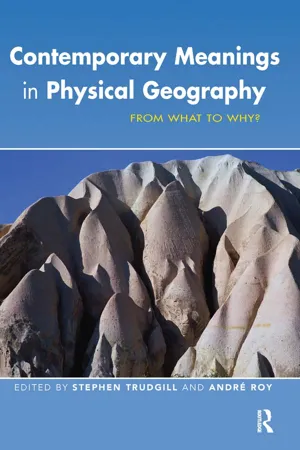
Over the past twenty years, geography as an academic discipline has become more and more reflective, asking the key questions 'What are we doing?' 'Why are we doing it?'. These questions have, so far, been more enthusiastically taken up by human geography rather than physical geography. Contemporary Meanings in Physical Geography aims to redress the balance.
Written and edited by a distinguished group of physical geographers, Contemporary Meanings in Physical Geography comprises of a collection of international writer's thoughts which reveal personal motivations, and look at tensions in the worlds of meaning in which physical geography is involved. How are the meanings of the physical environment derived? Is the future of physical geography one where the only, or at least the dominant, meanings are framed in the contexts of environmental issues.
Covering a diverse and lively selection of topics, the contributors of this book offer guides to the contemporary debates in the philosophy of physical geography, and introduce the reader to its wider cultural significance. This book is an essential companion to anyone studying, or with an interest in, physical geography.
- 256 pages
- English
- ePUB (mobile friendly)
- Available on iOS & Android
eBook - ePub
About this book
Information
PART I
SETTING THE SCENE
1
Previous actors and current influences: trends and fashions in physical geography
Peter Sims
1.1 Introduction
At first sight, this chapter is a straight forward introduction to the nature and content of the major themes and issues that have formed the basis of modern physical geography from the end of the 19th century to the present day. However, a little further thought poses two key questions. First, exactly what should be included in the term physical geography? Second, should the approach be essentially chronological or concentrate on thematic approaches and specific sub-disciplines? Being conscious of a recent comprehensive review of Physical Geography (Gregory, 2000), it would be impossible in one small chapter to do full justice to all branches of the subject — itself so heavily dominated by geomorphology and its own numerous subdivisions. Nevertheless, I have attempted to include some aspects of biogeography, climatology, soils, hydrology and Quaternary studies. However, most consideration is given to the links through to geomorphology — a reflection not only of the overriding influence of this area of study, but also of my own training and experience.
What follows is the result of an early decision on my part not to present a strictly chronological discussion, but to merge the historical development of physical geography with an identification of some of the key ideas which have emerged and been developed and modified. I attempt, therefore, to explore the way in which certain ideas have created a chronology of the development of this particular branch of science, and also examine how some ideas have become recurring themes which have been worked and re-worked through time. One could of course refer to these in terms of paradigms and paradigm shifts (or even paradigms revisited), although I prefer not to label matters in this way. This may perhaps be a result of my own uncertainty about what rightly can be given such a status (or not), as the case may be!
1.2 Speculation, observation, classification and categorization
The foundations of modem physical geography — origins and evolution: the Darwinian inheritance. The cycle of erosion and the influence of W.M. Davis — denudation chronology and all that! Climaxes, succession and stages. Climatic zones and biomes.
Experimentation — finer tuning of the Davisian ‘normal’ concepts.
Davies (1968) chronicled the very early ideas in earth sciences, reviewing the work of various authors who attempted explanations of earth history. However, the true beginnings of modern physical geography can be traced to the numerous developments in scientific thinking that emerged at the end of the 18th century and which were significantly advanced during the 19th century. Of particular note were the publications of a number of geologists, e.g. James Hutton’s Theory of the Earth (1795).
For Hutton, the earth was a machine — a kind of three-phase engine in which denudation of continental rocks provided the soil to maintain the earth’s fertile mantle, where continental debris was transported seawards by rivers in a second phase and sedimentation which took place on the ocean floors. There the material was converted into new sedimentary strata, eventually to be uplifted to form new continental masses in the third and final stage of the process. This pattern could be repeated through time, and so we see the beginnings of a concept which was to sustain much geomorphological thinking through to the middle of the 20th century i.e. repeated cycles of uplift, denudation resulting from the dominance of fluvial erosion and the subsequent deposition of transported rock materials. Hutton maintained quite clearly that the origin of the earth pre-dated existing continents and, in so doing, established long timescales which effectively banished earlier ideas which relied heavily on biblical interpretations of the creation of the earth and the role of a catastrophic universal flood.
Hutton’s work did not receive much in the way of immediate acclaim or recognition. Davies (1968) explains that apart from the problems caused by the dominance of accepted Christian teaching on the origin of the earth, Britain was embroiled in concerns surrounding the revolution in France — it would seem that the ‘Establishment’ could not handle two revolutions at once! Hutton’s thesis was re-stated and condensed by Playfair (1802) in his Illustrations of the Huttonian Theory of the Earth, but it required the input of further ideas before the old accepted theories were finally brought seriously under threat.
In part, momentum to these changing notions was given by the concept of uniformitarianism expounded by Charles Lyell in his Principles of Geology (1830) — ‘being an attempt to explain the former changes of the Earth’s surface by reference to causes now in action’. Lyell, throughout the following 45 years and 12 editions of his text, continued to extend the hypothesis that the earth’s surface was subject to natural processes operating over long timescales and that many of these processes could be observed moulding the scenery of the present day. Thus the present became the ‘key’ to the past and another fundamental geomorphological axiom was established, although the scale of operation and frequency of events were not fully discussed as possible ‘flaws’ in the general acceptance of these ideas.
The final impetus to this ‘new’ thinking came in the latter half of the century with the publication in 1859 of Charles Darwin’s Origin of Species. The impact on physical geography was immense. First came the recognition that the earth’s surface ‘evolved’, i.e. it changed through time — ideas developed earlier in Darwin’s (1842) work on coral islands, and second came a concept of organisation — that there were distinct relationships between plants and animals and the environment.
All of these ideas moved Victorian science forward significantly, although basic observation and description and, in some cases, the somewhat routine collection and categorization of natural phenomena continued for some time, as exemplified in works such as Mantell’s Geological Excursions round the Isle of Wight (1854) and Dana’s Manual of Mineralogy and Lithology (1879). Indeed, it was not until the last 15 years or so of the 19th century that the earth’s landscapes began to be explained utilizing some of the newer ideas — see for example Geology: chemical, physical and stratigraphical (Prestwich, 1886).
It was exactly at this stage that one of the great luminaries of geomorphology enters upon the scene. W.M. Davis (1850–1934), working mainly in the eastern part of the USA, absorbed and developed evolutionary and uniformitarian ideas into his explanation of landforms and the cycle of erosion (and related complications or modifications to the original hypothesis) in a number of papers published from 1889 to 1906 (see Geographical Essays edited by D.W. Johnson, 1954).
Davis suggested that after rapid uplift of an emergent sea floor, fluvial erosion (the dominant process) would act through time upon the underlying geology (lithology and structure) to produce a landscape described in terms of stage of development (youth, maturity and old age). An end-point would be a fluvially eroded base-level surface (the peneplain). To this basic model he introduced modifications to allow for rejuvenation (renewed uplift) and further hypotheses on the evolution of the meandering habit of rivers, together with the concept of grade and the graded profile in which the denudation of valley slopes was balanced by the removal of eroded material by rivers. In this context, according to Higgins (1975), Davis synthesized contemporary geological thought in using and developing the ideas of other American earth scientists, namely Powell (1834–1902) and Gilbert (1843–1918). Later work by Davis accepted that not all landscapes could be attributed to the basic model and papers on arid cycles and marine cycles were added, as were the ‘accidents’, which accounted for volcanic and glacial landforms.
Davis’ contribution to geomorphology was truly monumental. His thinking and writing dominated the subject for over 50 years and established geomorphology as the dominant branch of physical geography. In the States, Davis’ disciples included D.W. Johnson (who edited the main essays in 1909), Von Engeln (1942) and Thornbury (1954). Outside the US, Davis’ ideas were championed (amongst others) by Wooldridge and Morgan (1937) and Wooldridge and Linton (1939), based in Britain, and later by Cotton (1941, 1942), working in New Zealand.
Chorley et al. (1973) describe Davis as being ‘too important and too prolific to be ignored’. In fact, his publications, stretching over a 58-year time span, averaged about 10 per year and included significant output on a variety of themes in geology, meteorology, oceanography and geographical education, as well as the well-documented series on the genetic evolution of fluvially dominated landforms-the so-called ‘normal cycle of erosion’.
In other branches of physical geography similar developments, based partly on Darwinian ‘evolutionary’ ideas, occurred. In biogeography, Clements (1916, 1928) explained that the distribution of plant species in space and time was the result of a succession as the plant community adapted to sets of environmental or controlling conditions, ultimately producing a ‘climax’ vegetation community subject to a main control — climate; whilst Bjerknes (part of an influential early 20th century school of Norwegian meteorologists) discussed the life cycle of mid-latitude depressions — introducing the important concepts of cyclogenesis and frontogenesis.
1.3 Theorization and ‘love affairs’ in geomorphology
Denudation chronology, dynamic equilibrium, slopes and general systems. Climatic geomorphology. The beginnings of quantification and the shift towards processes.
In many respects, the theory of the normal cycle of erosion was unproven. Although it was based on extensive and detailed field observations of landforms in the eastern USA and Europe, it remained essentially a descriptive conceptual model. Davis, of course, was not without his critics, and perhaps the most notable objections to his ideas came from the disbelief that such rapid uplift could occur to initiate a new cycle and that examples of the end-point (the peneplain) could not be identified at or near any...
Table of contents
- Cover Page
- Half Title page
- Dedication
- Title Page
- Copyright Page
- Contents
- Editor's preface
- Author
- Acknowledgements
- Preface
- I Setting the Scene
- 1 Previous actors and current influences: trends and fashions in physical geography
- 2 Meaning, knowledge, constructs and fieldwork in physical geography
- II Personal Meanings
- 3 Realms of gold, wild surmise and wondering about physical geography
- 4 Goodbye to Geographical Reality: a retrospect on the New Geography
- III Research Meanings
- 5 The natural science of geomorphology?
- 6 Putting the morphology back into fluvial geomorphology: the case of river meanders and tributary junctions
- 7 Simple at heart? Landscape as a self-organizing complex system
- 8 Cultural climatology
- 9 Geomorphological and landscape wisdom — using local knowledge to manage slopes
- 10 Conceptions of nature: implications for an integrated geography
- 11 Ethical grounds for an integrated geography
- IV Futures
- 12 ‘The writing's on the walls': on style, substance and selling physical geography
- 13 Conclusion: contemporary meanings in physical geography
- Index
Trusted by 375,005 students
Access to over 1.5 million titles for a fair monthly price.
Study more efficiently using our study tools.
Frequently asked questions
Yes, you can cancel anytime from the Subscription tab in your account settings on the Perlego website. Your subscription will stay active until the end of your current billing period. Learn how to cancel your subscription
No, books cannot be downloaded as external files, such as PDFs, for use outside of Perlego. However, you can download books within the Perlego app for offline reading on mobile or tablet. Learn how to download books offline
We are an online textbook subscription service, where you can get access to an entire online library for less than the price of a single book per month. With over 1.5 million books across 990+ topics, we’ve got you covered! Learn about our mission
Look out for the read-aloud symbol on your next book to see if you can listen to it. The read-aloud tool reads text aloud for you, highlighting the text as it is being read. You can pause it, speed it up and slow it down. Learn more about Read Aloud
Yes! You can use the Perlego app on both iOS and Android devices to read anytime, anywhere — even offline. Perfect for commutes or when you’re on the go.
Please note we cannot support devices running on iOS 13 and Android 7 or earlier. Learn more about using the app
Please note we cannot support devices running on iOS 13 and Android 7 or earlier. Learn more about using the app
Yes, you can access Contemporary Meanings in Physical Geography by Andre Roy,Stephen Trudgill in PDF and/or ePUB format, as well as other popular books in Physical Sciences & Environmental Science. We have over 1.5 million books available in our catalogue for you to explore.