This remarkable book takes as its subject one of the most outstanding men that ever lived. The ultimate prodigy, Leonardo da Vinci was an artist of great originality and power, a scientist, and a powerful thinker. According to Sigmund Freud, he was also a flawed, repressed homosexual. The first psychosexual history to be published, Leonardo da Vinci was the only biography the great psychoanalyst wrote. When Jung first saw it, he told Freud it was 'wonderful', and it remained Freud's favourite composition. The text includes the first full emergence of the concept of narcissism and develops Freud's theories of homosexuality. While based upon controversial research, the book offers a fascinating insight into two men - the subject and the author. If you've ever wondered just what lies behind the Mona Lisa's enigmatic smile, read Freud on Leonardo. It's genius on genius.
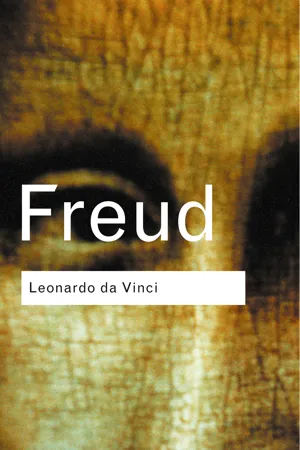
- 112 pages
- English
- ePUB (mobile friendly)
- Available on iOS & Android
eBook - ePub
Leonardo da Vinci
About this book
Information
EDITOR'S NOTE
EINE KINDHEITSERINNERUNG DES
LEONARDO DA VINCI
LEONARDO DA VINCI
(a) German Editions:
1910 Leipzig and Vienna: Deuticke. Pp. 71. (Schriften zur angewandten Seelenkunde, Heft 7)
1919 2nd ed. Same publishers. Pp. 76.
1923 3rd ed. Same publishers. Pp. 78.
1925 G.S., 9, 371–454.
1943 G.W., 8, 128–211.
(b) English Translation:
Leonardo da Vinci
1916 New York: Moffat, Yard. Pp. 130. (Tr. A. A. Brill.)
1922 London: Kegan Paul. Pp. v + 130. (Same translator, with a preface by Ernest Jones.)
1932 New York: Dodd Mead. Pp. 138. (Re-issue of above.)
The present translation, with a modified title, ‘Leonardo da Vinci and a Memory of his Childhood’, is an entirely new one by Alan Tyson.
That Freud's interest in Leonardo was of long standing is shown by a sentence in a letter to Fliess of October 9, 1898 (Freud, 1950a, Letter 98), in which he remarked that ‘perhaps the most famous left-handed individual was Leonardo, who is not known to have had any love-affairs’.1 This interest, furthermore, was not a passing one, for we find in Freud's reply to a ‘questionnaire’ on his favourite books (1907d) that he mentions among them Merezhkovsky's study of Leonardo. But the immediate stimulus to writing the present work appears to have come in the autumn of 1909 from one of his patients who, as he remarked in a letter to Jung on October 17, seemed to have the same constitution as Leonardo without his genius. He added that he was obtaining a book on Leonardo's youth from Italy. This was the monograph by Scognamiglio referred to on p. 29n. After reading this and some other books on Leonardo, he spoke on the subject to the Vienna Psycho-Analytical Society on December 1; but it was not until the beginning of April, 1910, that he finished writing his study. It was published at the end of May.
Freud made a number of corrections and additions in the later issues of the book. Among these may be specially mentioned the short footnote on circumcision (p. 46n), the excerpt from Reitler (pp. 16–17n), and the long quotation from Pfister (pp. 70–2n), all of them added in 1919, and the discussion of the London cartoon (pp. 69–70n), added in 1923.
This work of Freud's was not the first application of the methods of clinical psycho-analysis to the lives of historical figures in the past. Experiments in this direction had already been made by others, notably by Sadger, who had published studies on Conrad Ferdinand Meyer (1908), Lenau (1909) and Kleist (1909).1 Freud himself had never before embarked on a full-length biographical study of this kind, though he had previously made a few fragmentary analyses of writers, based on episodes in their works. Long before this, in fact on June 20, 1898, he had sent Fliess a study of one of C. F. Meyer's short stories, ‘Die Richterin’, which threw light on its author's early life (Freud, 1950a, Letter 91). But this monograph on Leonardo was not only in the field of biography. The book seems to have been greeted with more than the usual amount of disapproval, and Freud was evidently justified in defending himself in advance with the reflections at the beginning of Chapter VI (p. 88)—reflections which have a general application even to-day to the authors and critics of biographies.
It is a strange fact, however, that until very recently none of the critics of the present work seem to have lighted upon what is no doubt its weakest point. A prominent part is played by Leonardo's memory or phantasy of being visited in his cradle by a bird of prey. The name applied to this bird in his notebooks is ‘nibio’, which (in the modern form of ‘nibbio’) is the ordinary Italian word for ‘kite’. Freud, however, throughout his study translates the word by the German ‘Geier’, for which the English can only be ‘vulture’.2
Freud's mistake seems to have originated from some of the German translations which he used. Thus Marie Herzfeld (1906) uses the word ‘Geier’ in one of her versions of the cradle phantasy instead of ‘Milan’, the normal German word for ‘kite’. But probably the most important influence was the German translation of Merezhkovsky's Leonardo book which, as may be seen from the marked copy in Freud's library, was the source of a very great deal of his information about Leonardo and in which he probably came across the story for the first time. Here too the German word used in the cradle phantasy is ‘Geier’, though Merezhkovsky himself correctly used ‘korshun’, the Russian word for ‘kite’.
In face of this mistake, some readers may feel an impulse to dismiss the whole study as worthless. It will, however, be a good plan to examine the situation more coolly and consider in detail the exact respects in which Freud's arguments and conclusions are invalidated.
In the first place the ‘hidden bird’ in Leonardo's picture (p. 70n.) must be abandoned. If it is a bird at all, it is a vulture; it bears no resemblance to a kite. This ‘discovery’, however, was not made by Freud but by Pfister. It was not introduced until the second edition of the work, and Freud received it with considerable reserve.
Next, and more important, comes the Egyptian connection. The hieroglyph for the Egyptian word for ‘mother’ (‘mut’) quite certainly represents a vulture and not a kite. Gardiner in his authoritative Egyptian Grammar (2nd ed., 1950, 469) identifies the creature as ‘Gyps fulvus’, the griffon vulture. It follows from this that Freud's theory that the bird of Leonardo's phantasy stood for his mother cannot claim direct support from the Egyptian myth, and that the question of his acquaintance with that myth ceases to be relevant.1 The phantasy and the myth seem to have no immediate connection with each other. Nevertheless each of them, taken independently, raises an interesting problem. How was it that the ancient Egyptians came to link up the ideas of ‘vulture’ and ‘mother’? Does the egyptologists’ explanation that it is merely a matter of a chance phonetic coincidence meet the question? If not, Freud's discussion of androgynous mother-goddesses must have a value of its own, irrespective of its connection with the case of Leonardo. So too Leonardo's phantasy of the bird visiting him in his cradle and putting its tail into his mouth continues to cry out for an explanation even if the bird was not a vulture. And Freud's psychological analysis of the phantasy is not contradicted by this correction but merely deprived of one piece of corroborative support.
Apart, then, from the consequent irrelevance of the Egyptian discussion—though this nevertheless retains much of its independent value—the main body of Freud's study is unaffected by his mistake: the detailed construction of Leonardo's emotional life from his earliest years, the account of the conflict between his artistic and his scientific impulses, the deep analysis of his psychosexual history. And, in addition to this main topic, the study presents us with a number of not less important side-themes: a more general discussion of the nature and workings of the mind of the creative artist, an outline of the genesis of one particular type of homosexuality, and—of special interest to the history of psycho-analytic theory—the first full emergence of the concept of narcissism.
1 A connection between bilaterality and bisexuality had been asserted by Fliess but questioned by Freud. An indirect reference to this controversy (which was one of the occasions for their estrangement) will be found on p. 95 below.
1 The minutes of the Vienna Psycho-Analytical Society (which we are unfortunately precluded from quoting) show that at a meeting on December 11, 1907, Freud made some remarks on the subject of psycho-analytic biography. (Cf. Jones, 1955, 383.)
2This was pointed out by Irma Richter in a footnote to her recently published selection from Leonardo's Notebooks (1952, 286) Like Pfister (p. 72n. below), she refers to Leonardo's childhood memory as a ‘dream’.
1 Nor can the story of the virginal impregnation of vultures serve as evidence of Leonardo's having had an exclusive bond with his mother in his infancy— though the existence of that bond is not contradicted by the failure of this particular evidence.
1

When psychiatric research, normally content to draw on frailer men for its material, approaches one who is among the greatest of the human race, it is not doing so for the reasons so frequently ascribed to it by laymen. ‘To blacken the radiant and drag the sublime into the dust’ is no part of its purpose,1 and there is no satisfaction for it in narrowing the gulf which separates the perfection of the great from the inadequacy of the objects that are its usual concern. But it cannot help finding worthy of understanding everything that can be recognized in those illustrious models, and it believes there is no one so great as to be disgraced by being subject to the laws which govern both normal and pathological activity with equal cogency.
Leonardo da Vinci (1452–1519) was admired even by his contemporaries as one of the greatest men of the Italian renaissance; yet in their time he had already begun to seem an enigma, just as he does to us to-day. He was a universal genius ‘whose outlines can only be surmised,—never defined’.1 In his own time his most decisive influence was in painting, and it was left to us to recognize the greatness of the natural scientist (and engineer)2 that was combined in him with the artist. Though he left behind him masterpieces of painting, while his scientific discoveries remained unpublished and unused, the investigator in him never in the course of his development left the artist entirely free, but often made severe encroachments on him and perhaps in the end suppressed him. In the last hour of his life, according to the words that Vasari gives him, he reproached himself with having offended God and man by his failure to do his duty in his art.3 And even if this story of Vasari's has neither external nor much internal probability but belongs to the legend which began to be woven around the mysterious Master even before his death, it is still of incontestable value as evidence of what men believed at the time.
What was it that prevented Leonardo's personality from being understood by his contemporaries? The cause of this was certainly not the versatility of his talents and the range of his knowledge, which enabled him to introduce himself to the court of the Duke of Milan, Lodovico Sforza, called Il Moro, as a performer on a kind of lute of his own invention, or allowed him to write the remarkable letter to the same duke in which he boasted of his achievements as architect and military engineer. For the days of the renaissance were quite familiar with such a combination of wide and diverse abilities in a single individual—though we must allow that Leonardo himself was one of the most brilliant examples of this. Nor did he belong to the type of genius who has received a niggardly outward endowment from Nature, and who in his turn places no value on the outward forms of life, but in a spirit of painful gloom flies from all dealings with mankind. On the contrary, he was tall and well-proportioned; his features were of consummate beauty and his physical strength unusual; he was charming in his manner, supremely eloquent, and cheerful and amiable to everyone. He loved beauty in the things that surrounded him; he was fond of magnificent clothing and valued every refinement of living. In a passage from the treatise on painting, which reveals his lively capacity for enjoyment, he compares painting with its sister arts and describes the hardships that await the sculptor: ‘For his face is smeared and dusted all over with marble powder so that he looks like a baker, and he is completely covered with little chips of marble, so that it seems as if his back had been snowed on; and his house is full of splinters of stone and dust. In the case of the painter it is quite different … for the painter sits in front of his work in perfect comfort. He is well-dressed and handles the lightest of brushes which he dips in pleasant colours. He wears the clothes he likes; and his house is full of delightful paintings, and is spotlessly clean. He is often accompanied by music or by men who read from a variety of beautiful works, and he can listen to these with great pleasure and without the din of hammers and other noises.’1
It is indeed quite possible that the idea of a radiantly happy and pleasure-loving Leonardo is only applicable to the first and longer period of the artist's life. Afterwards, when the downfall of Lodovico Moro's rule forced him to leave Milan, the city that was the centre of his activity and where his position was assured, and...
Table of contents
- Front Cover
- Half Title
- Title Page
- Copyright
- Preface to the 1922 Edition
- EDITOR'S NOTE
Trusted by 375,005 students
Access to over 1.5 million titles for a fair monthly price.
Study more efficiently using our study tools.
Frequently asked questions
Yes, you can cancel anytime from the Subscription tab in your account settings on the Perlego website. Your subscription will stay active until the end of your current billing period. Learn how to cancel your subscription
No, books cannot be downloaded as external files, such as PDFs, for use outside of Perlego. However, you can download books within the Perlego app for offline reading on mobile or tablet. Learn how to download books offline
Perlego offers two plans: Essential and Complete
- Essential is ideal for learners and professionals who enjoy exploring a wide range of subjects. Access the Essential Library with 800,000+ trusted titles and best-sellers across business, personal growth, and the humanities. Includes unlimited reading time and Standard Read Aloud voice.
- Complete: Perfect for advanced learners and researchers needing full, unrestricted access. Unlock 1.5M+ books across hundreds of subjects, including academic and specialized titles. The Complete Plan also includes advanced features like Premium Read Aloud and Research Assistant.
We are an online textbook subscription service, where you can get access to an entire online library for less than the price of a single book per month. With over 1.5 million books across 990+ topics, we’ve got you covered! Learn about our mission
Look out for the read-aloud symbol on your next book to see if you can listen to it. The read-aloud tool reads text aloud for you, highlighting the text as it is being read. You can pause it, speed it up and slow it down. Learn more about Read Aloud
Yes! You can use the Perlego app on both iOS and Android devices to read anytime, anywhere — even offline. Perfect for commutes or when you’re on the go.
Please note we cannot support devices running on iOS 13 and Android 7 or earlier. Learn more about using the app
Please note we cannot support devices running on iOS 13 and Android 7 or earlier. Learn more about using the app
Yes, you can access Leonardo da Vinci by Sigmund Freud in PDF and/or ePUB format, as well as other popular books in Kunst & Künstlerbiographien. We have over 1.5 million books available in our catalogue for you to explore.