- 188 pages
- English
- ePUB (mobile friendly)
- Available on iOS & Android
eBook - ePub
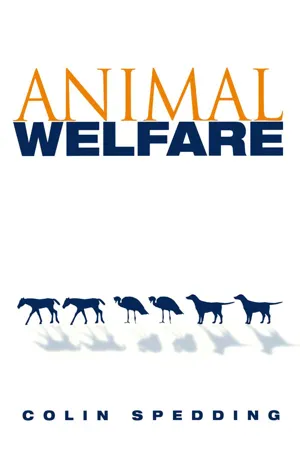
Animal Welfare
About this book
Awareness of the use of animals in human society in fields such as farming, biotechnology and sport is dogged by the lack of a clear and objective exposition of the issues involved and a sense of possible conflict between human and animal welfare. This text addresses these dilemmas - what is the actual scale of the animal welfare problem; where does responsibility begin; what positive steps are actually being taken to alleviate animal suffering; and can a rational and compelling argument be given for the importance of animal welfare. It therefore aims to offer a comprehensive guide to the uninformed as well as those who have knowledge of the issues but lack conviction.
Information
1
Introduction
‘Our civilization is largely defined by the way living beings are respected and how we deal with them’ (van Wifen)
An important starting point is how we define animal welfare (see Chapter 2). Clearly, it is difficult to make any progress – even in discussion – if we all mean different things by the same words. Simply bandying about highly-individual opinions on welfare is hardly likely to be productive.
It would be a laudable objective for society to have an agreed definition, but that would not prevent individuals disagreeing with it and trying to persuade others of their point of view.
Even so, an agreed definition – or one accepted by society – acts as a focus for debate and a form of words that can be the target for improvement. After all, attitudes to animals, their welfare and the importance of fostering it, have all changed over time and still vary greatly from one country and region to another.
In the UK, for example, attitudes to bear-baiting, cock-fighting, dog-fighting and badger-baiting have changed markedly over the years, as have views on the ways in which working horses, pets and farm animals should be treated.
Currently, the debate focuses on the hunting of wild animals, the culling of over-numerous populations, the control of pests and the ways in which animals are kept on farms and in zoos and circuses, but the emphasis is quite different in different countries.
Chapter 3 discusses the question of which animals should be included in our concerns for welfare, in our own and in other countries. For, as with the treatment of people, concern cannot simply be confined to one’s own village, town or nation. It is wise to be clear about exactly why we should be concerned anyway (see Chapter 2) and the extent to which this should be related to the nature and scale of the problem (see Chapter 4). For example, there are more chickens than cows, more wildlife (of some species) killed on the roads than in hunting, more marine fish killed than freshwater fish and so on. Does this affect how concerned we should be?
In any case, we have to ask what ‘the problem’ is. Just because a lot of animals are involved, does it follow that there is a problem? Or is it that, if there is a problem, it is a bigger or more important one if large numbers are involved?
In all this – and this will be a recurring theme – to an animal that is suffering, it does not make any difference whether it is the only one or one of thousands; just as it does not matter to the animal why anything is being done to it, or for what purpose. What matters to the animal is the degree, extent and duration of the suffering. So the essential questions to be asked are: Is the animal suffering? Are we sure? How can we tell? Are there signs or tests that can be used and is it the same for different species?
In some important respects, things must be different for different species. For example, if a hen suffers because it is deprived of a nest box in which to lay its eggs, this cannot be true of a bullock or a ewe. In other words, to the extent that being deprived of the opportunity to exercise natural behavioural patterns is a cause of suffering or poor welfare, it is likely that there are differences not only between species, but also between sexes, sizes and ages of a single species.
It is therefore necessary to lay down standards for the ways that different animals are kept, in general terms but also, it turns out, in very great detail. The need for such standards is discussed in Chapter 5. This requires a great deal of information, from scientific investigation and from practical experience, because standards have to be based on evidence. Some people will argue that it is perfectly obvious when an animal is suffering and, in some cases, this is obviously true. Not always, however. For instance, grazing animals, such as cattle and sheep, have evolved not to show pain, in order not to reveal weakness to a watching predator. Television regularly illustrates spectacular examples of antelope leaping about in an exaggerated manner as if to say to a predator ‘don’t bother with me, I’m exceptionally fit and therefore difficult to catch’. So it does not follow that because we observe no sign of pain that the animal is not suffering. Humans also vary in the degree of pain they can tolerate and the extent to which they show it.
It is customary, at this point, to warn against anthropomorphism, believing that, because we would be distressed by something, therefore the animal must be similarly affected. Clearly, we cannot assume that because we would feel pain from something, the animal does so too. We cannot know that it does; but, equally, we cannot know that it does not! We should therefore keep an open mind and base our judgement on evidence wherever possible.
Unfortunately, evidence may be lacking and very hard to obtain. In many cases, one would not wish to see the necessary experiments carried out to produce hard evidence. Fortunately, the technology of painlessly assessing all kinds of changes in the physiology and behaviour of unconstrained animals is developing very rapidly.
In many cases, we only need the evidence of our eyes: a goat dropped from a tower requires no supporting evidence (much less experimental evidence) to tell us that intolerable suffering is involved. Even in this obvious example, it is salutary to ask how we actually know that the animal suffers. This is not to suggest that it does not, but it may be helpful, in judging rather less obvious cases, to be clear about our reasoning. Bear in mind that dropping from a great height is not a problem for very small animals, such as ducklings of tree-nesting ducks and mice. In the first example, this is what happens in nature – ducklings simply drop to the ground and run off. The fact is that the smaller the animal, the greater its surface area relative to its weight, and this greatly affects its air resistance. If we wish to descend safely, we increase our air resistance by means of a parachute.
Where there is real doubt about whether an animal suffers, it is preferable to give the animal the benefit of it and assume that a practice should be avoided if there is a possibility that it causes unacceptable suffering. It is necessary to insert words like unacceptable, however suspect they may appear, because suffering is a part of life. Giving birth may involve considerable suffering, so may some fighting between animals that is necessary to establish a hierarchy of dominance, whether in a herd of dairy cows or between competing stags.
Where wild animals are concerned, we cannot sensibly interfere in their lives: predators must live as well as prey. But if we do interfere, we acquire responsibilities for welfare. If we exhibit dolphins in a pool, we have interfered, often in ways that we do not understand or even know about. This is also an example where most of us would need no evidence to support our instinct that, for example, too small a pool is being used. Where it is right that standards should be set, how can they be enforced? Who is going to act? Who is already doing what about it? These are the questions posed in Chapter 6.
Since there is much that needs to be done, Chapters 7 and 8 discuss how improvements in animal welfare can be best achieved – and by whom. Many people are not sure what they could do or, indeed, what needs to be done, but, in any case, feel that they can make very little difference by themselves. This is by no means always true: all those who consume animal products could refuse to buy those that have involved cruelty or poor welfare, and those who pay to go to animal circuses or watch dancing bears, for example, could stop doing so.
Fortunately, individuals do not have to act entirely on their own. There are at least 6000 animal welfare organizations across the world, in total doing an enormous amount of good in an astonishing number of ways. Some rehouse stray dogs and cats, some rescue wild animals from natural disaster and war zones, some deal with the casualties of pollution (eg oiled sea-birds), some lobby governments to bring about changes in the law (all dealt with in Chapter 6). All welcome members and need supporters, in however small a way.
So there are many ways in which we can all help, including persuading others that we all have responsibilities, as citizens. By a citizen I simply mean one who belongs to a human society (eg a town, city, state, nation or organized group of nations) in the sense that one has accepted the responsibilities and been granted the rights normally accorded by that society to its citizens. In other words, citizenship has to be conferred on an individual and can be withdrawn if the rules of that society are seriously infringed. Both rights and responsibilities may be related to age, sex, status, wealth and, historically, a whole range of other conditions.
In broad terms, the nature of the rights and responsibilities usually has certain characteristics (see Table 1.1).
| Rights | Responsibilitie |
| To play some part in the legislative proceedings of the state to which the citizen belongs | To contribute to the debates on which decisions and actions of the state are based |
| Freedom of speech, movement, religion, association etc, within the law | To obey the law and to exercise freedoms within it |
| To seek changes in the law (by appropriate means) | To avoid infringing the rights and freedoms of others |
| To influence the behaviour of society in relation to its treatment of people, animals and the environment |
Thus it is both the right and the responsibility of a citizen to help shape the way in which society behaves, and this includes its treatment of animals.
These responsibilities relating to animal welfare are not difficult to define in general terms (see Table 1.2) but are very hard to translate into detailed propositions, and it is the purpose of subsequent chapters to explore the problems and difficulties as well as possible solutions. Animal welfare is a subject on which many people feel very strongly and about which people may hold very different views.
However, although individuals are quite entitled to highly emotional attitudes to the ways in which animals are treated and a society in which no one cared would be intolerable to most of us, we do have to accept that such societies may exist and others also believe that they are right.
| 1 | To obey the law |
| 2 | To operate personally to high standards |
| 3 | To persuade others that standards should be raised (it is unlikely that improvement will not be needed on any foreseeable time-scale) |
| 4 | To encourage and participate in informed debate (both public and private) |
| 5 | To acquire (and help others to acquire) the knowledge and expertise needed to discharge these responsibilities |
But if every citizen has a responsibility as an individual, how can this be discharged? Is the current scene satisfactory? Are there enough well-supported organizations in the field? Is there actually a need for further action? If so, exactly what further action is needed? But the future may hold new welfare problems and, in some cases, it may be possible to avoid them by controlling the developments that cause them. Chapter 9 discusses what these developments are likely to be.
Finally, in Chapter 10, I have summarized conclusions I have reached whilst preparing this book that I did not necessarily start with, but which have confirmed my instinct that the welfare of all the different kinds of animals should be treated as one subject. Some conclusions, however, can be reached very quickly. The moral basis for concern and the principles of animal welfare should be the same for all countries and all people, but they may not be equally accepted, recognized or acted upon. Indeed, what is possible will vary from one count...
Table of contents
- Cover
- Half Title
- Dedication
- Title Page
- Copyright Page
- Table of Contents
- List of Tables
- List of Boxes
- Preface
- Acknowledgements
- Acronyms and Abbreviations
- Glossary
- 1 Introduction
- 2 What is animal welfare and why does it matter?
- 3 All animals - or only some?
- 4 The nature and scale of the welfare problem
- 5 The need for standards
- 6 Organizations concerned with animal welfare
- 7 Achieving improvement
- 8 Action needed
- 9 Future welfare issues
- 10 Reflections, unifying themes and conclusions
- Appendix 1 BFF and WSPA Recommendations
- Appendix 2 The Major Animal Welfare Organizations
- References
- Bibliography
- Index
Trusted by 375,005 students
Access to over 1.5 million titles for a fair monthly price.
Study more efficiently using our study tools.
Frequently asked questions
Yes, you can cancel anytime from the Subscription tab in your account settings on the Perlego website. Your subscription will stay active until the end of your current billing period. Learn how to cancel your subscription
No, books cannot be downloaded as external files, such as PDFs, for use outside of Perlego. However, you can download books within the Perlego app for offline reading on mobile or tablet. Learn how to download books offline
Perlego offers two plans: Essential and Complete
- Essential is ideal for learners and professionals who enjoy exploring a wide range of subjects. Access the Essential Library with 800,000+ trusted titles and best-sellers across business, personal growth, and the humanities. Includes unlimited reading time and Standard Read Aloud voice.
- Complete: Perfect for advanced learners and researchers needing full, unrestricted access. Unlock 1.5M+ books across hundreds of subjects, including academic and specialized titles. The Complete Plan also includes advanced features like Premium Read Aloud and Research Assistant.
We are an online textbook subscription service, where you can get access to an entire online library for less than the price of a single book per month. With over 1.5 million books across 990+ topics, we’ve got you covered! Learn about our mission
Look out for the read-aloud symbol on your next book to see if you can listen to it. The read-aloud tool reads text aloud for you, highlighting the text as it is being read. You can pause it, speed it up and slow it down. Learn more about Read Aloud
Yes! You can use the Perlego app on both iOS and Android devices to read anytime, anywhere — even offline. Perfect for commutes or when you’re on the go.
Please note we cannot support devices running on iOS 13 and Android 7 or earlier. Learn more about using the app
Please note we cannot support devices running on iOS 13 and Android 7 or earlier. Learn more about using the app
Yes, you can access Animal Welfare by Sir Colin Spedding in PDF and/or ePUB format, as well as other popular books in Biological Sciences & Ecology. We have over 1.5 million books available in our catalogue for you to explore.