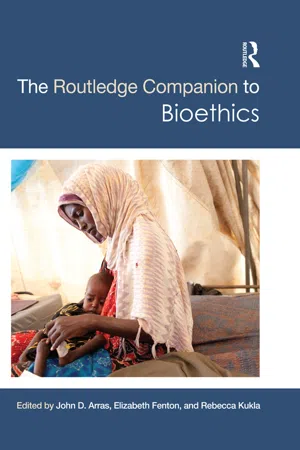
The Routledge Companion to Bioethics is a comprehensive reference guide to a wide range of contemporary concerns in bioethics. The volume orients the reader in a changing landscape shaped by globalization, health disparities, and rapidly advancing technologies. Bioethics has begun a turn toward a systematic concern with social justice, population health, and public policy. While also covering more traditional topics, this volume fully captures this recent shift and foreshadows the resulting developments in bioethics. It highlights emerging issues such as climate change, transgender, and medical tourism, and re-examines enduring topics, such as autonomy, end-of-life care, and resource allocation.
eBook - ePub
The Routledge Companion to Bioethics
- 608 pages
- English
- ePUB (mobile friendly)
- Available on iOS & Android
eBook - ePub
The Routledge Companion to Bioethics
About this book
Information
Part I JUSTICE AND HEALTH DISTRIBUTION
DOI: 10.4324/9780203804971-1
Considerations of justice are inseparable from many of the most challenging issues in contemporary bioethics; indeed one of the central aims of this volume is to draw out these considerations in debates in which they may otherwise have been obscured or overlooked. Justice is particularly salient in debates over access to and distribution of health care, and more broadly of the social, economic, and political conditions that make it possible for people to live healthy lives. The chapters in this section explore the general theme of how resources relevant to health can be fairly and justly distributed.
The first chapter in this section explores the contours of the longstanding debate over the right to health care. The debate is complex, including philosophical questions about the nature and function of rights in political and moral discourse; it is also contentious, with significant theoretical commitments on both sides. John Arras examines four leading moral and political theories (libertarianism, utilitarianism, liberal egalitarianism, and communitarianism) and the implications under each for the right to health care. Arras’s chapter also importantly situates this debate in the contemporary context of the landmark 2010 U.S. health care law known as the Affordable Care Act. In bringing the debate into the current health policy context, Arras pays particular attention to the growing understanding among bioethicists of the role of social, economic, and political factors in creating the conditions necessary for health. He notes that in light of this growing understanding many bioethicists have eschewed the language of a right to health care in favor of a right to health, which encompasses access not only to health care services but also to the conditions necessary for health. These conditions, and their relevance to social justice, are the subject of Sridhar Venkatapuram and Michael Marmot’s chapter on the social determinants of health and health inequalities. Health inequalities in populations often persist because of unjust distributions of other goods within society, such as income and education. This chapter outlines the increasingly strong evidence for the ways in which social, economic, and political conditions influence health and engender, and sometimes entrench, health inequalities. It also draws attention to the extent to which bioethics as a field (with notable exceptions) has been slow to comprehend the moral significance of the social determinants literature, and is an important reminder that bioethics must be expansive in its disciplinary scope if it is to be a force in addressing health injustice.
A deeper understanding of population-level health trends and the factors that influence them is critical to anyone engaging in contemporary bioethics. No less critical is an understanding of the ways in which health resources are allocated and prioritized in a community. The chapters by Dan Callahan, Greg Bognar, and Norman Daniels and Keren Ladin explore the ways in which health resources can be allocated more or less justly. Callahan discusses the ethics and politics of rationing health resources in an era of increasingly expensive health care and increasingly limited resources. Though many of his examples come from the U.S. context where “rationing” remains a dirty word, they are relevant to all health systems where demand outstrips supply, which is to say all health systems. Bognar’s chapter provides an excellent introduction to two concepts widely used in health resource allocation, quality-adjusted life years (QALYs) and disability-adjusted life years (DALYs). These concepts have been criticized for promoting distributions of resources that are insensitive to individual health needs and particularly complex health needs, but they remain fundamental to the strategies of many health systems seeking to spend limited budgets both efficiently and fairly. The final chapter by Norman Daniels and Kerin Ladin unifies the themes of this section by asking what we owe in terms of health resources to people who enter a society as immigrants, whether legally or illegally. The authors ask whether immigration status is morally relevant to the provision of health-related goods, based on considerations of reciprocity and the rights of states.
1 THE RIGHT TO HEALTH CARE
DOI: 10.4324/9780203804971-2
For many people in the world today, access to health care is unattainable. In the developing (i.e., poor) countries, yearly public expenditure on public health and health care often amounts to less than $10 per person (Pogge 2008). In the U.S. before the Affordable Care Act (ACA) took effect in 2010, estimates placed the number of uninsured individuals at roughly 48 million, with another 60 million underinsured (Centers for Disease Control and Prevention 2013). The passage of the ACA promised to place access to health insurance within the reach of just about every citizen, but the weakening of that Act by the Supreme Court and the refusal on the part of many states to implement the expansion of Medicaid under the Act have left millions without access to affordable insurance. Indeed, roughly half of the uninsured in the U.S. reside in states whose political leaders have refused to extend Medicaid to them (Tavernise and Gebeloff 2013). The promise of universal access thus remains unfulfilled for the foreseeable future.
What are we to think of this state of affairs? For those of a libertarian persuasion, premature mortality and untreated morbidity due to a lack of health insurance are viewed as “unfortunate but not unjust” (Engelhardt 1996, 1997). The world might be a better place were everyone’s health needs somehow met, but this, libertarians argue, is an issue of charity, not justice. Many others contend that lack of access and its contributions to ill health are indeed an injustice, a wrong perpetrated on the poor that cries out for political redress. For these critics, access to health care is a right, not a privilege underwritten by significant wealth.
These two polar opposite interpretations of the moral valence of lack of access to health insurance framed much of the recent debate in the U.S. regarding health reform. Many proponents of the ACA (“Obamacare”) stressed the moral importance of achieving universal access, while many opponents downplayed access in favor of an emphasis on cost containment and limited government. This essay will explore and scrutinize some of the arguments on both sides of this debate. I shall conclude that powerful moral arguments can buttress the case for a right to health care, but I shall also stress the limited (albeit important) role for such a right in debates over health policy.
As we shall see below, the notion of a right to health care is controversial. Some on the political right view it as morally unjustifiable, while others on the political left often view a focus on health care alone as excessively narrow. For these latter critics, a theory of justice in health should consider not just access to health care—what Norman Daniels has dubbed “the ambulance waiting at the bottom of a cliff” (Daniels 2008: 79)—but also all those so-called social determinants of health, such as public health provision of clean water and air, safe working conditions, and the social bases of self-respect on the job and in society generally (Wilkinson and Marmot 2003). Following the lead of these critics, I shall focus here on what I call access to health-related goods, not just to health care services.
Some Special Features of “Rights Talk”
First, if someone claims a “right to X,” they are saying a lot more than something like “the world would be a better place if everyone had X.” Consider this scenario inspired by philosopher Judith Thomson (1971): You are languishing in a New York City hospital, wasting away from some dread, lethal disease. The only prospect for a cure would miraculously require that the actor Matt Damon fly out from Hollywood to place his cool hand on your fevered brow. Since your life depends upon him, wouldn’t you have a right to Matt Damon’s time and efforts? Thomson’s answer is, No. Although it would be “terribly nice” if Matt were to go to all this trouble, you certainly have no right that he do so. It would, however, be a different story had Matt promised you that he’d come, or if he were your father. Hence, the first important defining feature of rights: They are justified claims, demands, or entitlements that we make vis-à-vis others. Failure to respect or grant someone’s right constitutes an injustice calling for redress; it is not the mere falling short of a social goal or ideal (Buchanan 1984; Wenar 2011).
Second, we must distinguish between moral and legal rights. Some rights—such as the right to be secure in your person or property, or the right of poor people to legal counsel in criminal cases—are carefully articulated and delimited by legal statutes, constitutions, or evolving case law. In the vast majority of cases, if there’s any doubt about the existence of such a right, you can just go look it up. By contrast, moral rights are discovered, created, or justified by moral arguments. We say that Joan has a moral right to X if sound and convincing arguments can be given showing that she has a justified entitlement to X. To say that Joan has a moral right to something leaves the legal question open. In many, but not all, cases we say that the existence of a moral right provides us with a good reason for turning that claim into a legal entitlement. So when we debate the existence of health care rights, we are making moral arguments that might later be cashed out as legal arguments.
Another distinction in the topography of rights separates negative from positive rights (Wenar 2011; Holmes and Sunstein 1999). The former are entitlements, inter alia, to be let alone, to speak or write freely about political matters in public, to gather with others in voluntary civil and religious associations, all without the interference of others, including the government. Put in a negative mode, these include the right not to be assaulted, not to have our property taken, not to be politically muzzled or imprisoned without good cause, and so on. Putative positive rights, by contrast, are entitlements to certain goods or services, such as legal representation, food, shelter, and, yes, health care.
Just how important this distinction between negative and positive is depends upon one’s larger philosophical commitments. Those of a predominantly libertarian persuasion place great stock in this distinction (Cranston 1967). They note that each of us can respect the negative rights of all other persons 24 hours a day, 7 days a week just by refraining from acting upon them in prohibited ways (e.g., stealing their property or killing them). Negative rights thus correlate with the duties of all others to refrain at all times from intervening against them. While negative rights are thus arguably cost free, positive rights obviously require that other people provide the goods and services to which we are allegedly entitled, usually by means of taxation. If we have a right to health care, then someone or some institution must have a corresponding duty to provide it to us, and this raises a fundamental problem_ Exactly how are we entitled to the money or labor of others? It is thus often concluded that negative rights are much easier to justify and fulfill than positive rights, which risk encroaching on the negative rights of others to be free to keep or spend their resources as they see fit (Cranston 1967). As we shall see momentarily, non-libertarians place much less weight on this distinction.
A final distinction concerns the weight or demandingness of various rights. Some people claim that some rights, such as the right to life of innocent people, are absolute; they cannot or should not be violated for any reason. Others argue that all or at least most rights are prima facie only (or pro tanto)—i.e., they hold for the most part or at first blush, but they can be overridden if countervailing rights or interests are sufficiently powerful. Philosopher Ronald Dworkin famously wrote that serious legal rights (e.g., to free speech) function like trumps in the game of bridge—i.e., they are claims that outrank most other claims, such as social utility (Dworkin 1978). Although he argued that most moral and legal rights should function as trumps in political argument, Dworkin conceded that they can occasionally be limited or outweighed by countervailing social considerations of great importance—e.g., shouting “Fire!” falsely in a crowded theater. Thus, if there is a right to health care, the logic of rights would disallow arguments against it merely on grounds of efficiency, social utility, or public opinion. If, however, a...
Table of contents
- Cover Page
- Half Title Page
- other Page
- series page
- Title Page
- Copyright Page
- Dedication
- Table of Contents
- Notes on Contributors
- Acknowledgments
- Introduction
- PART I Justice and Health Distribution
- PART III Intellectual Property and Commodification
- PART IV Research
- PART V Autonomy and Agency
- PART VI Reproduction
- PART VII End-of-Life and Long-Term Care
- PART VIII Embodiment
- Index
Trusted by 375,005 students
Access to over 1.5 million titles for a fair monthly price.
Study more efficiently using our study tools.
Frequently asked questions
Yes, you can cancel anytime from the Subscription tab in your account settings on the Perlego website. Your subscription will stay active until the end of your current billing period. Learn how to cancel your subscription
No, books cannot be downloaded as external files, such as PDFs, for use outside of Perlego. However, you can download books within the Perlego app for offline reading on mobile or tablet. Learn how to download books offline
Perlego offers two plans: Essential and Complete
- Essential is ideal for learners and professionals who enjoy exploring a wide range of subjects. Access the Essential Library with 800,000+ trusted titles and best-sellers across business, personal growth, and the humanities. Includes unlimited reading time and Standard Read Aloud voice.
- Complete: Perfect for advanced learners and researchers needing full, unrestricted access. Unlock 1.5M+ books across hundreds of subjects, including academic and specialized titles. The Complete Plan also includes advanced features like Premium Read Aloud and Research Assistant.
We are an online textbook subscription service, where you can get access to an entire online library for less than the price of a single book per month. With over 1.5 million books across 990+ topics, we’ve got you covered! Learn about our mission
Look out for the read-aloud symbol on your next book to see if you can listen to it. The read-aloud tool reads text aloud for you, highlighting the text as it is being read. You can pause it, speed it up and slow it down. Learn more about Read Aloud
Yes! You can use the Perlego app on both iOS and Android devices to read anytime, anywhere — even offline. Perfect for commutes or when you’re on the go.
Please note we cannot support devices running on iOS 13 and Android 7 or earlier. Learn more about using the app
Please note we cannot support devices running on iOS 13 and Android 7 or earlier. Learn more about using the app
Yes, you can access The Routledge Companion to Bioethics by John D. Arras, Elizabeth Fenton, Rebecca Kukla, John D. Arras,Elizabeth Fenton,Rebecca Kukla in PDF and/or ePUB format, as well as other popular books in Philosophy & Ethics in Medicine. We have over 1.5 million books available in our catalogue for you to explore.