Cognitive Therapy for Psychosis provides clinicians with a comprehensive cognitive model that can be applied to all patients with schizophrenia and related disorders in order to aid the development of a formulation that will incorporate all relevant factors. It illustrates the process of assessment, formulation and intervention and highlights potential difficulties arising from work with patients and how they can be overcome.
Experienced clinicians write assuming no prior knowledge of the area, covering all of the topics of necessary importance including:
* an introduction to cognitive theory and therapy
* difficulties in engagement and the therapeutic relationship
* how best to utilise homework with people who experience psychosis
* relapse prevention and management.
Illustrated by excerpts from therapy sessions, this book digests scientific evidence and theory but moreover provides clinicians with essential practical advice about how to best aid people with psychoses.
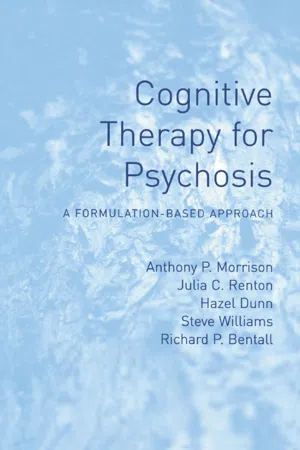
eBook - ePub
Cognitive Therapy for Psychosis
A Formulation-Based Approach
- 288 pages
- English
- ePUB (mobile friendly)
- Available on iOS & Android
eBook - ePub
Cognitive Therapy for Psychosis
A Formulation-Based Approach
About this book
Information
Part I
Theory, assessment and formulation
Chapter 1
An overview of psychosis
The decade preceding the publication of this book has seen a remarkable turnaround in professional attitudes towards the psychological treatment of severe mental illness. Whereas, before, most psychologists and psychiatrists were pessimistic about the possibility of helping psychotic patients other than by drug treatment, the last few years have seen important innovations in the psychological treatment of delusions, hallucinations and other symptoms previously assumed to be the spasms of a disordered brain. The roots of these developments can be traced in earlier experiments—for example the simple behaviour modification programmes introduced by Skinnerian psychologists in the late 1960s (Ayllon & Azrin, 1968; Paul & Lenz, 1977) and the more sophisticated behavioural family therapy interventions pioneered during the late 1970s and later (Falloon et al., 1985; Leff, Kuipers, Berkowitz, Eberlein-Fries, & Sturgeon, 1982; Tarrier et al., 1988). Nonetheless, the idea that individual therapy might ameliorate the core symptoms of psychosis, rather than merely enable the patients to cope better with their illness, is a relatively new one. Of course, pessimists remain, notably in the United States of America, where the idea that schizophrenia and bipolar disorder are varieties of brain disease that have no substantial psychological component continues to hold sway (Bellack, 1992). However, in Britain and continental Europe, for the most part, individual psychological treatments are rapidly becoming seen as an indispensable part of the therapeutic armoury.
The new treatments, which go under the generic term of cognitive behaviour therapy (CBT), have been developed partly by pragmatic experiment, partly on the basis of educated guesswork about the psychological processes that influence symptoms, and partly by adapting therapeutic methods known to be effective for non-psychotic conditions such as anxiety and depression. In this book, we introduce the reader to some of these techniques, always bearing in mind that this process of innovation is incomplete—methods that are available today are no more likely to constitute the last word in the psychological treatment of psychosis than current drug treatments are likely to constitute the last word in psychopharmacology. The approach we advocate is formulation based, which is to say that we believe that individual therapy should begin with a detailed formulation or theory about the origins of each particular patient’s symptoms and problems. In this first chapter, we provide some theoretical background to this approach, by briefly discussing recent developments in our understanding of the psychology of psychosis.
As a crude simplification, it is possible to discern two contrasting attitudes among those who research and practise CBT for psychosis. Some people in the field take a purely pragmatic approach to the development and delivery of new treatments. At its extreme, this attitude is exemplified in the belief that particular treatments can be devised for particular symptoms in such a way that new practitioners could just look up in a textbook the treatment recommended for their patient’s symptoms and proceed according to instructions. According to this approach, CBT might be prescribed for severe psychiatric disorders such as schizophrenia or bipolar disorder in the same way that, say, a particular neuroleptic medication might be prescribed.
Others working in the field, by contrast, believe that treatment should proceed from a thorough understanding and appreciation of the psychology of the patients’ symptoms and problems. In bringing together this understanding, therapists will base their therapeutic judgements on a careful appreciation of their patients’ history and circumstances, and will look to the latest research for inspiration and ideas about how these symptoms and problems can be explained. Many of those who advocate this scientist-practitioner, formulation-based approach (and in this category we include ourselves), therefore, argue that the development of CBT for psychotic symptoms requires a radical reappraisal of our understanding of the psychology of psychosis. Since the early 1990s, such a radical reappraisal has begun to emerge, and many of those who have contributed to this development have also contributed to the development of the formulation-based approach that we are advocating in this book.
Rethinking the psychology of psychosis
In order to sketch out the new, emerging understanding of psychosis, it will be helpful to look back on the theoretical models that preceded it. In fact, three general paradigms are discernible in the psychiatric literature on madness. The first, which was outlined by Emil Kraepelin (1990) and which dominated research between the end of the nineteenth century and the mid-1970s, assumed that psychosis is best described by broad diagnostic concepts such as schizophrenia or bipolar disorder, and that these concepts describe brain diseases that are probably inherited. The task of psychology within this conceptual framework is to identify neuropsychological abnormalities in patients, in the hope that these might provide clues about the aetiology of the presumed brain pathology. Within this paradigm, there is little scope for psychological intervention, as it is assumed that brain diseases are unresponsive to this kind of treatment.
The second paradigm is exemplified by stress-vulnerability models of psychosis (Nuechterlein & Dawson, 1984; Zubin & Spring, 1977) and assumes that biologically vulnerable individuals become psychotic only when exposed to stressful life events. Although psychotic disorders are still held to fall into general disease categories such as schizophrenia and bipolar disorder, these diseases are hypothesised to lie along continua with ordinary behaviours and experiences, so that individuals can be more or less schizophrenic, or more or less manic-depressive. From the therapist’s point of view, this approach is much more useful than the traditional disease model, because it points to environmental factors that may be manipulated in order to bring about therapeutic change. However, it leaves unchallenged the diagnostic concepts assumed by earlier investigators.
The third paradigm, which began to be developed in the late 1980s, focuses on symptoms (particular classes of behaviours, experiences or complaints) rather than broad diagnostic categories (Bentall, in press). According to this approach, the task of psychological research is to discover the psychological processes that give rise to these behaviours and experiences; once this has been achieved there will be no residual diseases such as schizophrenia or bipolar disorder that remain to be explained. This paradigm has been associated with renewed optimism about the value of individual psychological treatments for psychotic patients, as the processes responsible for each symptom have sometimes proven to be tractable to psychological intervention (Kuipers et al., 1997; Sensky et al., 2000; Tarrier, 1997; Tarrier, Beckett, Harwood, Baker, Yusupoff, & Ugarteburu, 1993). In the remaining sections of this chapter, we outline each of these paradigms in turn, and discuss their limitations and implications for treatment in more detail.
The disease paradigm
At the end of the nineteenth century, the German psychiatrist Emil Kraepelin (1899/1990) argued that many of the clinical problems he had encountered in the asylums of industrial Germany had a common characteristic, namely a progressively deteriorating course. This observation led him to suggest that many conditions previously considered to be different—for example hebephrenic, catatonic and paranoid states—were in fact caused by the same (unknown) morbid process and ought therefore to be considered as variants of the same disease, he named this disease dementia praecox, or senility of early life. It differed from neurological conditions such as cerebral syphilis because no obvious biological cause could be identified. On the other hand, it could be distinguished from manic depression (a term he used to encompass all conditions in which abnormal mood was the prominent symptom), which had a more favourable outcome. The progressive deterioration seen in dementia praecox patients was regarded as inevitable and unstoppable, leading to intellectual deterioration, poor judgement and the eventual destruction of the personality.
Kraepelin’s distinction between dementia praecox and the affective psychoses has been described as a cornerstone of modern psychiatry (Kendell & Gourlay, 1970), and is evident in modern diagnostic manuals such as DSM-IV (American Psychiatric Association (APA), 1994) and ICD-10 (World Health Organization (WHO), 1992). However, his characterisation of these conditions has not gone unchallenged. Famously, Eugen Bleuler (1950) in Zurich observed a more varied outcome in patients diagnosed as suffering from dementia praecox. Rejecting Kraepelin’s view that intellectual deterioration was a core feature of the disorder, Bleuler identified subtle emotional and intellectual characteristics as fundamental symptoms of the condition—inappropriate affect, emotional ambivalence, autism (a retreat into a preferred fantasy world) and loosening of associations. Intriguingly, he believed hallucinations and delusions to be mere accessory symptoms (byproducts) of the morbid disease process. His more optimistic view ultimately led him to reject the term dementia praecox on the grounds that the disorder was neither a dementia (not everyone deteriorated) nor praecox (although onset was most common in early adulthood, it could strike people later in life). Arguably his substitute term schizophrenia, although more enduring, has caused at least as much confusion, leading lay people to confuse the shattering of personality that the term was meant to suggest with the type of Jekell and Hyde multiple personality sometimes portrayed in Hollywood movies.
Nearly fifty years later, Kurt Schneider (1959) brought about another seismic shift in thinking about schizophrenia, by trying to establish criteria for the diagnosis according to two ranks. In the first rank were signs of the disorder that were relatively easy for the clinician to detect—audible thoughts, delusional perceptions and the experiencing of outside influences on the body. In the second rank were all the other symptoms of schizophrenia. It is often assumed that he held the first rank symptoms to be fundamental features of the disorder, but this was not the case (Hoenig, 1982). Schneider was a pragmatist who simply wanted to make the process of diagnosis more transparent. However, English-speaking psychiatrists (many of whom had not read his original work, which was not widely available in English translation) took Schneider to mean that the first rank symptoms were those which were most important, and this view has prevailed in modern diagnostic manuals such as DSM-IV and ICD-10, which tend to highlight positive symptoms such as hallucinations and delusions.
Kraepelin’s characterisation of manic depression has also been substantially revised by later psychiatrists. Most notably, Klaus Leonhard (1957/1979) argued that this broad diagnostic entity should be subdivided into unipolar disorders (in which only depression is evident) and bipolar disorders (in which the patient suffers from episodes of depression and episodes of mania), a distinction that is recognised in both the DSM and ICD diagnostic systems.
Mary Boyle (1990) has pointed out that the diagnostic concepts proposed and revised by Kraepelin and those who followed him were not derived from empirical research (although Kraepelin certainly collected and analysed symptom data from a large number of patients) but reflected particular assumptions about the nature of psychiatric disorder. These assumptions were spelt out over eighty years later by Gerald Klerman (1978), one of a group of American psychiatrists who dubbed themselves ‘neoKraepelinians’ and who were responsible for the highly influential third edition of the DSM. Klerman’s neoKraepelinian manifesto had ten main points, but three are particularly important in the present context. First, the neoKraepelians assumed that there is a clear dividing line between mental health and mental ill-health. Someone was either mentally sick or not sick. Second, it was assumed that there are a finite number of different psychiatric disorders: someone could be either manic depressive or schizophrenic. Third, it was assumed that mental disorders were brain diseases. Each of these assumptions merits close examination.
Bleuler challenged the assumption that there is a clear boundary between mentally healthy and mentally sick people, arguing that “There is also a latent schizophrenia, and I am convinced that this is the most frequent form, although admittedly these people hardly ever come for treatment. It is not necessary to give a detailed description of the various manifestations of latent schizophrenia. In this form we can see…all the symptoms, and the combinations of symptoms, which are present in the manifest types of the disease.” This idea of a continuum between psychosis and normality was taken up by later investigators, notably Paul Meehl (1962) and Jean and Loren Chapman and their colleagues (Chapman, Chapman, & Raulin, 1976; Chapman, Edell, & Chapman, 1980) in the United States, and Gordon Claridge (1987) in Britain. Studies conducted by these researchers and others have established beyond doubt that psychotic symptoms, often transient and attenuated, are experienced by a sizeable minority of the “normal” population. These findings have been reinforced by the results of recent epidemiological studies, in which large population samples have been interviewed, which have confirmed that perhaps ten times as many people experience symptoms such as delusions and hallucinations as seek and receive psychiatric treatment (Tien, 1991; van Os, Hanssen, Bijl, & Ravelli, 2000). There are as yet few clues about why some people are able to live in the community as happy and well-adjusted psychotics, but it seems most likely that these people find ways of thinking about their experiences that minimise their distress. Later, we shall see that patients’ reactions to their psychotic experiences may be more important in determining their long-term outcome and quality of life than the characteristics of the symptoms themselves (Morrison, 2001).
The idea that diagnoses such as schizophrenia and manic depression denote separate disorders has, of course, been the central methodological assumption made by researchers in the century following Kraepelin. Patients are allocated to groups and compared on the basis of these diagnoses. The poor reliability of psychiatric diagnoses (the tendency for different clinicians to give the same patients different diagnoses) was therefore a source of embarrassment to neoKraepelinians (Spitzer & Fliess, 1974). Their development of operational definitions of psychiatric disorders, contained in manuals such as DSM-IV (APA, 1994) was an attempt to overcome this problem. The classification of schizophrenia and bipolar disorder according to this system is made on the basis of a checklist of symptoms, social and occupational dysfunction and duration. For example, a person may be diagnosed as schizophrenic if he or she has two of the following symptoms: delusions, hallucinations, disorganised speech (derailment or incoherence), grossly disorganised/catatonic behaviour or negative symptoms such as affective flattening or is avolitional. However, for reasons that are not obvious, if a person has bizarre delusions, or a voice keeping up a running commentary, or two or more voices conversing, then a diagnosis can be made without any other symptom from this list. The criteria also require that a person’s social/occupational functioning must be markedly below what was achieved prior to the onset of the disorder, and that the person must have been experiencing difficulties for at least six months, which must include at least one month (less if treated successfully) of acute symptoms. However, again, exceptions to this rule are specified. For example, if a person has not been experiencing acute phase symptoms for the full six months, prodromal or residual symptoms may still be used to justify the diagnosis.
As in earlier versions of the manual, exclusion criteria specify that the individual must not meet the criteria for other diagnoses, for example bipolar disorder or psychotic depression. Of course, when we turn to the DSM criteria for these conditions, we find that schizophrenia must be excluded, giving a clue that these conditions may not be as separate as the manual implies. In fact, researchers in a large epidemiological study in the United States experimented by deliberately ignoring these exclusion criteria, and discovered that over half of the people who met the criteria for one DSM-III diagnosis met the criteria for at least one other (Robins & Locke, 1991). Some diagnoses appeared to be particularly closely related. For example, anyone meeting the DSM-III criteria for schizophrenia had a forty-six times greater than expected chance of also meeting the criteria for mania.
The many other lines of evidence that undermine the distinction between schizophrenia and bipolar disorder can only be briefly alluded to here (see Bentall, in press, for a detailed discussion of these issues). For example, statistical analyses of the symptoms reported by patients show that they do not fall into two distinct groups as the Kraepelinian model supposes (Brockington, 1992; Kendell & Gourlay, 1970). Indeed, the symptoms experienced by people who have become psychotic seem to fall into at least three distinct subgroups— positive symptoms (delusions and hallucinations), problems of cognitive disorganisation (including incoherent speech) and negative symptoms (social withdrawal, apathy and anhedonia)—that are common to (although experienced to varying degrees by) patients diagnosed as schizophrenic or manic depressive (Andreasen, Roy, & Flaum, 1995; Klimidis, St...
Table of contents
- Cover Page
- Title Page
- Copyright Page
- Illustrations
- Preface
- Introduction
- Part I Theory, assessment and formulation
- Part II Process of therapy and change strategies
- Part III Implementation and maintaining process
- Appendices
- References
Trusted by 375,005 students
Access to over 1.5 million titles for a fair monthly price.
Study more efficiently using our study tools.
Frequently asked questions
Yes, you can cancel anytime from the Subscription tab in your account settings on the Perlego website. Your subscription will stay active until the end of your current billing period. Learn how to cancel your subscription
No, books cannot be downloaded as external files, such as PDFs, for use outside of Perlego. However, you can download books within the Perlego app for offline reading on mobile or tablet. Learn how to download books offline
Perlego offers two plans: Essential and Complete
- Essential is ideal for learners and professionals who enjoy exploring a wide range of subjects. Access the Essential Library with 800,000+ trusted titles and best-sellers across business, personal growth, and the humanities. Includes unlimited reading time and Standard Read Aloud voice.
- Complete: Perfect for advanced learners and researchers needing full, unrestricted access. Unlock 1.5M+ books across hundreds of subjects, including academic and specialized titles. The Complete Plan also includes advanced features like Premium Read Aloud and Research Assistant.
We are an online textbook subscription service, where you can get access to an entire online library for less than the price of a single book per month. With over 1.5 million books across 990+ topics, we’ve got you covered! Learn about our mission
Look out for the read-aloud symbol on your next book to see if you can listen to it. The read-aloud tool reads text aloud for you, highlighting the text as it is being read. You can pause it, speed it up and slow it down. Learn more about Read Aloud
Yes! You can use the Perlego app on both iOS and Android devices to read anytime, anywhere — even offline. Perfect for commutes or when you’re on the go.
Please note we cannot support devices running on iOS 13 and Android 7 or earlier. Learn more about using the app
Please note we cannot support devices running on iOS 13 and Android 7 or earlier. Learn more about using the app
Yes, you can access Cognitive Therapy for Psychosis by Anthony Morrison,Julia Renton,Hazel Dunn,Steve Williams,Richard Bentall,Anthony P Morrison in PDF and/or ePUB format, as well as other popular books in Psychology & Abnormal Psychology. We have over 1.5 million books available in our catalogue for you to explore.