- 248 pages
- English
- ePUB (mobile friendly)
- Available on iOS & Android
eBook - ePub
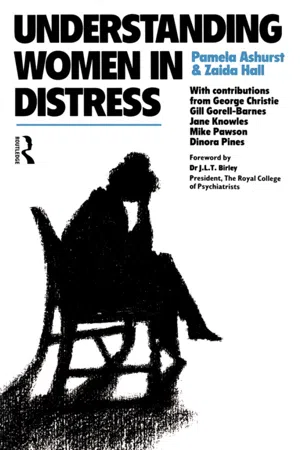
Understanding Women in Distress
About this book
Women are usually more in touch with their emotions than men and more readily seek help from professional sources when they encounter stress. The response they meet from doctors and other helping professionals at this point can be vital in determining the best outcome for them. Ashurst and Hall have written this book as a contribution towards a better understanding of the psychological aspects of women's health problems.
Information
Part One
Womanhood
Chapter one
Understanding distress
The development and relief of symptoms
Below the surface-stream, shallow and light,
Of what we say we feel – below the stream,
As light, of what we think we feel – there flows
With noiseless current strong, obscure and deep
The central stream of what we feel indeed.Matthew Arnold
Distress is the experience by which we signify that all is not well with our world. It may be life-saving or life-threatening. We express it in many different ways, determined largely by our previous experience, all of which indicate a state of ‘dis-ease’ with our bodies, with our environment, and with other people. Health is that state of equilibrium that we enjoy when we thrive in the context in which we live. Illness, or dis-ease, represents a deviation from that healthy equilibrium.
People consult their doctors in order to seek an explanation for symptoms or experiences that they identify as sickness or disease. Such symptoms may have developed recently or may have been present for a long time, but the act of consulting a doctor defines the person concerned as a patient.
Distress or mental pain manifests itself in physical or mental symptoms or experiences. We may use psychological language to try to describe the experiences, but whether we have bodily or psychological symptoms, we probably experience them cerebrally as a mind-body continuum. Language gives a poor approximation of what we are experiencing but is essential if we are to communicate our distress. The psychotherapist does not try to classify or label a patients’ symptoms with a diagnosis in order to give treatment, but accepts the existential description of the distress as the actual disease, and addresses that.
When we are healthy we experience ourselves as being in control of our bodies and thus of our immediate world. When we are sick we fear loss of control, and our very existence seems threatened. Putting the experience of distress into words to another person who listens and hears brings some relief to the patient. It gives him the possibility of control over it. The task of the doctor is to make sense of the symptoms and signs of which the patient complains, providing an explanation and thereby reassuring him that the situation is comprehensible, that his symptoms can be understood and treated or managed, or will recover spontaneously. Such explanation and reassurance is a major part of the healing offered by the physician and a necessary accompaniment of any form of treatment.
For the psychotherapist, explaining and making sense of the patient’s predicament is one of the most potent tools in therapy. Language is thus the vehicle for the practice of psychotherapy, which consists of the mutual exploration by patient and therapist of the underlying causes of his distress. The therapist is like a sherpa or mountain guide who knows something of the terrain and is more familiar with it than the person he is guiding. The sherpa cannot, however, take the steps for the traveller or stop him from experiencing some further pain on the way; but he can, by his presence, support and reassure, and take away the loneliness and terror of the journey.
How stress causes symptoms
Somewhat surprisingly, the explanation of how mental and physical symptoms arise as a result of the stresses of life experience is an endeavour rarely attempted in textbooks on psychiatry or psychotherapy; the emphasis is usually on unravelling the causation in past experience rather than on following the effect of the cause, or the multiple causes or stresses, on the individual through to the production of symptoms. The term ‘stress’ is often misused, being taken to refer to the disease itself – ‘I’m suffering from stress’ – as well as to the cause of the disease. Our explanation of the chain of events – stress → distress → symptoms – can only provide a theoretical model of the process based on our experience as psychotherapists and supervisors of trainee therapists, in individual, group, marital, and family therapy over twenty years.
Identity
The key structure in this pathway is our concept of self or identity. We are conscious of our body image, the way in which we appear to ourselves and others. We use our role and the immediate environment both as an expression and an extension of our identity. Our clothes express the sort of person we feel we are. An adolescent’s room with its posters represents so vividly what he feels to be his personality that any attempt to alter it or tidy it by his mother is felt as an assault upon his person. A woman’s house or a man’s car may be experienced as similar extensions of the self, vehemently defended against attack.
Identity is not static; it is constantly altered by the reflections back from the other people in our lives. That is, in fact, the way in which our identity is first formed, as we discuss in greater detail in Chapter 3. The closer the family relationship, the greater the effect, strengthening or weakening our identity. We are less influenced by friends, and even less by acquaintances, unless they occupy positions of importance for us – for instance the boss, or the form teacher, or the special friend; though the effect of the peer group can be enhancing or belittling. It is this reflective quality known as ‘mirroring’ that can make group therapy so healing, each member ‘discovering himself’ from the reflections of the other members.
The most important reflections are therefore in the immediate family – mother, father, siblings, partner or spouse, or child. For a student it might be the other students with whom he shares a house. Outside this closed circle is the wider environment, which also exerts an influence on identity.
But a person’s identity does not only exist in the present: it extends to the future, with expectations and aims. A middle-aged woman whose husband dies experiences not only the pain of his absence now but apprehension about her future. It is threatening to her identity not to be able to envisage how her life will continue as a widow. University students are often less anxious about the final examinations than about what they will be doing and where they will be living after graduation. Losing a job may have grave implications for the future. Life-threatening illness brings with it not only fears of incapacity and of possible death, but also fears for the future of the family left behind.
Individual identity depends not only on the present and the future but also on the past or what is thought to the the past. A discovery that one’s origins were not exactly what one had always assumed can be profoundly unsettling.
A young woman was told by her mother on the day of her father’s death, when she was 10 years old, that her father was not really her father, and that her mother had married him while pregnant by another man. Her identity was thus doubly assaulted by the death of her father and by the loss of his being her true father. Who wasshe then? This immense discontinuity to her concept of herself was more disturbing because the loved father was no longer there to comfort and reassure her.
Revelations about the past are often made by relatives and neighbours to young people reaching adolescence, increasing the usual emotional turmoil experienced at that age. Then parents, relatives, and social workers are surprised at the resulting acting-out behaviour – disobedience at home, disruption at school, and acceptance of deviant peer-group values.
An adolescent girl was upset to discover that the person she had supposed to be her mother was not in fact her mother but her grandmother, and that her true mother was the rather tiresome older sister now married, with her own children, who had never bothered with her. (The girl had been an illegitimate baby and her grandmother had brought her up as her own child.) Her identity was threatened by this discovery, and her behaviour became disturbed.
How is this identity formed? It has been assumed that the infant’s concept of self has its beginnings after birth, but it is by no means certain that some dim awareness of his presence in the womb does not contribute to his concept. Whether or not this is so, the moment of conception has special significance for the parents, and later for the child, as it is at that instant that the inheritance of the ‘good’ or ‘bad’ blood – or, if one is more sophisticated, the ‘good’ or ‘bad’ genes – occurs. The family members’ view of the inherited characteristics can influence their upbringing of the child. If they expect the child to be bearing the bad inheritance, they will reflect back the child’s identity accordingly.
For instance, some adoptive parents were being interviewed about their adopted teenage daughter’s shoplifting. Because her natural mother had been unmarried when the daughter had been born, they assumed that she was ‘a bad lot’ and cited the daughter’s stealing of toffees as a young child as evidence of her inherited badness, and would not be convinced otherwise. It was, in fact, their lack of love towards her and constant ‘picking on her’ that drove her in adolescence to delinquent behaviour; she acted in the way she was expected to.
Those who wish to make a child develop a particular attribute must see the potential for its development in the child and must somehow communicate this to him. This trust in a child’s ability to learn or to behave in a certain way is likely to produce the required result, whereas constant criticism is counterproductive. Indeed, this trust of a persons’ potential and acceptance and valuing of what he is at that moment, is also one of the most useful tools of the psychotherapist in what is predominantly the learning experience of therapy.
The influence of the mother or the primary carer is of paramount importance to the infant. She needs to be, in Winnicott’s terms (1960) the ‘good enough mother’, responding readily to her child’s needs at first, but later, as she senses he is ready to cope with some frustration, responding less readily. From her smiling face and the way she handles him, mirroring back to him what a marvellous person she finds him, he will slowly begin to develop some concept of himself as a person and, moreover, as an acceptable person.
With the dawning understanding of himself as a separate person from his mother, the infant begins to focus on the father, and, in the oedipal triad, his own position in relation to his parents influences his sexuality. These early influences are discussed further in Chapter 3.
The rivalries between siblings for the parents’ attention and affection, and the increasing influence of the world outside the family – the playgroup and school – characterize the period from toddlerhood to adolescence. Puberty has a profound effect on the individual’s self-image, with the great change in body size and shape, and in boys’ strength, with the hormonal changes, and with the developing sexuality. In addition there are all the social changes inherent in the move to secondary schooling – increase in the size of buildings, in the number and size of the other pupils, and in opportunities for the more grown-up excitements of smoking, graffiti, bullying, sex, drinking, drugs, and delinquency. If the home life is deprived and there is no security at home or at school, the emerging identity is profoundly threatened. With enough stability and security in home and school, however, the adolescent can undertake the tasks of becoming independent of parents and of discovering sexual identity, choice of career, and religious and political values (Erikson, 1959). These tasks take time, and the identity is not fully formed – that is adolescence is not ended – until somewhere between the ages of 18 and 23.
Everyone carries an internal image of one or both parents, often highly critical, sometimes approving. Good images are enabling, whereas critical ones are usually disabling. Even in adulthood many people have not been able fully to free themselves from the controlling standards of their parents, continuing either to adhere to them slavishly or to rebel against them on principle. This is a hallmark of adolescence, and the establishment of one’s own values and opinions is evidence of autonomy and emotional maturity. In order to try to escape them, some people put physical distance (sometimes thousands of miles) between themselves and their parents, but clearly have not been able to achieve emotional distance.
Even though identity has been formed, it is not fixed and must constantly be adjusted to changing life circumstances if the individual is to remain free from dis-ease. The self-image has to weather the more-or-less inevitable storms that come with the finding of a partner, the advent of children, the establishment of a career, the realization of limitations on achievement, and the abandonment of adolescent dreams of fame and success; and, at a later stage, to come to terms with children leaving home, the waning of power with retirement, and the increasing physical, and often mental, disabilities of old age. There are also the chance storms such as moving house, illness in oneself or in others, loss of a job, or bereavement. If an individual has had good-enough parenting, he will be robust enough to weather these storms, especially if there is enough support during the crisis from spouse, parent, child, friend, teacher, priest, or counsellor.
A person jogs along in relative balance or coherence in his identity, until a trauma or stress occurs. All change is stressful, even those changes that are welcome and freely chosen such as promotion, moving house, marriage, or parenthood. Change that is unsought and unwelcome is obviously more stressful. The stress may be acute, as in sudden bereavement or sudden illness. It may be chronic, as when an employee is constantly picked on by a superior, or one spouse is constantly nagged and denigrated by the other. Or it may be intermittent, as for instance the experience of worrying about an exam, or an unwanted pregnancy, when it may be forgotten at intervals, but as time progresses the dreaded event looms larger.
Our concept of self depends on many factors, but perhaps a sense of mastery, of being in control of one’s environment, including one’s body, is crucial. We all fear being out of control, ‘losing control’, and linked with this is the fear of losing one’s authenticity, of ‘not being’. Lack of constancy and consistency may threaten our very sense of being, as Kafka portrayed it in The Trial when all the familiar landmarks and values in the man’s life were inexplicably and terrifyingly altered (Kafka, 1977). Stress threatens all aspects of the self, particularly those of continuity and the sense of mastery of life, and it thus provokes powerful emotions in response. These include anxiety, despondency, despair, hate, rage, sexual feelings, and love. If the stress is too great or there are many cumulative stresses, especially if the identity is not basically robust (which probably derives from the early mother-child relationship), the individual feels threatened and unable to cope. It is at this point that distress is expressed by symptoms. An individual can seemingly take many stresses in his stride, only to ‘break down’ (i.e. to produce symptoms of distress) as a result of a final relatively minor trauma. Unless a careful history is taken, the preceding traumatic life events are unrecognized as sources of anguish.
The patient often fails to recognize the importance of earlier traumatic events. A woman who had been agoraphobic for many years was surprised when a therapist connected it to the time fifteen years earlier when she had been raped.A first-year University student with severe identity problems relating to the break-up of his parents’ marriage, was lonely and depressed in the strange environment. He felt under continuous pressure because he had to share a room with two others. He finally broke down in tears when a coffee-vending machine poured the coffee but failed to provide the cup to catch it in.
The emotional turmoil resulting from stress – with mental and physical symptoms of sleeplessness, irritability, lack of appetite, overeating, and so on – is an entirely normal reaction. If the emotions can be expressed in some way, the turmoil eventually lessens. If there is no trusted person available at the time, then at least feelings can be expressed in solitude, for instance by weeping alone, by pummelling the pillow, or by furiously digging the garden. Or the feelings may be given vent in poetry, in a diary, or by writing a book. If the emotions, for whatever reason, cannot be expressed at the time, they can be shared perhaps years later in psychotherapy, when sufficient trust in the therapist has been built up.
It is probably the adequate recognition and expression of one’s emotions, preferably to another person, that determines whether there can be a healthy outcome of crises, with the individual growing and becoming stronger. Then the sense of authenticity, self-esteem, and self-confidence increases. Alternatively, no growth may occur and the individual remains as he was. If the feelings are not expressed in any way, weakening of identity may occur. If this path is taken with successive stresses, the individual may end up with disabling mental or physical symptoms needing psychiatric or psychotherapeutic help.
Emotions may be so powerful that a person may unconsciously feel that their heat will cause a conflagration. Or that the tide of them will swamp him and he will drown – as Alice did in her tears. A girl may feel that her emotions will be so out of her control that she stops eating in an attempt to control them. The strength of feelings, particularly hate or rage may make a person fear he will ‘go beserk’, with fantasies of being carted off to prison or to a padded cell. This fear of ‘going mad’ is quite common. Whatever the fantasy, the individual may feel his emotions to be so out of control that they will annihilate him completely, so that he ceases to exist. This is a more terrifying concept for the self than that of dying, when there may be religious or other reasons for assuming some continuity in the afterlife. Emotions must therefore be forcefully defended against or controlled, not only to prevent the self from bearing the pain, but to protect other loved persons from their destructive effects. This ‘defence’ is the neurosis, the symptoms of which can become more threatening than the feelings produced by the original trauma.
There are many unconscious ways of defending against emotions. They can be suppressed, so that the feelings are not recognized as they arise; many abused children use this numbing mechanism in order to survive. Alcohol and drugs may also be used to suppress feelings. The individual may try to control the unconscious inner feelings by obsessive–compulsive behaviour – endlessly checking gas taps to prevent explosion, checking water taps to prevent flooding, or keeping everything in the outer world in control by excessive tidiness, thus defending against inner chaos. The obsessively houseproud woman and the martinet of a teacher fall into this latter category.
Alternatively, the individual may unconsciously ‘act out’ his emotions instead of daring to experience them – the behaviour of the young husband, forced to abandon football on television by his wife’s silent reproach over the washing-up, who ‘accidentally’ drops a precious plate; the adolescent who slams the door when scolded by his mother, instead of hitting her; and the wife who develops a headache at bedtime. Much addictive and delinquent behaviour is a form of acting out, often with symbolic meaning.
The strand of symptoms ‘chosen’ by the patient to express his neurosis will be drawn from the many threads of his past experiences and from his present fantasies.
An adolescent girl shoplifted expensive tins of Chinese food she did not really want. Her divorced young mother was about to marry a younger man of whom the girl was jealous. The girl had recently managed to give up cannabis and ‘speed’, and she felt orally deprived by losing the comfort of the drugs and of her mother’s food/milk. Without understanding why, she stole the most unusual and expensive examples of oral satisfaction in the supermarket, although in fact she preferred fish and chips and ice cream.The housewife whose back ‘went’ when her invalid mother came to be nursed felt this extra stress was literally ‘breaking her back’. Her symptom symbolized her inability to bear the burden, although consciously she could not register her protest.
The turbulent feelings are often suppressed, displaced, or projected, and only anxiety is experienced, with its various mental and physical symptoms. This may be accompanied by anger and rage that some people, partly because of their upbringing, find particularly difficult to acknowledge. It is the underlying cause of much phobic anxiety and of panic attacks.
The Psychotherapies
Once the various defences ...
Table of contents
- Cover Page
- Title Page
- Copyright Page
- Authors and contributors
- Foreword
- Introduction
- Part One: Womanhood
- Part Two: Distressed Womanhood
- Coda
- Bibliography
Trusted by 375,005 students
Access to over 1.5 million titles for a fair monthly price.
Study more efficiently using our study tools.
Frequently asked questions
Yes, you can cancel anytime from the Subscription tab in your account settings on the Perlego website. Your subscription will stay active until the end of your current billing period. Learn how to cancel your subscription
No, books cannot be downloaded as external files, such as PDFs, for use outside of Perlego. However, you can download books within the Perlego app for offline reading on mobile or tablet. Learn how to download books offline
Perlego offers two plans: Essential and Complete
- Essential is ideal for learners and professionals who enjoy exploring a wide range of subjects. Access the Essential Library with 800,000+ trusted titles and best-sellers across business, personal growth, and the humanities. Includes unlimited reading time and Standard Read Aloud voice.
- Complete: Perfect for advanced learners and researchers needing full, unrestricted access. Unlock 1.5M+ books across hundreds of subjects, including academic and specialized titles. The Complete Plan also includes advanced features like Premium Read Aloud and Research Assistant.
We are an online textbook subscription service, where you can get access to an entire online library for less than the price of a single book per month. With over 1.5 million books across 990+ topics, we’ve got you covered! Learn about our mission
Look out for the read-aloud symbol on your next book to see if you can listen to it. The read-aloud tool reads text aloud for you, highlighting the text as it is being read. You can pause it, speed it up and slow it down. Learn more about Read Aloud
Yes! You can use the Perlego app on both iOS and Android devices to read anytime, anywhere — even offline. Perfect for commutes or when you’re on the go.
Please note we cannot support devices running on iOS 13 and Android 7 or earlier. Learn more about using the app
Please note we cannot support devices running on iOS 13 and Android 7 or earlier. Learn more about using the app
Yes, you can access Understanding Women in Distress by Dr Pamela Ashurst,Dr Zaida Hall in PDF and/or ePUB format, as well as other popular books in Psychology & History & Theory in Psychology. We have over 1.5 million books available in our catalogue for you to explore.