eBook - ePub
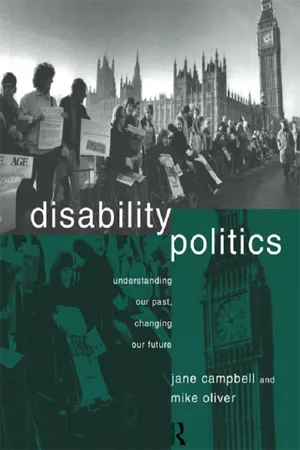
Disability Politics
Understanding Our Past, Changing Our Future
- 240 pages
- English
- ePUB (mobile friendly)
- Available on iOS & Android
eBook - ePub
About this book
This powerful book presents a series of perspectives on the process of self-organisation of disabled people which has taken place over the last thirty years. The 1980s saw a transformation in our understanding of the nature of disability, and consequently the kinds of policies and services necessary to ensure the full economic and social integration of disabled people. At the heart of this transformation has been the rise in the number of organisations controlled and run by disabled people themselves. Through a series of interviews with disabled people who have been centrally involved in the rise of the disability movement, the authors present a new collective history which throws light on the politics of the 1980s, and offers insights into future political developments in the 1990s and on into the twenty-first century.
Information
Chapter 1
Setting the scene
Social movements can be viewed as collective enterprises to establish a new order of life.(Blumer 1995: 60)
WHERE TO BEGIN?
At the outset it is important to say what this book is not. It is not a history of disability. It is not the history of the disability movement. Both of these projects may, one day, materialise; but, because of the neglect of the lives and experiences of disabled people, the former is not yet feasible; and as far as the latter is concerned, while we are clear about what constitutes the disability movement, others are less sure, or not sure if it is a movement at all.
Our intention is much simpler than that; it is to present a series of perspectives on the process of self-organisation of disabled people that has been occurring over the last thirty years. If the book has a rationale at all, it is captured in the words of deaf activist Paddy Ladd, when he responded to our request to be involved in the project:
the process of freeing ourselves from imposed histories is in itself a historical and dialectical process. In these new and exciting times, whatever you or I set down are merely the first steps on the road to a full and comprehensive history of not just the disability movement as a whole, but of all its constituent parts of each particular disability group.
All projects or histories have to start somewhere after the dawn of time, the big bang or the coupling of Adam and Eve. We have chosen to start somewhere around thirty years ago, although we fully acknowledge and recognise the fact that some disabled people were self-organising long before that. Indeed, some of the contributors to the project have made this point crystal clear. Phillip Mason, who has been active in the independent living (IL) movement for many years, suggests that disabled people have always been involved in collective self-organisation:
I think there's always been a disability movement. I don't think, necessarily, it's ever regarded itself as a disability movement but the struggles that we identify with today may be the struggles individuals or perhaps groups have always identified with in the past. Although perhaps they focused on different issues in their day, nevertheless groups of oppressed people, which is the language that we use now but perhaps wasn't the language that was used in those days, always existed and always strove for the sort of things that we would recognise. I think that's always gone on and perhaps to call it a disability movement is stretching a point but, nevertheless, we should recognise that the spirit of what's going on today always existed. It's always been human nature to want more personal autonomy, to want to have more control over what happens in one's own life. There's nothing peculiar about what's going on today, it's always been there. Perhaps we're fortunate today in that it's at last found a route, it's at last begun to be recognised by the population at large.
Mason not only takes us to task for our historical shortsightedness but also raises the question of what constitutes a movement. Judy Hunt, a long-term ally of the movement and widow of the late Paul Hunt, has herself studied the history and development of the disability movement. Paul was one of the first disabled people to confront segregation and institutionalisation as a form of oppression, by organising disabled people incarcerated in homes either to ‘take over the management’ or to ‘break out’. She draws attention to the way the movement has evolved historically and relates this to other social movements:
My understanding of the movement is that you get a lot of protest activity going on; bits and pieces here and there and you can go right back into the nineteenth century and see bits of protest, but does that constitute a movement? Some people might say that is the beginning of a movement. Whereas recent studies of other social movements tend to look at how they become much more developed, how they enthuse society much more, how they filter through. It's not just small groups here and there; it actually begins to have an impact much more broadly. And studying the history of the disability movement is like trying to put together the jigsaw puzzle of that process. At what point or what points do you decide that certain key developments, with hindsight, were influential?
Here Hunt is drawing attention to the distinction that sociologists, who have studied social movements, draw between emergent and mature social movements. This process of transformation from an emergent to a mature movement is, we would suggest, precisely the point at which we are writing this book about the disability movement.
But there is an earlier question that also needs to be addressed: Tn the long history and theorizing about social movements, no question has received more attention than that concerning the origin of social movements. What factors make for a movement in the first place?' (Marx and McAdam 1994: 77). This is a question we will be addressing in subsequent chapters, but here we need to make clear why we started where we did, why we consider disabled people's attempt at self-organisation to be a movement, how we undertook the work and why we chose to carry it out in the way we did.
WHY WE STARTED WHERE WE DID
The decade of the 1980s saw a transformation in our understandings of disability. In consequence, and in order to ensure the full economic and social integration of disabled people, as required by the United Nations Declaration of the Rights of Disabled Persons (1975), the kinds of policy and service have changed. Section 3447.12 of this Declaration asserts: ‘organisations of disabled persons may be usefully consulted in all matters regarding the rights of disabled persons’.
At the heart of this was the rise in the number of organisations controlled and run by disabled people themselves. At the beginning of the decade there were very few such organisations, but by 1990 there was an international organisation known as Disabled People's International (DPI) and a national co-ordinating body, the British Council of Organisations of Disabled People (BCODP). By this time the BCODP's constituent organisations had risen to over a hundred, most of which were local coalitions of disabled people or centres for integrated living (CILs).
By any standards this numerical growth was remarkable, but there are four reasons why it was even more remarkable than appears at first sight. First, all organisations controlled by disabled people suffered from chronic underfunding throughout the decade, even from national and international agencies which are supposed to support such developments. Second, many politicians, policy makers and professionals had no faith in the viability of a new movement which was being built by people who had so far seemed passive and dependent. Third, the new movement was built in the teeth of opposition from the traditional voluntary organisations which, up to now, had been in control of disability; and this opposition was often active rather than passive. Finally, because of the disabling environments that disabled people encounter, the difficulties involved in simply finding ways to meet, communicate and organise should not be underestimated.
This growth was not merely a numerical phenomenon, but also reflected the individual and collective empowerment of disabled people through the organisations they were creating. This can be seen in a number of ways. It can be seen in the challenge to dominant social perceptions of disability as personal tragedy and the affirmation of positive images of disability through the development of a politics of personal identity. It can be also be seen in the development and articulation of the social model of disability, which, by focusing on disabling environments rather than individual impairments, freed up disabled people's hearts and minds by offering an alternative conceptualisation of the problem. Liberated, the direction of disabled people's personal energies turned outwards to building a force for changing society. The social model vehicle has been fundamental in carrying the movement forward at such a rapid pace. Finally, it can be seen in the numbers of disabled people literally taking to the streets, not only as a form of social protest but in pursuit of their everyday lives.
The origins of these fundamental changes, it seems to us, can be found in the 1960s with the coming of the ‘age of affluence’, when disabled people began to organise around issues of income, employment, rights and community living rather than institutional care. It continued in the 1970s with the passage of the Chronically Sick and Disabled Persons Act (1970) and the formation of the Union of the Physically Impaired Against Segregation (UPIAS). It culminated in the 1980s with the events already described.
WHY DOES THIS CONSTITUTE A SOCIAL MOVEMENT?
There is a need to describe, chart and analyse all this, not simply because a remarkable decade of activity needs to be captured and recorded, although of course the history of disability as seen by disabled people is important in its own right. But more than that, the decade of the 1980s saw a range of new social movements develop, from environmentalism and the green movement, through the challenges to social oppression by groups such as women, black people and gays and lesbians, and on to a resurgence of the peace movement.
These new movements differed radically from older ones which had tended to campaign on single issues, were led by experts and saw parliamentary lobbying as their only tactic. The new movements were much more concerned with a broad range of issues, were populist and used a variety of tactics. Providing a precise definition of the disability movement is no easy task, but Barbara Lisicki, a prominent member of the Direct Action Network (DAN), comes nearest to our own definition:
I don't think anyone knows for sure what a movement is but essentially what we are talking about is a set of ideas and an analysis which people can then support in different ways. I always think of the movement as a set of people that have somehow made a connection with a set of ideas. The disability movement is obviously a set of ideas that presents a challenge to dominant ideology that says disabled people are burdens on society and that they should be taken care of but the disability movement is also about people who believe that they have right to a life.
A case study of one such movement will throw light on the politics of the 1980s and offer insights into future political developments on into the twenty-first century. There is also a not-so-hidden agenda for us in writing this book. In the vast majority of other studies and analyses of new social movements, the struggles of disabled people barely get a mention, and even when they do, the authors tend to use the category ‘the disabled’ or even ‘the handicapped’ in an almost throw-away manner that indicates that they know nothing and care little about our struggles.
In earlier writings one of us (Oliver and Zarb 1989; Oliver 1990) argued that the formation of these organisations controlled and run by disabled people constituted a movement, and that collectively these organisations exhibited the characteristics of new social movements. In a recent paper, disabled activist Ken Davis (1993) not only describes the history of what he calls ‘the disability movement’ but supports our claims that it constitutes what social theorists would call a new social movement.
The reasons for this are, at one level, very simple, for: ‘Social movements can be defined as organised efforts to promote or resist change in society that rely, at least in part, on non-institutionalised forms of political action’ (Marx and McAdam 1994:3). Clearly the purpose of disabled people's self-organisation is to promote change: to improve the quality of our lives and promote our full inclusion into society. It does this both through involvement in the formal political system and through the promotion of other kinds of political activity.
The definitional issues surrounding new social movements are more complex than this (for extended discussion, see Oliver 1995: Ch. 10), and we will return to them later. However, here we need to make clear that our definition of the disability movement focuses on those organisations democratically controlled and run by disabled people themselves. It does not include those traditional voluntary organisations and charities that are not run by disabled people.
Throughout the book we will use the term ‘the disability movement’ rather than the alternative ‘the disabled people's movement’ because the former is the term used by most members of the movement itself. The latter term may gain increasing currency over the next few years because it clearly demarcates between those organisations controlled by disabled people and those not. Even though some may use the term ‘the disability movement’ to include non-democratic and non-accountable organisations, we state clearly here that we exclude those organisations from our definition used throughout this book.
Thus, for us, the disability movement is a new social movement in that it is beginning to offer disabled people a democratic and political voice; something we have never had before. In similar ways, other new social movements are offering other disenfranchised groups a voice where they were previously silent. So our intention is to write a book which will be a case study of the rise of the disability movement and to locate this within discussions of new social movements in general and their effects on the changing nature of politics in the late twentieth century.
Not everyone who participated in this project was in agreement with our focus. Colin Low provides the most articulate criticism:
First of all, one or two points about the central focus of the project, which I think requires some re-emphasis if it is to do full justice to historical reality. Your proposal paper reads as if the disability movement owes its origins to the developments of the 1980s. This does not take sufficient account of the great amount of activity undertaken before that time by organisations such as the National League of the Blind and the British Deaf Association, which dates back to the 1890s, and the National Federation of the Blind which was founded in 1947. Nor I think should one lose sight of the contribution of the Disablement Income Group from the mid-60s. Simply confining myself to things which are within my own knowledge, these organisations undertook an enormous amount of self-organisation, representation, lobbying, agitation and general development of a disability consciousness. Perhaps the most outstanding illustration of this is the agitation of the National League of the Blind which led to the passing of the Blind Persons Acts of 1920 and 1938.
So far little has been written on this specific topic except for a brief discussion of the origins of the disability movement (Pagel 1988), the development (Oliver 1984) and refinement (Oliver 1990) of a framework to analyse the rise of disability organisations and their relationship to traditional voluntary organisations, and a case study of international aspects of the movement (Driedger 1989). More recently, Davis and Mullender (1993) have described the rise of a local coalition of disabled people. We hope, therefore, that this book will be a contribution to this literature and offer a path for disabled people not just to take control of our current lives but also to reclaim our own history.
HOW WE APPROACHED THE WORK
Our attempts to produce this book reflect an inherent tension in much social research: that between insider and outsider accounts. We are both insiders in the disability movement, although, obviously, our individual relationships to this movement are very different. We have provided brief biographies of ourselves and the other participants in this study (see ‘Introductions’) to enable the reader to contextualise the accounts we provide.
We should make it clear that, therefore, we are unashamedly attempting to provide an insider account of the rise of the disability movement as we define it. Until now, with the notable exceptions of Touraine (1981) and Altman (1994), there have been fe...
Table of contents
- Cover
- Half Title
- Full Title
- Copyright
- Dedication
- Contents
- Foreword
- Acknowledgements
- List of abbreviations
- Introductions
- 1 Setting the scene
- 2 Politics, policy and disability
- 3 Disability organisations and the political process
- 4 The rise of the disability movement
- 5 Organising disabled people
- 6 Disability consciousness
- 7 Making connections through rights and empowerment
- 8 New visions or the existing order?
- 9 The disability movement: is it a new soial movement
- 10 Interviews with Jane Campbell and Mike Oliver by Bamber Postance
- Glossary
- Bibliography
- Index
Trusted by 375,005 students
Access to over 1.5 million titles for a fair monthly price.
Study more efficiently using our study tools.
Frequently asked questions
Yes, you can cancel anytime from the Subscription tab in your account settings on the Perlego website. Your subscription will stay active until the end of your current billing period. Learn how to cancel your subscription
No, books cannot be downloaded as external files, such as PDFs, for use outside of Perlego. However, you can download books within the Perlego app for offline reading on mobile or tablet. Learn how to download books offline
Perlego offers two plans: Essential and Complete
- Essential is ideal for learners and professionals who enjoy exploring a wide range of subjects. Access the Essential Library with 800,000+ trusted titles and best-sellers across business, personal growth, and the humanities. Includes unlimited reading time and Standard Read Aloud voice.
- Complete: Perfect for advanced learners and researchers needing full, unrestricted access. Unlock 1.5M+ books across hundreds of subjects, including academic and specialized titles. The Complete Plan also includes advanced features like Premium Read Aloud and Research Assistant.
We are an online textbook subscription service, where you can get access to an entire online library for less than the price of a single book per month. With over 1.5 million books across 990+ topics, we’ve got you covered! Learn about our mission
Look out for the read-aloud symbol on your next book to see if you can listen to it. The read-aloud tool reads text aloud for you, highlighting the text as it is being read. You can pause it, speed it up and slow it down. Learn more about Read Aloud
Yes! You can use the Perlego app on both iOS and Android devices to read anytime, anywhere — even offline. Perfect for commutes or when you’re on the go.
Please note we cannot support devices running on iOS 13 and Android 7 or earlier. Learn more about using the app
Please note we cannot support devices running on iOS 13 and Android 7 or earlier. Learn more about using the app
Yes, you can access Disability Politics by Jane Campbell,Mike Oliver in PDF and/or ePUB format, as well as other popular books in Education & Education General. We have over 1.5 million books available in our catalogue for you to explore.