eBook - ePub
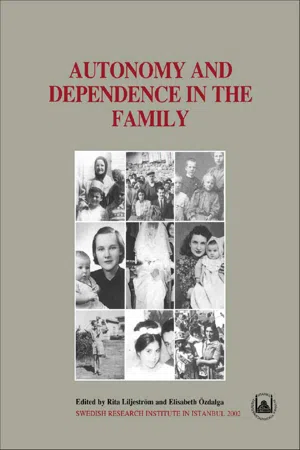
Autonomy and Dependence in the Family
Turkey and Sweden in Critical Perspective
- 300 pages
- English
- ePUB (mobile friendly)
- Available on iOS & Android
eBook - ePub
About this book
What are the future prospects of the modern family? For a long time the common image in the West has been to see the nuclear family, consisting of two economically independent spouses and their children, as the natural outcome of the modernization process. As the hierarchies of patriarchal society vanish, a social order based on equal and autonomous individuals all set for self-realisation has been assumed. However, high rates of divorce, often reported domestic violence, teenagers left on their own at an early age, do not harmonize very well with this idealized image. Critical analysis of family order in two countries at the opposite edges of the European continent - Turkey and Sweden - approaches these problems and attempts to create a more realistic picture of family life in the modern world.
Information
Subtopic
Middle Eastern HistoryIndex
Social SciencesPATTERNS OF AUTONOMY AND INTERDEPENDENCE
Cross-cultural Perspectives on Family Change
ÇİĞDEM KAĞITÇIBAŞI
This chapter presents a cross-cultural perspective on the family within a social psychological framework and with a comparative theoretical orientation: it examines how ongoing family changes and social transformations influence each other. It also examines the corresponding patterns of change in the self and in human relations. The theoretical perspective refers to a model of family change that I have developed over the last decade. The model is based on my own research and other research evidence from diverse societies. The social transformation of concern here is basically urbanization, which entails significant lifestyle changes. Thus, the focus of attention is the so-called “majority world,” i.e., the developing countries with strong family and kinship networks, Turkish society being an example of such a family collectivistic culture. However, as the model is also comparative it involves family patterns from Western industrial societies, not least from the Swedish family. The implications of the model for Turkish and Swedish societies will be considered.
Some current examples from Turkish and Swedish demographic and societal data may help to draw attention to certain social psychological aspects of family dynamics that the model may help to explain. For example, there are striking differences between Swedish and Turkish rates of marriage, divorce, solo living (single-person households), suicide, and birth rates. Some of these are tenfold differences. How can those contrasts be explained? Do they result mainly from macrolevel economic and demographic variables, such as differences in the standard of living and education levels, or are there also other influences that relate to family cultures and go above and beyond such structural macro-variables? The theoretical explanations proposed here may throw further light on these issues.
Social science perspectives are valuable in situating family processes in their socioeconomic and historical contexts. However, the family can also be studied as the central component of individual (self)-family-society linkages, which require psychological analysis as well. In understanding how societal values link with childrearing patterns and human developmental outcomes, including the development of the self, family is the crucial mediator. Nevertheless, the complexity of the family as an intergenerational system moving through time has been a deterrent to its psychological analysis (McGoldrick and Carter 1982). Consequently, there has not been much progress in psychological and social psychological theory on the family except in the more applied clinical approaches, such as family systems theory. Yet, it is exactly this theoretical gap at the level of the self-family-society interface that needs to be filled in order to achieve a better understanding of the family and of some of the contrasts between Turkish and Swedish societies.
In particular, a functional and contextual perspective promises to be useful. An important underlying human dimension emerges as mutuality-autonomy, family collectivism-individualism, or at the level of the “self,” as the interdependent-independent self. The so-called independent self is commonly seen in individualistic societies, whereas the interdependent or mutually dependent self is more characteristic of family-collectivistic societies (e.g., Kağitçibaşi 1990, 1996a, 1997; Kim et. al. 1994; Triandis 1994). There is a great deal of cross-cultural psychological research pointing to behavioural differences between the interdependent and the independent selves (see Markus and Kitayama 1991). Such research, though providing insights into these two main types of self, does not answer the basic questions of how they develop and why they emerge in different types of sociocultural contexts. When we ask how a particular type of self develops, we need to go beyond the descriptive psychological level into interaction patterns in families, parenting values, and childrearing practices. When we further ask why a certain type of self develops in a particular sociocultural context and not in another, we need to go into the underlying functional links between the socioeconomic contexts and family variables (Kağitçibaşi 1996a).
The family change model presented here attempts to find answers to such questions. It may also provide insights into some of the family dynamics underlying the contrasting Turkish and Swedish societal data, which will be taken up again when discussing some of the implications of the model. Indeed, this chapter may also serve as a general heuristic device for some of the discussions in the following chapters, since it presents a general comparative perspective on family diversity and change.
Modernization Theory
The model entails a questioning of some of the main assumptions and predictions of modernization theory regarding the family. Therefore, some comments on modernization theory will place the present discussion in its historical context. Modernization perspective is based on a “convergence” model of change towards the Western pattern, characterized by individualism and independence both at the individual and the familial levels. This prediction is based on two implicit assumptions. The first is a social evolutionist assumption to the effect that whatever is different from the (most evolved) Western patterns is deficient and is thus bound to evolve and change towards it with societal development. It is commonly assumed, for example, that family-collectivistic or interdependent family orientations are not compatible with economic growth. The second assumption is a historical one, arguing that in the West the family had been a collectivistic, interdependent system but that industrialization necessitated a shift towards the nuclear, independent, individualistic family pattern.
Regarding the first assumption, the claim is often made that collectivistic family patterns are not compatible with economic progress (see Sinha 1988 for a review). Such claims are also expressed in empirical studies that find a strong relationship between individualism and societal economic affluence, as shown for example by a correlation of .80 by Hofstede (1980) in a study covering 50 countries. Even though correlation does not show causation, the general interpretation of this finding has been in terms of individualism causing economic development rather than the reverse. More recent evidence has, however, challenged this assumption with evidence of fast economic growth in some family-collectivistic societies in the Pacific Rim, without cultural shifts towards the Western individualistic pattern (Kao and Hong 1988). In particular, the economic boom in the Pacific Rim has taken place without a corresponding change in culture towards individualism. For instance, Morsbach (1980, p. 342) notes the “remarkable continuity in important patterns of personal relations despite historical changes” among the Japanese. In fact, economic growth in collectivistic societies of East Asia has decreased the overall correlation between individualism and economic affluence from .80 to .50 in about two decades (Shwartz 1994).
The second assumption about the historical evolution of the Western family is also being challenged by recent historical-demographic scholarship that points to individualistic patterns in Western Europe predating industrialization (Razi 1993; Macfarlane 1986; Lesthage and Surkin 1988). This research has documented, for example, how the British family was nuclear rather than extended; the bond between family and land was weak; wider ties of kinship were also weak so that villagers relied on institutional support rather than kin assistance; rural society was highly mobile; children often left home in their teens and spent a few years as living-in servants in other families before starting their own families; and women married later and some never married. Similarly, in other family, marriage, and residence patterns derived from demographic records and court rolls, pervasive individualistic themes are seen (reviewed by Razi 1993), particularly in England but also in other Western European countries and the United States (Aries 1980; Furstenberg 1966; Thornton and Fricke 1987).
Therefore, if individualism is not the necessary outcome of industrialization nor the only pattern that is compatible with industrialization and economic growth, then the shift accompanying socioeconomic development elsewhere in the world does not have to be towards the individualistic Western pattern. Other, possibly more complex patterns of change are probably occurring in the family, and as social scientists we need to understand these patterns. Furthermore, it is not only changes in family structures but also in family interaction patterns and dynamics that need to be studied. Interdisciplinary and cross-cultural comparative perspectives would appear to be more promising for understanding the underlying dynamics than single society studies. In this process, at times new insights take the form of learning from our mistakes. Thoughts like these underlie the Family Model of Emotional Interdependence emerging from the Value of Children Study.
Value of Children Study
In the mid-1970s I conducted a nationwide study in Turkey on the value of children for parents, as part of a nine-country population research project investigating motivations for childbearing and the values attributed to children. More than 20,000 married respondents were interviewed, using nationally representative samples in Indonesia (Sundanese and Javanese samples), Korea, the Philippines, Singapore, Taiwan, Thailand, Turkey, and the United States, and a women’s sample from Munich in Germany (Bulatao 1979; Darroch, Meyer and Singarimbun 1981; Fawcett 1983; Hoffman 1987; Kağitçibaşi 1982 a, b). Two kinds of basic values attributed to children emerged from the study, namely, economic/utilitarian and psychological.
The utilitarian (economic) value of children entails their material contribution to the family both when they are young (as child labour or help with household chores) as well as their old-age security value when they grow up. This value reflects the dependence of the family on especially grown-up children for its material well-being, and the strong family loyalty of the children, a family-collectivistic pattern. The psychological value of children, on the other hand, is attributed to them by parents on the basis of the joy, pride, fun, companionship, and love derived from children.
A main finding of the study was the greater salience of the utilitarian value of children and especially the old-age security value, in less developed countries. For example, old-age security as a reason for having a child was considered very important among women by 93 per cent and 98 per cent of the two samples in Indonesia, by 89 per cent in the Philippines, by 79 per cent each in Thailand and Taiwan, and by 77 per cent in Turkey: this contrasts sharply with only 8 per cent each in Germany and the United States. The percentages in Korea (54 per cent) and Singapore (51 per cent), though still high, were significantly lower than in the other developing countries, in keeping with their higher levels of economic development. Variations within each country also reflected similar patterns of socioeconomic progress. For example, as the standard of living of the residence area in Turkey rose, the salience of the old-age security value of children decreased dramatically (100 per cent in the least developed areas, 73 per cent in medium developed, 61 per cent in more developed, and 40 per cent in metropolitan centres).
At first glance these findings appear to support a modernization perspective, showing decreased intergenerational dependencies (family interdependencies) and increased separation and nucleation, and pointing to a convergence on the Western individualistic model as socioeconomic development increases. When I wrote about this at that time, I relied on a modernization theory interpretation (Kağitçibaşi 1985a).
However, at about the same time, different research results indicated continued family interdependencies (e.g., Duben 1982; Olson 1982). My own impressions also pointed in that direction. This prompted me to reexamine the Value of Children Study results, and I discovered that our questions had determined our results. The study had been informed mainly by economic and demographic conceptualizations, because it had been conceived as a population study even though it focused on motivations underlying fertility, and the available theories were mainly demographic and economic. Thus, the questions used in the study dealt mostly with economic and material interdependencies, such as, “Would you expect your son/daughter to support you financially when you grow old?”
Moreover, when the findings showed decreased interdependencies, we wrongly interpreted these as decreasing dependencies in general, not only in economic and material terms, even though only the economic value was found to decrease, not the overall value attributed to children. In fact, it was found that their psychological value either did not change with socioeconomic development (Fawcett 1983) or it even increased with it, as found, for example, in Turkey (Kağitçibaşi 1982 a, b). This realization led me to distinguish between material and emotional (psychological) interdependencies. This was a conceptual breakthrough that paved the way for the development of a model of family change.
The Value of Children results made it clear that socioeconomic development, involving increased urbanization, education, and income, decreased the material dependencies in the family, whereas the psychological dependencies remained unchanged. This, in fact, did not support the modernization theory prediction of a general reduction in personal and generational interdependencies and, thus, increased nucleation and separation.
Indeed, research from various societies has also been showing that despite socioeconomic development, urbanization, etc., in family-collectivistic cultural settings the expected individuation/separation of family relations is not taking place (e.g., Erelcin 1988; İmamoğlu 1987; Kao and Hong 1988; Lin and Fu 1990, Morsbach 1980). What is noted in this research is that material interdependencies, both personal and familial, tend to become weaker with growing affluence, while psychological (emotional) interdependencies continue to be important. This general pattern is the basis of the Model of Emotional Interdependence.
Reverting to the material versus psychological interdependencies in the family, it is understandable why the former should decrease with increased affluence, urbanization, and economic development. With these lifestyle changes, organized social support systems, such as old age pensions, social security benefits, life and health insurance, etc., become more readily available to the elderly so that they don’t have to depend on their grown-up offspring for their survival. On the contrary, there is no reason why emotional or psychological connectedness or interdependencies should decrease with socioeconomic progress in family-collectivistic cultures, where “relatedness” values are cherished. These are not incompatible with socioeconomic development and urban lifestyles. What actually happens with an improved socioeconomic standard, urbaniza-tion, etc., is a reduction in the importance attributed to the economic and utilitarian value but an increase in the importance of the psychological value attributed by parents to the child (Kağitçibaşi 1982 a, b). There are important implications of this shift for fertility because the economic and utilitarian value of children is associated with numbers of children while their psychological value is not number-based. For example, if a family has many children, each one’s economic contribution to the family or to the old-age security of their elderly parents adds up. Thus, the economic value of children is cumulative. However, one can get all the love and joy one needs from one or two children and one does not need more children, since these psychological satisfactions do not accumulate with child numbers. Therefore, urbanization and socioeconomic development leads to reduced fertility (Kağitçibaşi 1982 a, b).
A Model of Family Change
The model of family change involves decreasing material but continuing psychological interdependencies in the family with socioeconomic development (particularly urbanization) in societies with family-collectivistic cultures. This model fits with the above research and with research conducted in Asian countries as well as with ethnic minorities in North America and Europe. The model analyzes two rather well-known prototypical patterns of family functioning, each belonging to contrasting cultural and socioeconomic contexts. I then propose a third pattern which overlaps in some respects with the other two, but is different from them in other important respects (Kağitçibaşi 1990, 1996).
The first prototypical family pattern is the Family Model of Interdependence, which is more prevalent in less developed, rural, agrarian socioeconomic settings with “cultures of relatedness” or collectivism (Kağitçibaşi 1985b). The contrasting pattern is the Family Model of Independence, prevalent in Western industrialized urban settings with individualistic cultures. Each of the family models includes both material and psychological bonds. The interdependence-independence dimension is crucial to an understanding of family relationships, particularly those between generations.
The proposed third Family Model of Emotional Interdependence is distinct from the two commonly recognized prototypical models of interdependence and independence. It may be seen as a synthesis of the two. In the Model of Emotional Interdependence there is independence in the material realm but mutual dependence in the psychological sense. Thus, this model is in line with research evidence, such as, for instance, the Value of Children Study, distinguishing the material and the psychological dimensions of family interdependence. The overall model of family change rejects the modernization prediction of a shift from the model of interdependence to the Family Model of Independence. Instead, it predicts a shift towards the family model of psychol...
Table of contents
- Cover Page
- Title Page
- Copyright Page
- Acknowledgment
- Introduction
- Patterns of Autonomy and Interdependence
- Fairness and Equity
- Appendix: Facts and Figures about Turkey and Sweden
- List of Participants
Trusted by 375,005 students
Access to over 1.5 million titles for a fair monthly price.
Study more efficiently using our study tools.
Frequently asked questions
Yes, you can cancel anytime from the Subscription tab in your account settings on the Perlego website. Your subscription will stay active until the end of your current billing period. Learn how to cancel your subscription
No, books cannot be downloaded as external files, such as PDFs, for use outside of Perlego. However, you can download books within the Perlego app for offline reading on mobile or tablet. Learn how to download books offline
Perlego offers two plans: Essential and Complete
- Essential is ideal for learners and professionals who enjoy exploring a wide range of subjects. Access the Essential Library with 800,000+ trusted titles and best-sellers across business, personal growth, and the humanities. Includes unlimited reading time and Standard Read Aloud voice.
- Complete: Perfect for advanced learners and researchers needing full, unrestricted access. Unlock 1.5M+ books across hundreds of subjects, including academic and specialized titles. The Complete Plan also includes advanced features like Premium Read Aloud and Research Assistant.
We are an online textbook subscription service, where you can get access to an entire online library for less than the price of a single book per month. With over 1.5 million books across 990+ topics, we’ve got you covered! Learn about our mission
Look out for the read-aloud symbol on your next book to see if you can listen to it. The read-aloud tool reads text aloud for you, highlighting the text as it is being read. You can pause it, speed it up and slow it down. Learn more about Read Aloud
Yes! You can use the Perlego app on both iOS and Android devices to read anytime, anywhere — even offline. Perfect for commutes or when you’re on the go.
Please note we cannot support devices running on iOS 13 and Android 7 or earlier. Learn more about using the app
Please note we cannot support devices running on iOS 13 and Android 7 or earlier. Learn more about using the app
Yes, you can access Autonomy and Dependence in the Family by Rita Liljestrom in PDF and/or ePUB format, as well as other popular books in Social Sciences & Middle Eastern History. We have over 1.5 million books available in our catalogue for you to explore.