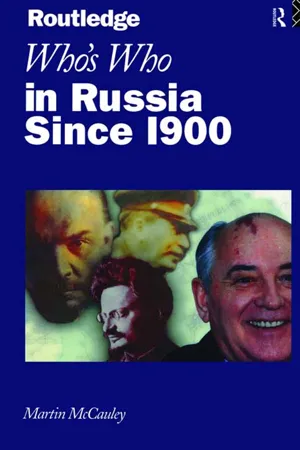
Who's Who is Russia and the Soviet Union is a unique reference guide which examines the leading political, economic, cultural, military, scientific and sporting personalities from 1900-1991. Through analysis of figures such as Stalin, Brezhnev, Khrushchev, Yeltsin, Ratushinskaya and Sakharov, a comprehensive portrait of Russian and Soviet society in this era emerges. The book takes the reader up to the collapse of the Soviet Union and provides:
- detailed biographical information on each leading figure
- bibliographical references with entries as an aid to further research
- a comprehensive glossary of Russian terms, concepts and institutions and a useful chronology of events
- an accessible and user-friendly A-Z layout
- an invaluable guide for students, teachers, researchers, and the general reader alike.
- 296 pages
- English
- ePUB (mobile friendly)
- Available on iOS & Android
eBook - ePub
Who's Who in Russia since 1900
About this book
A
Abakumov, Viktor Semenovich (1894–1954), one of the most brutal henchmen of STALIN and BERIA, who as head of Smersh, 1942–6, was ruthless in eliminating Stalin's perceived foes. Apparently he gave the order in 1944 to kidnap Raoul Wallenberg, the Swedish diplomat who had saved thousands of Hungarian Jews by issuing them with Swedish passports. Rumour has it that Abakumov personally shot Wallenberg during interrogation in his Lubyanka office. Abakumov was USSR Minister of State Security, 1946–51, and, as such, in charge of fabricating the Leningrad Affair after the death of Andrei ZHDANOV in August 1948. The Affair cost many their lives and thousands others their posts. While in Berlin in April 1946 to arrest some Soviet officers, Abakumov clashed with Marshal ZHUKOV, commander of Soviet forces. This led to Zhukov being recalled to Moscow and accused of conspiratorial activities. Stalin had became suspicious of Beria and ordered Abakumov to fabricate a conspiracy against several of Beria's Mingrelian (one of the nationalities in Georgia) associates. He claimed later that Stalin had told him to ‘go after the big Mingrelian [Beria]’. Just as all this was moving into place Stalin had Abakumov arrested in June 1951. Aba-kumov's bitter rival, Merkulov, had written a letter to Stalin denouncing Abakumov. The latter's deputy, M.D. Ryumin, informed Stalin that Abakumov had known for some time about a Jewish bourgeois nationalist plot, involving American spies, but had for some reason kept it secret. Abakumov had allegedly also murdered a prisoner, a Kremlin doctor, who had important information. Stalin appointed Semen IGNATEV to succeed Abakumov in 1951. Abakumov sent many letters to Beria about being tortured and begging for help to get out of prison. Abakumov was not taken in by the Doctors’ Plot, launched in January 1953, according to which a group of doctors (mainly Jewish) had as their aim the shortening of the life of leading Soviet officials. He was arrested on Stalin's orders but released after the master's death by Beria who brought him back into state security work. The fall of Beria signalled Abakumov's demise. He was put on trial in Leningrad for his role in the Leningrad Affair and he was executed in December 1954.
Abalkin, Leonid Ivanovich (b. 1930), One of the leading economic reformers during perestroika and supporter of GORBACHEV until he lost patience in November 1990. He graduated from the prestigious Moscow Plekhanov Economics Institute, 1952, and taught at the institute from 1971 to 1977, becoming a professor. He then moved to the Academy of Social Sciences where he rose to become head of the department of political economy in 1985. He became director of the Institute of the National Economy, USSR Academy of Sciences, 1986, and was elected an academician (member of the USSR Academy of Sciences), 1987. He was a deputy chair of the USSR Council of Ministers, 1989–91. He was elected a deputy to the USSR Congress of People's Deputies, 1989, and then became the first chair of the State Commission on Economic Reform when it was set up, June 1989. This meant that he had to give up his mandate as a deputy. He found working with Nikolai Ryzhkov, the USSR Prime Minister, frustrating, as RYZHKOV was not as enamoured of market solutions as Abalkin.
Abashidze, Irakly Vissarionovich (1909–92), a leading Georgian poet and literary figure who mixed politics and culture. He was born in Mingrelia, Georgia, and graduated from Tbilisi University. He attended the Ist Congress of the USSR Union of Writers, 1934, when socialist realism was laid down as the cultural orthodoxy. He was sent to labour camp (Gulag) immediately afterwards but wrote a highly flattering poem in honour of Lavrenty BERIA (another Mingrelian). Abashidze was released and became editor of several literary journals. He became a member of the Communist Party, 1939, and secretary of the Union of Georgian Writers (subordinate to the USSR Union of Writers). He became chair of the Georgian organisation in 1953 and remained until 1967. In 1958 he played his part in attacking Boris PASTERNAK for his novel Doctor Zhivago and the award of the Nobel Prize for Literature to him. He also joined in attacks on the United States and Britain when the US intervened in Lebanon, 1958. He was a leading member of the Georgian Academy of Sciences, becoming its vice-president, 1960. He was also a deputy of the USSR Supreme Soviet. He cultivated relations with KHRUSHCHEV and BREZHNEV, flattering them when the occasion arose. Under perestroika he revised his biographical entry in the Soviet Georgian Encyclopedia to excise his former good understanding with Beria. For ever an establishment figure, he supported Zviad GAMSAKHURDIA, a fellow Mingrelian, when he came to power after Georgian independence, 1991. Gamsakhurdia's dictatorial behaviour quickly produced many enemies and Abashidze consequently went over to the opposition. The Military Council which removed Gamsakhurdia by force afforded Abashidze a state funeral.
Abdrashitov, Vadim Yusupovich (b. 1945), a leading film director who rose to prominence under glasnost. He developed his skills as a pupil of Romm and had a fruitful partnership with Aleksandr Mindadze which produced many films, including The Parade of the Planets, 1984. A constant theme in his work was the reality of everyday Soviet life and The Train Has Stopped, 1982, was daring in its portrayal of small-time corruption. He gained an international reputation with Plumbum, or a Dangerous Game, 1986, which portrays the malaise of society, especially its pessimism, towards the end of the communist era.
Abdulatipov, Ramazan Gadzhimuradovich (b. 1946), an Avar, he became a leading specialist on nationality issues under GORBACHEV. He was born in Dagestan into a large family and graduated from the history faculty, Dagestan State University, Makhachkala, and worked in the agitation and propaganda department of the Party apparatus in Dagestan, 1974–5. In 1975 he became a postgraduate student in the faculty of philosophy, Leningrad State University, and successfully presented his candidate dissertation on personality and ethnic relations in a developed socialist state (PhD). He returned to a pedagogical institute, Makhachkala, and later headed a sociological laboratory in Murmansk. In 1985 he successfully presented his doctoral dissertation on ethnic relations in a developed socialist society (DLitt). In 1978 he became head of faculty, Murmansk Higher Marine Engineering Technical College, and in 1987 he returned again to Makhachkala to head the department of philosophy, Dagestan Pedagogical Institute. In 1988 he was invited to Moscow to head a section of the department for inter-ethnic relations, Central Committee Secretariat and remained there until June 1990. He was elected to the RSFSR Congress of People's deputies and the RSFSR Supreme Soviet, 1990, and was elected speaker, Soviet of Nationalities, RSFSR Supreme Soviet, June 1990. He was a member of the Communist Party, 1973–91. Abdulatipov, mainly due to his Dagestani background, was a leading advocate of reconciliation between nationalities in the Soviet Union. He quickly came to distrust Boris YELTSIN and became an ally of Ruslan KHASBULATOV when the latter succeeded Yeltsin as speaker of parliament. He belonged to the centre right bloc which attempted to impeach President Yeltsin, March 1993.
Abel, Rudolf Ivanovich (Fischer, William) (1903–71), a successful Soviet spy who was exchanged for Francis Gary Powers, the US U-2. pilot shot down over Sverdlovsk in May 1960. Abel was born into the family of a German communist who moved to the Soviet Union after the Nazis came to power. He spent part of his childhood in England. He was a GRU (military intelligence) agent in Germany during the Second World War. In 1947 he entered Canada on a German passport and moved to the US, using a forged Canadian passport. The Communist Party of the USA provided him with the birth certificate of a dead child. He set up a business in Brooklyn where he displayed his multi-faceted talents. He was an excellent musician, radio engineer and linguist. He operated a large network of Soviet agents throughout the US under the name of Emil Robert Goldfus. He was recalled to Moscow, and then sent to Finland where he married a Finn. He reentered the US with her in 1952. His cover was blown by another GRU agent and he was arrested and sentenced to thirty years, 1957. He was exchanged for Francis Gary Powers in 1962. in East Berlin. On his return to Moscow he took up residence in the Lubyanka and headed the Anglo-American desk. Louise Bernikow: Abel, New York, 1970.
Abramov, Fedor Aleksandrovich (1920–83), a Russian writer who championed the rural community against the depradations of the planned economy. He was born in Arkhangelsk oblast and was an officer in Smersh (death to spies) during the Great Fatherland War. He graduated from the faculty of philology, Kirov Leningrad State University, 1948. He taught at the university and became a professor of literature. He participated in the campaign during the Zhdanovshchina against cosmopolitanism (mainly anti-Semitic). He first came to the notice of a wider public in 1954 in an article attacking the over-optimistic representation of rural life in Soviet novels. He knew of the drudgery and poverty of many rural areas, especially in the north, at first hand. He devoted a trilogy of novels to rural life in Arkhangelsk oblast (The Pryaslins, 1974) which depicts the stark reality of the effects of collectivisation on the rural community and the land. He praised the stoicism of the peasant and as such was a precursor of the rural school of writers, the derevenshchiki.
Abuladze, Tengiz Evgenevich (b. 1924), a Georgian film producer who became an overnight sensation in 1987 when his film, Repentance, about the dreadful times under STALIN, hit the box office. It had been completed in 1984 but with Konstantin CHERNENKO in the Kremlin it was wiser to conceal its existence until the first shoots of glasnost appeared. It became an immediate success and provided a great stimulus to glasnost, especially in the film world. Abuladze studied in State Film School, Moscow, under Yutkevich and Romm. His first feature film (with Revaz Chkheidze), Magdan's Donkey, 1955, won a prize at the Cannes Film Festival, 1956. He concentrated on the realities of everyday life and as such was skating on thin ice with the Sovietcultural establishment. He became very popular in the Soviet Union and became an internationally acclaimed director with Repentance.
Adamishin, Anatoly Leonidovich (b. 1934), a senior Russian diplomat who was born in Kiev and graduated from the Lomonosov Moscow State University, 1957. He was a member of the Communist Party, 1965–91. He worked in the USSR Ministry of Foreign Affairs (MID), 1957–9; then in the USSR embassy in Rome as attaché, third and second secretary, 1959–65. There he struck up relationships with leading Italian communists and their families. Then he returned to MID, as second and first secretary, counsellor and consultant to the First European department, 1965–71. He was a senior counsellor in MID, 1973–8. Then he headed the First European department, 1978–86. He was promoted to deputy USSR Foreign Minister, May 1986, and remained in that post until 1990. He became first deputy Russian Foreign Minister, 1992–4. He then replaced Leonid ZAMYATIN as Russian ambassador to the Court of St James, London.
Adamov, Arkady Grigorevich (1920–91), the Soviet Agatha Christie who was hugely popular for his detective stories in the Soviet Union. His first book, Delo Pestrykh (The Motley Case) was published in 1956 in Yunost. It was an instant hit and revealed the almost insatiable appetite for thrillers in the USSR. He wrote over thirty books, almost all of which were turned into films.
Adzhubei, Aleksei Ivanovich (b. 1924), KHRUSHCHEV'S son-in-law whose family connections led to a glittering career as a journalist. He became known as the king of the Soviet press. He was born in Samarkand, Uzbekistan, the son of a Ukrainian peasant who later became a well-known singer, working on occasions with Fedor CHALIAPIN. His mother was a dressmaker and among her clients was NINA, the wife of Lavrenty BERIA. Adzhubei moved to Moscow with his mother, 1932. He graduated from Lomonosov Moscow State University in journalism, 1952. By this time he and Rada KHRUSHCHEVA had already married and Adzhubei became a top Soviet journalist, becoming editor-in-chief of Komsomoloskaya Pravda, and Izvestiya. He accompanied his father-inlaw on many of his western jaunts, including the hugely successful visit to the United States, 1959. During the summer of 1964 Adzhubei unwittingly helped the opposition to oust Khrushchev. His father-in-law wanted to introduce the five-day week, something that would have been very popular at a time when Khrushchev's star was in the descendant. Adzhubei, at the instigation of some of the conspirators, persuaded him otherwise without realising that they had an ulterior motive. One of the accusations levelled against Khrushchev in October 1964 was that he had turned Adzhubei into a shadow foreign minister and had attempted to meddle in diplomatic matters at the highest level, confusing the Soviet ambassadors. On one occasion in Bonn, Adzhubei had made a slighting reference to Walter Ulbricht, the East German leader. The latter had personally complained to Moscow and it had taken some effort to smooth his ruffled feathers. Adzhubei's visits to Prague and Bonn led to a rumour that he was preparing the way for another Khrushchev initiative on Germany. He fell like a stone with Khrushchev in October 1964 and his official career was over.
Adzhubei, Rada Nikitichna (née Khrushcheva) (b. 1929), the daughter of Nikita and Nina KHRUSHCHEV. She was born in Kiev where her father was a Party official. She graduated from Lomonosov Moscow State University, 1952, in journalism and biology. She and ALEKSEI ADZHUBEI had already married as students. She worked as an editor of journals such as Nauka i Zhizn, from 1956 onwards. Her husband became the journalist of the moment while her father was in power, rising eventually to become editor-in-chief of Izvestiya. She continued her career after her father's removal and in 1990 she was deputy editor-in-chief of Nauka i Zhizn. Their son, Aleksei Alekseevich, born in 1954, is a biophysicist and in 1990 began working for the Imperial Cancer Research Fund, London.
Afanasev, Viktor Grigorevich (b. 1922), a leading Soviet journalist who was removed as editor-in-chief of Pravda for not being sufficiently enthusiastic about perestroika. He was born in Aktanysh in present-day Tatarstan and is Russian. He served in the Red Army, joined the Communist Party, 1943, and graduated from the Chita Pedagogical Institute, 1950. He was Professor of Marxism-Leninism at the institute, 1954–9, then Professor of Scientific Communism at the Academy of Social Sciences of the Central Committee of the Communist Party, 1960–8. He then moved into journalism, working on Voprosy Filosofii and Pravda, 1968–74, ending up as first deputy editor-in-chief of the latter. He was promoted to the position of editor-in-chief of Kommunist, the Party's theoretical journal, 1974. He moved back as editor-in-chief of Pravda in 1976 and remained there until 1989 when he was sacked and replaced by Ivan Frolov. Afanasev was also chair of the USSR Union of Journalists, 1976–90. He was elected a member of the Central Committee of the Communist Party, 1976, and remained there until 1990. He was elected a member of the USSR Academy of Sciences, 1981, and this afforded him the much sought after title of academician. Such a career reveals an orthodox, conservative communist turn of mind but, in line with the BREZHNEV times, he did support modest reform in the economy and society. Under GORBACHEV he found himself out of temper with the times and he was ill-suited to be an iconoclastic editor when radical solutions were needed.
Afanasev, Yury Nikolaevich (b. 1934), one of the most prominent reformers during the GORBACHEV era who eventually became frustrated with the Soviet leader's lack of consistency. He was born into a Russian worker's family in Ulyanovsk (Simbirsk). He graduated from Lomonosov Moscow State University, 1957, in history, worked in the Komsomol in Krasnoyarsk, Siberia, and joined the Communist Party, 1961. He became a specialist in French history in 1968 (the year of momentous changes in de Gaulle's France), specialising in the French Revolution, at the Academy of Social Sciences of the Central Committee of the Communist Party, undertaking research in France. He became editor of the history section of the Party journal, Kommunist, 1980. He moved back to academic life to become rector of the Moscow State Archive Institute, 1986, and he immediately used his access to Soviet archives to begin unearthing information about the past. As such he was an enthusiastic supporter of glasnost. STALIN and Stalinism quickly became targets (he claimed that Stalin had destroyed history in the USSR) and as he delved further he became more and more radical, not fearing to criticise the founding father, LENIN. He went into politics in March 1989 when he was elected to the USSR Congress of People's Deputies, representing Noginsk, near Moscow. As a radical Communist, Afanasev became one of the leaders of the Inter-Regional Group in the parliament. As an effective and energetic speaker, he addressed many demonstrations and gained respect and support from a wide spectrum of opinion. Conflict was bound to accompany such a high-profile figure who was impatient with anything but radical and speedy reform. Inevitably he became disillusioned with Gorbachev who had the unenviable task of balancing various power interests in the leadership. One of his accusations against the Soviet leader was that he was trying simultaneously to be leader of perestroika and the nomenklatura. Afanasev resigned from the Communist Party, April 1990, the first prominent person to do so. He was active in the Memorial Society, whose main task was to make known the repressions of the Stalin era and to erect a memorial to its victims. During his time at the Archive Institute, Father Aleksandr Men, the charismatic Orthodox priest, began giving lectures in theology, the first biblical teaching since the early 1930s. Afanasev was a prolific author and among his publications is a two-volume history of the Soviet Union, 1991, which reveals an impressive knowledge of western writing on the Soviet Union. He became rector of the Russian Humanitarian University, May 1991.
Afinogenov, Aleksandr Nikolaevich (1904–41), a playwright who was born in Ryazan guberniya, joined the Communist Party, 1922, and published his first play in 1924. During the 1920s he was associated with the proletarian culture movement (Proletkult) and directed plays. He became a member of the Russian Association of Proletarian Writers (RAPP) when it was formed in 1928. These writers were dedicated to producing a truly proletarian literature, imbued with communist ideology. He became a leading theorist of the movement but wrote plays depicting characters living in an epoch of permanent fear. Fear, 1931, and The Lie made him well known. He married an American. He came under criticism, 1936, and was expelled from the Party and the USSR Union of Writers, 1937, but was readmitted to both after recanting, 1938. He carried on writing and was killed during a German air raid on Moscow while waiting to be sent to the US as a representative of the Soviet Information Bureau (Sovinformburo).
Agadzhanova-Shutko, Nina Ferdinandovna (1889–1974), a leading script-writer whose earlier career was in intelligence. She was an active worker for the Bolshevik Party, 1911–16, being arrested several times. She participated in the Civil War as a member of the Cheka. She was posted to the Soviet embassy in Czechoslovakia, 1921–2, and the Soviet embassy in Latvia, 1934–8, gathering intelligence in both countries. She temporarily retired from intelligence, 1924, and devoted herself to writing film scripts: 1905 God, (The Year 1905), became the basis of Sergei EISENSTEIN'S The Battleship Potemkin, 1926. She co-scripted with Lev Kuleshov the film, Dva Buldi Dva (The Two Buldis), 1930, and also coscripted with V.Pudovkin, Dezertir (The Deserter), 1933. She taught at the All-Union State Institute of Cinematography (VGIK), 1945–52.
Aganbegyan, Abel Gazevich (b. 1932), one of the key Soviet economists during the early phase of GORBACHEV'S perestroika. An Armenian, he was born in Tbilisi, Georgia. He graduated from the State Institute of Economics, Moscow, 1954, and joined the Communist Party, 1956. He was engaged in the USSR State Committee on Labour and Wages, 1955–61. When KHRUSHCHEV supported the concept of moving many scientists out of Moscow to the USSR Academy of Sciences, Novosibirsk, Siberia, Aganbegyan was among the first to go. He was head of the laboratory of the Institute of Economics and Organisation of Industrial Production, Siberian Section, USSR Academy of Sciences, 1961, and was the institute's director, 1967–85. He also edited the institute's journal, EKO, which quickly established itself as one of the leading economics journals and the most interesting. One of the reforms floated was to remove subsidies from everything except education, health, care for the elderly and book publishing. Gorbachev had been introduced to some radical-thinking specialists, including Tatyana ZASLAVSKAYA, in the early 1980s, and Aganbegyan in due course attended Gorbachev's discussion group. Aganbegyan was not as radical (pro-market) a reformer as others and his star, which had been brightest in the early years of perestroika, waned with him being over-taken by YAVLINSKY, SHATALIN and others. Aganbegyan chaired many influential committees, such as the committee on productive forces, 1985–91. He was academic secretary of the USSR Academy of Sciences, 1987–9. He was also director of the Academy of National Economy. Abel Aganbegyan: Moving the Mountain. Inside the Perestroika Revolution, London 1987.
Agursky, Mikhail Samuilovich (1933–91), a leading writer on the Soviet Union after he emigrated to Israel, 1975. He was born in Moscow, the son of a founding member of the Communist Party of the USA. He graduated as a mechanical engineer and became a candidate of technical science (PhD (Eng)). He became a leading human rights activist from the e...
Table of contents
- Front Cover
- Who’s Who in Russia Since 1900
- Title Page
- Copyright
- Contents
- List_of_Maps
- Introduction
- Chronology
- WHO’S WHO IN RUSSIA SINCE 1900
- Glossary
- Maps
- Bibliography
Trusted by 375,005 students
Access to over 1.5 million titles for a fair monthly price.
Study more efficiently using our study tools.
Frequently asked questions
Yes, you can cancel anytime from the Subscription tab in your account settings on the Perlego website. Your subscription will stay active until the end of your current billing period. Learn how to cancel your subscription
No, books cannot be downloaded as external files, such as PDFs, for use outside of Perlego. However, you can download books within the Perlego app for offline reading on mobile or tablet. Learn how to download books offline
Perlego offers two plans: Essential and Complete
- Essential is ideal for learners and professionals who enjoy exploring a wide range of subjects. Access the Essential Library with 800,000+ trusted titles and best-sellers across business, personal growth, and the humanities. Includes unlimited reading time and Standard Read Aloud voice.
- Complete: Perfect for advanced learners and researchers needing full, unrestricted access. Unlock 1.5M+ books across hundreds of subjects, including academic and specialized titles. The Complete Plan also includes advanced features like Premium Read Aloud and Research Assistant.
We are an online textbook subscription service, where you can get access to an entire online library for less than the price of a single book per month. With over 1.5 million books across 990+ topics, we’ve got you covered! Learn about our mission
Look out for the read-aloud symbol on your next book to see if you can listen to it. The read-aloud tool reads text aloud for you, highlighting the text as it is being read. You can pause it, speed it up and slow it down. Learn more about Read Aloud
Yes! You can use the Perlego app on both iOS and Android devices to read anytime, anywhere — even offline. Perfect for commutes or when you’re on the go.
Please note we cannot support devices running on iOS 13 and Android 7 or earlier. Learn more about using the app
Please note we cannot support devices running on iOS 13 and Android 7 or earlier. Learn more about using the app
Yes, you can access Who's Who in Russia since 1900 by Martin McCauley,Martin Mccauley in PDF and/or ePUB format, as well as other popular books in History & Russian History. We have over 1.5 million books available in our catalogue for you to explore.