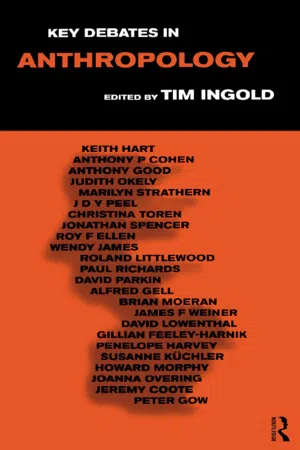
Every year, leading social anthropologists meet to debate a motion at the heart of current theoretical developments in their subject and this book includes the first six of these debates, spanning the period from 1988 to 1993. Each debate has four principal speakers: one to propose the motion, another to oppose it, and two seconders.
The first debate addresses the disciplinary character of social anthropology: can it be regarded as a science, and if so, is it able to establish general propositions about human culture and social life? The second examines the concept of society, and in the third debate the spotlight is turned on the role of culture in people's perception of their environments. The fourth debate focuses on the place of language in the formation of culture. The fifth takes up the question of how we view the past in relation to the present. Finally, in the sixth debate, the concern is with the cross-cultural applicability of the concept of aesthetics.
With its unique debate format, Key Debates in Anthropology addresses issues that are currently at the top of the theoretical agenda, which register the pulse of contemporary thinking in social anthropology. It will be of value to students who are not only introduced to the different sides of every argument, but are challenged to join in and to develop informed positions of their own.
- 320 pages
- English
- ePUB (mobile friendly)
- Available on iOS & Android
eBook - ePub
Key Debates in Anthropology
About this book
Information
Part I
The presentations
FOR THE MOTION (1)
KEITH HART
The reason I have for taking part in this debate is not to rehash inconclusive arguments over methodology, but rather to revive interest in the objectives of anthropology. It is appropriate to be concerned with the means of acquiring knowledge if we are confident that the established ends of our collective efforts are sound. But, when our social purpose is uncertain and our discipline reflects a general intellectual malaise, preoccupation with means rather than ends becomes self-defeating.
I take British social anthropology today to be marginal, fragmented, confused; to be obsessed with its own internal affairs more than with any larger conception of the purposes of knowledge. The demoralized descendants of Radcliffe-Brown and Malinowski are now increasingly given to insular reflection on the sources of their own anxiety, an anxiety induced by the loss of empire and with it the closure of that window on the world which once gave British anthropology its breadth and global vision.
We are not alone in this. The great project of modern social science with which our century began is manifestly in disarray. The West is now facing for the first time, in the shape of Asia’s resurgence, a challenge to its intellectual and practical ascendency. If we wish to situate our dilemmas within these epochal events, it will not do to dwell on the methodological legacies of those who wrested a niche for social anthropology in the British academy half a century ago. Rather, we must take a broader view of our place in world history, the better to devise a strategy for making a constructive contribution to understanding modern society’s next phase.
There are two great ideas driving modern history and they are inextricably linked— democracy and science. The first of these says that societies fit for human beings to live in must guarantee the freedom and equality of all citizens so that the people may be selfgoverning. The second says that such societies can only flourish if knowledge in them is based on the discovery of what is objectively real.
Science has two great objects—nature (everything out there that we did not consciously make up) and society itself (which is both a part of nature and the result of human intentions, however misguided). A democratic society has to break down intrinsic barriers to its own development—poverty, ignorance, injustice. To do so it needs science. Whatever we plan to do is more likely to succeed if we employ reason to find out how essential things work.
Moreover, the principles on which society is founded must be common to all of us; they must touch what is ‘natural’ in us, as opposed to what is merely conventional or arbitrary. This is the core of the modern quest for human, civil or natural rights. Equally, science thrives on democratic social organization. It is above all a communal enterprise, relying on the painstaking, cumulative efforts of generations towards shared ends. When science is merely an elite exercise, cut off from the general impulses of ordinary people, it is in danger of atrophying. The idea that links the two sides is education. Free and equal citizens must be knowledgeable. And science must be sustained by a general culture which values truth, learning and practical invention.
There is only one modern revolution and it is far from finished. It began in earnest in seventeenth-century England, which Veblen once described as ‘an isolation hospital for science, technology and civil rights’. The discoveries of Locke and Newton were made general in the eighteenth century by the European Enlightenment and were realized as a living social experiment in the United States of America. Since then, the French and Russian revolutions have dominated the thinking of progressive intellectuals. And, as the Western industrial nations became more wealthy and, it must be said, more equal, the pursuit of knowledge has often become more esoteric and personal.
Of late it has been claimed that we are already in a post-modern, postindustrial or postscientific phase. I doubt if this is true even of the richest countries; but it is manifestly untrue of world society as a whole, where poverty, ignorance and the starkest inequalities are normal for the vast majority. The task of building a world fit for human beings to live in has barely begun.
Two attitudes predominate among our intellectual and political elites: one turns its nose up at ‘bourgeois’ democracy and science, declaring them a sham, without enquiring too deeply into institutional realities; while the other rejoices in the apparent achievements of ‘free’ Western states whose citizens remain at this time extremely unfree and unequal, being governed by remote rulers for whom science is largely an aspect of the military budget, rather than a means of general emancipation.
It may be objected that my idea of science is old-hat, that the world has moved on in the last three hundred years. And so it has. Keywords like nature, society and science move with history. This is a dialectical process and its principle is negation. What science is supposed not to be, its place in a set of terms referring to what it is not, offers a better guide to historical shifts in its meaning than positive definitions taken in isolation.
There can be little doubt that what science originally was not was mystical beliefs— religion, superstition, stories—uninspected traditions referring human existence to a supernatural cause; in a word, it was not ‘myth’. After five thousand years of agrarian civilization, the main task of modern societies is to found knowledge on a truly secular footing. Even a century ago the political drive sustaining science was largely anticlerical; and, in a world where fundamentalist Christianity and Islam flourish (not to mention the Catholic Church), this crusade is still necessary.
Yet, in this century, for most Western intellectuals that battle may appear to have been won. What science principally is not has shifted ground to embrace the oppositions which sustain an expanded academic division of labour. The negation of science is now most commonly the creative arts—literature, poetry, the critical imagination—reflecting the division between natural science and the humanities (the separation of matter and spirit) which has spawned, as a hybrid experiment, social science.
Today’s debate could be taken as a referendum on the social sciences and on anthropology’s place as one of them. Most of this audience probably came to it with the word ‘science’ already fixed in mind as a positive or negative notion defined by one of several linked oppositions, all of them retained in present-day usage. For the founders of British social anthropology, our science of ethnography had as its principal negation ‘history’ or Victorian evolutionism. Now ethnography may be appropriated by the advocates of anthropology as writing and reflection, the very antithesis of science. Meanwhile scientific anthropologists are likely to insist that their subject matter is largely historical.
It is for this reason that I have sought to rescue the original and, I would hope, unifying conception of science as one of the two great objects of modern development. I feel sure that, if we concern ourselves with the method of knowing rather than with the object of knowledge, we will repeat the mistake which has led twentieth-century social science into a blind alley; and our debate will be hopelessly confused. Science undoubtedly rests on the premiss that it is possible to know what is objectively real. But to be committed to that idea is not to be forced to sign up for an ossified seventeenth-century epistemology, as, for example, economics has (thereby revealing itself to be more secular religion than science).
The intellectual achievements of the last three hundred years, in both science and the humanities, have necessarily altered our conception of subject-object relations and of ways of knowing. A modern science must incorporate notions of history, reflexivity, relativity, linguistic and logical traps, Western ethnocentrism, the need for selfknowledge and much else. The best twentieth-century scientists have already done so. The ideal type ‘science’—the positivist stereotype of the man in the white coat—cannot capture what scientists, the best and the worst of them, actually do.
The mistake is to emulate scientific method, while forgetting what science is supposed to be for—to be so wrapped up in the problem of one’s own ability to know or communicate anything that the priorities determining what needs to be known are lost. If modern anthropologists can often be seen to fall into this error, they are no more guilty than most modern intellectuals. We have lost our way; and this may be because we can no longer see the connection between the social purposes of knowledge and the pursuit of knowledge for its own sake.
Our problem is that the natural scientists can no longer relate what they do to the complex character of human existence, including their own; while the humanists have given up trying to understand how the world works. The social scientists have proved incapable of spanning the gap, for a number of reasons, but mainly because they tried to behave like scientists without seeking to alter what natural scientists think or being able to learn fast enough from what they have discovered. As a result they (including ourselves, as British social anthropologists) have nothing to say about the reciprocal interdependence of nature and society.
My contention is that our civilization desperately needs to reconstitute the original Enlightenment goal of progress through the systematic application of reason, in a world where nature and human society are understood to be interdependent. The prevailing division of intellectual effort within the universities stands in the way of such a development. But the progress of humanity on a world scale will demand a new concept of scientific knowledge and of its constituent branches. The mechanization of brains is one aspect of our phase of the modern revolution which is already requiring such a reorganization.
Even as I contend that anthropology must be part of the great modern project to institute democratic societies on a firm basis of objective knowledge, I would still argue that the experiment known as social science has been a failure and that we would be well advised to distance ourselves from it as fast as we can. Otherwise we will soon go down with sociology, economics and other benighted ‘pseudo-sciences’ into that dustbin of history reserved for disciplines which failed to move with their times.
The task of our generation is to bring knowledge of nature and society once more into an active, mutually reinforcing relationship. This means mediating and ultimately transcending the opposition between science and the humanities. Anthropologists are uniquely placed to begin such a task. We retain vestiges of an evolutionary anthropology which combines the study of humanity’s nature, societies and cultures. Even within social anthropology we combine both the scientific tradition of social theory and humanistic scholarship, as well as our own distinctive hybrid style of ethnographic writing, of abstract generalization pursued through concrete description. Above all our subject matter is the vital, inclusive middle ground—humankind as a whole.
Our virtue as an eclectic anti-discipline is that we are (or should be) open to all the currents which will make the next intellectual synthesis. It would be absurd to tie ourselves to the analytical relics of the last synthesis, to the social sciences that were formed in the early twentieth century. I do not know what this next synthesis will call itself, but I suspect that it may be ‘science’, perhaps ‘human sciences’. The rhetorical power of the word is too strong for us to abandon it lightly. If Derrida and the deconstructionists are human scientists—and I take their synoptic review of the history of Western thought to be a scientific enterprise—then current academic divisions cannot be taken seriously as a guide to whatever science may become in the next century. It is only through the dialectical synthesis of what science is and what it is not that progress in the pursuit of knowledge can continue. What matters is that we should seek to play an active role in the ongoing redefinition of what knowledge is centrally thought to be in our society. If we do not, we deserve to go under in the global upheaval that is building to a climax under our noses.
The task of a science is to generate replicable knowledge; to help others to do difficult things more easily and reliably; to get something right again and again; and, when it is no longer right enough, to think again. Anthropology as an academic discipline must be a part of science. We are in the public domain and we must fight for our place there. The rhetoric of serious public discourse concerns science. We have plenty to say about what that ought to be. We are not artists, even less priests. We have nothing to gain by declaring ourselves to be against science.
AGAINST THE MOTION (1)
ANTHONY P.COHEN
The ‘opposition’ will divide its labour: Judith Okely will deal with the issues of ‘science’; I will limit myself to the question of generalization.
It is undeniable that, throughout most of its history, social anthropology has been a generalizing discipline. Indeed, one might well go so far as to say that if our predecessors did not generalize, they did nothing. But our concern today is not to debate historical facts. Rather, we must address ourselves to contemporary truths.
Our subject is not what the discipline has been in the past, but what it should be now, this normative view informed both by developments which have transformed anthropology especially during the last twenty years or so, and by the intellectual and political circumstances within which we are presently working.
Whatever the ambivalence with which any of us approach this motion today, I am certain that none of us will be tempted into the kind of soggy compromise offered recently by Peacock in his The anthropological lens. There, he tells us that anthropology deals ‘exquisitely’ (his word) with individuals—but sees them as representative of their societies. ‘Ethnography,’ he says, ‘reveals the general through the particular From the Kula ring, we learn about order and integration; from the shaky-handed circumciser, about the interplay of tradition and conflict; and from the cockfight, about hierarchy.’1 The adjacency of these two latter examples would have intrigued Freud, but there is nothing very intriguing about Peacock’s contention: it is nonsense. We have been taught to make sense of the Kula as if it was ordering process; and to see Ndembu circumcision as an exemplary case of ritual mediating conflict—in other words, to use the general as a matrix with which to de-particularize the particular; and thereby to validate itself. Generalization becomes a self-confirming hypothesis—a classic instance of what Ardener might have characterized as text becoming genre.
While we will not ape the ploys of formal debate, we are entitled to test a little the terms of the motion. While we do not feel that it is incumbent upon us to reject generalization out of hand, we do dispute that generalization is the defining activity or competence of anthropology. Indeed, although we accept that there may be circumstances in which, and audiences to which, generalization might be appropriate, we deny that it is among the more important qualities of the anthropological exercise. Furthermore, we do not regard it as necessary to show by repeated example that generalization can be vacuous. What strikes me as curious is the notion that we should aspire to generality, for generalization is such a dull, such an unambitious, mode of discourse—rather like regarding any performance of a Bruckner symphony as if it were an unvarying reproduction of Bruckner’s notes; or, as in the critic’s version, as if it were merely an expression of the conductor’s reading, ignoring the hundred or so musicians who do the actual bowing and blowing, the plucking and banging.
No wonder orchestral musicians view the maestro through such jaundiced eyes. With what tinge of yellow should we regard our respected colleague who tells us, in a nearorgy of generalization, that Sinhalese abhor individualism as an affront to the cosmic integrity of the State and hierarchy; while Australians regard the State as an offence to the individualism which they venerate, and therefore, drink excessively in celebration of their personal autonomy?2
Well, if von Karajan can have his Bruckner, we must allow Kapferer his Australia, so long as we are clear that it is a figment of his vivid and ingenious imagination, whatever claims may be made for its ‘ontologies’. We, on this side, prefer to think of Australians rather than of Australia, and see no reason to suppose that they are any more generalizable than we are. Are there groups whose members are lesscomfortable with generalization about themselves than departments of anthropology? Let me repeat to you an instructive observation, arising out of a consideration of literature on American and Indian kinship: ‘Blanket considerations... involve so much selectivity and systemization by the analyst, that they cannot reflect indigenous thinking to the extent claimed.’ This is a caution I applaud, and was made in an excellent article on the anthropology of kinship by my opponent today, Anthony Good.3
It may reasonably be objected that generalization does not have to take such crude, allembracing forms. I agree. What kind or degree of generalization might we then regard as acceptable? To the extent that we think with categories—of gender, age, ethnicity, class, and so forth—we know we cannot eschew typification altogether; thinking and intellectual discourse could not proceed without it. But that is not to say that the proper objective of anthropology is to generalize. I would prefer to say that anthropologists use generalization pragmatically as an essential weapon in their struggle to beat a path through generalities towards some greater sensitivity and enlightenment. In this regard, we can measure ourselves against the politician, the journalist, the advertiser, the survey researcher, whose entire enterprise depends upon their capacity to make the grossest kinds of generalization, and to make them stick. But we may also distinguish ourselves from those scholars who are content to ignore, or to miss, the inconvenient qualification, the exceptions to the rule—those devastating pieces of information which, when once revealed, turn out not to be quite so exceptional after all, and, indeed, to show the general statement to be a travesty. Our own experience surely leaves us in no doubt that the ubiquitous failure of development projects, of urban plans, indeed, of strategic planning of all kinds, often results from the planners’ neglect of, or disdain for, the vital differences among people which their generalizing models obscure. Social scientists, from econometricians to ethnomethodologists, are obsessed with the postulation of pattern, or rules which purportedly govern behaviour, or some contrived regularity, or with testing their unfalsifiable metaphysics of regularity. But what strikes us so forcibly through ethnographic observation are the irregularities among people. If anthropology’s concern is not with complication, with complexity, with differentiation, with nongeneralizability, we might just as well retreat to the positivistic pleasures of numbercrunching, of social surveys and statistical sampling; take refuge in comfortable, but mindless statements about ‘human na...
Table of contents
- Cover Page
- Title Page
- Copyright Page
- Preface
- General introduction
- 1988 debate: Social anthropology is a generalizing science or it is nothing
- Introduction
- Part I: The presentations
- Part II: The debate
- 1989 debate: The concept of society is theoretically obsolete
- Introduction
- Part I: The presentations
- Part II: The debate
- 1990 debate: Human worlds are culturally constructed
- Introduction
- Part I: The presentations
- Part II: The debate
- 1991 debate: Language is the essence of culture
- Introduction
- Part I: The presentations
- Part II: The debate
- 1992 debate: The past is a foreign country
- Introduction
- Part I: The presentations
- Part II: The debate
- 1993 debate: Aesthetics is a cross-cultural category
- Introduction
- Part I: The presentations
- Part II: The debate
Trusted by 375,005 students
Access to over 1.5 million titles for a fair monthly price.
Study more efficiently using our study tools.
Frequently asked questions
Yes, you can cancel anytime from the Subscription tab in your account settings on the Perlego website. Your subscription will stay active until the end of your current billing period. Learn how to cancel your subscription
No, books cannot be downloaded as external files, such as PDFs, for use outside of Perlego. However, you can download books within the Perlego app for offline reading on mobile or tablet. Learn how to download books offline
Perlego offers two plans: Essential and Complete
- Essential is ideal for learners and professionals who enjoy exploring a wide range of subjects. Access the Essential Library with 800,000+ trusted titles and best-sellers across business, personal growth, and the humanities. Includes unlimited reading time and Standard Read Aloud voice.
- Complete: Perfect for advanced learners and researchers needing full, unrestricted access. Unlock 1.5M+ books across hundreds of subjects, including academic and specialized titles. The Complete Plan also includes advanced features like Premium Read Aloud and Research Assistant.
We are an online textbook subscription service, where you can get access to an entire online library for less than the price of a single book per month. With over 1.5 million books across 990+ topics, we’ve got you covered! Learn about our mission
Look out for the read-aloud symbol on your next book to see if you can listen to it. The read-aloud tool reads text aloud for you, highlighting the text as it is being read. You can pause it, speed it up and slow it down. Learn more about Read Aloud
Yes! You can use the Perlego app on both iOS and Android devices to read anytime, anywhere — even offline. Perfect for commutes or when you’re on the go.
Please note we cannot support devices running on iOS 13 and Android 7 or earlier. Learn more about using the app
Please note we cannot support devices running on iOS 13 and Android 7 or earlier. Learn more about using the app
Yes, you can access Key Debates in Anthropology by Tim Ingold in PDF and/or ePUB format, as well as other popular books in Social Sciences & Anthropology. We have over 1.5 million books available in our catalogue for you to explore.