- 176 pages
- English
- ePUB (mobile friendly)
- Available on iOS & Android
eBook - ePub
About this book
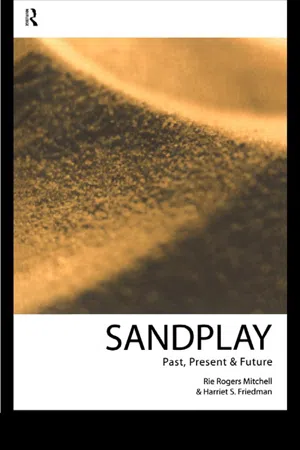
Sandplay is one of the fastest growing therapies. What are its origins, who were it pioneers, and how have they influenced the current practice of sandplay? What does the future hold?
Rie Rogers Mitchell and Harriet S. Friedman have written a unique book that answers all these questions and many more. They give an overview of the historical origins of sandplay, including biographical profiles of the innovators together with discussions of their seminal writings. The five main therapeutic trends are explored, and in a final chapter the future of sandplay is discussed through addressing emerging issues and concerns. A special feature is a comprehensive international bibliography as well as a listing of sandtray videotapes and audiotapes.
Information
Chapter 1
Inspired the creation of the “World Technique”
The British author H. (Herbert) G. (George) Wells (1866–1946), writer of such renowned books as The Time Machine (1895) and War of the Worlds (1898), also wrote a little-known book in 1911, Floor Games, that would later inspire the creation of the field of sand tray therapy. In Floor Games, Wells described the spontaneous play he enjoyed with his two young sons, using miniatures and other small objects. Wells’ portrayal of the creative games and play materials they used served as an inspiration to Margaret Lowenfeld in her development of the “World Technique” (Lowenfeld 1979). In his lifetime, Wells was unaware of the profound impact of his book. In fact, Wells considered Floor Games a minor work and did not even mention it in his autobiography (Wells 1934).
Floor Games was an unusual book for its time, reflecting a unique situation in the Edwardian 1900s—a father playing with his children! Not only was H.G.Wells an unconventional father, he was also an unusual thinker. His unorthodox viewpoints engendered considerable criticism by eminent and influential people, which began about the time Floor Games was first published in 1911 (G.West 1930), although that book was far overshadowed by the publication of two other books around the same time: Ann Veronica (1909) and The New Machiavelli (1911b). It was these two books that outraged certain segments of British society and triggered the heated verbal attacks that wounded Wells so deeply (Mackenzie and Mackenzie 1973; A.West 1984). Accused of being a radical and a feminist, and regarded as sympathetic to the Suffragette Movement, Wells’ critics viewed him as more dangerous than the militant women, for he advocated not only the Vote, but also economic freedom and “an entire new system of relations between men and women, that will be free from servitude, aggression, provocation, or parasitism” (G.West 1930:172, quoting Wells 1914). Wells’ attitude toward his own children, together with his unconventional view of the equality of men and women, was perceived as representing a threat to the dominant patriarchal system. At the same time that Wells was being criticized by his peers, he served as a cult hero for some of the youth, who also felt an urgent need to break away from the old value system (Wells 1934).
The original edition of Floor Games, published in 1911, has large, primary-type printing (as though it were a book for a child to read), line drawings, and photographs of the actual play taken by Wells himself. The father— son play sometimes lasted for days at a time, and the many visitors to their home were drawn into the elaborate procedures (Mackenzie and Mackenzie 1973). The play took place in a contained area defined by boards and planks. From many boxes emerged small houses, people, soldiers, boats, trains, and animals, which transformed the floor of the nursery into a fantasyland of cities and islands. Two central games emerged from this play, which Wells described in his book: “The Game of Marvelous Islands” and “Games of the Construction of Cities.” Wells also described in detail various historic scenes, barricaded castles, and little war games, as well as the play environment itself, the miniatures used, and the reasons why he encouraged this type of play with his young sons.
Wells harbored a deep, philosophical belief that play promoted a framework for expansive and creative ideas in adulthood. Floor Games, which emerged from his own personal experience, was his way of presenting this belief to the public. Even though Wells’ idea that play facilitates optimum development is now central in the psychotherapeutic treatment of children, Wells himself was not aware of, or even interested in, the psychological meaning of the play. Psychological interpretations of his sons’ spontaneous constructions were far from his mind, even when he observed that the children took “strange pleasure” in this kind of play (Wells 1911a). Years later, it was Margaret Lowenfeld’s genius that seized Wells’ idea, saw its psychological application, and developed it—all in one creative leap. Lowenfeld recognized the potential of using small toys to enable children to communicate their deepest, preverbal thoughts and feelings. At the same time, she recognized that the use of miniatures in a defined space could be objectively recorded and analyzed, independently of prevailing theories (Lowenfeld 1979).
Wells’ interest in the development of the creative imagination shares some correspondence with C.G.Jung’s formulation of the concept of the collective unconscious. In 1923, Wells spent a stimulating evening with Jung, who had come to England to give a lecture. Wells found that Jung’s idea of the collective unconscious was compatible with some of his own views (Mackenzie and Mackenzie 1973). Wells himself held strong beliefs that “the immortal soul of the race” controls the direction of our individual lives. His writings urged reflection on this condition, and he encouraged increased human consciousness and societal evolution (G. West 1930). Wells also invoked Jung as an expert in his introductory soliloquy to The World of William Clissold (1926), and he quoted from Jung in his thesis for the D.Sci. degree, which he received from London University in 1942, when he was seventy-six years old (Smith 1986).
H.G.Wells was a complex man of many moods. In the Mackenzie and Mackenzie biography, Wells’ at-home behavior was described by his sons’ Swiss governess: “There are days when he goes skylarking about the house and garden like a schoolboy home for the holidays, and the next day everybody seems to get in his way and annoy him. So beware…” (1973:230). What the governess “admired most about him was the enthusiasm he threw into his role as a father. His eyes twinkled with boyish gaiety when he talked to Gip and Frank: ‘they assailed him with endless questions and how interesting were the answers which the learned man was ever ready to give them’” (1973:230). The relationships between Wells and his boys were warm and loving, and he was deeply involved in their imaginative lives. “Whenever he was at home, bedtime was a ritual. H.G. would sit between the boys inventing stories and drawing endless ‘picshuas’ to illustrate them” (Mackenzie and Mackenzie 1973:230–1).
When Floor Games was published, Wells’ sons were eight and ten years old. It is interesting to follow the lives and careers of the two sons who engaged in the nursery games with their famous father. They did maintain close, lifelong relationships with him. The oldest son, Gip (George Philip, born in 1901 and later known as G.P.), became a zoologist at the University College in London. He married his father’s secretary, Marjorie Craig, in 1927. She remained as Wells’ secretary and, after his wife’s death in 1927, became his manager, guide, and alter ego (Smith 1986). G.P. was also involved in his father’s business as one of the collaborators on Wells’ book, The Science of Life (1930). In 1968, G.P. wrote an introduction to The Last Books of H.G.Wells (Mackenzie and Mackenzie 1973).
Wells’ younger son, Frank Richard (born in 1903 and named after Wells’ brother), married Peggy Gibbons in 1927, a local girl whom he had known for many years. She later took over the management of Wells’ beloved garden at his home in Hanover Terrace. When the critically acclaimed film Things to Come (1936) was produced, Wells spent a great deal of time on the set accompanied by his son, Frank, “who was the artistic limb of the Wells family and its chief film expert” (Smith 1986: 325). Frank also worked as an assistant on the set design for the film version of The Man Who Could Work Miracles (c. 1932), and he adapted three short comedies (Bluebottles, The Tonic, and Daydreams) for film that his father had written in 1928 (Mackenzie and Mackenzie 1973).
During his lifetime, Wells had a profound influence on many facets of contemporary life. He was described at his memorial service by William Beveridge as a “volcano in perpetual eruption of burning thoughts and luminous images” (Smith 1986:484). He was a man who was internally driven to point the way to human progress. By some of his contemporaries he was viewed as the greatest intellectual force in the English-speaking world. He was given credit for shaping a new world view by giving voice to ideas that had never been expressed before (G.West 1930). His writings, which represent a remarkable achievement unequalled by any other author (G.West 1930), ranged from inquiry, criticism, and suggestion to entertainment and information.
Wells was aware of the impact of many of his ideas, but he was unaware of the rippling effect that his modest book, Floor Games, had on the subsequent development of child therapy. As with many ideas that are seen as relatively unimportant at the time, his notions about play have taken root in a particularly unique way, profoundly affecting the direction of psychotherapeutic treatment.
REFERENCES
Lowenfeld, M. (1979). The World Technique. London: George Allen & Unwin.
Mackenzie, N. and Mackenzie, J. (1973). H.G.Wells: A Biography. New York: Simon & Schuster.
Smith, D.C. (1986). H.G.Wells: Desperately Mortal. New Haven, Connecticut: Yale University Press.
Wells, G.P. (1968). Introduction in H.G.Wells, The Last Books of H.G.Wells. London: H.G.Wells Society.
Wells, H.G. (1895). The Time Machine: An Invention. London: Heinemann.
—— (1898). The War of the Worlds. London: Heinemann.
—— (1909). Ann Veronica. London: T.Fisher Unwin.
—— (1911a). Floor Games. London: Palmer. Reprinted (1976) New York: Arno Press.
—— (1911b). The New Machiavelli. London: John Lane.
—— (1914). An Englishman Looks at the World: The Great State. London: Cassell.
—— (1926). The World of William Clissold. London: Benn.
—— (1934). Experiment in Autobiography: Discoveries and Conclusions of a Very Ordinary Brain (since 1866). New York: The Macmillan Company.
Wells, H.G., Huxley, J. and Wells, G.P. (1930). The Science of Life: A Summary of Contemporary Knowledge about Life and its Possibilities. London: Amalgamated Press.
West, A. (1984). H.G.Wells: Aspects of a Life. New York: Random House.
West, G. (1930). H.G.Wells: A Sketch for a Portrait. New York: W.W.Norton & Company, Inc.
Chapter 2
Originator of the “World Technique”
Margaret Lowenfeld (1890–1973), originator of the World Technique (a psychological technique used in communicating with children), was born in London and grew up in a large, lavish house in Lowndes Square. Her father, Henry (Heinz) Lowenfeld, was a descendant of a prominent Jewish family who had vast landholdings in the Polish part of Austria. By the 1880s his family had lost much of their wealth as a result of Poland’s struggle for independence. This financial setback landed Henry Lowenfeld in England as a young man with only five pounds in his pocket. In an amazingly short period of time, he married a young English woman whom he had met earlier at his family home in Poland, made a large personal fortune through buying and selling property, and bought back the family landholdings that had been sold previously for unpaid debts (Evans 1984).
Margaret’s mother, Alice E.Evans, was the daughter of a naval captain. After she married the successful and eminent Henry Lowenfeld, she spent much of her energy becoming a prominent society hostess. Consequently, during their childhood years Margaret and her older sister, Helena, saw little of their mother, received little support or affection from her, and were relegated to the care of a nursemaid (Evans 1984).
Margaret described herself as an unhappy and delicate child. She spent a large part of her childhood ill in bed, enduring long periods of solitude. In her letters she recalled once hearing her mother say with exasperation, “Is that child ill again?” (Evans 1984:24). She later recalled having “night terrors and screaming fits,” and she was given to thumbsucking, a habit that was “very difficult to break.” She also felt she had to compete with her gifted and successful elder sister, to whom interpersonal relationships and academic studies came so easily, while she herself found life difficult.
Margaret’s early years were spent in both Poland and England. In Poland, she shared her long, free summer holidays with three Polish and eight German cousins, none of whom spoke English. At that age, Margaret spoke only English, which left her feeling powerless to make herself understood, an experience she found confusing and even frightening. She later relieved her anxiety by learning to speak Polish and to understand German (Urwin and Hood-Williams 1988).
As a young child, Margaret both admired and idealized her father, who was an avid collector and a lover of the arts (Urwin and Hood-Williams 1988). The homes in which she was raised were full of interesting and colorful objects from faraway places (Lowenfeld 1979). Her father’s friends were musicians, actors, writers, and artists; she and her sister were encouraged to meet these friends and listen to their multilingual conversation (Evans 1984).
At thirteen years of age, Margaret’s life changed abruptly when her parents divorced. Her mother was left with custody of the two girls and a large financial settlement. Acrimonious contact between the parents ensued and her mother eventually succumbed to a series of illnesses. During these difficult times, she clung to her children. Both Margaret and Helena felt her neediness and attempted to compensate for her feelings of abandonment and emotional distress. Often her mother’s illnesses were followed by bouts of illness in Margaret (Urwin and Hood-Williams 1988)....
Table of contents
- COVER PAGE
- TITLE PAGE
- COPYRIGHT PAGE
- ILLUSTRATIONS
- FOREWORD
- PREFACE
- ACKNOWLEDGEMENTS
- CHAPTER 1: INSPIRED THE CREATION OF THE “WORLD TECHNIQUE”
- CHAPTER 2: ORIGINATOR OF THE “WORLD TECHNIQUE”
- CHAPTER 3: ORIGINATOR OF THE “DRAMATIC PRODUCTIONS TEST” (DPT)
- CHAPTER 4: ORIGINATOR OF THE “WORLD TEST”
- CHAPTER 5: ORIGINATORS OF THE “LITTLE WORLD TEST”
- CHAPTER 6: ORIGINATOR OF “SANDPLAY”
- CHAPTER 7: MAJOR CONTRIBUTOR TO SAND TRAY RESEARCH
- CHAPTER 8: CURRENT TRENDS
- CHAPTER 9: THE FUTURE OF SANDPLAY
- BIBLIOGRAPHIES
Trusted by 375,005 students
Access to over 1.5 million titles for a fair monthly price.
Study more efficiently using our study tools.
Frequently asked questions
Yes, you can cancel anytime from the Subscription tab in your account settings on the Perlego website. Your subscription will stay active until the end of your current billing period. Learn how to cancel your subscription
No, books cannot be downloaded as external files, such as PDFs, for use outside of Perlego. However, you can download books within the Perlego app for offline reading on mobile or tablet. Learn how to download books offline
Perlego offers two plans: Essential and Complete
- Essential is ideal for learners and professionals who enjoy exploring a wide range of subjects. Access the Essential Library with 800,000+ trusted titles and best-sellers across business, personal growth, and the humanities. Includes unlimited reading time and Standard Read Aloud voice.
- Complete: Perfect for advanced learners and researchers needing full, unrestricted access. Unlock 1.5M+ books across hundreds of subjects, including academic and specialized titles. The Complete Plan also includes advanced features like Premium Read Aloud and Research Assistant.
We are an online textbook subscription service, where you can get access to an entire online library for less than the price of a single book per month. With over 1.5 million books across 990+ topics, we’ve got you covered! Learn about our mission
Look out for the read-aloud symbol on your next book to see if you can listen to it. The read-aloud tool reads text aloud for you, highlighting the text as it is being read. You can pause it, speed it up and slow it down. Learn more about Read Aloud
Yes! You can use the Perlego app on both iOS and Android devices to read anytime, anywhere — even offline. Perfect for commutes or when you’re on the go.
Please note we cannot support devices running on iOS 13 and Android 7 or earlier. Learn more about using the app
Please note we cannot support devices running on iOS 13 and Android 7 or earlier. Learn more about using the app
Yes, you can access Sandplay by Harriet S. Friedman,Rie Rogers Mitchell in PDF and/or ePUB format, as well as other popular books in Psychology & History & Theory in Psychology. We have over 1.5 million books available in our catalogue for you to explore.