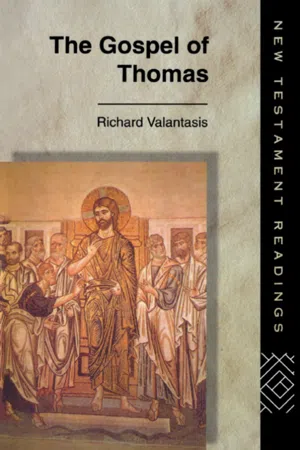
This volume offers the first full commentary on the Gospel of Thomas, a work which has previously been accessible only to theologians and scholars. Valantasis provides fresh translations of the Coptic and Greek text, with an illuminating commentary, examining the text line by line. He includes a general introduction outlining the debates of previous scholars and situating the Gospel in its historical and theological contexts.
The Gospel of Thomas provides an insight into a previously inaccessible text and presents Thomas' gospel as an integral part of the canon of Biblical writings, which can inform us further about the literature of the Judeo-Christian tradition and early Christianity.
- 240 pages
- English
- ePUB (mobile friendly)
- Available on iOS & Android
eBook - ePub
The Gospel of Thomas
About this book
Information
Chapter 1
Introduction
The dry desert conditions in Egypt are ideal for the preservation of papyrus and other ancient writing materials. Two discoveries of papyri at two different sites in the Egyptian desert (Oxyrhynchus and Nag Hammadi) bear particular relevance to the Gospel of Thomas. Nearly 100 years ago Grenfell and Hunt discovered at Oxyrhynchus and published some fragmentary Greek papyri containing several sayings attributed to Jesus (Grenfell and Hunt 1897 and 1904). Although most of these sayings curiously did not have counterparts in the sayings already known in the canonical New Testament, these early Greek fragments were initially acknowledged simply as sayings unattested in the canonical tradition and unparalleled in other early Christian literature. They captured the imagination of scholar and layperson alike; their origin was unknown, but their significance was generally recognized.
Then, over 50 years ago, thirteen codices (ancient books constructed from papyrus sheets) were discovered at Nag Hammadi (Robinson 1979). These codices were written in Coptic, a dialect of Egyptian. Among the Coptic codices found in this collection (commonly called the “Nag Hammadi Library”) were a number of different tractates of great interest to scholars studying the literature of early Christianity because the codices contained a number of tractates entitled “gospels” (such as the “Gospel of Peter,” the “Gospel of Truth,” and the “Gospel of the Egyptians”) as well as a tractate (the second tractate of Codex II) entitled at the end “The Gospel According to Thomas.” Scholars eventually linked the earlier unattested Greek fragments discovered at Oxyrhynchus and the Coptic tractate entitled “The Gospel According to Thomas” discovered at Nag Hammadi. The earlier Greek sayings of Jesus were nearly the same as some of the Coptic sayings from the Gospel of Thomas. From that time forward, the Gospel of Thomas became a permanent fixture in the search for understanding the origins and development of primitive Christianity. The desert of Egypt had preserved some Greek fragments and a complete Coptic version of a lost Gospel of Thomas.
Although these discoveries of Greek and Coptic sayings of Jesus attributed to the Gospel of Thomas were dramatic and exciting, the existence of such a gospel had long been known. Ancient Christian testimonia witnessed to knowledge of a gospel by this title and to ancient knowledge of some of the sayings that now are known to be part of the Gospel of Thomas (Attridge 1989:103–12). Modern knowledge was dependent upon these later testimonies until these dramatic discoveries made in Egypt’s desert. The discovery of new gospel material, especially that of the Gospel of Thomas, inaugurated an international quest in the general public and among scholars to understand anew the origins and development of Christianity.
The discovery of the complete Coptic version of the Gospel of Thomas caused a great stir for three primary reasons. First, New Testament scholars had theorized for many years that behind Matthew’s and Luke’s revision of the Gospel of Mark stood a collection of sayings, known simply as the Synoptic Sayings Source Q (Kloppenborg 1987:1–40 provides a good history of the issue). This theory, known as the “two-source hypothesis,” explains the literary relationship among the three synoptic gospels (Mark, Matthew, and Luke) and it maintains that the earliest narrative gospel was Mark’s. Matthew and Luke used the majority of Mark’s gospel as the basis for their own gospels, and then added one other major source (called the Synoptic Sayings Source Q) in addition to some of their own traditions about Jesus, to supplement Mark’s narrative frame. The Synoptic Sayings Source Q that Matthew and Luke used was considered a collection of sayings of Jesus without any narrative frame. The content of this Synoptic Sayings Source Q could only be established by comparing the sayings common to Matthew and Luke and by then reconstructing the common text; the genre of collections of “sayings of Jesus” remained theoretical. With the discovery of the Gospel of Thomas in Coptic, scholars finally had an actual document in the same genre as had been theorized, an existent gospel composed only of sayings of Jesus in a collection of sayings. Although the Gospel of Thomas is not believed to be the source that Matthew and Luke used, the fact that many of the sayings from it directly paralleled sayings known from the common Synoptic Sayings Source Q added strength to the argument that such a source could have existed. The two-source hypothesis was in this way strengthened and renewed by the discovery.
Second, prior to the discovery of the Nag Hammadi Library, gnosticism could be studied primarily by reading the writings of those orthodox church writers (known as heresiologists) who described and copied parts of larger “heretical” works in their own anti-heresy literature in order to criticize supposed heretical beliefs. With the discovery of the presumed “gnostic” library at Nag Hammadi, church historians, historians of theology, and historians of religion finally had real and ancient gnostic documents that were not preserved by being embedded in heresiological treatises but that were both carefully copied and even more carefully preserved at a time when heterodoxy was being persecuted. These “heretical” writings would provide scholars with an original voice against which to evaluate the heresiologists’ assessment of gnosticism.
Finally, people (both among the academic and general public) who were interested in alternative Christianities, gnosticism, and syncretistic religions, as well as people who were either tired of or bored with the traditional view of Jesus were captivated by the voice present in these sayings. Many thought that they could hear immediately the words of Jesus without the intermediary of the institutional church and its orthodox theologians.
It has been over 50 years since the discovery and interest in the Gospel of Thomas has not waned. Of all of the Nag Hammadi documents, this gospel has received the most interest and been the subject of the most writing. It has been at the heart of a general debate about the historical Jesus, the status of the canonical view of Jesus and his sayings, and religious journalistic speculation. It has also been heatedly debated by European and American scholars.
A DESCRIPTION OF THE GOSPEL OF THOMAS
The Gospel of Thomas is a tractate preserved in two ways: a fragmentary set of Greek papyri; and a complete Coptic text written in a “particularly fine script” (Turner and Montefiore 1962:11). The physical evidence (that is, the actual papyras and codices) dates from about the year 200 CE for the Greek and the middle of the fourth century CE for the Coptic. The scholarly consensus holds that these two sources provide evidence for an earlier gospel written originally in Greek in Syria (Koester 1989:38), most probably emergent from the Greek-speaking Jewish- Christian community (Quispel 1957; MacRae 1960) in Syrian Antioch (Desjardins 1992).
So what is this gospel that has been discovered in two different places, two languages, two versions, and from two different times? The answer to that question is not easy. The Greek fragments found at Oxyrhynchus and the Coptic version found at Nag Hammadi have both similarities and differences. The Coptic sayings comparable to the Greek do not seem to be a direct translation of the same Greek text, and the Greek seems to witness to another version of the gospel than the one on which the Coptic translation is based. So there is not really a singular gospel, but two divergent textual traditions. This situation makes a precise and well-delineated description of the Gospel of Thomas problematic, because the Gospel of Thomas may refer to a number of different elements in its textual history.
To answer the question about the exact referent, Edward Rewolinski (1996) has outlined clearly the various layers of the possible texts that may make up the gospel. These layers at once make the problem more complex and more simple: complex, in that the layers show the stages of the tractate’s development; simple, because it allows me to locate a specific layer or phase of development for this commentary.
There are seven layers at least. First, there are the original sayings of Jesus that probably circulated orally and were repeated by various followers of Jesus in their own ministries. These sayings constitute the original field of possible sayings from which those in this particular gospel could have been selected. Second, there is the author of this particular collection of the sayings of Jesus who collected and then wrote the sayings down and published them. Not all the sayings of Jesus were recorded, rather the author or collector selected from those available. The second layer offers an opportunity both for an intentional selection of sayings from among the oral texts and for the adjustment of these sayings to suit the author’s purpose and perspective. Third, the author’s collection of sayings was probably used by various people and communities who would have read them, perhaps used them liturgically, and produced other copies of the gospel. In this process those people and communities probably adapted the sayings to their life-situations. This was a common practice in ancient Christian literature, especially in gospel literature, and it can safely be assumed to have occurred here and at any other stage in the transmission of the gospel. Fourth, these community adaptations of their text of the gospel would effect another text: the communities that produced the texts of the gospel would reproduce the text currently in use in their communities and pass them on to others who would not know in what way the texts had been adjusted. Therefore, the subsequent text would reflect the particular community’s changes and show how they made their own adjustments to fit their own life-situation. Fifth, there is the last Greek scribe who influenced the text of the gospel in transcribing it (as in the fragments discovered at Oxyrhynchus); changes often occurred each time a scribe produced another copy. A number of scribes (in Syria as well as Egypt) transcribed their text of the gospel; the Oxyrhynchus fragments provide the physical evidence of at least parts of the gospel for which we have witnesses. Sixth, there is the Coptic translation of the text. In all likelihood, more than one person translated the gospel into Coptic. Translations involve an interpretative process because the translator renders into another language (here Coptic) what he or she understands the original text (here Greek) to mean. The process of translation itself, then, provides another version in Coptic of the Greek text that came into the hands of the Coptic translator. And seventh, there is the last Coptic scribe who produced the text that was hidden in a jar in the fourth century only to be discovered at Nag Hammadi nearly fifteen centuries later.
Each one of these layers could safely be called the Gospel of Thomas, but clearly each one refers to a different production, version, or edition of the gospel that the author wrote. The gospel could refer to the original core of sayings, the author’s originally published collection, the Greek editions used by any number of communities, the Greek edition to which the Oxyrhynchus fragments witness, one of the Coptic translations, or the final Coptic version that was discovered. For the purposes of this commentary, the Gospel of Thomas refers to the authorial level only as it can be discerned through the physical evidence of the Greek and the Coptic texts that have survived: in other words, this commentary looks to the text that the author originally created, but only to those versions that exist in one fragmentary Greek version and one (presumably) complete Coptic version.
The tractate that we call the Gospel of Thomas actually has two possible descriptions within the tractate itself (see Robinson 1971a; Meyer 1990). The Prologue calls it “The Secret Sayings that the Living Jesus spoke and Didymos Judas Thomas recorded.” This designation would indicate that the tractate consists of a collection of secret sayings spoken by Jesus and recorded by Didymos Judas Thomas. The title found at the end of the tractate (as is customary in these documents) reads “The Gospel According to Thomas.” Here the tractate becomes an example of the literary genre “gospel,” and receives a title parallel to the canonical gospels in structure, namely a gospel “according to” an identified disciple authority in parallel to Mark, Matthew, Luke, and John. This second designation creates problems, because the content of this gospel differs from those other texts in the genre in that there is comparatively little narrative material in the Gospel of Thomas (see Wilson 1960:4; but also Koester 1990a: 80–84). Despite what it might be called, the tractate consists of a collection of sayings of Jesus.
The sayings are not in any particular order (Koester 1989:41–42): they are not organized by themes or topics; they are not organized with any discernible theological direction; they do not exhibit any particular logical or cohesive overall structure that holds them together (see Wilson 1960:4–10; Patterson 1993:94–102). The sayings are bound together by a diminutive narrative structure consisting mostly of the phrase “Jesus said.” Some evidence exists that the sayings were originally preserved in oral communication (Haenchen 1961–62; Cameron 1986:34), because there are words that link certain sayings in sequence (a list is provided in Patterson 1993:100–2), even though that sequence does not display any theological or literary connection beyond the linking words themselves.
Not all the sayings are unique to this collection. There are three classes of sayings in the Gospel of Thomas: those that have a parallel saying in the synoptic gospels (Mark, Matthew, and Luke); sayings of Jesus attested elsewhere in early Christian literature, but that have no parallel in the canonical tradition of gospels; and hitherto unattested and unknown sayings of Jesus (MacRae 1960). Some of these sayings have parallels to other literature of the period, both religious and philosophical (Baker 1964 and 1965–66; Quispel 1981). Some sayings have distinct parallels to material in Paul’s Corinthian correspondence (Haenchen 1961; Davies 1983:138–47; Koester 1990b:51–52; Patterson 1991). Most all of the sayings are attributed to Jesus, although other people (disciples, for example) also speak and ask questions of Jesus.
THE THEOLOGY OF THE GOSPEL OF THOMAS
The Gospel of Thomas, as a collection of sayings of Jesus, does not purport to be a systematic or even an organized theological tractate. A collection of sayings by nature cannot fulfill expectations of a systematic presentation of discursive theology, so that any description of its theology must emerge from the oblique references in the sayings. The theology of a collection of sayings must be constructed, that is, from such indirect and opaque elements as inferences, innuendo, connotations of words, analysis of metaphors, and other elements both non-theological and non-discursive. In constructing from these elements, the theology remains fragmentary: not every theological question that an ancient or a modern reader might ask will be addressed in a satisfactory or consistent manner. It must be made clear, however, that the Gospel of Thomas does indeed present a recognizable and articulated theology, but both the mode and the content of that theology differs from other theological discourses. The theology of the Gospel of Thomas, moreover, presents even greater challenges because some of its content (the sayings parallel to canonical sayings) is familiar from the canonical tradition. This familiarity with other scriptural traditions tends to emphasize the normative status of the canonical tradition and to underscore the deviations and differences from that tradition in this gospel. Even with these difficulties it is possible to construct some elements of a theology characteristic of the Gospel of Thomas.
I would characterize this theology as a performative theology whose mode of discourse and whose method of theology revolves about effecting a change in thought and understanding in the readers and hearers (both ancient and modern). The sayings challenge, puzzle, sometimes even provide conflicting information about a given subject, and in so confronting the readers and hearers force them to create in their own minds the place where all the elements fit together. The theology comes from the audience’s own effort in reflecting and interpreting the sayings, and, therefore, it is a practical and constructed theology even for them. In communicating through a collection of sayings, moreover, the topics move rapidly from one to another with little meaningful connection between them. The sayings cajole the audience into thinking, experiencing, processing information, and responding to important issues of life and living without providing more than a brief time to consider the question fully. The audience’s forced movement through and interpretation of rapidly changing topics and issues bases the theological reflection in cumulative experience emergent from their responses to the stimuli of the sayings. That is why it is performative theology: the theology emerges from the readers’ and hearers’ responses to the sayings and their sequence and their variety.
The community that forms around the collection of sayings is one created by the association of the readers and by their mutual experience of finding the interpretation of the sayings. The community developed in this gospel is not one analogous to a parish, or a church, or any other organized group of people with a structure and a charter. Rather, this community is a loose confederation of people who have independently related to the sayings and found their interpretation, who have begun to perform the actions that inaugurate the new identity, and who have become capable of seeing other people who perform similar activities. The community, in short, is a by-product of the theological mode, a loose conglomeration of people of similar mentality and ways of living, but who do not necessarily live together as an intentional community. This introductory overview of the theology of the gospel will focus upon this performative aspect.
The person of Jesus
In the gospel, Jesus pronounces a number of sayings to his disciples. Actually, it is more complicated than that. In these sayings, the narrator presents Jesus as a character speaking to an audience, and at one point (Saying 111) the generally diminutive narrative voice breaks out of its hidden presence and asks “Does not Jesus say…?” as a direct address to the implied audience of the gospel. The narrator indicates that these sayings come from Jesus (“Jesus said”), so that the narrator adopts the voice of Jesus as its own. Jesus is the character the narrator has created to transmit the sayings.
This narrativized Jesus pronounces sayings. He functions primarily as a voice, and the gospel provides little information about his identity, his intellectual or emotional life, or any significant biographical information about the major events of his life. One time in the sayings, Jesus describes his emotion at the empty world full of spiritually blind people (Saying 28: “My soul ached for the children of humanity”), but beyond that readers are not admitted into Jesus’ emotional structure. Moreover, Jesus’ mother and brothers are mentioned (Saying 99), although Jesus generally rejects the legitimacy and centrality of family bonds (Sayings 55 and 101) in favor of a redefined society (Saying 99) which is the group comprised of those who hear his sayings. The gospel affirms that Jesus appeared in the flesh to do his work in the world (Saying 28), and that he did not understand himself to be a philosopher, an angel, or a teacher (Saying 13). The most significant theological factor about the Gospel of Thomas is that it contains no information about the passion, death, and resurrection of Jesus. The only mention of the crucifixion occurs in an indirect reference to his disciples carrying a cross as does Jesus (Saying 55). Beyond these few elements, Jesus’ life remains opaque.
The preceding examples provide a negative appraisal of the person of Jesus from the absence of biographical information. A more positive appraisal may be constructed from Jesus’ function as the chief speaker in the narrative. The gospel presents Jesus as “the living Jesus” (Prologue) who is “the living one in (the audience’s) presence” (Sayings 52 and 91, my parentheses). This gospel portrays Jesus as immediately accessible to the hearers of the sayings; his voice is that of a fully engaged speaker and guide who speaks the sayings to his followers (Saying 38). The readers of these sayings, then, connect not to the narrative of Jesus’ life (as in the canonical gospels of Mark, Matthew, Luke, and John), but to his living presence as a person speaking directly to them.
Jesus entered the world as a fleshly being precisely in order to assist people to change their way of living (Saying 28). Consequently, Jesus’ mission revolved about presenting hidden mysteries (Sayings 17 and 62), reorganizing the meaning of discipleship (Sayings 3, 31, 34, 61, 101), calling people who live in the world to a sober and full life (Saying 28), enabling people to drink from the bubbling well of his spiritual direction (Sayings 13 and 108; also see Sayings 45 and 114), encouraging people to manifest their interior and spiritual selves (Saying 70), and leading the worthy to rest (Sayings 50, 51, 60, 90). This mission may be best summarized in Jesus’ saying: “Look to the living one as long as you live, otherwise you might the and then try to see the living one, and you will be unable to see” (Saying 59). The immediacy of Jesus’ active speech underscores the urgency of the message to choose another mode of life.
Jesus is also constructed as a mystagogue (Saying 17), a revealer of sacred knowledge to seekers, who discloses the mysteries to those who are worthy (Saying 62). This mystagogic Jesus describes himself as the light, the “all” found in every place, the one who is the origin and destiny of all creation (Saying 77). As a bearer of secret wisdom (Prologue), Jesus is portrayed as a divine figure who not only permeates all life, but enables true vision to occur (Saying 37), and who guides people to the fulfilling of their deepest desires (Saying 51). Moreover, Jesus’ presence becomes merged with the seekers so that there can be no distinction between Jesus and those who follow him (Saying 108).
Performances
Exploring what Jesus tells his readers to do in these sayings provides the most productive way of understanding Jesus’ mission. Jesus instructs the readers in a new way of living, and his instructions advocate certain actions or performances that are appropriate to that new lifestyle. Jesus’ sayings function at the heart of the new life; this means that the interpretation of the sayings is the key to the reformation of life. Saying 1 encapsulates this central performance: “Whoever discovers the interpretation of these sayings will not taste death.” Jesus’ voice, and the content of his speaking, define the means of becoming a new person (Sayings 38 and 52) and guide seekers to various discoveries that transform life (Sayings 5, 80, 91, 110).
In addition to these more sublime instructions, Jesus also provides very practical guidance. His followers are advised: to reject pious acts such as fasting, praying, almsgiving, dietary restrictions (Sayings 6 and 104), and circumcision (Saying 53); to have no worry about food and clothing (Saying 36); to renounce power (Saying 81) and wealth (Saying 110); to lend money to people who will not repay it (Saying 95); to endure persecution, hatred, and hunger (Sayings 68 and 69); to practice privately the death-dealing relationship with the outside world (Saying 98); to love the other members of their community (Sayings 25, 26); to hate father and mother, sisters and brothers (Sayings 55 and 101); to manifest their interior and saving worth (Saying 70); to work on the reformation of their own life before helping others (...
Table of contents
- Cover Page
- New Testament Readings
- Title Page
- Copyright Page
- Series editor’s preface
- Preface
- Abbreviations and symbols
- Chapter 1: Introduction
- Chapter 2: A window on the Gospel of Thomas:the Greek fragment texts
- Chapter 3: The Coptic version of the Gospel of Thomas
- Blbliography
Trusted by 375,005 students
Access to over 1.5 million titles for a fair monthly price.
Study more efficiently using our study tools.
Frequently asked questions
Yes, you can cancel anytime from the Subscription tab in your account settings on the Perlego website. Your subscription will stay active until the end of your current billing period. Learn how to cancel your subscription
No, books cannot be downloaded as external files, such as PDFs, for use outside of Perlego. However, you can download books within the Perlego app for offline reading on mobile or tablet. Learn how to download books offline
Perlego offers two plans: Essential and Complete
- Essential is ideal for learners and professionals who enjoy exploring a wide range of subjects. Access the Essential Library with 800,000+ trusted titles and best-sellers across business, personal growth, and the humanities. Includes unlimited reading time and Standard Read Aloud voice.
- Complete: Perfect for advanced learners and researchers needing full, unrestricted access. Unlock 1.5M+ books across hundreds of subjects, including academic and specialized titles. The Complete Plan also includes advanced features like Premium Read Aloud and Research Assistant.
We are an online textbook subscription service, where you can get access to an entire online library for less than the price of a single book per month. With over 1.5 million books across 990+ topics, we’ve got you covered! Learn about our mission
Look out for the read-aloud symbol on your next book to see if you can listen to it. The read-aloud tool reads text aloud for you, highlighting the text as it is being read. You can pause it, speed it up and slow it down. Learn more about Read Aloud
Yes! You can use the Perlego app on both iOS and Android devices to read anytime, anywhere — even offline. Perfect for commutes or when you’re on the go.
Please note we cannot support devices running on iOS 13 and Android 7 or earlier. Learn more about using the app
Please note we cannot support devices running on iOS 13 and Android 7 or earlier. Learn more about using the app
Yes, you can access The Gospel of Thomas by Richard Valantasis in PDF and/or ePUB format, as well as other popular books in Theology & Religion & World History. We have over 1.5 million books available in our catalogue for you to explore.