eBook - ePub
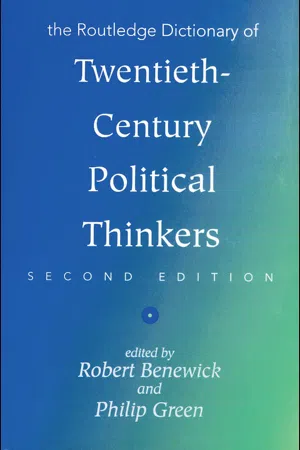
The Routledge Dictionary of Twentieth-Century Political Thinkers
- 296 pages
- English
- ePUB (mobile friendly)
- Available on iOS & Android
eBook - ePub
The Routledge Dictionary of Twentieth-Century Political Thinkers
About this book
This edition has been revised and extended to include eleven new entries on Berlin, Chomsky, Derrida, Rorty and many others. Key features of this unique guide include:
* 170 entries from 96 contributors, many of whom are leading authorities in their field
* alphabetically arranged entries which include brief biographies, outlines of major ideas and suggestions for further reading
* coverage of Western and Third World political theorists as well as those who have influenced new movements based on the issues of ethnicity, gender and ecology
* a thematically organised index
Information
Twentieth-Century Political Thinkers
Max Adler 1873–1937
Austro-Marxist philosopher and supporter of the post-First World War workers’ council movement in Austria, best known theoretically for his attempt to establish Marxism as a scientific sociology in the modern positivist sense.
See also
Hilferding.
Works include
Kausalität und Teleologie im Streite um die Wissenschaft, Vienna, Wiener Volksbuchhandlung, 1904.
Der Soziologische Sinn der Lehre von Karl Marx, Vienna, Wiener Volksbuchhandlung, 1914.
Die Staatsauffassung des Marxismus. Ein Betrag zur Unterscheidung von soziologischer und juristischer Methode, Vienna, Wiener Volksbuchhandlung, 1922.
Soziologie des Marxismus two volumes, Vienna, Wiener Volksbuchhandlung, 1930.
Other works
Tom Bottomore and Patrick Goode (eds.), AustroMarxism, Oxford, Clarendon Press, 1978.
Theodor W.Adorno 1903–1969
Theodor W.Adorno was born in Frankfurt, Germany, into an upper-class bourgeois family. The son of a German Jewish father and an Italian Catholic mother, Adorno studied philosophy, psychology and musicology at the University of Frankfurt, where he received his Ph.D. in 1924. He also engaged in professional music training, studying piano and composition with the modernist composer Alban Berg. During the 1920s and early 1930s Adorno edited a musical journal, Anbruch, and continued his studies of philosophy. He completed his Habilitationschrift on Kierkegaard in 1931 and began teaching at the University of Frankfurt. He there became associated with the Marxistoriented Institute for Social Research with which he worked for the rest of his life.
Upon Hitler’s rise to power, Adorno first emigrated to England and then joined the Institute for Social Research in exile at Columbia University in New York. During the 1930s he became closely connected with the institute’s attempt to develop a critical theory of society. This involved him in one of the first attempts to develop a Marxian critique of mass culture, which Adorno and the institute discerned was becoming ever more significant as an instrument of ideological manipulation and social control in democratic capitalist, fascist and communist societies. Adorno first developed this critique in studies of popular music. In a 1932 study, ‘On popular music’, he argued that music was commodified like everything else in capitalist society and should be analysed as a commodity produced primarily for its exchange value and its success on the market. This marketing of music led to the reduction of culture to preconceived formulas and codes, thus producing what Adorno and his colleagues saw as a degradation of culture.
Adorno also studied the effects of popular music and utilized Lukács’s category of ‘reification’ to describe what he perceived as the degrading effects on consciousness of music reduced simply to rhythms and lyrics which could be easily memorized and hummed. During the 1930s Adorno carried out further studies of music, working with the ‘father of mass communications research’, Paul Lazarsfeld, at the Princeton Radio Project and later at Columbia University on one of the first sustained research projects on the effects of popular music. Later, Adorno was also to work on one of the first attempts to develop a critical analysis of television, producing an article on ‘How to look at television’ in 1954.
Adorno also participated in the intradisciplinary research projects at the institute and worked on their researches into fascism and antisemitism. When the institute broke up in the early 1940s—with its director, Max Horkheimer, going to California for health reasons and other members like Herbert Marcuse, Franz Neumann, Leo Lowenthal and Otto Kirchheimer going to Washington to join the US government in the fight against fascism—Adorno went to California. There he worked closely with Max Horkheimer on the book that became Dialectic of Enlightenment. Horkheimer and Adorno moved away from the Marxian emphasis on the primacy of political economy to stress the importance of the project of the domination of nature, from the Greeks and Christians to the present. Consequently, they placed technology and what they called ‘instrumental reason’ at the centre of their new sociocultural theory, displacing the primacy of class struggle as well as the Marxian theory of crisis.
Drawing on the institute’s previous research into mass culture, Horkheimer and Adorno developed a theory of the culture industry that produced the first systematic Marxian critique of mass culture and communication. Horkheimer and Adorno argued that although mass culture purported to be mere entertainment it was a vehicle of ideology that served as a powerful instrument of social control; from this perspective, mass culture was eminently political, and the critique of a society’s dominant ideologies should focus serious attention on mass culture. On Horkheimer and Adorno’s conception, mass culture produced a system of products that idealized the existing society and suggested that happiness could be found through conformity to its institutions and way of life. The culture industries thus provided contemporary capitalism, and fascism and state communism, with powerful instruments of domination that secured the power of hegemonic institutions over individuals and contributed to the decline of the individual through their growing control of thought and behaviour.
Horkheimer and Adorno also presented a variety of theses on antisemitism and a set of aphorisms which expressed their growing pessimism and sense that totalitarian social powers were coming to control the entire world. Adorno pursued the aphoristic strategy in a collection of short entries written during this period and published in 1951 under the title Minima Moralia. In the introduction to this book Adorno situated the text within the project of developing a critical theory of contemporary society, though the main focus was on culture, everyday life and ‘the teaching of the good life’. His aphorisms evoke the growing power of society over the individual and the desire for individual emancipation and happiness, as when he writes, ‘Perhaps the true society will grow tired of development and, out of freedom, leave possibilities unused, instead of storming under a confused compulsion to the conquest of strange stars…. Rien faire comme une bête, lying on water and looking peacefully at the sky, “being, nothing else, without any further definition and fulfilment”, might take the place of process, act, satisfaction, and so truly keep the promise of dialectical logic that it would culminate in its origin. None of the abstract concepts comes closer to fulfilled Utopia than that of eternal peace’ (pp. 156–7).
In Minima Moralia, and other essays of the period, Adorno continued the institute’s studies of the stabilization of capitalism and the integration of the working class as a conservative force in the capitalist system. In such a situation, deeply influenced by his sojourn in New York and California, Adorno only saw the possibility of individual revolt. He also feared, however, the resurgence of authoritarianism in the United States and collaborated on a ground-breaking collective study of The Authoritarian Personality with a group of Berkeley researchers. The project embodied the institute’s desire to merge theoretical construction with empirical research and produced a portrait of a disturbing authoritarian potential in the United States. Adorno was responsible for elaborating the theoretical implications and helped design the research apparatus.
In the early 1950s he returned with Horkheimer to Germany to re-establish the institute in Frankfurt. He continued his studies in sociology and culture, though he turned to philosophy during the last years of his life. During the 1950s he participated in the institute’s sociological studies of education, students, workers and the potential for democracy. Adorno wrote many sociological essays at this time and participated in the debates published in The Positivist Dispute in German Sociology. Adorno defended the institute’s conception of dialectical social theory against positivism and the ‘critical rationalism’ espoused by Karl Popper and other neo-positivists.
Increasingly critical of communism and sceptical of Marxism, Adorno engaged primarily in cultural criticism and studies of philosophy and aesthetics during his last decade. Deeply shocked by Auschwitz and the Holocaust, Adorno’s criticism became ever more negative and oppositional. In the postwar period he became increasingly known as a champion of modernist avant-garde art, which he saw as the most powerful weapon of liberation. Although he followed Lukács and other Marxist theorists in his sociological and ideological approach to culture, he broke with standard Marxian normative aesthetics, which championed realist art à la Lukács or political modernism à la Brecht. Adorno, by contrast, championed avantgarde modernism, which he believed carried out the most extreme negation of existing society and culture. Thus in ‘Commitment’ he polemicized against Brecht, Sartre and ‘committed’ literature, and championed Kafka, Beckett and other exponents of what he saw as extreme negation of existing society.
While Adorno’s last major published work during his lifetime, Negative Dialectics, was deeply philosophical, his essays were often directed towards the political issues of the day, and he continued the politicization of cultural criticism that he had helped inaugurate in the 1930s. Although many of his students were active in the German student movement in the 1960s, Adorno was highly critical of the movement and even called in the police during a student occupation of the institute during an anti-war protest. His estrangement from the student movement and the sharp criticism that he received from student activists hurt him deeply and he died suddenly of a heart attack in 1969 with his magnum opus, Aesthetic Theory, still unpublished, though it soon appeared posthumously.
While Adorno’s contributions to philosophy, sociology and cultural criticism are immense, his major political contributions reside in his politicizing of these disciplines, showing that all have a deeply political dimension. Thus his studies of Wagner’s music dramas and of Husserl’s and Heidegger’s philosophy emphasize their political import, as do his studies of mass culture. Increasingly sceptical of standard varieties of political action, and pessimistic concerning the possibilities of emancipatory political change, Adorno championed individual rebellion and resistance and will be remembered as an uncompromising critic of existing societies and politics and a champion of individual emancipation.
See also
Heidegger, Horkheimer, Lukács, Marcuse, Popper, Sartre.
Works
The Authoritarian Personality (with others), New York, Norton, 1950.
‘How to look at television’, Quarterly of Film, Radio, and Television VIII (spring 1954).
Prisms, London, Neville Spearman, 1967.
Dialectic of Enlightenment (with Max Horkheimer), New York, Herder, 1972.
Negative Dialectics, London, Routledge, 1973.
Minima Moralia, London, Verso, 1974.
‘Commitment’, in Aesthetics and Politics, London, Verso, 1977.
‘The social situation of music’, Telos 35 (spring 1978).
Aesthetic Theory, London, Routledge, 1984.
Kierkegaard: Construction of the Aesthetic, Minneapolis, Minn., University of Minnesota Press, 1989.
Other works
Susan Buck-Morss, The Origins of Negative Dialectics, New York, Free Press, 1977.
Martin Jay, Adorno, Cambridge, Mass., Harvard University Press, 1984.
Douglas Kellner, Critical Theory, Marxism, and Modernity, Cambridge, Polity Press, and Baltimore, Md, Johns Hopkins University Press, 1988.
Frederic Jameson, Late Marxism, London and New York, Verso, 1990.
Michel ‘Aflaq 1910–1989
Michel ‘Aflaq, one of the founders of Ba‘thism, a form of pan-Arab nationalism, and its best-known ideologue, was a Greek Orthodox Christian, born and educated in Damascus. Between 1929 and 1933 he studied philosophy at the Sorbonne, where he was influenced by the writings of Bergson; in addition, he made no secret of his admiration for National Socialist Germany, which he saw as a model for his ideas of a synthesis between nationalism and socialism. While in Paris he met his fellow countryman Salah alDin al-Bitar, and the two stayed in close contact on their return to Syria, founding what was to become the Ba‘th Party in the early 1940s. (The precise chronology of the foundation of the party is disputed: the Syrian Ba‘th traces its origins to the teachings and writings of Zaki al-Arsuzi (1900–69), while the Iraqi Ba‘th claims descent from ‘Aflaq and Bitar.) ‘Aflaq was secretary-general of the Ba‘th Party for most of his later life, first between 1954 and 1965, then again from February 1968 until his death; in addition, he was Syrian Minister of Education for a few months in 1949, and worked as...
Table of contents
- Cover Page
- Title Page
- Copyright Page
- Introduction
- Contributors
- Twentieth-Century Political Thinkers
Trusted by 375,005 students
Access to over 1.5 million titles for a fair monthly price.
Study more efficiently using our study tools.
Frequently asked questions
Yes, you can cancel anytime from the Subscription tab in your account settings on the Perlego website. Your subscription will stay active until the end of your current billing period. Learn how to cancel your subscription
No, books cannot be downloaded as external files, such as PDFs, for use outside of Perlego. However, you can download books within the Perlego app for offline reading on mobile or tablet. Learn how to download books offline
Perlego offers two plans: Essential and Complete
- Essential is ideal for learners and professionals who enjoy exploring a wide range of subjects. Access the Essential Library with 800,000+ trusted titles and best-sellers across business, personal growth, and the humanities. Includes unlimited reading time and Standard Read Aloud voice.
- Complete: Perfect for advanced learners and researchers needing full, unrestricted access. Unlock 1.5M+ books across hundreds of subjects, including academic and specialized titles. The Complete Plan also includes advanced features like Premium Read Aloud and Research Assistant.
We are an online textbook subscription service, where you can get access to an entire online library for less than the price of a single book per month. With over 1.5 million books across 990+ topics, we’ve got you covered! Learn about our mission
Look out for the read-aloud symbol on your next book to see if you can listen to it. The read-aloud tool reads text aloud for you, highlighting the text as it is being read. You can pause it, speed it up and slow it down. Learn more about Read Aloud
Yes! You can use the Perlego app on both iOS and Android devices to read anytime, anywhere — even offline. Perfect for commutes or when you’re on the go.
Please note we cannot support devices running on iOS 13 and Android 7 or earlier. Learn more about using the app
Please note we cannot support devices running on iOS 13 and Android 7 or earlier. Learn more about using the app
Yes, you can access The Routledge Dictionary of Twentieth-Century Political Thinkers by Robert Benewick,Philip Green in PDF and/or ePUB format, as well as other popular books in Politics & International Relations & Political History & Theory. We have over 1.5 million books available in our catalogue for you to explore.