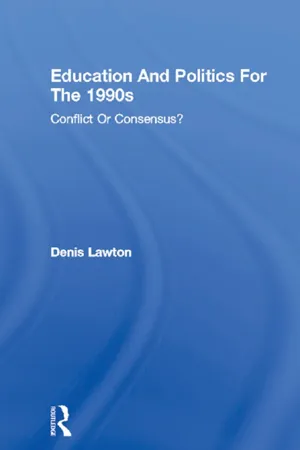
- 176 pages
- English
- ePUB (mobile friendly)
- Available on iOS & Android
eBook - ePub
About this book
Examines the ideological differences between the education policies of the two main political parties in the UK and discusses the emergence of these differences within the context of the 1988 Education Reform Act. It also looks at the world-wide influence of the "New Right" politics on education.
Information
Chapter 1
Politics, Ideology and Education
The Old Testament prophets did not say ‘Brothers I want a consensus’. They said: ‘This is my faith, this is what I passionately believe. If you believe it too, then come with me.’
(Margaret Thatcher (1979) quoted by Gamble (1988)
A good deal has been written about the New Right, Reaganomics in the USA, and Thatcherism in the UK, but comparatively little has been written about the New Right and education. In this chapter I want to try to fill that gap by exploring the concept ideology and the ideas of the New Right on education.
Whatever one’s views about political and educational events since 1979, it is difficult to disagree with the view that education in England will never be the same again. In education—as with other aspects of social life—the policies pursued since the Conservative victory in 1979 have brought about some changes which are irreversible. One of the problems for those who have come after Margaret Thatcher is to decide exactly what they should try to reverse and what might provide a platform for further development. At the time of writing (August 1991) it was too soon to decide whether John Major as Prime Minister would continue the Thatcher tradition in education or would embark on radical new ventures. The only clues were his early statements about the desirability of a ‘classless society’, his speech to the Young Conservatives in February 1991 and his July 1991 address on education to the Centre for Policy Studies in which he indicated that he would give the highest priority to education and training. But what kind of education? It seems likely that some aspects of Thatcherism will continue, at least in the short term. It is, therefore, important to analyze the impact of New Right ideas on education, for their future relevance as well as out of purely historical interest.
Some educationists, whilst disapproving of much that happened during the period 1979 to 1990, would be willing to acknowledge that all was not well with the education service in the 1970s and that in the 1980s education was at least submitted to radical review. But another way of looking at those years would suggest that some policies have come perilously close to destroying the DES/LEA partnership system altogether.
The New Right and Thatcherism
Several complete books have been written on this question (for example, Gamble, 1988; Skidelsky, 1988; Kavanagh, 1987; Kavanagh and Seldon, 1989; Hall and Jacques, 1983. Many of them, correctly in my view, wish to distinguish between the emergence (or re-emergence) of certain right-wing policies, and the particular style and personality of Margaret Thatcher. This is important but not always easy.
Another aspect of the problem of analyzing Thatcherism is that it combined features of neo-liberal libertarianism as well as neoconservative ‘cultural rightism’ which are by no means completely compatible, and are seen by some to be contradictory. Yet another feature of Thatcherism was that it attempted to generalize the laissez-faire economic doctrines of the neo-liberals into the whole of social life under the guise of another ideology—individualism.
It is probably safe to say that most of these doctrines of the ‘New Right’ would have become part of the political debate of the 1980s without Margaret Thatcher as Prime Minister. They were part of worldwide changes in the political debate, but she added a style of leadership and public argument which increased the impact and influence of those doctrines.
What then is, or was, Thatcherism? And what has been its effect on education? Some writers, for example, Kavanagh (1987) and Skidelsky (1988) have examined Thatcherism in the context of the political failures (Labour and Conservative) of the 1960s and 1970s. Part of Margaret Thatcher’s appeal may have been that she offered to lead the Conservative Party (and the country) away from the ‘consensus politics’ which had failed to work for Wilson, Heath or Callaghan. Hence the quotation which heads this chapter. But that cannot be the whole truth: the evidence of public opinion polls and analyses of popular values indicate a lack of wholesale support for the more extreme aspects of Thatcherism.
The consensus approach which Margaret Thatcher disliked involved trying to make an ailing mixed economy work, and was based on Keynesian economics as well as guaranteed support for the welfare state—including education. We shall see, in some detail in chapter 3, that the apparent consensus between Crosland and Boyle on education policies was encountering more and more criticism from within the Conservative Party in the late 1960s and 1970s. This could be seen as part of a much wider, to some extent international, reaction against collectivism—or at least against some practices of collectivist administrations.
Let us then return to the twin New Right ideological bases of Thatcherism: neo-liberal economic theories and neoconservatism, which are philosophically quite distinct.
Neo-liberalism derives from the ideas of the eighteenth century classical economist, Adam Smith. Some like Hahn (1988) would say on an over simplification or misinterpretation of Smith. The major modern exponent of the free market is however the Austrian economist Hayek who condemned socialism as The Road to Serfdom (1944) and saw collectivist ideas and practices as a threat to freedom and prosperity. It was Hayek who in 1947 founded an international society devoted to the preservation of the non-socialist liberal order (later called the Mount Pelerin Society, after its first meeting place in Switzerland). Many English right-wing economists have been members of, and contributed to, the discussions of the Society. A recurring theme in Hayek’s work has been the idea that collectivist social planning is doomed to failure because society is so complex and the ‘facts’ that planners deal with are not concrete, but are based on human behaviour and relationships which are unpredictable. Hence, according to Hayek, the superiority of the free market over any kind of planning for full employment, a welfare state, economic targets and redistribution of income. The market mechanism is superior to all planning because it works automatically with a beautiful simplicity—if you leave it alone. The ‘selfish’ acts of individuals end up by being for the good of society as a whole.
There is a theory behind this optimistic faith. Hayek argues that the classic distinction between ‘natural’ and ‘artificial’ is false because there is a third category of ‘social’ which includes human institutions that have evolved rather than been consciously planned. Language would be a good example of the social category, law would be another, and in some societies, the notion of the market as a means of organizing the production and exchange of goods and services. To illustrate his faith in the social benefits arising out of selfish individual acts, Hayek uses the example of a footpath: an individual will tend to choose to walk in someone else’s tracks, not with the intention of helping to create a footpath, but simply because it is easier to walk where someone else has already trodden down the plants. But the beneficial, unintended result is— eventually—a footpath for the whole community! However, if we try to plan, we run the risk of believing that one individual (or a group of planners) can understand detailed human needs better than a system developed unconsciously over many generations. We should beware of tampering with an established social institution such as the market which works automatically and is not amenable to improvement because it is already a perfect mechanism based on the freedom of individuals making their own decisions rather than being told what is good for them. (Hayek does not say what a group of individuals should do who, seeing the benefit of a footpath, decide they would like a bridge.)
Part of Hayek’s faith in the free market is based on a simple belief (which, ironically, he shares with Marx) that the economic relationship between individuals is the dominant social relationship: social theory should be based on this ‘fact’ not on the desire to do good, to be generous or to put right any injustices. The price mechanism is superior to those sentiments—it is the perfect information system for the whole society, ensuring by automatic competition low costs and efficiency. Such supply and demand information could never be known to any central planning bureaucracy. The free market mechanism is superior to planning both in terms of efficiency and in terms of individual freedom. Economic freedom means social freedom. There will, of course, be ‘winners and losers’ as the result of the market. But we should be careful not to introduce ideas of fairness or social justice into the formula. In a free market economy there will, for example, be occasions when a poor individual will die because he cannot afford expensive drugs or an operation, but that is not unfair or unjust— it is only a bit of bad luck:
To discover the meaning of what is called ‘social justice’ has been one of my chief preoccupations for more than ten years. I have failed in this endeavour—or rather, have reached the conclusion that, with reference to a society of free men, the phrase has no meaning whatever
(Hayek, 1978, p. 57. See also Hayek, 1976)
If an individual contracts a fatal disease, this may be, according to Hayek, unfortunate, but it is not meaningful to say that it is ‘unjust’ because justice is a moral concept necessarily involving human motivation and behaviour: it is unjust for an individual to steal from another, but it cannot be unjust for an individual to be ill or poor or badly housed—they are simply the losers in a game of chance. (Hayek criticizes socialists for the mistaken concept of social justice, but ignores the traditional Christian doctrine about the existence of sins of omission as well as sins of commission— that is, that it is a sin to fail to give charity to the poor as well as to steal from the rich.)
Hayek and his followers insist that ‘social justice’ or ‘redistributive justice’ is not only meaningless but is fraudulent and harmful to freedom. The financial rewards bestowed upon individuals by the market will, in general, be good indicators of their ‘contribution’ (apart from luck), but will not necessarily fit in with any collectivist notion of social justice, need or merit. Hayek does not, however, go as far as some libertarians such as the American philosopher Nozick (1974) who claims that taxation is a combination of theft and slavery; Hayek acknowledges the need for a minimum state to ensure that the economic game is played fairly. Thus some coercion may be necessary, but it should be as little as possible. An army to guard against foreign interference and a police force to preserve traditional law and order would be permitted, but much of the collectivist welfare state would have to go.
I have dealt with Hayek at some length because his ideas are directly relevant to some aspects of economic Thatcherism and indirectly relevant to some New Right views on education. It is quite easy to see links between Hayek’s views and the public statements of Margaret Thatcher, and, in particular, of her onetime mentor, Keith Joseph:
The blind, unplanned, uncoordinated wisdom of the market ...is overwhelmingly superior to the well-researched, rational, systematic, well-meaning, cooperative, science-based, forward-looking, statistically respectable plans of government... The market system is the greatest generator of national wealth known to mankind: coordinating and fulfilling the diverse needs of countless individuals in a way which no human mind or minds could ever comprehend, without coercion, without direction, without bureaucratic interference.
(Joseph, 1976)
As we shall see, the problem of reconciling such Hayekian views with the task of making a collectivist state education system work, proved difficult for Joseph when he became Secretary of State for Education and Science. In addition, several Conservative Party education advisers have been influenced by Hayek, for example, Oliver Letwin (1988) and Stuart Sexton, arguably the major architect of education policy in the Thatcher years, is a consistent advocate of bringing education more into line with the free market (see chapter 3). As we shall also see, some aspects of ERA (1988) were the result of right-wing interventions from the free market side of the Conservative Party. Hugo Young (1989) suggests that Margaret Thatcher had read The Road to Serfdom when she was an Oxford undergraduate, but that she did not get to grips with Hayek’s other work until the 1970s. Other influences were important, including that of Keith Joseph, and, indirectly, Milton Friedman.
So much for the neo-liberal ideological side of Thatcherism. I will now deal more briefly with the neo-Conservative ideology and its influence on the New Right and education policies. Neoliberal Hayekian thinking is optimistic in believing that human selfishness is not a problem because it is eventually transformed into a public good. (A view derived from Leibniz and satirised by Voltaire in Candide as ‘all is for the best in the best of all possible worlds’); neo-Conservative thinking, on the other hand, has a more pessimistic view of society derived from Hobbes’s vision of human interaction as ‘nasty, brutish and short’ unless human nature could be tightly constrained by social rules. This view can be seen in the context of the history of the Conservative Party in some of the writings of Edmund Burke and in the paternalist doctrine of the strong state to control evil (and sometimes to protect the weak). ‘Custom’, ‘tradition’ and ‘order’ are the key words in this conception of the state and political theory. One version of this view assumes that tradition and order are essential, but claims that Conservatives are non-ideological and pragmatic. This has tended to be the attitude of some anti-Thatcherites in the Conservative Party such as James Prior, Sir Ian Gilmour and others who left her Cabinet.
The 1980s version of this Conservative tradition has been provided, above all, by Roger Scruton. In his book The Meaning of Conservatism (1980) Scruton defines the traditionalist character of Conservative political doctrine, and in other publications such as The Salisbury Review, which he edits, he brings these traditional views to bear on problems of modern English society such as gender, race and education.
It is this strand of Conservative thinking which is frequently behind education publications of the Hillgate Group making pronouncements on the curriculum (The Reform of British Education, 1987), teacher training (Learning to Teach, 1989) and the dangers of left-wing indoctrination (Scruton et al, 1985). I shall want to refer to these later: at this stage I would simply like to note that whereas the neo-liberals tend to talk about choice, competition and the market in education, the neo-Conservatives are more likely to advocate traditional values, traditional subjects, and less educational theory in the training of teachers, but greater immersion into the traditional values of good schools. The mixture of neo-liberal and neo-conservative doctrines is uncomfortable, although some individuals have managed to write for both groups, for example Dennis O’Keeffe who wrote The Wayward Elite (1990) for the Adam Smith Institute having previously collaborated with Scruton (1985) on Education and Indoctrination.
Andrew Gamble (1988) argues that Thatcherism is a combination of the two traditions I have described above, which Gamble refers to as ‘the free economy and the strong state’. Margaret Thatcher managed to square the circle by ensuring that ‘rolling back the state’ meant a reduction in the scope of government but not a diminution in its strength. Less government need not mean weak government.
Gamble sees Thatcherism as a particular manifestation of New Right politics which emerged in the 1970s in response to the world recession, the exhaustion of Fordism as a regime of accumulation and the breakdown of American hegemony. In Britain Thatcherism had the peculiar national characterization derived partly from the crisis of state authority in the mid-1970s—and not least the failure of Heath to win the 1974 election with a ‘Who governs Britain...
Table of contents
- Cover
- Title
- Copyright
- Contents
- List of Abbreviations
- Preface: The Purpose of the Book
- Chapter 1 Politics, Ideology and Education
- Chapter 2 Education, Ideology and the Labour Party
- Chapter 3 Education, Ideology and the Conservative Party from 1944 to 1988
- Chapter 4 The Growth of Ideological Conflicts: The Education Reform Act (1988)
- Chapter 5 Events Since 1988
- Chapter 6 Problems of Choice, the Market and Educational Planning
- Chapter 7 Towards a New Consensus?
- Chapter 8 Agenda for a New Consensus
- Bibliography
- Index
Trusted by 375,005 students
Access to over 1.5 million titles for a fair monthly price.
Study more efficiently using our study tools.
Frequently asked questions
Yes, you can cancel anytime from the Subscription tab in your account settings on the Perlego website. Your subscription will stay active until the end of your current billing period. Learn how to cancel your subscription
No, books cannot be downloaded as external files, such as PDFs, for use outside of Perlego. However, you can download books within the Perlego app for offline reading on mobile or tablet. Learn how to download books offline
Perlego offers two plans: Essential and Complete
- Essential is ideal for learners and professionals who enjoy exploring a wide range of subjects. Access the Essential Library with 800,000+ trusted titles and best-sellers across business, personal growth, and the humanities. Includes unlimited reading time and Standard Read Aloud voice.
- Complete: Perfect for advanced learners and researchers needing full, unrestricted access. Unlock 1.5M+ books across hundreds of subjects, including academic and specialized titles. The Complete Plan also includes advanced features like Premium Read Aloud and Research Assistant.
We are an online textbook subscription service, where you can get access to an entire online library for less than the price of a single book per month. With over 1.5 million books across 990+ topics, we’ve got you covered! Learn about our mission
Look out for the read-aloud symbol on your next book to see if you can listen to it. The read-aloud tool reads text aloud for you, highlighting the text as it is being read. You can pause it, speed it up and slow it down. Learn more about Read Aloud
Yes! You can use the Perlego app on both iOS and Android devices to read anytime, anywhere — even offline. Perfect for commutes or when you’re on the go.
Please note we cannot support devices running on iOS 13 and Android 7 or earlier. Learn more about using the app
Please note we cannot support devices running on iOS 13 and Android 7 or earlier. Learn more about using the app
Yes, you can access Education And Politics For The 1990s by Denis Lawton in PDF and/or ePUB format, as well as other popular books in Education & Education General. We have over 1.5 million books available in our catalogue for you to explore.