- 264 pages
- English
- ePUB (mobile friendly)
- Available on iOS & Android
eBook - ePub
About this book
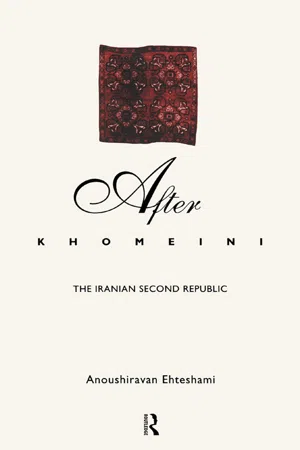
For Iran the years since Ayatollah Khomeini's death have been dominated by the need for political consolidation and economic reconstruction.
The book assesses the critical dilemmas of the regime both previous to and since the demise of its first spiritual leader. The vital issues of political succession and constitutional reform are addressed, contributing to an analysis of the structures and politics of power. How these have reflected upon economic policy is considered with close atttention being given to the reform policies of Rafsanjani. Foreign policy and security issues are discussed in both regional and global terms and include a study of Iranian defence strategy and its controversial re-armament drive.
The final chapter examines the direction and context of all of these major policy areas, providing an analysis of whether the Islamic Republic truly represents a revolutionary alternative for the Third World or whether in fact it has developed in time to fall within a similar mould to other notable revolutions, casting by the wayside any uniquely Islamic agenda and alternatives.
At the heart of this study is the belief that the Islamic regime has, since the cease-fire with Iraq, but more specifically since Ayatollah Khomeini's death passed into a new stage of development, referred to in the book as the `Second Republic'.
Trusted by 375,005 students
Access to over 1.5 million titles for a fair monthly price.
Study more efficiently using our study tools.
Information
Subtopic
Political Economy1 Political succession in republican Iran
The February revolution was a surprise attack, it took the old society unawares…it is no longer the monarchy that appears to have been overthrown but the liberal concessions extracted from it by a century of struggle. Instead of society conquering a new content for itself, it only seems that the state has returned to its most ancient form, the unashamedly simple rule of the military sabre and the clerical cowl.
Karl Marx, Surveys from Exile (II)
Since the defeat of Mohammad Mossadeq’s bid for political power in 1953, the question of the political continuity of leadership in Iran has been fraught with uncertainties. Although the rule of Mohammad Reza Shah Pahlavi was uninterrupted from 1953 until 1979, his reign was not to be unchallenged (not least by Ayatollah Khomeini himself during the mid-1960s) (Abrahamian 1982:473–9). The monarch’s consequent preoccupation with control of the Iranian elite, coupled with his concerns over dissension from the traditional ruling classes or the armed forces, ensured that he would not accord the question of succession priority lest it might help to undermine his position as the governing monarch. In a formal sense the issue of succession had resolved itself with the birth of a male heir, Reza Pahlavi, in 1960 and it was not until 1978 and the advent of the revolutionary movement that the issue of succession became a serious political factor in the considerations of the opposition and the loyalists alike. The rapid erosion of support for the Pahlavi monarchy, coupled with the steady deterioration in the regime’s ability to confront the revolutionaries, accelerated the collapse of the whole system, leaving little prospect of the Shah abdicating in favour of his son in order to provide for the continuity of the Pahlavi dynasty.
Similarly, the question of succession has since been an important political factor in revolutionary Iran. The revolution of 1979 gave birth to a new (ruling) political elite which, during the first two years of the Islamic Republic, remained a coalition between the Shah’s secular and religious opponents. After 1981, the clerical forces gained the upper hand and, under the guidance of Ayatollah Ruhollah Khomeini (the Supreme Leader), formed the backbone of the republic’s political leadership. After 1989, however, important changes in the political leadership occurred, giving rise to the consolidation of the position of some of Ayatollah Khomeini’s more junior trusted allies at the top of the power pyramid. They solved the issue of succession to their own advantage by gaining the upper hand in the contest for the control of the state and its constituent parts. In so doing, they seemed to have put an end to the problem of political continuity in modern Iran, as defined by the absence of a peaceful transfer of power, which had always threatened to undermine the position of the ruler in Iran’s post-1945 history. This is perhaps the most important demonstration of a much altered political structure and attendant policies which emerged during and since the period of Ayatollah Khomeini’s demise and which merit the use of the term Second Republic. The problems of succession and political continuity are at the heart of the progression of the Islamic Republic from a state the authority of which is ultimately in the hands of one man to a constitutionally more solid and institutionally based distribution of power.
If one is to look for political continuity in republican Iran, one has to accept that the seeds of the Second Republic were sown during the infant years of the republican regime and the unfolding drama surrounding the balance of forces therein. It was almost inevitable that the system would change after Ayatollah Khomeini’s death, although it was never certain in just what manner. Less clear still was whether the Islamic Republic as a system would survive the death of its founder. As the years wore on, it became apparent that even if the system survived Ayatollah Khomeini’s death it would inevitably have to change in order to adapt to new realities.
The problems of political continuity after Khomeini’s death were evident from the earliest days of the revolution, in some ways reflecting a concern inherited from the Pahlavi regime along with the structures of power. Not least of the worries of the revolutionary forces was the advanced age of Ayatollah Khomeini, the undisputed leader of the revolution after October 1978, and the knowledge that a resolution of the succession dilemma would have to come sooner rather than later.
The Iran-Iraq war provided the main backdrop to the internal debates of the ruling elite about the succession. Any successor, it was assumed, would have to have the necessary skills to lead the country’s war effort, maintain cohesion amongst the ruling factions, and provide guidance for the masses. A tall order indeed. It is not surprising, therefore, that no single individual with the required qualities emerged in the early years of the republic. The leadership problem was compounded by in-fighting and factionalism at the national political level and the opposition of a number of the leading Shii clerics (Ayatollahs and Grand Ayatollahs) to the Faqih doctrine of Ayatollah Khomeini and his followers in the Shii hierarchy. The peculiarities of the Islamic Republican system and the constitutional pronouncements on the qualities of the Faqih—he had to be of high (Iranian) Shii Islamic standing, and a recognised leader in the field of Islamic scholarship—made the prospects of a ‘natural’ leader emerging that much harder (Abrahamian 1993).
The doctrine of the Velayat-e Faqih as enunciated by the late Imam caused some serious difficulties for his political and politico-religious successors, who were by and large of a more junior religious rank and status. Indeed, this was the case largely because the concept clearly assigned the responsibility of leading the nation to the Marja‘a-e Taqlid (source of emulation in Shiism), and not to the junior clerics themselves. ‘The just fuqaha’, wrote Khomeini, ‘must be the leaders and rulers, implementing divine ordinance and establishing the institution of Islam’ (Algar 1982:79). As Irfani points out, the ‘just fuqaha are none other than the Marja‘a-e Taqlid’ (Irfani 1986:35). Omid also stresses the plurality of (religious) leadership in Ayatollah Khomeini’s conceptualisation of an Islamic government. In his writings, Ayatollah Khomeini normally referred to the ‘Fuqaha’ (religious leaders) and not the ‘Faqih’ (religious leader) (Omid 1992). Milani notes that the framers of the 1979 constitution deliberately established an organic relationship between the institution of the Faqih and the Marja‘aiyat (Milani 1992). In 1989, therefore, when Khomeini’s death resulted in the post of Faqih being transferred to his successor, the question was left open as to when the new Faqih, only recently promoted to the rank of Ayatollah, might become a Marja‘a. This has since become a highly controversial political issue and a source of great tension within the system, being exacerbated by the passing away of the established Ayatollah Ozmas (Grand Ayatollahs) in recent years (Jahanpour 1994).
As it was, a number of senior Ayatollahs opposed the concept of the Faqih. At least one Grand Ayatollah raised objections to the whole process of the religious establishment’s drive to monopolise political power. Grand Ayatollah Hassan Tabataba‘i Qomi’s comments stand as a testimony to the depth of the opposition among the orthodox Shii establishment to the fundamentalist Islamic republicans’ rush for power:
I told Ayatollah Khomeini that the IRP [Islamic Republican Party] was corrupt and rotten, and it was for him not to permit these filthy laws to come into force nor allow a bunch of corrupt, irrelevant, and unqualified ‘experts’ to go ahead and constitute authority.
(Irfani 1983:221)
Qomi went as far as declaring the new constitution ‘no good’ because a number of its articles were un-Islamic, in his view.
Another aspect of Ayatollah Khomeini’s rule with a bearing on the succession issue was his style and leadership. In general Ayatollah Khomeini himself did not engage in factional politics until the latter part of the 1980s, when a crisis of institutional competition demanded it of him. Although his subordinates were selected or elected to run the Islamic state, the centrality of his role as the Supreme Leader often meant that he would exercise his power by passing judgement on major issues of the day. His pronouncements, however, were usually open to interpretation and his interventions non-strategic; they did not end a line of thought, but merely helped to weaken it against others. By intervening to bolster the position of an individual, an institution or a line of thought against others, he in fact tended to fuel the factionalism and competitive nature of elite politics in the Islamic Republic (Schahgaldian 1989). A by-product of this method of rule was the way in which it allowed the development of diverse interpretations of his views that crystallised into ideological factions among the politicised clergy. Khomeini’s style of leadership has had significant implications for his successors because some of them, including perhaps the current Faqih, may not have the temperament, acumen or charisma to forge compromises among the factions as Khomeini himself managed to do so successfully.
ONTINUITY AND CHANGE IN IRAN’S POLITICAL POWER STRUCTURES
If the issue of succession has dogged the Islamic Republic since its early years, so too have the structures of Pahlavi society, many of which have remained in place, sometimes essential to the new republic and at other times appearing to haunt it. For many observers of (and participants in) the 1979 anti-Shah revolution, the movement fell well short of a social transformation of society by forcibly limiting the boundaries of change to the political level. Moaddel argues that:
The initial years of the post-revolutionary period were punctuated by events favouring a major structural change directed against the land-owners and capitalists. However, a reverse trend soon gained momentum. At first, it was able to halt the move toward social revolution. Then it began to undo what had been done in [the] previous phase.
(Moaddel 1991:319)
Although the social structure of the Islamic Republic did change sufficiently to reflect Iran’s new political realities (in terms of the overthrow of the Shah and the departure and/or alienation of the ‘comprador’ social groups allied to his regime), the view persisted that the emergence of the Islamic Republic signified an exercise in the violent circulation of Iran’s political elite and not a revolutionary transformation of its social structure (Ja‘far and Tabari 1984). As such, therefore, it was argued that the new elite not only did not ‘revolutionise’ the centralised state machinery (its monopoly of legitimacy, administration and violence), but went only so far as to fine-tune it and to add new appendages to the government machinery as hallmarks of the Islamic Republic’s life.
There is considerable evidence to suggest that the social relations of ‘production, circulation and exchange’ created by the Shah remained very much intact under the new system. Later chapters will deal at some length with the economic structures of the Islamic Republic. It is sufficient to say here that at the socio-economic level capitalism was not eradicated with the end of the ‘dependent capitalist system’ of the post-1953 Pahlavi period. Its political appearances changed, however, to reflect Iran’s new class realities. If the Shah had come to represent the pinnacle of the socio-economic pyramid of Iran, the republican leadership reflected the ascendancy of lower social strata; they in fact came to signify the medium and upper layers of the new ‘flat-top’ socio-economic pyramid. Despite Ayatollah Khomeini’s efforts to institutionalise a new pinnacle (substituting the Faqih for the Shah), the newly liberated ‘flat-top’ elites of the pyramid had already begun their competition for political power (and for control of the state as the enabling instrument of power), the essential condition for perpetuating their own social existence.
The revolution neither eliminated the political challenge of the former elites nor ended the challenge of the politically active non-elites to the preserved and newly established vestiges of power. Despite their physical and intellectual presence, however, many of the Islamic Republic of Iran (IRI), opponents be they monarchist or republican, failed to mount an effective challenge. Part of the reason for this failure lay in the opposition’s inability to account correctly for the nature of the theocratic regime. Many elements within the leftist movements, for instance, limited their analytical tools to a prescribed set of conditions said to have existed during the Shah’s era. They continued to identify the players and forces of the clergy-led movement— and regime—with the so-called ‘dependent capitalist’ socio-economic model. According to this view, if the entire Iranian system was, and continued to be, dependent capitalist then its ruling class(es) must also be, or eventually become, comprador bourgeois (this view was particularly prevalent amongst those leftists who had been influenced by the views and theories of the Fadayin Organisation) (Moghadam 1987). Furthermore, the state machinery was said to continue to operate according to the governing laws of the capitalist system which dominated Iran before the revolution and vis-à-vis the world capitalist system. The latter enabled the former to gain some autonomy from the ruling classes in order to fulfil its own historical function of preserving the interests of dependent capitalism in the long term. The recommended solution of the leftists was therefore the destruction of the entire system.
The left Islamic Mojahedin movement based its analysis of the IRI system on the character and personality of the Ayatollah himself. In the early days of the revolution they viewed him as a progressive cleric. By 1981, however, they had revised their opinion, comparing his socio-economic position to that of the Shah. They saw in Ayatollah Khomeini the symbol of an Islamic Republican dependent system, little different from the capitalist-dependent system of the Pahlavis save in its Islamic accessories. Their failure to recognise the relationship between Khomeini himself and the character of the Islamic Republic was reflected in their choice of strategic slogans. The continuing belief that without Khomeini the Islamic Republic could indeed abandon its capitalist-dependent status led them to call for ‘Death to Khomeini’ along with ‘Death to the Shah’, reflecting the desire to attain a tactical goal, i.e. to create a change in the regime through removing the republic’s leading figure(s) but preserving the post-Pahlavi structures. A fissure existed, then, between leftist secular groups—who called for an end to the Islamic Republican structures (‘Death to the Islamic Republic’) —and the Mojahedin—who sought only an end to Khomeini’s personal rule. This confusion over strategy and differences over the choice of correct slogans served to distance the Mojahedin from their potential allies on the left at the height of the struggle between the regime and its opponents. Divided and confronted by overwhelming popular support for the regime, the opposition fell!
The monarchist and pro-monarchist forces, on the other hand, were likewise unable to analyse the nature of the revolutionary changes in Iran. Convinced of the Pahlavi regime’s integrity, they constantly looked beyond Iran to find exogenous causes of the revolution, such as ‘international communism’. The conspiracy to overthrow the Shah, in the eyes of the pro- Pahlavi groups, did not end with communist interference, however. Their assessment was very wide in scope, ranging from accusing the PLO of having organised and armed the militant Islamic groups, attacking President Carter for his human rights campaigns (seen to have helped to undermine the Iranian monarch’s authority at home), and condemning the Carter administration for not rushing to the aid of the Shah in his hour of need. The monarchical forces failed to understand the configuration of forces which had come to make up the political elite of the Islamic Republic. The Paris-based National Movement of Iranian Resistance (NAMIR), headed by the late Shahpour Bakhtiar (the Shah’s last Prime Minister), for instance, continued to identify the leading clerics of the republic with the Soviet Union and the ‘sinister aims of World Communism’. In adopting such positions he and his contemporaries failed to appreciate the socio-economic dimensions of the regime’s suppression of the leftist-radical and reformist movements in Iran, in the process missing the opportunity to organise an effective united front-type structure with some of the domestic opposition forces.
Both republican and monarchist camps were divided over how to deal with the burning issues of the day: social philosophy, the national economic development strategy, land reform, taxation, whether to expand the public sector or free the economy to market forces, foreign policy, the role of clergy in politics, and the status of the expatriates. Lack of clear-cut policies on these issues added to the confusion over the future development of Iran and the country’s place in the international community.
Thus it is fair to say that, during the crucial first two years after the revolution, the clerics were able to build upon continuities in the political and socio-economic realms to consolidate their own power, while the contenders for that power were emasculated by failure to comprehend the nature of those continuities and their own positions within the new republic. If one is to ask at this point where the succession issue comes into this, it is in the realisation by the republican Islamic regime that, to hold on to that power and to continue to defy the efforts of the opposition to seize it from them, they must recreate the existing system to allow for a peaceful transfer of power from one generation of Islamic leadership to another without exposing fragilities which could be exploited for their downfall.
At this point, it is useful to identify the various factions and political groupings which were competing for power in the early post-revolution years and to assess their respective impacts upon the succession issue within the Islamic Republic. This can provide us with essential clues as to why the Islamic regime was able to manage its peaceful transfer of power as and when it did.
THE REPUBLICAN CONTENDERS
The republican camp can be divided into three distinct groups: the fundamentalist Islamic republicans (FIR), the liberal Islamic republicans (LIR) and the secular republicans (SR). It was the first two of these groups which were ultimately to capture the reins of power at the expense of the third.
It is within the first category that the Islamic Republic’s internal feuds have been fermenting. Most observers have divided the factions in the FIR camp into three or four competing groups. Until the official demise of the Hojatieh Society, the on-going power struggle within the FIR camp had centered around the two main axes of the Hojatieh and the ‘Followers of the Imam’s Line’ (also known as the Maktabis). While formally everyone involved with the governing and administering of the state adhered to the Imam’s Line, clear and distinguishable differences over the interpretation of its content began to emerge soon after the revolution. From the ranks of the ‘Followers of the Imam’s Line’ were drawn the so-called ‘radicals’, those who from the period prior to the death of Ayatollah Khomeini were associated with anti-Western foreign policy, favouring the continuation of the war with Iraq, the export of the ‘Islamic revolution’ by any means, s...
Table of contents
- COVER PAGE
- TITLE PAGE
- COPYRIGHT PAGE
- LIST OF TABLES
- ACKNOWLEDGEMENTS
- INTRODUCTION
- 1: POLITICAL SUCCESSION IN REPUBLICAN IRAN
- 2: THE EMERGENCE OF THE SECOND REPUBLIC
- 3: THE POLITICS OF POWER IN POST-KHOMEINI IRAN
- 4: THE REVOLUTIONARY STATE IN SEARCH OF AN ECONOMIC SYSTEM: THE MOUSSAVI YEARS
- 5: STATE AND ECONOMY UNDER RAFSANJANI
- 6: IRAN’S POST-REVOLUTION REGIONAL POLICY
- 7: THE FOREIGN POLICY OF THE SECOND REPUBLIC
- 8: SECURITY AND DEFENCE STRATEGY OF THE SECOND REPUBLIC
- 9: THE ISLAMIC REPUBLIC OF IRAN A REVOLUTIONARY ALTERNATIVE FOR THE THIRD WORLD?
- BIBLIOGRAPHY
Frequently asked questions
Yes, you can cancel anytime from the Subscription tab in your account settings on the Perlego website. Your subscription will stay active until the end of your current billing period. Learn how to cancel your subscription
No, books cannot be downloaded as external files, such as PDFs, for use outside of Perlego. However, you can download books within the Perlego app for offline reading on mobile or tablet. Learn how to download books offline
Perlego offers two plans: Essential and Complete
- Essential is ideal for learners and professionals who enjoy exploring a wide range of subjects. Access the Essential Library with 800,000+ trusted titles and best-sellers across business, personal growth, and the humanities. Includes unlimited reading time and Standard Read Aloud voice.
- Complete: Perfect for advanced learners and researchers needing full, unrestricted access. Unlock 1.5M+ books across hundreds of subjects, including academic and specialized titles. The Complete Plan also includes advanced features like Premium Read Aloud and Research Assistant.
We are an online textbook subscription service, where you can get access to an entire online library for less than the price of a single book per month. With over 1.5 million books across 990+ topics, we’ve got you covered! Learn about our mission
Look out for the read-aloud symbol on your next book to see if you can listen to it. The read-aloud tool reads text aloud for you, highlighting the text as it is being read. You can pause it, speed it up and slow it down. Learn more about Read Aloud
Yes! You can use the Perlego app on both iOS and Android devices to read anytime, anywhere — even offline. Perfect for commutes or when you’re on the go.
Please note we cannot support devices running on iOS 13 and Android 7 or earlier. Learn more about using the app
Please note we cannot support devices running on iOS 13 and Android 7 or earlier. Learn more about using the app
Yes, you can access After Khomeini by Anoushiravan Ehteshami in PDF and/or ePUB format, as well as other popular books in Politics & International Relations & Political Economy. We have over 1.5 million books available in our catalogue for you to explore.