Woman's Relationship with Herself explores the relationship women have with themselves and demonstrates how this relationship is often dominated by debilitating practices of self-surveillance. Employing Foucault's notion of panoptical power, Helen O'Grady illuminates the link between this kind of self-surveillance and the broader mechanisms of social control, arguing that these negative practices prevent women from enjoying a satisfying, affirming relationship with themselves. Cultural factors that render women vulnerable to dissatisfying self-relations are identified and analysed and, drawing on the insights of Foucault, feminism and narrative therapy, the possibilities for developing a more empowering relationship with the self are examined.
This innovative contribution to feminist debates about gender and the self will be of interest to students and researchers in social psychology, feminist psychology, mental health studies and gender studies, and to practitioners in psychological therapies and counselling psychology.
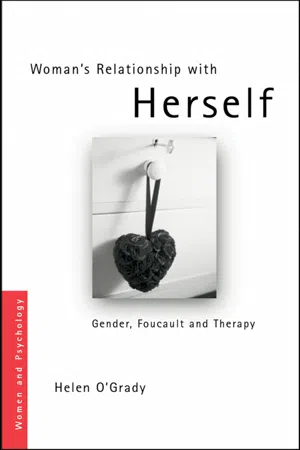
- 160 pages
- English
- ePUB (mobile friendly)
- Available on iOS & Android
eBook - ePub
About this book
Information
1
A LENS FOR VIEWING SELF-POLICING
Disciplinary practices… secure their hold not through the threat of violence or force, but rather by creating desires, attaching individuals to specific identities, and establishing norms against which individuals and their behaviors and bodies are judged and against which they police themselves.
(Sawicki, 1991, pp. 67-68)
INTRODUCTION
While theoretical explanations are sometimes perceived as onerous (not least when presented in dense, inaccessible forms), at their best they offer interesting, sometimes provocative, ways of thinking about and understanding a range of human experiences. They provide a space of reflection in which to step back from the immediacy of experience and gain a broader perspective, while at the same time their relevance to concrete practices can be assessed. It is this type of dynamic that I aspire to bring to the discussion of self-policing. One of the key theoretical frameworks informing this discussion is elaborated next. Illuminating the broader cultural context of individual experience, this framework links self-surveillance to the maintenance of contemporary western identities, social standards and norms. This is described by Michel Foucault as a peculiarly modern form of social control replacing earlier more authoritarian mechanisms. Foucault’s analysis of self-surveillance forms part of a broader critique which challenges the universalizing tendency of modern thought. Of particular concern is the idea of a human essence or core amenable to the interpretive powers of reason. In his view, such a notion locks individuals into a narrowly defined identity. In seeking to demonstrate the contingent rather than given nature of identity, his historical analyses help disturb over and over again the apparent inevitability of the ways we have come to relate to and understand ourselves. As such, they encourage critique and transformation of current practices of self-surveillance and associated cultural norms. Experimentation with different identity practices can draw on Foucault’s redefinition of freedom as an ongoing negotiation of existing power relations. Moreover, an emphasis on the sociocultural context guards against the imposition of an “essential” identity.
CONTEXTUALIZING THE PERSONAL
In reflecting on the type of internal struggles frequently described by women – those characterized by varying degrees of self-doubt, self-criticism or self-dislike – Foucault’s thought provides a useful framework of understanding. Of particular significance is the link between self-policing practices and the maintenance of dominant identity norms. This type of contextual approach offers an important counterbalance to the individualistic impulse in much of western culture whereby, against clear evidence to the contrary, it often is assumed that who we are and how we live is solely a matter of personal decision or will. Such an assumption places the onus of responsibility for both success and failure largely on individual shoulders. In the case of success this can invite an exaggerated sense of personal achievement, particularly in the socially privileged. In terms of failure, it tends to encourage feelings of self-blame, shame and powerlessness. This is not to deny aspects of identity and life for which we can and should take responsibility but rather that a predominantly individualist orientation obscures the powerful influence of social forces in the construction of a sense of self and life possibilities. Foucault’s illumination of the sociopolitical dimension of self-policing helps address this imbalance. From this perspective, while surveillance and judgement of our own feelings, thoughts and conduct in line with generally accepted social standards and norms is an intensely personal experience, it is also part of a broader mechanism which intricately enmeshes the personal and the sociopolitical.
POWER AND KNOWLEDGE
Foucault’s notion of self-surveillance as a form of social control is linked to his analysis of the modern system of power. In Discipline and Punish (1979) he depicts power as existing in a network of diverse and ever shifting relationships that permeate the entire fabric of society. In his view, conventional analyses which focus on power relations at the level of the state or dominant social groups tend to neglect the small but important everyday workings of power that reach into the depths of society – to the bodies, wills, thoughts, conduct and everyday life of individuals. Power’s hold at this “micro-physical” level is such that merely to change a society’s economic system or its type of government or institutions would leave untouched a myriad of minute, diffuse and constantly active power relations (Foucault, 1979, pp. 26-27). If such a claim is correct, and the continued presence of women’s self-policing in the face of various social advances would seem to support it, this underscores the importance of addressing power relations at the intra-subjective level. Foucault claims that what allows power to exert such a grip is that it is not merely a repressive force but is also creative: “What makes power hold good, what makes it accepted, is simply the fact that it doesn’t only weigh on us as a force that says no, but that it traverses and produces things, it induces pleasure, forms knowledge, produces discourse” (Rabinow, 1984, p. 61). In this regard, he points to the pivotal role played by social science discourse in shaping us as beings with certain desires, feelings, habits and dispositions. Thus it is not that particular ways of being are superimposed on who we really are but rather the very stuff of who we are – how we think, feel, behave, our sense of self and what we desire – is fashioned in line with ideas and practices which have come to prominence at a specific historical moment. This linking of systems of power and forms of knowledge contrasts with the conventional view that power acts to repress or deny truth. Such a view is reflected in the widespread belief in an innate or true self constrained by various psychological/social/historical forces of power. For Foucault, however, the very idea of a human essence is itself a product of power. It is an historically specific conception of what it means to be human. To deny this is to foreclose the possibility of freeing ourselves from subjection to an “essential” identity. It blinds us to practices of power which operate through discourses of truth such as those embodied in the human sciences (Owen, 1995, p. 495) – for example the historical construction of sexuality as a defining feature of identity (Foucault, 1978). He therefore rejects the tradition of modern thought in which knowledge can exist and develop only in the absence of power, arguing instead that power and knowledge are mutually constitutive. In this view, no power relation can exist without the constitution of a corresponding sphere of knowledge; nor can knowledge exist which simultaneously does not assume and constitute relations of power:
truth isn’t outside power, or lacking in power… truth isn’t the reward of free spirits,… nor the privilege of those who have succeeded in liberating themselves. Truth is a thing of this world: it is produced only by virtue of multiple forms of constraint. And it induces regular effects of power.
(Rabinow, 1984, pp. 72-73)
Implicit in such a view is a challenge to the conventional understanding of ourselves as “knowing subjects” capable of discerning objective truth. One of the benefits of such a challenge is to undermine the untouchable quality that tends to surround so-called “truth” discourses. This increases prospects for reflection on the ethical implications of the ideas and practices embodied in such discourse. This issue is taken up in Chapter 3’s discussion of the therapeutic domain.
THE RISE OF DISCIPLINARY POWER
The idea that we are products, rather than the driving force, of knowledge is reflected in Foucault’s history of punishment. Repudiating the conventional view that the practice of incarcerating (rather than torturing or executing) criminals from the end of the eighteenth century reflects a humanitarian advance, he describes instead the emergence of a peculiarly modern form of punishment as discipline. Central to this type of punishment is an attempt to place individuals’ everyday lives – their bodily behaviour, identity, activity and seemingly insignificant gestures – under surveillance in order that these undergo correction through the imposition of a rigorous time-table, the development of habits and corporeal constraints. In this light what emerges is “not so much a new respect for the humanity of the condemned… as a tendency towards a more finely tuned justice, towards a closer penal mapping of the social body” (Foucault, 1979, p. 78). In this account, disciplinary methods are not confined to institutions such as the prison but gradually permeate broader social relations.
Foucault illustrates his claim about the distinct character of modern power by referring to an ideal architectural form called the Panopticon. Proposed at the end of the eighteenth century by English philosopher and social reformer Jeremy Bentham, its purpose was to enable the constant observation of individual inmates in organizations such as the asylum, hospital, prison, factory or school. Housed in a transparent, circular building featuring a tall central observation tower, inmates are separated from each other and unable to see those observing them. Its principle effect is “to induce in the inmate a state of conscious and permanent visibility that assures the automatic functioning of power” (Foucault, 1979, p. 201). The efficiency and effectiveness of this type of arrangement lie in the fact that both inmates and staff feel under constant pressure to behave in line with the rules of the institution because they can never be certain they are not under surveillance by superiors. In this way they come to scrutinize their own behaviour as the gaze of surveillance turns inwards:
He who is subjected to a field of visibility, and who knows it, assumes responsibility for the constraints of power; he makes them play spontaneously upon himself; he inscribes in himself the power relation in which he simultaneously plays both roles; he becomes the principle of his own subjection.
(Foucault, 1979, pp. 202-203)
Although the full implementation of this design never occurs, nor do its many adaptations ever live up to Bentham’s intentions (Rabinow, 1984, pp. 19-20), for Foucault this type of panoptical power captures an important dimension of modern reality. In analysing its effects he claims that, while not replacing all other forms of power, it enables power to extend to the smallest and furthest reaches, operating on an anonymous, permanent and mostly silent basis. This involves the constant play of the calculated social gaze which occurs, in principle at least, without an appeal to force, violence or excess.
Foucault contrasts this mechanism of social control with that of the pre-modern west in which law and order were much more of an authoritarian, top-down affair. While such a system suited the structure of feudal societies, in the late eighteenth century it no longer was an efficient or economical way to govern the developing commercial and industrial states. He depicts the development of disciplinary power as a response to the need to adjust the fit between a significant increase in numbers of people and the growing expansion and complexity of productive forces which call for higher profit levels. It is at this time that the concept of “population” emerges, accompanied by an intense interest in the way a society is governed and the maximization of its resources. According to Foucault, the body and sexuality are central to these concerns. In Discipline and Punish, he describes a strategy of meticulous regulation of the bodies, gestures and behaviours of individuals in order to increase their usefulness for institutions such as the military, the hospital, the school and the factory. This new “political anatomy” emerges earlier in some institutional settings than others and in most cases is a response to specific needs, such as industrial progress or a renewed spread of contagious disease (Foucault, 1979). He depicts “bio-power” as the means by which disciplinary methods penetrate all levels of life. This is a form of power which takes charge of the biological processes of the population for the purposes of maximizing its health and well-being, as reflected in an unprecedented concern by governments with specific variables such as rates of birth and death, health, frequency of sickness, fertility, birth control, the character and frequency of sexual activities, legitimate and illegitimate births, the impact of unmarried life, life expectancy, nutrition and housing patterns. In this process, sex assumes strategic importance because of its proximity to the biological processes of both the individual body and the population as a whole. These types of investigations and the policies they generate involve increasingly pervasive “expert” surveillance of the population, and social norms are introduced to ensure regularity in people’s behaviour (Foucault, 1978).
SELF-POLICING
Foucault claims that while the immediate object of the emerging system of government is to ensure the development of individual welfare in a way that is significant to the state, its ultimate aim is to render its overseer role superfluous by making people agents of their own subjection (Rabinow, 1984, pp. 241-242). This involves individuals incorporating the “gaze” of external authority structures, including dominant cultural ideas and practices, which embody certain prescriptions for thinking and living. Hence the crucial role played by self-policing as a mechanism of social control:
There is no need for arms, physical violence, material constraints. Just a gaze. An inspecting gaze, a gaze which each individual under its weight will end by interiorising to the point that he is his own overseer, each individual thus exercising this surveillance over, and against, himself.
(Gordon, 1980, p. 155)
The contemporary power of self-policing can be understood, in part, in terms of the pervasive western ethos of individual responsibility and autonomy. The internalizing impulse of such an ethos discourages the con-textualization of experience. This is reflected in the widespread belief that, regardless of circumstances, individuals are largely responsible for their own life choices and experience. While taking responsibility for various aspects of one’s life is clearly important – for example making the most of available opportunities and feeling as though one has some control over life direction – the overriding individualistic impulse of much of western culture tends to trivialize and obscure the very real effects of social structures which privilege some groups and disadvantage others. A lack of societal acknowledgement of this increases the likelihood of individuals blaming themselves, and being blamed by others, for aspects of life over which they have no control – for example being out of work in communities where largescale economic strategies have resulted in structural unemployment. This type of blame merely compounds the feeling of dis-empowerment that often accompanies failure to measure up to mainstream standards.
Moreover, self-policing works in the service of what Foucault describes as the modern imperative towards sameness and the pathologizing of difference. This is characteristic of societies in which human worth has come to be measured primarily by the scientific categories of the “normal” and “abnormal” (Foucault, 1979, p. 184). Like the commonly accepted standards and norms it supports, self-surveillance has become such a taken-for-granted part of psychic make up that it is mostly invisible to conscious awareness. This makes it difficult to subject it to reflective scrutiny. Thus, while in one sense it is hard to imagine any torments worse than the physical torture inflicted on the pre-modern French prisoner depicted in the opening page of Discipline and Punish, Foucault’s portrayal of self-policing importantly highlights the less brutal but nonetheless soul-destroying effects of this modern practice of power. In societies whose basic organizing principle is the group norm, self-surveillance reproduces the constant monitoring, differentiation and ranking of individual conduct “as better than or below average, normal, deviant, and so on” (Allen, 1998, p. 175).
The effectiveness of self-policing seems to lie in its ability to grasp individuals at the very level of self-understanding and the norms governing identity formation (Sawicki, 1998, pp. 94-95). This means that when a person fails to conform to accepted identity modes, aspects, or even the whole, of their sense of self can be experienced as “wrong”. For instance, a lesbian or gay person in a society dominated by heterosexism is likely to be acutely aware of the lack of societal affirmation of her or his sexuality, all the more so if she or he is not connected to a supportive gay/lesbian/bi-/ transsexual community. Being affirmed culturally is a crucial element of a robust sense of self. The reason its importance often is glossed over, or goes unrecognized, lies in its taken-for-granted pervasiveness in relation to mainstream identities. In the case of heterosexuality, social affirmation is so ingrained in the fabric of everyday existence that it can appear invisible to those being affirmed. To those whose sexuality it silences, however, it is highly visible.
Another example is whiteness. The overwhelming number of ways in which being white is taken for granted and continually affirmed in western cultures renders many white people blind to the fact of having a skin colour at all, let alone to the reality that its social privileging requires the derogation of differently coloured skin. Those constantly subjected to the discriminating “gaze” of white culture are denied the luxury of such colour blindness. Further examples can be seen in relation to gender, class and health. There are also those whose sense of self may have been shattered or poorly formed through the trauma of violence or abuse and whose experience has been silenced by a culture in denial. This is by no means an exhaustive list. Nor, however, is it meant to imply that people cannot or do not protest against marginalization or disadvantage and defy illfitting identities and social norms. Resistance is always part of the response to oppression, often in remarkable, and sometimes remarkably successful, forms. At the same time, it is important to remain aware of the myriad ways in which mainstream culture continues to discriminate against those who do not fit its norms and the ceaseless invitations to internalize this oppression.
THE BROADER CRITIQUE
Foucault’s analysis of self-surveillance forms part of a broader critique which begins with historical analyses of the discourses of madness, clinical medicine and nineteenth-century positivism. These analyses seek to disrupt the conventional wisdom that scientific and rational thought from the seventeenth century onwards represents the unfolding of progressively enlightened knowledge – that is, the belief that in modernity reason increasingly has moved closer to discovering the truth about humanity. Foucault points to the way in which the construction of the human figure implicit in such a view – that of a universal and rational subject of knowledge – has generated practices of exclusion and repression. This is reflected in Madness and Civilisation’s account of the classical era’s repression of forms of thought not compatible with reason. This results in the constitution of the mad as social “other” and their institutional confinement (Foucault, 1967). Such a process undermines the claim that the integrity of all individuals is respected within Enlightenment rationality (McNay, 1994, p. 27). Moreover, The Birth of the Clinic (1973) points to the objectifying effects of practices of scientific classification which gradually permeate the social fabric and play a significant role in mechanisms of social control. This is evidenced in increased “expert” interest in, and regulation of, a broad range of human activities in the modern era. Objectifying practices also tend to be mirr...
Table of contents
- COVER PAGE
- TITLE PAGE
- COPYRIGHT PAGE
- ACKNOWLEDGEMENTS
- INTRODUCTION
- 1: A LENS FOR VIEWING SELF-POLICING
- 2: GENDER AND SELF-POLICING
- 3: CHALLENGING NEGATIVE IDENTITY PRACTICES–NARRATIVE THERAPY
- 4: IMMANENT CRITIQUES: EXPANDED POSSIBILITIES FOR REFUSING SELF-POLICING
- 5: AN ETHICS OF CARE FOR THE SELF
- 6: FOUCAULT AND THERAPY–A CONTRADICTION?
- CONCLUSION
- NOTES
- BIBLIOGRAPHY
Trusted by 375,005 students
Access to over 1.5 million titles for a fair monthly price.
Study more efficiently using our study tools.
Frequently asked questions
Yes, you can cancel anytime from the Subscription tab in your account settings on the Perlego website. Your subscription will stay active until the end of your current billing period. Learn how to cancel your subscription
No, books cannot be downloaded as external files, such as PDFs, for use outside of Perlego. However, you can download books within the Perlego app for offline reading on mobile or tablet. Learn how to download books offline
We are an online textbook subscription service, where you can get access to an entire online library for less than the price of a single book per month. With over 1.5 million books across 990+ topics, we’ve got you covered! Learn about our mission
Look out for the read-aloud symbol on your next book to see if you can listen to it. The read-aloud tool reads text aloud for you, highlighting the text as it is being read. You can pause it, speed it up and slow it down. Learn more about Read Aloud
Yes! You can use the Perlego app on both iOS and Android devices to read anytime, anywhere — even offline. Perfect for commutes or when you’re on the go.
Please note we cannot support devices running on iOS 13 and Android 7 or earlier. Learn more about using the app
Please note we cannot support devices running on iOS 13 and Android 7 or earlier. Learn more about using the app
Yes, you can access Woman's Relationship with Herself by Helen O'Grady in PDF and/or ePUB format, as well as other popular books in Psychology & Mental Health in Psychology. We have over 1.5 million books available in our catalogue for you to explore.