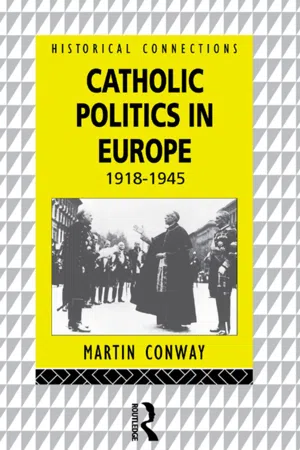
The history of Catholic political movements has long been a missing dimension of the history of Europe during the twentieth century. Martin Conway explores the fascinating history of Catholic political movements in Europe between 1918 and 1945, demonstrating the crucial role which Catholics played in the rise of fascism in Italy and Germany, the events of the Spanish Civil War and of the Second World War.
Drawing on the findings of recent research, Conway shows how Catholic political movements formed a vital element of the political life of Europe during the inter-war years. In countries as diverse as France, Germany, Italy, Spain and Austria, as well as further east in Poland, Slovakia, Croatia, and Lithuania, Catholic political parties flourished. Inspired by the values of Catholicism, these movements fought for their own political ideals; hostile to both liberal democracy and totalitarian fascism, Catholics were a 'third force' in European politics. During the Second World War, Catholic political movements continued to pursue their own goals; some chose to fight alongside the German armies, other groups joined Resistance movements to fight against German oppression and for a new social and political order based on Catholic principles.
Catholic Politics in Europe will provide an original key point of reference for twentieth century history, for comparison with fascist and communist movements of the period, and will give insight into the present-day character of Catholicism.
- 128 pages
- English
- ePUB (mobile friendly)
- Available on iOS & Android
eBook - ePub
Catholic Politics in Europe, 1918-1945
About this book
1
The Catholic heritage
It is easy to forget that Catholicism has been the major religion of twentieth-century Europe. This is not to diminish the importance of other religions, both Christian and non-Christian. In Scandinavia, Britain, the Netherlands and northern Germany as well as in areas of Switzerland, the Czech lands and Hungary, Protestantism predominated, while the different variants of the Orthodox faith were the major religion in Greece, in much of the Balkans as well as in Russia and its borderlands. Until the horrors of the Holocaust, Jewish populations—especially in central Europe, but also in almost all of the major urban centres of Europe—formed an integral element of the religious culture of Europe, while in the former lands of the Ottoman Empire Islam retained a presence, most notably in Bosnia. For most of the populations of Europe in the 1920s and 1930s, however, the Catholic faith constituted the dominant religious presence and, to a large extent, provided the religious superstructure of daily life. It was the Catholic Church that guarded the gates of entry and departure from human existence, that marked the major events of the calendar and that provided a wide range of social, cultural and educational services.
If the increasing mobility of the European populations meant that by the inter-war years Catholics were present throughout Europe, the frontiers of Catholicism nevertheless had remained largely unchanged since the religious wars of the sixteenth century. The Catholic heart of Europe was formed by a central band of territories stretching down from Belgium and southern areas of the Netherlands, through France and western and southern Germany into Austria, much of Switzerland and Italy. To the west, Catholicism was the dominant religion of Spain, Portugal and Ireland. Further east, it predominated in the Croat and Slovak areas of Yugoslavia and Czechoslovakia respectively as well as in Poland, Lithuania and much of Hungary.
These generalisations hide, however, a much more complicated reality. The steady decline in religious practice evident throughout much of Catholic and Protestant Europe from at least the end of the eighteenth century had irredeemably destroyed—if it had ever existed—any notion of a people united in their Christian faith. In many regions of Catholic Europe, large sections of the population had abandoned all but the most perfunctory contact with the structures of Catholicism while others had espoused political ideologies such as liberalism, socialism or anarchism which rejected the intellectual principles of Catholicism and sought to combat the social and political power of the Catholic Church. Religious indifference, militant atheism and political anti-clericalism became, during the nineteenth century, powerful forces with the consequence that in some regions practising Catholics formed only a small minority of the population.
Who, then, were the Catholics of inter-war Europe? The answer inevitably is complex and must also, to some extent, remain impressionistic. Religious faith is, by its very nature, a subjective phenomenon and historians possess no magic tool by which to measure the strength of religious beliefs of the past. Statistics provide only a very limited solution. Few reliable statistics of religious practice exist for many areas of Europe and, where they do, they are open to very divergent interpretations. Religious sociology is an art, not a science, which depends upon the significance that one chooses to place on certain external manifestations of religious faith, such as the baptism of children or Church attendance at Easter or Christmas. Thus, while statistics compiled in some areas of Catholic Europe during the 1920s and 1930s appear to show a stabilisation (or even a small rise) in levels of religious practice after the declines of the previous century, it is very difficult to know what conclusions to draw from this information. Did the willingness of the peoples of Europe to participate in certain Catholic rituals signify a resurgence in their religious faith or merely the pressures of fashion or of social conformism?
The only certainty is that levels of religious practice in Catholic Europe varied greatly depending on region, urbanisation, social class, age and gender. Regional differences were in many respects the most deep rooted. As the maps devised by religious sociologists have long demonstrated, commitment to religion varied markedly between different regions, or even between one community and another. Thus, in Italy the high levels of Church attendance in the north-east of the country contrasted with the almost dechristianised character of much of central Italy, while in Spain the weakness of Catholicism in southern regions such as Andalusia found its counterpoint in the strength of the Catholic faith in some northern areas, most notably Galicia and the Basque country. Similarly, in France, the traditional bastions of Catholicism in the east and west (especially in the Vendée and Brittany) contrasted with the low levels of religious practice in large areas of the centre and south of the country.
The reasons for such variations were manifold and, once established, became self-perpetuating. It would be wrong, however, to regard certain regions as being inevitably more inclined towards Catholicism. Clichés about the supposedly ‘natural’ religiosity of the Bretons or Basques disguise the reality that the strength or weakness of Catholicism in any area owed much to the position of religion and of the Church within society. Thus, Catholicism flourished in those rural areas where it succeeded in identifying with the interests of the population and where—as, for example, in Poland and Ireland during the nineteenth century—loyalty to Catholicism became a symbol of nascent nationalism and of the rejection of foreign domination.
The rapid industrialisation and urbanisation of many areas of Europe presented the Catholic Church with many new challenges. The populations drawn to the cities and to the factories often lost contact with the Church amidst the distractions of their new environments and it is not surprising that even in the 1930s many clerics still tended to look on the new large cities as places of atheist decadence. Again, however, it is impossible to generalise. While religious practice was indeed low in many urban centres, especially when—as in many Spanish cities—the Catholic authorities failed to build churches in the new industrial suburbs, there was no automatic connection between urbanisation and secularisation. New forms of religious faith gradually emerged which were better adapted to the more atomised and individualist realities of urban life while the rapid expansion in Catholic educational, welfare and cultural organisations from approximately 1870 onwards had provided the Church with new means of reaching out to the urban populations of Europe.
Despite its frequent protestations to the contrary, Catholicism could not remain immune from divisions of social class. Patterns of religious practice varied markedly between different classes in Europe during the inter-war years even if, once again, the picture was more complicated than one might at first suspect. Although often portrayed by its opponents as a tool of the ruling classes, the social basis of the Catholic Church was, in reality, considerably more diverse. During the nineteenth century, it had often been liberal elements of the bourgeoisie who were the first to reject the Church and who, especially through their membership of freemasonic lodges (which in Catholic areas of Europe assumed a strongly anti-Catholic character), had been to the fore in anti-clerical campaigns. By the end of the century, fear of social upheaval and, more especially, of atheist socialism encouraged some middle-class liberals to develop a more positive opinion of the Church but throughout the first half of the twentieth century the middle class in much of Europe remained divided between practising Catholics and those who rejected the Church in the name of the secular values of liberal progress and freedom of thought.
Working-class attitudes to Catholicism were similarly varied. In a city such as Barcelona, for example, conflicts of social class dominated patterns of religious practice. The Catholic Church was identified emphatically with the employers, and most workers espoused a virulent anti-clericalism. This pattern was repeated in many other industrial regions of Europe where Catholic practice was largely limited to the bourgeoisie and socialist movements retained during the 1920s and 1930s a strongly anti-Catholic character. Elsewhere, however, working-class Catholicism was far from being a contradiction in terms. Immigration from Ireland undermined the formerly middle-class and aristocratic character of English Catholicism, while in some industrial regions such as northern France, the German Rhineland and Upper Silesia in Poland, levels of Catholic practice always remained high among the working class. Catholic trade union confederations, youth movements and social insurance institutions expanded rapidly in size and influence in these areas and helped to create a vigorous and increasingly self-assertive working-class Catholic culture.
Alongside social class, age and gender also formed important determinants of patterns of Catholic practice. One of the defining characteristics of the Catholic religion in the modern era has been the all-pervading and often suffocating emphasis that it has placed on the glorification of children and youth, both in terms of integrating the young into the life of the Church through rituals such as first communion and through the priority given to Catholic youth movements and educational institutions. Not surprisingly, levels of religious practice were therefore higher among the young and contributed to the generational tensions evident in many areas of Europe during the 1920s and 1930s between a militant and numerous Catholic youth and their elders. If Catholicism was increasingly associated with a particular stage of life, it was also indisputably more feminine than masculine in composition. The origins of this imbalance between the genders lie in the nineteenth century and would seem to have been a product both of male alienation from the Church and the appeal that Catholicism held for many women. While its hierarchical structures and hostility to values of individual freedom alienated some men, it was the Catholic Church’s message of divine consolation, its emotional piety and the opportunity that it offered to women to engage in social and charitable activities in an otherwise male-dominated world that help to explain the positive attraction of many women to the Church.
The impact of these trends was evident in manifold ways within the Catholic Church of the inter-war years. Membership of female religious orders—devoted largely to educational and nursing work—continued to expand and women’s spiritual, welfare and youth movements were among the most important and conspicuous of Catholic associations. Above all, the piety of the Church was strongly influenced by the disproportionately female composition of its audience. The first half of the twentieth century marked the peak of a personal and emotional Catholic faith which elevated the Virgin Mary to a central role in the life of the Church and which privileged the intense, private devotion symbolised by a figure such as St Thérèse of Lisieux, a young French nun who died in 1897 and whose posthumously published writings became among the most popular devotional Catholic literature of the era. To speak, as some have done, of a feminisation of Catholicism is clearly an exaggeration for a Church that continued to be directed by an exclusively male elite; but much of the strength of the Catholic religion—and also, perhaps, part of the explanation of its marginalisation in much work by historians on inter-war Europe—lay in the symbiosis that existed between Catholicism and a certain form of female self-identity.
The social composition of the Catholic faith was therefore anything but simple. Subject to strong historic variations between different regions, rural in its roots but increasingly urban in character, bourgeois in some areas, working class in others, more young than adult, more female than male, it defies any glib generalisations. Historians eager to see the declines in religious practice in the nineteenth century and in the 1960s and 1970s as part of a unitary process have often spoken of a remorseless secularisation of Europe from the French Revolution to the present day. The term is one, however, that presents many difficulties. Not only does it ignore the forms of popular religion, such as superstitions, faith healing, pilgrimages and festivals, that have continued to flourish outside the formal structures of what is conventionally regarded as organised religion, but it can only be applied with difficulty to a period such as the early twentieth century when little overall change in religious practice can be discerned. The resilience of the Catholic faith in many areas of Europe during the 1920s and 1930s was perhaps no more than a pause in a long-term decline brought about by economic, social and technological changes, but it also might suggest that the relationship between modernisation and religious belief in Europe was more complex than has often been suggested.
In particular, it is clear that, while the effect of the social and economic transformations of Europe during the nineteenth and twentieth centuries has been to diminish the general ascendancy of Catholicism and of Catholic values within society, they also served conversely to increase the sense of community and of common purpose among Catholics. Already during the pre-1914 decades an evolution towards a new and more self-conscious Catholic identity had been evident in many areas of Europe, This trend gathered pace during the years between the two world wars. In some rural areas, such as northern Spain or the west of France, for example, the Catholic faith remained an inescapable element in the fabric of existence. The church and its priest formed the centre of the community, its festivals marked the passage of the seasons, and its statues and ceremonies furnished the symbolism of community life. Such examples were, however, increasingly rare. In many other areas, and most notably in the major cities, Catholicism was not integrated into the patterns of daily life in the same way. The basilica of Sacré Coeur (built towards the end of the nineteenth century) might loom over the Parisian skyline from Montmartre as a gesture of the ambition of the Church to direct the lives of the city’s inhabitants, but in reality Parisians could, if they so wished—and many very much did—avoid all contact with Catholicism. The converse of this rejection of the Church was that those who did participate in Catholicism were increasingly conscious of having made a choice and of being members of a distinct group in society.
The extent to which this slow revolution in the nature of Catholic faith had taken place in Europe by the 1920s and 1930s should not be exaggerated. The ‘privatisation’ of religion from social ritual to personal belief was far from uniform and was indeed opposed by many priests, who saw it as a threat to the pretensions of the Church to preach to the whole of society. For many individuals, moreover, their allegiance to Catholicism formed only one of a number of overlapping self-identities. ‘Catholic first’ was a slogan often used by the more militant Catholic movements during the 1920s and 1930s to describe their sense of overriding commitment to their faith. It was, however, misleading in its simplicity. Religious faith did not exist in isolation; rather, it was defined by family background, by ethnic or community membership or by social and educational influences. Thus, for example, the Catholic faith of Irish immigrants in England or of Croat peasants was sincere but also clearly served as a token of their membership of a particular ethnic community. To segregate the religious element from this wider context was impossible and would have been alien to their definition of their religious faith. They were Catholic because of who they were; just as they were who they were because they were Catholic.
Despite such qualifications, the Catholicism of the inter-war years was, however, marked by a rhetoric and symbolism of voluntarism and personal commitment which— especially in urban areas—did reflect the sense of identity felt by many Catholics. This was evident in a number of ways. Most obviously, it encouraged an emphasis on personal piety and contributed to the surge in the popularity of devotions such as those to the Virgin Mary and to the Sacred Heart of Jesus. It also led to an enthusiasm for what might be glibly termed the ‘voluntary extras’ of Catholicism. Regular attendance at mass was the duty of a sincere Catholic, but for increasing numbers of Catholics this formed only one element of a much wider commitment to the Catholic faith. A vogue for religious retreats, a renewed interest in missionary movements and the success of spiritual movements such as Opus Dei (Work of God) founded in Spain in 1928 were all manifestations of this more all-embracing definition of what it meant to be a Catholic.
So too was the enhanced popularity of pilgrimages. The fortuitous combination of railways and the new-found willingness of the Virgin Mary to appear to the faithful (often to children and in remote locations) had instituted an era of mass pilgrimages in the late nineteenth century to sites such as Lourdes in the French Pyrenees or Marpingen in the German Saarland. These retained their popularity during the inter-war years (Lourdes annually received almost one million pilgrims by the 1920s) but were also joined by further Marian apparitions, including those at Fatima in Portugal, at Ezkioga in the Spanish Basque country and at Beauraing and Banneux in Belgium. Such pilgrimages were not bizarre legacies of the past but an integral element of a more volatile and even febrile religious belief which manifested itself, for example, in the crowds that surged to various Cantabrian villages in northern Spain in the 1920s when it was reported that local statues of Christ on the cross had been seen to move or to weep tears.
Above all, Catholic associationism expanded rapidly. From the 1890s onwards, there was a rapid development in Catholic women’s organisations, youth movements, trade unions and workers’ associations, as well as myriad other organisations devoted to the interests of groups such as Catholic families, farmers or former soldiers. This expansion of Catholicism from the spiritual domain into many areas of social and cultural life was most pronounced in northern Europe. In Germany and the Low Countries, it took the form of enveloping the Catholic faithful in a comprehensive network of confessional organisations which—in parallel with the development of Catholic educational and welfare systems—had the effect of creating a self-contained Catholic world. This ‘ghetto’ Catholicism, as it has frequently been termed, should not be exaggerated. Despite the often extreme lengths to which it was taken, with the creation of Catholic football clubs and pigeon-racing societies, these Catholic associations rarely had the effect of excluding Catholics from wider society. Nor were the Catholics the only group to pursue such a strategy. In the Low Countries especially, this development of Catholic associationism formed part of a much broader ‘pillarisation’ of society, in which all the major sociopolitical movements—including Socialists, Liberals and Protestants—developed their own networks of cultural and social organisations.
Nevertheless, the development of these myriad Catholic associations clearly did reflect the willingness of many Catholics to regard their religious faith as something that extended beyond the doors of the Church. The implications of this more self-conscious Catholic faith for the role that Catholicism should play in society as a whole were ambivalent. On the one hand, it led some Catholics to focus on a personal piety that encouraged a withdrawal from the world. On the other, the sense of religious commitment prompted many to assert the presence of Catholicism in modern society. It was this public and, at times, almost arrogant mentality that was most prominent during the inter-war years. The Nazi mass rallies at Nuremberg or Stalinist parades have become such central images of the 1930s that it is easy to forget that these forms of mass mobilisation were far from being the monopoly of movements of the extreme right or left. Rallies, parades, uniforms and anthems were a widespread phenomenon in Europe and strongly marked the Catholicism of the era. Annual Catholic festivals, such as the Katholikentage (Catholic Days) in Germany and the Semaines Sociales Catholiques (Catholic Social Weeks) in France, were supplemented by special events such as the Eucharistic Congress attended by a million Irish Catholics in Phoenix Park in Dublin in 1932 and the similarly grandiose celebrations held at Nitra in Slovakia in 1933 to mark the 1,100th anniversary of the foundation of the first Christian church on Slovak soil. These events were consciously intended to demonstrate the strength and common purpose of the Catholic faithful. The parades of the uniformed youth movements, the acts of collective worship and the speeches by the clergy and secular leaders, all reinforced the image of a Catholic faith resolutely determined to assert its public presence.
Nor was it merely such national events that reflected this mentality. It also permeated the life of many local parishes, which were increasingly dominated by public events, such as the annual parades by Catholic organisations, open-air masses or campaigns against forms of mass entertainment deemed to reflect the pernicious spirit of modern immorality. Catholicism was more visible, more strident and in some respects more intolerant. The language of the Church and of its supporters was militant and frequently intransigent, eager to proclaim the universality of the Catholic truth and dismissive of the values of other faiths and political traditions. Such rhetoric should not, of course, be taken at face value. The euphoric declarations of young militants or the impression of categorical authority self-consciously fostered by the papacy were not representative of the mentality of all Catholics. Nor should the emphatic condemnations of liberal and socialist heresies issued from the pulpits and echoed in much of the Catholic press be allowed to disguise the spirit of common purpose that often led Catholics to collaborate with non-believers. Nevertheless, the dominant impression conveyed by Catholicism was that of a faith that sought to confront the modern world without compromise. Hierarchical in its structures, categorical in its certainties and intransigent in its relations with others, the Catholic Church presented itself as a bastion of truth in a corrupt and decadent society.
The evolution within Catholicism towards a faith that was more personal and at the same time more concerned to assert the public presence of the religion provides the background which helps to understand the expansion in Catholic political movements in Europe during the interwar years. The sense of shared identity and, simultaneously, the belief that Catholicism offered a solution to the wider problems of society created an inextricable interconnection between religious beliefs and political actions which often ran directly counter to the conventional liberal notion that religious belief was a matter of private conscience. Although some Catholic intellectuals feared that the direct involvement of Catholicism in political life symbolised by the existence of explicitly Catholic parties threatened to undermine the purity of the faith, their views were not shared by the majority of their co-believers, for whom the connection between Catholicism and politics was both necessary and natural.
This conviction was not, however, solely a product of the changing nature of the Catholic faith. It was also the legacy of past history. Throughout the nineteenth century, conflicts between the competing authorities of Church and State had dominated much of the political life of Catholic Europe. Although it would be possible to trace the origins of these disputes back to the religious wars of the sixteenth century or indeed to the interminable rivalries of monarchs and clerics of the medieval world, it was the French Revolution of 1789 that indisputably marked the beginning of these modern wars of Church and State. By elevating (even if it did not entirely invent) the notion of a secular state authority deriving its legitimacy not from God but from the people or—in its less radical form—the nation, the regimes of the Revolutionary years laid the basis for the subsequent political conflicts. In doing so, they also brought matters of religion to the centre of political life. Their efforts to subordinate the Catholic Church to the civil authorities while also trying to rationalise its structures and practic...
Table of contents
- Cover Page
- Historical Connections
- Title Page
- Copyright Page
- Series editors’ preface
- Preface
- Introduction
- 1: The Catholic heritage
- 2: The 1920s
- 3: The 1930s
- 4: Catholicism during the Second World War
- Conclusion
- Bibliography
Trusted by 375,005 students
Access to over 1.5 million titles for a fair monthly price.
Study more efficiently using our study tools.
Frequently asked questions
Yes, you can cancel anytime from the Subscription tab in your account settings on the Perlego website. Your subscription will stay active until the end of your current billing period. Learn how to cancel your subscription
No, books cannot be downloaded as external files, such as PDFs, for use outside of Perlego. However, you can download books within the Perlego app for offline reading on mobile or tablet. Learn how to download books offline
Perlego offers two plans: Essential and Complete
- Essential is ideal for learners and professionals who enjoy exploring a wide range of subjects. Access the Essential Library with 800,000+ trusted titles and best-sellers across business, personal growth, and the humanities. Includes unlimited reading time and Standard Read Aloud voice.
- Complete: Perfect for advanced learners and researchers needing full, unrestricted access. Unlock 1.5M+ books across hundreds of subjects, including academic and specialized titles. The Complete Plan also includes advanced features like Premium Read Aloud and Research Assistant.
We are an online textbook subscription service, where you can get access to an entire online library for less than the price of a single book per month. With over 1.5 million books across 990+ topics, we’ve got you covered! Learn about our mission
Look out for the read-aloud symbol on your next book to see if you can listen to it. The read-aloud tool reads text aloud for you, highlighting the text as it is being read. You can pause it, speed it up and slow it down. Learn more about Read Aloud
Yes! You can use the Perlego app on both iOS and Android devices to read anytime, anywhere — even offline. Perfect for commutes or when you’re on the go.
Please note we cannot support devices running on iOS 13 and Android 7 or earlier. Learn more about using the app
Please note we cannot support devices running on iOS 13 and Android 7 or earlier. Learn more about using the app
Yes, you can access Catholic Politics in Europe, 1918-1945 by Martin Conway in PDF and/or ePUB format, as well as other popular books in History & 20th Century History. We have over 1.5 million books available in our catalogue for you to explore.