- 272 pages
- English
- ePUB (mobile friendly)
- Available on iOS & Android
eBook - ePub
About this book
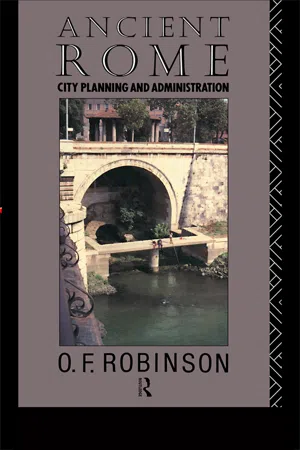
Rome was a huge city. Running it required not only public works and services but also specialised law. This innovative work traces the development of that law and system in the main areas of administration. The book incorporates and develops previous historical and topographical works by relating their findings to the Roman legal framework, building up a portrait of public administration, unusually comprehensive for the ancient world.
1
THE PHYSICAL CITY
The city founded by Romulus lay conveniently on a permanently navigable river, not too far from the sea—some 24 kilometres in a direct line, more than 30 by water—and was easily fortified. In addition the site was well supplied with springs, and healthy because of the hill-top breezes. The founder might almost have had foreknowledge of the city’s destiny, says Cicero.1
THE CITY’S BOUNDARIES
The City was properly the area within the pomerium. This was created when a furrow was solemnly ploughed round the site of a city, of which the earth made a wall—murus—on the inner side; within this was the post-murum, marked out with stones. It set limits for the taking of the auspices for the city.2 Though the pomerium remained the limit of the City for religious functions, it had ceased to be so for administrative purposes even before the first century BC, when Sulla is said to have enlarged it.3 His pomerium seems to have coincided with the Servian Wall (traditionally the city wall of the regal period, though what survives dates largely from the fourth century, after the Gallic sack; it was restored in 87 BC), except that the Aventine was excluded. It was further extended by Julius Caesar, 4 Claudius,5 Vespasian,6 and Aurelian.7 (It seems reasonably certain that Augustus did not extend it;8 as Mommsen pointed out, he got what he wanted, and more flexibly, through the establishment of the Fourteen Regions.9)
Claudius’ motives may well have been partially fiscal;10 if the portoria, the duties levied at the gates,11 were charged at the pomerium, then to include the Emporium and Monte Testaccio areas and also the land between the via Flaminia and the Tiber within the official City boundary would bring in all the most commercially active districts; the Aventine proper and the Pincian were of less commercial importance but, being well-populated, they were better in than out. Claudius may well have had also a legal and antiquarian interest in bringing about a greater coincidence between the pomerium and the XIV regions (or indeed the built-up area) since technically so many matters of religion and of jurisdiction were confined to the City. Surviving cippi (marker stones) give some indication of the limits to which Claudius and Vespasian extended it, and Hadrian seems to have restored their work.12 The pomerium probably never extended across the Tiber, and there remains uncertainty about the western side in general.13 The Aurelian Wall was probably built simply to the demands of defensive tactics;14 the built-up area of the City at the end of the Republic seems already to have stretched considerably beyond its future line, as much as 5 or even 10 kilometres from the city centre.15 The wall seems to lie on the approximate line of Commodus’ customs frontier for the City, which itself perhaps originated in Vespasian’s censorship and extension of the pomerium16 (also marked by cippi17).
have been found, but if Aurelian did extend it, his wall presumably marked the line.
Defining the City and its boundaries was also necessary for legal purposes. A procurator was held to act for one who was present in Rome if his principal was in the gardens,18 in the forum, in the city or in the built-up area.19 When there was a legacy of ‘the victuals which are at Rome’, it was questioned whether this meant what was within the built-up area or only what was within the wall; while the boundary of most cities was their wall, at Rome it was the built-up area, and it was this which defined the City of Rome.20 We find Gaius explaining that ‘statutory courts are defined as being in the City of Rome or within one mile of the City’.21 Here, ‘in the City’ might mean within the pomerium or the walls, and the mile must surely have been somewhat elastic since the built-up area is not static; 22 one may compare the definition of the jurisdiction of the Urban Prefect as exercisable within a hundred Roman miles.23 The mille passus—or thousand yard —doctrine was certainly familiar to Gaius, but as early as the so-called lex Julia municipalis of Julius Caesar’s time there are several such references.24 The jurists, however, did not refer to the pomerium, and seem generally to have been concerned to minimise any anomalies: ‘As Alfenus says, “the city” is Rome girdled with a wall’—one must remember that when the jurists were writing Ro me’s walls were still Servian—“‘Rome” is also the built-up area…by everyday usage’.25 Paul said much the same and so did Terentius Clemens.26
POPULATION
Probably some three-quarters of a million people lived within this area at the end of the Republic.27 Attempts have been made to estimate the population by using the figures given for the number of recipients of the grain dole,28 or the information on the number of houses and apartment blocks listed topographically in the Regionaries.29 In general the arguments of Brunt30 seem convincing. The City was probably at its largest in the mid-second century, and the likeliest rough figure for its population then, taking into account the alleged Augustan base, is a million plus. Although figures given in the Regionaries31 are undoubtedlycorrupt and frequently inflated, as is clear from the seating alleged for the Colosseum (and it is hard to believe the numbers of horrea, for example, listed for the Palatine), nevertheless archaeology reveals facilities for a numerous resident population, even allowing for many visitors. An article by Hermansen ends with a citation from Ammianus,32 for whom the expulsion of teachers from the City in 383 was recent; the actors and dancing girls, however, had remained to pacify the populace. ‘A city which absorbs 3,000 foreign chorus girls has a considerable population’33 It is agreed by all that Rome shrank considerably in the third century and that the foundation of Constantinople as a rival capital— New Rome—will also have drawn off considerable numbers, so the population in the time of Constantine and his sons is likely to have been under the half million. (Modern Glasgow is a city of comparable size, which has been over the million and has now shrunk.)
THE DIVISIONS OF THE CITY
The City and its population were subdivided. In the Republic there were four regiones within the pomerium, Suburana, Esquilina, Collina and Palatina,34 the original basis of the four urban tribes; the Capitoline seems to have been excluded from the organisation, rather like Washington, DC. Their significance may have been primarily religious,35 but there also may have been an administrative function; at any rate in the so-called Caesarian lex Julia municipalis36 the two curule and the two plebeian aediles are ‘to arrange between themselves, either by agreement or by lot, in which part of the City each of themshall see to the repairing and paving of the public roads within the City of Rome and within one mile of the City of Rome, and shall have the special charge of such business’. But the four regiones did not long survive this law.
In 7 BC Augustus created a new administrative order within the City, dividing it into fourteen regiones;37 this was presumably linked with his division of Italy into new administrative regions.38 The outline boundaries of these regiones are fairly generally agreed39 (but there is room for doubt and argument in some details); they were presumably extended outwards as the City grew. Their outer boundaries do not seem to have coincided with the pomerium or with the Aurelian Wall; they...
Table of contents
- COVER PAGE
- TITLE PAGE
- COPYRIGHT PAGE
- PREFACE
- INTRODUCTION LIMITATIONS OF SPACE AND TIME
- 1: THE PHYSICAL CITY
- 2: PLANNING: THE OVERALL VIEW
- 3: BUILDING CONTROLS
- 4: PUBLIC BUILDINGS AND PUBLIC WORKS
- 5: STREETS AND THOROUGHFARES
- 6: THE TIBER
- 7: WATER AND FIRE
- 8: PUBLIC HEALTH
- 9: CONTROL OF SERVICES
- 10: FEEDING THE CITY
- 11: SHOWS AND SPECTACLES
- 12: THE FORCES OF LAW AND ORDER
- 13: PUBLIC ORDER
- 14: LOOSE ENDS
- BIBLIOGRAPHY
- ADDITIONAL BIBLIOGRAPHY
Trusted by 375,005 students
Access to over 1.5 million titles for a fair monthly price.
Study more efficiently using our study tools.
Frequently asked questions
Yes, you can cancel anytime from the Subscription tab in your account settings on the Perlego website. Your subscription will stay active until the end of your current billing period. Learn how to cancel your subscription
No, books cannot be downloaded as external files, such as PDFs, for use outside of Perlego. However, you can download books within the Perlego app for offline reading on mobile or tablet. Learn how to download books offline
Perlego offers two plans: Essential and Complete
- Essential is ideal for learners and professionals who enjoy exploring a wide range of subjects. Access the Essential Library with 800,000+ trusted titles and best-sellers across business, personal growth, and the humanities. Includes unlimited reading time and Standard Read Aloud voice.
- Complete: Perfect for advanced learners and researchers needing full, unrestricted access. Unlock 1.5M+ books across hundreds of subjects, including academic and specialized titles. The Complete Plan also includes advanced features like Premium Read Aloud and Research Assistant.
We are an online textbook subscription service, where you can get access to an entire online library for less than the price of a single book per month. With over 1.5 million books across 990+ topics, we’ve got you covered! Learn about our mission
Look out for the read-aloud symbol on your next book to see if you can listen to it. The read-aloud tool reads text aloud for you, highlighting the text as it is being read. You can pause it, speed it up and slow it down. Learn more about Read Aloud
Yes! You can use the Perlego app on both iOS and Android devices to read anytime, anywhere — even offline. Perfect for commutes or when you’re on the go.
Please note we cannot support devices running on iOS 13 and Android 7 or earlier. Learn more about using the app
Please note we cannot support devices running on iOS 13 and Android 7 or earlier. Learn more about using the app
Yes, you can access Ancient Rome by O. F. Robinson in PDF and/or ePUB format, as well as other popular books in History & Ancient History. We have over 1.5 million books available in our catalogue for you to explore.