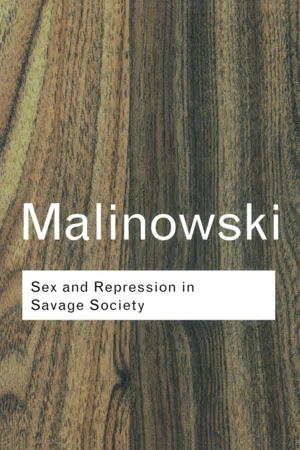
During the First World War the pioneer anthropologist Bronislaw Malinowski found himself stranded on the Trobriand Islands, off the eastern coast of New Guinea. By living among the people he studied there, speaking their language and participating in their activities, he invented what became known as 'participant-observation'. This new type of ethnographic study was to have a huge impact on the emerging discipline of anthropology. In Sex and Repression in Savage Society Malinowski applied his experiences on the Trobriand Islands to the study of sexuality, and the attendant issues of eroticism, obscenity, incest, oppression, power and parenthood. In so doing, he both utilized and challenged the psychoanalytical methods being popularized at the time in Europe by Freud and others. The result is a unique and brilliant book that, though revolutionary when first published, has since become a standard work on the psychology of sex.
Psycho-analysis was born from medical practice, and its theories are mainly psychological, but it stands in close relation to two other branches of learning—biology and the science of society. It is perhaps one of its chief merits that it forges another link between these three divisions of the science of man. The psychological views of Freud—his theories of conflict, repression, the unconscious, the formation of complexes—form the best elaborated part of psycho-analysis, and they cover its proper field. The biological doctrine—the treatment of sexuality and of its relation to other instincts, the concept of the ‘libido’ and its various transformations—is a part of the theory which is much less finished, less free from contradictions and lacunæ, and which receives more criticism, partly spurious and partly justified. The sociological aspect, which most interests us here, will deserve more attention. Curiously enough, though sociology and anthropology have contributed most evidence in favour of psycho-analysis, and though the doctrine of the Œdipus complex has obviously a sociological aspect, this aspect has received the least attention.
Psycho-analytic doctrine is essentially a theory of the influence of family life on the human mind. We are shown how the passions, stresses and conflicts of the child in relation to its father, mother, brother and sister result in the formation of certain permanent mental attitudes or sentiments towards them, sentiments which, partly living in memory, partly embedded in the unconscious, influence the later life of the individual in his relations to society. I am using the word sentiment in the technical sense given to it by Mr. A. F. Shand, with all the important implications which it has received in his theory of emotions and instincts.
The sociological nature of this doctrine is obvious—the whole Freudian drama is played out within a definite type of social organization, in the narrow circle of the family, composed of father, mother, and children. Thus the family complex, the most important psychological fact according to Freud, is due to the action of a certain type of social grouping upon the human mind. Again, the mental imprint received by every individual in youth exercises further social influences, in that it predisposes him to the formation of certain ties, and moulds his receptive dispositions and his creative power in the domains of tradition, art, thought, and religion.
Thus the sociologist feels that to the psychological treatment of the complex there should be added two sociological chapters: an introduction with an account of the sociological nature of family influences, and an epilogue containing the analysis of the consequences of the complex for society. Two problems therefore emerge for the sociologist.
First problem. If family life is so fateful for human mentality, its character deserves more attention. For the fact is that the family is not the same in all human societies. Its constitution varies greatly with the level of development and with the character of the civilization of the people, and it is not the same in the different strata of the same society. According to theories current even today among anthropologists, the family has changed enormously during the development of humanity, passing from its first promiscuous form, based on sexual and economic communism, through ‘group-family’ based on ‘group-marriage’, ‘consanguineous family’, based on ‘Punalua marriage’, through the Grossfamilie and clan kindred to its final form in our present-day society—the individual family based on monogamous marriage and the patria potestas. But apart from such anthropological constructions which combine some fact with much hypothesis, there is no doubt that from actual observation among present-day savages we can see great variations in the constitution of the family. There are differences depending on the distribution of power which, vested in a varying degree in the father, give the several forms of patriarchy, or vested in the mother, the various sub-divisions of mother-right. There are considerable divergencies in the methods of counting and regarding descent—matriliny based on ignorance of fatherhood and patriliny in spite of this ignorance; patriliny due to power, and patriliny due to economic reasons. Moreover, differences in settlement, housing, sources of food supply, division of labour and so on, alter greatly the constitution of the human family among the various races and peoples of mankind.
The problem therefore emerges: do the conflicts, passions and attachments within the family vary with its constitution or do they remain the same throughout humanity? If they vary, as in fact they do, then the nuclear complex of the family cannot remain constant in all human races and peoples; it must vary with the constitution of the family. The main task of psycho-analytic theory is, therefore, to study the limits of the variation; to frame the appropriate formula; and finally, to discuss the outstanding types of family constitution and to state the corresponding forms of the nuclear complex.
With perhaps one exception,1 this problem has not yet been raised, at least not in an explicit and direct manner. The complex exclusively known to the Freudian School, and assumed by them to be universal, I mean the Œdipus complex, corresponds essentially to our patrilineal Aryan family with the developed patria potestas, buttressed by Roman law and Christian morals, and accentuated by the modern economic conditions of the well-to-do bourgeoisie. Yet this complex is assumed to exist in every savage or barbarous society. This certainly cannot be correct, and a detailed discussion of the first problem will show us how far this assumption is untrue.
The second problem. What is the nature of the influence of the family complex on the formation of myth, legend, and fairy tale, on certain types of savage and barbarous customs, forms of social organization and achievements of material culture? This problem has been clearly recognized by the psycho-analytic writers who have been applying their principles to the study of myth, religion, and culture. But the theory of how the constitution of the family influences culture and society through the forces of the family complex has not been worked out correctly. Most of the views bearing on this second problem need a thorough revision from the sociological point of view. The concrete solutions, on the other hand, offered by Freud, Rank and Jones of the actual mythological problems are much sounder than their general principle that the ‘myth is the secular dream of the race’.
Psycho-analysis, by emphasizing that the interest of primitive man is centred in himself and in the people around him, and is of a concrete and dynamic nature, has given the right foundation
1 I refer to Mr. J. C. Flügel's The Psycho-Analytic Study of the Family, which, though written by a psychologist, is throughout orientated in the sociological direction. The later chapters, especially XV and XVII, contain much which is an approach to the present problem, although the writer does not formulate it explicitly.
to primitive psychology, hitherto frequently immeshed in a false view of the dispassionate interest of man in nature and of his concern with philosophic speculations about his destiny. But by ignoring the first problem, and by making the tacit assumption that the Œdipus complex exists in all types of society, certain errors have crept into the anthropological work of psychoanalysts. Thus they cannot reach correct results when they try to trace the Œdipus complex, essentially patriarchal in character, in a matrilineal society; or when they play about with the hypotheses of group-marriage or promiscuity, as if no special precautions were necessary when approaching conditions so entirely foreign to the constitution of our own form of family as it is known to psycho-analytic practice. Involved in such contradictions, the anthropologizing psycho-analyst makes a hypothetical assumption about some type of primitive horde, or about a prehistoric prototype of the totemic sacrifice, or about the dream character of the myth, usually quite incompatible with the fundamental principles of psycho-analysis itself.
Part I of the present work is essentially an attempt based on facts observed at first hand among savages, to discuss the first problem—the dependence of the nuclear complex upon the constitution of the family. The treatment of the second problem is reserved for Part II, while in the last two parts the same twin subjects are discussed in a general manner.
THE FAMILY IN FATHER-RIGHT AND MOTHER-RIGHT
The best way to examine this first problem—in what manner the ‘family complex’ is influenced and modified by the constitution of the family in a given society—is to enter concretely into the matter, to follow up the formation of the complex in the course of typical family life, and to do it comparatively in the case of different civilizations. I do not propose here to survey all forms of human family, but shall compare in detail two types, known to me from personal observation: the patrilineal family of modern civilization, and the matrilineal family of certain island communities in North-Western Melanesia. These two cases, however, represent perhaps the two most radically different types of family known to sociological observation, and will thus serve our purpose well. A few words will be necessary to introduce the Trobriand Islanders of North-Eastern New Guinea (or North-Western Melanesia) who will form the other term of our comparison, besides our own culture.
These natives are matrilineal, that is, they live in a social order in which kinship is reckoned through the mother only, and succession and inheritance descend in the female line. This means that the boy or girl belongs to the mother's family, clan and community: the boy succeeds to the dignities and social position of the mother's brother, and it is not from the father but from the maternal uncle or maternal aunt, respectively, that a child inherits its possessions.
Every man and woman in the Trobriands settles down eventually to matrimony, after a period of sexual play in childhood, followed by general licence in adolescence, and later by a time when the lovers live together in a more permanent intrigue, sharing with two or three other couples a communal ‘bachelor's house’. Matrimony, which is usually monogamous, except with chiefs, who have several wives, is a permanent union, involving sexual exclusiveness, a common economic existence, and an independent household. At first glance it might appear to a superficial observer to be the exact pattern of marriage among ourselves. In reality, however, it is entirely different. To begin with, the husband is not regarded as the father of the children in the sense in which we use this word; physiologically he has nothing to do with their birth, according to the ideas of the natives, who are ignorant of physical fatherhood. Children, in native belief, are inserted into the mother's womb as tiny spirits, generally by the agency of the spirit of a deceased kinswoman of the mother.1 Her husband has then to protect and cherish the children, to ‘receive them in his arms’ when they are born, but they are not ‘his’ in the sense that he has had a share in their procreation.
The father is thus a beloved, benevolent friend, but not a recognized kinsman of the children. He is a stranger, having authority through his personal relations to the child, but not through his sociological position in the lineage. Real kinship, that is identity of substance, ‘same body’, exists only through the mother. The authority over the children is vested in the mother's brother. Now this person, owing to the strict taboo which prevents all friendly relations between brothers and sisters, can never be intimate with the mother, or therefore with her household. She recognizes his authority, and bends before him as a commoner before a chief, but there can never be tender relations between them. Her children are, however, his only heirs and successors, and he wields over them the direct potestas. At his death his worldly goods pass into their keeping, and during his lifetime he has to hand over to them any special accomplishment he may possess—dances, songs, myths, magic and crafts. He also it is who supplies his sister and her household with food, the greater part of his garden produce going to them. To the father, therefore, the children look only for loving care and tender companionship. Their mother's brother represents the principle of discipline, authority, and executive power within the family.1
The bearing of the wife towards her husband is not at all servile. She has her own possessions and her own sphere of influence, private and public. It never happens that the children see their mother bullied by the father. On the other hand, the father is only partially the bread-winner, and has to work mainly for his own sisters, while the boys know that when they grow up they in turn will have to work for their sisters' households.
Marriage is patrilocal: that is, the girl goes to join her husband in his house and migrates to his community, if she comes from another, which is in general the case. The children therefore grow up in a community where they are legally strangers, having no right to the soil, no lawful pride in the village glory; while their home, their traditional centre of local patriotism, their possessions, and their pride of ancestorship are in another place. Strange combinations and confusion arise, associated with this dual influence.
From an early age boys and girls of the same mother are separated in the family, owing to the strict taboo which enjoins that there shall be no intimate relations between them, and that above all any subject connected with sex should never interest them in common. It thus comes about that though the brother is really the person in authority over the sister, the taboo forbids him to use this authority when it is a question of her marriage. The privilege of giving or withholding consent, therefore, is left to the parents, and the father—her mother's husband—is the person who has most authority, in this one matter of his daughter's marriage.
The great difference in the two family types which we are going to compare is beginning to be clear. In our own type of family we have the authoritative, powerful husband and father backed up by society.1 We have also the economic arrangement whereby he is the bread-winner, and can—nominally at least— withhold supplies or be generous with them at his will. In the Trobriands, on the other hand, we have the independent mother and her husband, who has nothing to do with the procreation of the children, and is not the bread-winner, who cannot leave his possessions to the children, and has socially no established authority over them. The mother's relatives on the other hand are endowed with very powerful influence, especially her brother, who is the authoritative person, the producer of supplies for the family, and whose possessions the sons will inherit at his death. Thus the pattern of social life and the constitution of the family are arranged on entirely different lines from those of our culture.
It might appear that while it would be interesting to survey the family life in a matrilineal society, it is superfluous to dwell on our own family life, so intimately known to everyone of us and so frequently recapitulated in recent psycho-analytic literatur...
Table of contents
Cover
Sex and Repression in Savage Society
Full Title
Copyright
Dedication
Contents
PREFACE
PART I The Formation of a Complex
PART II The Mirror of Tradition
PART III Psycho-analysis and Anthropology
PART IV Instinct and Culture
INDEX
Trusted by 375,005 students
Access to over 1.5 million titles for a fair monthly price.
Study more efficiently using our study tools.
Frequently asked questions
Yes, you can cancel anytime from the Subscription tab in your account settings on the Perlego website. Your subscription will stay active until the end of your current billing period. Learn how to cancel your subscription
No, books cannot be downloaded as external files, such as PDFs, for use outside of Perlego. However, you can download books within the Perlego app for offline reading on mobile or tablet. Learn how to download books offline
We are an online textbook subscription service, where you can get access to an entire online library for less than the price of a single book per month. With over 1.5 million books across 990+ topics, we’ve got you covered! Learn about our mission
Look out for the read-aloud symbol on your next book to see if you can listen to it. The read-aloud tool reads text aloud for you, highlighting the text as it is being read. You can pause it, speed it up and slow it down. Learn more about Read Aloud
Yes! You can use the Perlego app on both iOS and Android devices to read anytime, anywhere — even offline. Perfect for commutes or when you’re on the go. Please note we cannot support devices running on iOS 13 and Android 7 or earlier. Learn more about using the app
Yes, you can access Sex and Repression in Savage Society by Bronislaw Malinowski in PDF and/or ePUB format, as well as other popular books in Social Sciences & Human Sexuality in Psychology. We have over 1.5 million books available in our catalogue for you to explore.