eBook - ePub
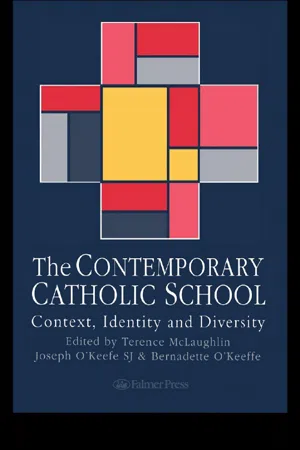
The Contemporary Catholic School
Context, Identity And Diversity
- 328 pages
- English
- ePUB (mobile friendly)
- Available on iOS & Android
eBook - ePub
The Contemporary Catholic School
Context, Identity And Diversity
About this book
This collection of essays by American and British authors discusses how the methods and issues of Catholic schooling are becoming of increasing interest to non-Catholic schools - due to the Catholic method of schooling being perceived as more humane.
Information
Chapter 1
Setting the Scene: Current Realities and Historical Perspectives
Terence H.McLaughlin, Joseph O’Keefe S.J. and Bernadette O’Keeffe
This volume is designed to contribute to the research effort which is needed if appropriate forms of analysis and enquiry are to be brought to bear on the many issues which arise concerning the contemporary Catholic school. Written by contributors from both sides of the Atlantic, and from a number of different disciplinary backgrounds and points of view, these essays tackle a number of the central questions which confront Catholic schools today.
The volume arises in part from a conference on ‘The Contemporary Catholic School and the Common Good’ which was jointly organized by the Von Hügel Institute at St Edmund’s College in the University of Cambridge and Boston College which was held at St Edmund’s in July 1993. The conference featured Professor Bryk from the University of Chicago as its main speaker and included participants from the UK, Ireland and the United States concerned with questions of Catholic education, including educational practitioners and policy makers, as well as theologians, philosophers, sociologists and psychologists working in the academic study of education and in educational research. A number of the papers presented at the conference are included in this book, together with additional papers especially commissioned by the editors.
The themes of context, identity and diversity are prominent throughout the volume. We shall consider briefly each of these themes in turn.
Context
It is necessary to provide some general and historical background relating to the context of contemporary Catholic schools on both sides of the Atlantic. The two contexts differ in a number of significant respects. In England and Wales, for example, Catholic schools enjoy considerable support from public funds in a way inconceivable in the United States. In the US, the term ‘Catholic school’ embraces the higher education sector, whereas in England and Wales the Catholic element of the higher education sector is small and there are no Catholic universities. In this volume we shall be confining attention to Catholic institutions of learning for students up to the age of 18. Before looking in more detail at some comparative statistics relating to Catholic schools in England and Wales and in the US, we offer a historical perspective from which they can be viewed.
Historical Context of Catholic Schools in England and Wales
In a review of the roots of the emergence of the post-Reformation English Catholic community, Hornsby-Smith identifies four distinct strands. First, ‘recusant Catholics’, those Catholics who can trace the continuity of their Catholicism from pre-Reformation times. The term recusant was used to refer to Catholics who were subject to penal taxation and fines because of their refusal to attend Anglican services. There are an estimated 650,000 successors of ‘recusant’ Catholics in England and Wales who can trace their Catholicism to the pre-Reformation period (Hornsby-Smith, 1987, pp. 23–4). These ‘Old Catholics’ for the most part were members of the aristocracy; landowners together with their tenants and defendants.
A second strand in the growth of the post-Reformation Catholic Church was conversion. Between 1900 and 1960, it was estimated that there were 740,000 adult conversions to Catholicism in Britain (Hornsby-Smith, 1987, p. 23). A significant number of converts were influenced by Newman. In 1952, converts over the age of 14 reached a peak and accounted for 10.2 per cent of all baptisms (Spencer, 1975). More recently, the 1978 study of Roman Catholic opinion estimates that approximately 11 per cent of Catholic adults are converts (Hornsby-Smith, 1987, p. 24).
Third, Irish immigrants made a vital contribution to the growth of the Catholic community. For more than a century, Irish immigration was one of the most important factors in the Catholic revival. Cardinal Manning, writing in 1890, noted that eight-tenths of the Catholic population in England were Irish. However, the Irish Catholic factor had been important long before the immigration which followed the famine (Gwynn, 1950, p. 266). The number of Irish priests who had come to minister before the Hierarchy was restored increased greatly when new parishes were created which literally laid the foundations of the subsequent progress (Gwynn, 1950, p. 289). Bishop Ward, writing some twenty years later about the Catholic revival, makes the point that Irish immigration after the famine:
…affected the future of Catholicism in this country more than the Oxford Movement, for it was the influx of Irish in 1844 and the following years which made our congregations what they are… Up to that time, English Catholics relied for the building of their churches almost solely on the donations of the few hereditary Catholics and others of the upper classes; after Irish immigration, it became possible to build from the pennies of the poor. Many missions owe their very existence, including serviceable churches and schools, to the large Irish congregations. (Gwynn, 1950, p. 270)
In general, the Irish Catholics settled initially in specific areas, particularly in London and crowded northern cities and they were subject to marked religious and racial discrimination. Throughout the nineteenth century, large sections of the Catholic community continued to face hardship, insecurity and powerlessness born out of poverty and economic insecurity. The newly built churches and schools were central to their lives insofar as they nurtured a sense of identity and group solidarity. Those nineteenth century Irish immigrants brought to the Church in Britain more than their deeply rooted faith. Their peasant, rural (foreign) origins contrasted starkly with the educated aristocratic and landowning ‘old English’ Catholic stock. A reflection of the class structure in the wider society became manifest in the body of the Catholic community.
Fourth, a large number of Catholics who were born in countries outside the British Isles, enlarged the Catholic community. The greatest numbers came from Italy and Poland. It is estimated that there are now over 100,000 Catholics from Africa, West Indian and Asian countries. Estimates suggest that there are about 460,000 second generation immigrants in the population as a whole whose origins lie outside of the British Isles (Hornsby-Smith, 1989, pp. 86–7).
The year 1850 was critical for Catholics in England and Wales. Not only was the Hierarchy restored, but it was a time when the Bishops had ‘all but everything to do’ as Hughes notes:1
They had to provide everywhere the urgently needed priests, and churches, and schools—and these schools, in that age when for poor men’s children there were no schools save those which religious bodies built and maintained, were not only the security that education should be centred round the knowledge of God, but they were sole means of instructing the working classes in the rudiments of reading and writing. (Hughes, 1950, p. 4)
Additionally, the bishops in seeking to defend the faith against ‘old bitter calumnies’ confronted the need to tackle the widespread prejudice, ignorance and misunderstanding of Catholic beliefs and practices. Hughes refers to Greville’s comments on the prevailing climate: ‘While everything else is in a constant state of change, Protestant bigotry and anti-Catholic rancour continue to flourish with undiminished intensity, and all the more from being founded on nothing but prejudice and ignorance, without a particle of sense and reason’ (Hughes, 1950, p. 4).
By the middle of the nineteenth century, Catholic schools already existed for educating the children of the upper classes. These schools, apart from a few exceptions, were long standing and flourished on the Continent in Penal Times. They were single sex schools founded by religious teaching orders. For their existence, these schools had to depend on school fees and endowments thus largely limiting their intake to pupils whose parents could afford them. Many of these schools had a considerable number of non-Catholic pupils.
State intervention in Catholic education was introduced in 1847 when the State gave a grant to the Catholic Poor School Committee which was set up to help with the founding of Catholic schools. The grant signified an important point in the history of Catholic schools as it implied a recognition that the Catholic school sector was an integral part of the national provision of state maintained education. In the following quarter of the century, Catholics built 439 churches and the number of priests virtually doubled to 1,634. A momentum to build and maintain a system of elementary schools was generated. Whereas in 1851 there were 99 elementary Catholic schools with a pupil population of 7,769, by 1874 there were 1,484 schools and 100,372 pupils (Hughes, 1950, p. 20). As Beales notes, the bishops were single-minded on the ‘schools question’. So much so, he observes that: ‘Whereas the story of Catholic secondary education is the story of the Religious Orders, that of the primary schools for the masses is the story of the Bishops to the extent which makes the two parts of the picture delineable separately without doing violence to the whole’ (Hughes, 1950, p. 367). Despite the formidable constraints on Catholics, pioneers of Catholic elementary education set up schools for educating and (later) clothing and (still later) apprenticing poor Catholic children. The policy of the Secretary of the Poor School Committee, Thomas William Allies (1853–90) was based on three maxims: ‘There can be no sound education without religion. As is the teacher so is the child. As is the trainer so is the teacher’ (Hughes, 1950, p. 372).
From their inception, Catholic elementary schools were established on a parochial basis and controlled by the parish priest or a religious teaching order, and set out to preserve the religious culture between parish, school, and home, which assisted the Church in its mission of ‘preserving the faithful’ in a world sheltered from alien influences.
The consistently declared policy of providing a place for every Catholic child in a Catholic school derived from Canon 1374 which simply stipulated that policy, but as Sharratt notes, this question was also coloured by the tone of Canon 2313 which prescribed excommunication for a Catholic who entered a ‘mixed marriage’ with the intention of educating children outside the faith. The link between the two—education and marriage ‘suggested a deliberately self perpetuating process of social enclosure’ (Sharratt, 1977, p. 130). Not surprisingly, the past tensions and suspicions which bequeathed a long legacy of mistrust between Catholics and the wider society led the Catholic Church to pursue a separatist policy of Catholic education. The bishops were single-minded in their attempt to maintain a religious subculture against perceived threats of an increasingly secular society and what they saw as an emerging secular state school system. As a result, the Church carried out its educational role in relative isolation from the wider state maintained education system. The pursuit of a separate Catholic school system and the emphasis on religious endogamy was a major mechanism by which the Catholic community maintained its group identity.
Increased financial support was given when the Elementary Act of 1870 established a national educational system. However, the issue of state funding for denominational schools, both Anglican and Catholic, was surrounded by ideological storms of conflict and sectarian bitterness.2 Nevertheless, there was general agreement that no education, whether provided by the State or the Churches could be regarded as complete without instruction in the Christian religion. The disagreement was over the content of the instruction.
The basic claims of the Catholic Church for a separate school system and control over the religious curriculum and moral teaching were based on the natural rights and duties of parents to have their children educated according to their consciences; and a civic right in respect of financial justice, in the sense that the education of a child should not cost a Catholic parent relatively more than parents who sent their children to other schools.
The partnership between the Catholic Church and State was advanced by the Act of 1902, which formed the basis of what has become known as the ‘dual system’ of Church and County schools.3 By 1920, the Catholic community in England and Wales had grown to over two million. By this time, Catholic schools were educating some 400,000 children. Importantly, this period ushered in a growing acceptance of Catholic educational claims for publicly funded Catholic education.
The 1944 Education Act did much to build a climate of common interest and a strong sense of partnership. It marked a new relationship between the Catholic Church and State by bringing both partners into a single publicly funded national education system. It was the end of passionate intensity after decades of strident opposition. Religious teaching in Catholic schools continued to be both instructional, in the sense of teaching pupils the Catholic faith and ‘ecclesiastical’ so as to encourage pupils to become full and participating members of the Catholic Church. The Act facilitated the building up of the Catholic schools sector and as Hastings observes, the Act ‘raised them educationally without submerging them religiously’ (Hastings, 1986, p. 422). It put an end to a much declared principle expressed by opponents of Church schools that there should be no denominational teaching in schools provided for by public money.
The 1944 Education Act made possible the objective of the Catholic bishops to establish a network of schools, initially at primary level, but later at secondary level with a minimum of encroachment on the Church’s autonomy. In 1974, the Catholic school population peaked with almost half a million children attending primary schools. An additional 352,642 pupils were receiving their education in Catholic secondary schools.4
The history of Catholic elementary schools is one of self-help, of enormous financial commitment and immense striving in pursuit of a Catholic school sector. Expansion, progress and achievement were painstakingly won by generations of Catholics. The Catholic Church invested vast resources, personal and financial, in the development of a system of Catholic primary and secondary schools within the state maintained sector. However, despite its enormous commitment, by the mid 1960s only 60 per cent of Catholic children had access to a Catholic school.
In the late 1950s, the breaking up of the old working class Catholic culture, when the younger generations moved out of the inner cities to the suburbs and new housing estates, was an important factor contributing to change in the hitherto flourishing Catholic community. The changes initiated by the 1944 Education Act were themselves symptomatic of wider and deeper currents within society at large. Greater social mobility, a lessening of deference in the face of authority and an enlargement of horizons in many directions has characterized the post-war experience. The growth of secular institutions offered...
Table of contents
- Cover Page
- Title Page
- Copyright Page
- Chapter 1: Setting the Scene: Current Realities and Historical Perspectives
- Part 1: The Context of the Contemporary Catholic School
- Part 2: The Identity of the Catholic School
- Part 3: Social Justice, Diversity and the Catholic School
- Part 4: Catholic Schools: The Way Forward
- Notes On Contributors
Trusted by 375,005 students
Access to over 1.5 million titles for a fair monthly price.
Study more efficiently using our study tools.
Frequently asked questions
Yes, you can cancel anytime from the Subscription tab in your account settings on the Perlego website. Your subscription will stay active until the end of your current billing period. Learn how to cancel your subscription
No, books cannot be downloaded as external files, such as PDFs, for use outside of Perlego. However, you can download books within the Perlego app for offline reading on mobile or tablet. Learn how to download books offline
We are an online textbook subscription service, where you can get access to an entire online library for less than the price of a single book per month. With over 1.5 million books across 990+ topics, we’ve got you covered! Learn about our mission
Look out for the read-aloud symbol on your next book to see if you can listen to it. The read-aloud tool reads text aloud for you, highlighting the text as it is being read. You can pause it, speed it up and slow it down. Learn more about Read Aloud
Yes! You can use the Perlego app on both iOS and Android devices to read anytime, anywhere — even offline. Perfect for commutes or when you’re on the go.
Please note we cannot support devices running on iOS 13 and Android 7 or earlier. Learn more about using the app
Please note we cannot support devices running on iOS 13 and Android 7 or earlier. Learn more about using the app
Yes, you can access The Contemporary Catholic School by Terence McLaughlin, Joseph O'Keefe, Terence McLaughlin,Joseph O'Keefe, Terence McLaughlin, Joseph O'Keefe, Joseph O'Keefe in PDF and/or ePUB format, as well as other popular books in Education & Education General. We have over 1.5 million books available in our catalogue for you to explore.