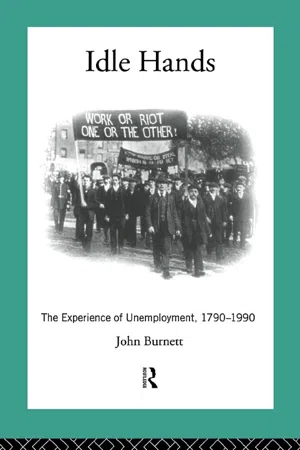
Idle Hands is the first major social history of unemployment in Britain covering the last 200 years. It focuses on the experiences of working people in becoming unemployed, coping with unemployment and searching for work, and their reactions and responses to their problems. Direct evidence of the impact of unemployment drawn from extensive personal biographies complements economic and statistical analysis.
eBook - ePub
Idle Hands
The Experience of Unemployment, 1790-1990
- 384 pages
- English
- ePUB (mobile friendly)
- Available on iOS & Android
eBook - ePub
1
UNEMPLOYMENT IN THE COUNTRYSIDE, 1790–1834
WAR AND UNEMPLOYMENT, 1793–1815
In their classic study of the village labourer in the early nineteenth century J.L. and Barbara Hammond wrote that This world has no Member of Parliament, no press, it does not make literature, or write history; no diary or memoirs have kept alive for us the thoughts and cares of the passing day’.1 More recent research suggests that it is possible to penetrate this ‘underground world’, at least to some extent, from the writings of labourers themselves, a surprising number of whom recorded their experiences of rural life from the late eighteenth century onwards. One of these was Joseph Mayett of Quainton, Buckinghamshire, (1783–1839), who wrote his autobiography between 1828 and 1831, in itself a remarkable achievement for someone whose only formal education was at Sunday school. He was the fourth of ten children of an agricultural labourer who worked for many years for the same farmer at 9s. a week in summer and 6s. in winter, but managed without recourse to poor relief, preferring his respectable poverty. Joseph’s own life spanned a very different economic climate—the long succession of French Wars between 1793 and 1815, rapid inflation and famine years of bad harvests, then the post-war depression and widespread unemployment: his history was therefore one of downward social mobility from what was already a miserably low base. His autobiography is the antithesis of a success story: it falls into two distinct periods—youth and early manhood during the war, and adult life from 1815 until his early death in 1839.
I was deprived of a liberal Education for instead of being Sent to School I was Set to Lace making to provide something toward a livelihood through the narrowness of our Circumstances. However, notwithstanding this my mother being able to read and write a little though in some instances hardly legible yet She taught me to read at a very early age.
He was then seven years old. In 1795, the first of the famine years when wheat rose to double its normal price, he was twelve and strong enough for field labour despite suffering from periodic fits. He now began regular work, at first for the same master as his father, then in a series of yearly hirings during which he lived in with his employers as a farm servant.
In the year 1798 I left my place on the llth of October and on the 12th [Michaelmas Day] I went to Aylesbury fair and my father with me and there I was hired servant to another master in our own Parish at a lone farmhouse where there was only one servant man besides myself…. My father [a devout Methodist] Requested that my master would employ me in the garden in the spring of the year after I had done my other work while other servants had their liberty to go Cricket playing and other pastimes.
At Michaelmas 1800, now seventeen, he travelled further afield to the fair at Bicester in Oxfordshire and was hired by a farmer at Godington. This was to be his first experience of how precarious employment could be, even in wartime when there was a general scarcity of labour: ‘when I had been there just a month he came to me…and told me he thought I should not suit him and paid me for my time and told me to take my cloths and go but he never told me the reason nor he and I never disagreed’. By this date the natural recourse of someone ‘out of place’ was to turn to his parish of settlement for help. Quainton had evidently adopted a ‘roundsman’ system by which the unemployed were sent to local farmers at wages below the usual rate paid either by the parish or by the employer in lieu of his poor rates.
So I came away and went to the overseer for work and he sent me one week to a master in the parish to work and gave me eight pence per day [4s. a week] and the next week he sent me to another master at the same price or wages…. This was the first time that the Cares of the world laid hold on me and now I began to wonder what I should do for Bread almost all that year untill the next harvest at three shillings and eightpence the half peck loaf [4 Ibs. 5 1/4 ozs.] and I worked for four shillings per week…. After I had been there one week my master sent his son to tell me to Come to him again and he would pay me himself. Accordingly I went and when the next week was ended he advanced my wages sixpence per week…. During this time through the dearness of provisions I was obliged to live cheifly on barley bread and hog peas except when my master gave me my dinner when I went out with the team. This I was not very fond of but it being winter and provisions dear and many servants out of place I could not extracate myself from it but in about a month or five weeks after Christmass in the begining of the year 1801 I found my master intended to keep me on but in consequence of the dearness of provision he would not hire me servant so long as he could have me at four shillings and sixpence per week.
At Michaelmas 1802, now nineteen, Mayett obtained another hiring at Waddesdon Hill in Buckinghamshire, with a family who were staunch members of the Calvinist Baptist church there. Mayett was troubled with his conscience at this time, though his sins do not seem to have been more heinous than occasional swearing and a minutely documented theft of apples. When his innocent association with a young woman member of the Baptist church was publicly denounced by the minister, Mayett left this hiring of his own accord. As a farm servant he was required to be under the control of his employers, not only in his working hours but in respect of his social life and moral behaviour, but as a strong-willed youth on the verge of manhood, Mayett was not willing to accept such abuses of authority. After one more employment, making altogether twelve hirings between the ages of thirteen and twenty, in February 1803 he enlisted into the Royal Buckinghamshire Militia, serving with them until the end of the war in 1815. Although Mayett is not specific about his reasons it is not difficult to imagine them. He had had several unhappy hirings, including beatings, abuse, and what he considered unjustified attacks on his character; there had been brief periods of unemployment and poorly paid parish work; above all, the army offered an escape from field drudgery and precarious poverty into what he believed was an honourable and glamorous career with hopes of promotion into a non-commissioned rank. In his last hiring at Buckingham he had seen the soldiers at Church service there ‘all Serjants and Corporals and musick men and all very Clean. I was much delighted to see them and to hear the musick. This was Congenial with my carnal nature and a great opening for Satan to draw me away from all thoughts about religion’.2
In one respect at least Mayett was a typical man of his time. At the first official census of the population in 1801, 80 per cent of the nine million people of England and Wales were rural inhabitants, only 20 per cent town-dwellers: in 1831, when occupations were enumerated in some detail, there were 961,000 families in Britain and 1,243,000 males over twenty engaged in agriculture—by far the largest single occupation and almost three times greater than the next largest, the textile industries.3 Contrary to what William Cobbett believed, the rural population continued to expand in the first half of the century despite the growing attractions of towns, and no English or Welsh county recorded a decline in numbers until after 1851: even then, agriculture was still the occupation of a quarter of all males.
In this vast army of toilers of the fields Mayett was always in the lower ranks, and in later life was to sink to the bottom. By his time there were at least four clear categories of farmworkers with markedly differing wages, security of employment, housing and general standards of comfort. The ‘sergeants’ he so much admired—the aristocrats of agricultural labour—were skilled workers such as hedgers, thatchers and drainers, some of whom were resident on large estates and some itinerant, working for piece-rates or by contract.4 Below them were regular labourers who worked for the same master for years or sometimes for life: they usually had responsibility for a department of farming such as plough-teams, wagons or livestock, and had the somewhat doubtful privilege of a tied cottage which rendered them always on call. A third category was the farm servant who was hired for up to a year, was boarded and lodged in the farmhouse or in farm buildings such as the stable, and was paid a small lump sum, usually at the end of the hiring: some had their service renewed for years; others, like Mayett, changed frequently by mutual consent, dismissal or resignation.
By Mayett’s time farm service was in decline in the south and east of England, though it persisted throughout the century in many parts of the north and west. As Ann Kussmaul has shown, it was mainly a transitional status between childhood and adulthood, a kind of agricultural apprenticeship usually beginning at around twelve to fourteen and ending at marriage.5 In past times the majority of English youths had experienced this removal from home and family, which released space in overcrowded cottages and obliged an employer to feed and maintain a growing lad. In Mayett’s Buckinghamshire in 1778 there were 1,190 farmers, 1,750 labourers and 1,360 servants,6 suggesting that most farmers had still found it convenient to keep a supply of living-in labour always on hand. The advantages to the servant were an informal training in many branches of farmwork, fairly high security of employment (though Mayett was twice without a place in seven years) and the rather remote chance of accumulating sufficient savings to rent a small farm after about ten years. But during the French Wars farm service rapidly declined in the arable counties of the south and east for a variety of economic and social reasons. In the years of hyper-inflation it became increasingly costly for employers to board servants: moreover, the more intensive farming methods on enclosed lands required labour which was more seasonal and flexible, much between spring and harvest, but less in winter. In these circumstances it made sense to throw the burden of costs on to the independent day labourer, often subsidized by the poor-rates. At the same time, the high profits of wartime agriculture were creating a wealthier farming class which could aspire to the social refinements of the squirearchy in terms of housing, furnishing, dress and diet: the ‘rude manners’ of farm servants were no longer welcome at the farmer’s mahogany table or even in his wife’s tidy kitchen. By 1851 only 277,887 farm servants over the age of twenty remained in England, 74 per cent of them in the north and west where pastoral farming still needed year-round labour.7
In the arable counties the result was substantially to change the ratio between servants and day labourers, the lowest category in the hierarchy of farmworkers. Unlike the ‘constant men’ these had no regular employer but picked up work by the week or the day as they could: they usually rented cottages in ‘open’ villages and therefore often had to walk miles to and from their work. They were particularly vulnerable to seasonal unemployment and in a hard winter might find little or no work for three or four months, but since they could be laid off at a moment’s notice they were also at the mercy of storms, heavy rains or drought at other times of the year: the account books of farmers make it clear that there were many weeks when a man only worked and was therefore only paid for three or four days. On arable farms the trend during the war was to use the day labourers as a reserve army, called in as required to augment the smaller numbers of regular men and living-in servants, and to pay them by the piece for specific tasks rather than on a regular basis. The only time these men might be reasonably sure of constant work was between spring and autumn, and especially during the busy periods between May to June and September to October, when, with extra harvest earnings, they could expect to renew boots and clothes and repay debts. The demand for labour at hay and corn harvests was often so great that casual workers were also brought in—old men, women and children, people from neighbouring towns and specialized gangs of migrant workers from Scotland, Wales and Ireland who followed regular harvest routes through the summer months. This marked irregularity of labour requirements is illustrated by a 1,600-acre farm at Dunton, Norfolk, in the 1780s, where the fourteen servants and twelve day labourers needed sixty-three hands at harvest time, paid from 42 to 45s. for taking the harvest (usually four to five weeks) and supplied with meat and beer three times a day.8
Although during the war years farm servants might suffer from breaks in hirings and day labourers from short-time and winter lay-offs, widespread or long-term unemployment were not major problems. More serious were price-rises during which wages tended to lag behind, especially in the frequent years of harvest failure when bread, the staple food, could double or treble in a very short time. Inflation had already been occurring during the second half of the eighteenth century, as the Revd David Davies noted when he surveyed the budgets of his parishioners of Barkham, Berkshire, in 1795: between 1750 and 1795 the cost of a half-peck loaf had risen from 7–8d. to 11d.–1s. 2d., a pound of bacon from 5–6d. to 8–9d., a pound of butter from 5–6d. to 10d.–ls. and a pair of men’s shoes from 4s. 6d.–5s. to 6s. 6d.–7s. 6d.: in total, he recorded price-rises in the period from 50 to 100 per cent.9 Davies concluded that the earnings of a man in regular work (7s. a week plus a further 1s. a week for four months in the year extra task work) together with the occasional earnings of his wife (averaged at 6d. a week over a year) would barely maintain them and two children, whereas in 1750 they would have supported three children ‘and in a better manner too’.10 Unlike many of his contemporaries, Davies did not ascribe the poverty of his parishioners to idleness or extravagance: ‘These thrifty people, in assigning the cause of their misery, agreed in ascribing it to the high prices of the necessities of life. Everything, said they, is so dear that we can hardly live’.11
It was, wrote Davies, ‘The insufficiency of their wages for the supply of their wants’: earnings barely covered the basic food items of flour (6s. 3d. out of the weekly earnings of 8s. 6d.), yeast, salt, a pound of bacon, three-quarters of a pound of sugar and one ounce of tea, but when rent, clothing, fuel and medical expenses were added, every one of the Barkham budgets examined was in deficit by amounts ranging up to £7 2s. 9d. a year.
Two years later, in 1797, Sir Frederic Morton Eden’s much larger study, The State of the Poor, disclosed a similar situation in many parts of the country. Of fifty-two family budgets of labourers examined, forty-four were accumulating debts ranging from a few shillings a year to £18 6s. 1d. at Diss in Norfolk and £25 12s. 2d. at Kegworth in Leicestershire.12 Here, ‘work was very scarce in the beginning of 1795’. Although Eden believed that the main causes of poverty were high prices and large families of children not yet old enough to work, it was noticeable that unemployment now sometimes featured as an independent factor. At Stony Stratford in Buckinghamshire, ‘there seems to be a great want of employment: most labourers are (as it is termed) on The Rounds’ and wholly paid by the parish. At Yardley Gobion in Northamptonshire, nine or ten men were ‘out of employ’ in winter and the parish had agreed that every farmer whose rent was £20 a year or more should take a man for a day at 1s., while at Kibworth-Beauchamp, Leicestershire, a recent enclosure had converted arable land to pasture and only one-third of the men employed twenty years ago were now needed. Here the farmer paid 6d. a day to the roundsmen, the parish adding 4d.13
In discussing remedies for what was now widely recognized as a critical situation, Davies suggested ‘providing additional employment for men and boys in winter, that they may lose no time at that season when they are usually most distressed’, regulating the wages of labourers according to the price of wheat, and making specific provision from the poor-rates for families with three or more children too young to earn. The unemployed should be found work on bringing the wastes and commons into cultivation, but if useful work could not be found, ‘it would be obviously better policy to set all such persons as cannot otherwise be employed on the useless work of building pyramids than to let them starve in idleness, or become rogues, vagabonds and beggars’.14
Contemporary observers like Eden and Davies were at least half-aware that great structural changes were occurring in the agricultural economy. Farming was attempting to meet a growing demand for food from a rapidly increasing population at a time of war when imports were difficult or impossible: given this monopoly of a seller’s market farmers and landowners prospered as never before. At least three million acres of common fields and wastes were enclosed by private Act of Parliament during the war, and probably as many again by private agreement: much of this was marginal land, only worth cultivating during the period of high prices. Before the war wheat had usually sold at 40 to 50s. a quarter: in 1795, after a bad harvest, it jumped to 80s., averaged 83s. over the decade 1801–10 and 106s. from 1811 to 1813; at its highest yearly average, in 1812, it was 126s. 6d. and in one month reached 176s. a quarter.15 With a commodity like wheat, the demand for which was relatively inelas-tic, quite small failures of the crop could push up prices disproportion-ately, and of the twenty-two wartime years, fourteen harvests were deficient in some respect. Although over the wartime period it is likely that labourer’s wages nearly doubled16 keeping roughly in line with wholesale prices, they tended to be ‘stickier’ and to lag behind the sudden and unprecedented rises in retail costs not only of wheat but also of barley, oats, beef and mutton. Given also the facts that work was tending to become more seasonal on the newly-enclosed arable farms17 and that in some parts of the country labourers’ wives were losing their by-employment of domestic spinning and weaving as factories took over, it seems impossible to ignore the contemporary evidence of decline in the labourer’s condition.
In the crisis year 1795, and against the background of war and fears of discontent if not of actual revolution, the magistrates of Berkshire assembled at Speenhamland and agreed to supplement the wages of labourers on a fixed scale according to the price of bread and the number of children in the family. Forms of ‘Speenhamland’ relief quickly spread over the arable counties of the south and east, though in fact a large variety of poor law practices was developed by the virtually autonomous parishes:18 our concern is only with those which attempted to provide for the unemployed. Under the great Poor Law ...
Table of contents
- Cover Page
- Title Page
- Copyright Page
- LIST OF TABLES
- ACKNOWLEDGEMENTS
- INTRODUCTION
- 1 UNEMPLOYMENT IN THE COUNTRYSIDE, 1790–1834
- 2 A DYING TRADE: THE CASE OF THE HANDLOOM WEAVERS, 1790–1850
- 3 UNEMPLOYMENT AMONG SKILLED WORKERS, 1815–70
- 4 UNEMPLOYMENT ON THE LAND, 1834–1914
- 5 THE ‘DISCOVERY’ OF UNEMPLOYMENT, 1870–1914
- 6 ‘THE WORST OF TIMES?’ UNEMPLOYMENT BETWEEN THE WARS
- 7 BACK TO UNEMPLOYMENT, 1970–90
- CONCLUSION
- REFERENCES
- BIBLIOGRAPHY
Trusted by 375,005 students
Access to over 1.5 million titles for a fair monthly price.
Study more efficiently using our study tools.
Frequently asked questions
Yes, you can cancel anytime from the Subscription tab in your account settings on the Perlego website. Your subscription will stay active until the end of your current billing period. Learn how to cancel your subscription
No, books cannot be downloaded as external files, such as PDFs, for use outside of Perlego. However, you can download books within the Perlego app for offline reading on mobile or tablet. Learn how to download books offline
Perlego offers two plans: Essential and Complete
- Essential is ideal for learners and professionals who enjoy exploring a wide range of subjects. Access the Essential Library with 800,000+ trusted titles and best-sellers across business, personal growth, and the humanities. Includes unlimited reading time and Standard Read Aloud voice.
- Complete: Perfect for advanced learners and researchers needing full, unrestricted access. Unlock 1.5M+ books across hundreds of subjects, including academic and specialized titles. The Complete Plan also includes advanced features like Premium Read Aloud and Research Assistant.
We are an online textbook subscription service, where you can get access to an entire online library for less than the price of a single book per month. With over 1.5 million books across 990+ topics, we’ve got you covered! Learn about our mission
Look out for the read-aloud symbol on your next book to see if you can listen to it. The read-aloud tool reads text aloud for you, highlighting the text as it is being read. You can pause it, speed it up and slow it down. Learn more about Read Aloud
Yes! You can use the Perlego app on both iOS and Android devices to read anytime, anywhere — even offline. Perfect for commutes or when you’re on the go.
Please note we cannot support devices running on iOS 13 and Android 7 or earlier. Learn more about using the app
Please note we cannot support devices running on iOS 13 and Android 7 or earlier. Learn more about using the app
Yes, you can access Idle Hands by Proffessor John Burnett,John Burnett in PDF and/or ePUB format, as well as other popular books in History & Economic History. We have over 1.5 million books available in our catalogue for you to explore.