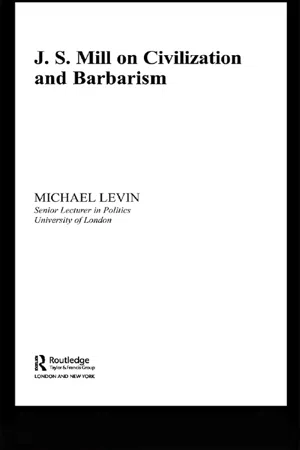
John Stuart Mill's best-known work is On Liberty (1859). In it he declared that Western society was in danger of coming to a standstill. To understand how Mill came to this conclusion requires one to investigate his notion of the stages from barbarism to civilisation, and also his belief in imperialism as part of the civilising process. This study encompasses discourses on the blessings, curses and dangers of modernisation from approximately the time of the American and French revolutions to that of the so-called mid-Victorian calm in which On Liberty was written. Current political issues concerning the West and Islamic countries have heightened interest in just the kind of question that this book discusses: that of how the West relates to, and assesses, the rest of the world.
- 168 pages
- English
- ePUB (mobile friendly)
- Available on iOS & Android
eBook - ePub
Mill on Civilization and Barbarism
About this book
Information
Chapter One
Introduction
John Stuart Mill is remarkable not merely for the quality of his intellect but also for the breadth of his concerns. His writings cover the fields of philosophy, politics, economics, sociology, religion and psychology. This particular study derives from an initial interest in his political theory. Within that field scholarship has tended to concentrate around a few key issues. First there is the question of how Mill adapted his utilitarian heritage; of whether his suggested modifications reform or undermine it. Related to this is the question of whether On Liberty, his most famous work, is compatible with his professed utilitarianism or whether it is based on other principles. Second, there is Mill’s attempted defence of individuality against both society and the state. This question involves the adequacy, or otherwise, of Mill’s famous distinction between self- and other-regarding actions. Third, there is discussion of where, if anywhere, to draw the line on free expression. Fourth, in his Autobiography Mill declared his adherence to a ‘qualified socialism’, without saying precisely what the qualifications were. Fifth, the connection between Mill and liberalism has been much discussed, and is an issue to which I shall turn in the final chapter.
Here I shall suggest that the categories of relevance within which we place a thinker put the focus on certain issues concerning them and so necessarily downgrade or exclude others. In political theory we too easily ignore Mill’s major contribution to economics. His Principles of Political Economy went through seven editions in his lifetime and was probably the major British economics textbook of the second half of the nineteenth century. Mill is also famous for the early and severe education that his father imposed upon him. He did not go out to school and so had minimal contact with other children. He was reading Greek and Latin at an age when other boys were sent outdoors to get some fresh air and exercise. His education, presumably, gave him his life-long commitment to education as such, and so he is well known for his concern with individual development.
What is relatively neglected, and what we shall here discuss, is that Mill showed an equal commitment to societal development and so can be placed in the discourse associated with such contemporaries as Comte and Tocqueville, with both of whom he corresponded, and with Marx, of whom he had almost certainly never heard. Like them he examined the mechanisms and the paths along which societies had developed from barbarism to civilization. For Mill personal and social development were parallel concerns. In both instances he looked for improvement. The individual has to be educated towards the higher pleasures, the society to civilization. The civilizing process, then, is necessary to both the individual and the society.
On the issue of Mill and civilization it is surprising how little interest there is in his belief that, at the height of its global power, Britain’s civilization was coming to a standstill. It was the most serious charge that Mill ever made against his own society; not that you would know it from the secondary commentary.
FROM PHILOSOPHY TO POLITICS
One recent discussion of Mill’s reputation states that ‘Most commentators accord him a representative position in nineteenth-century Victorian liberalism.’ Another describes him as ‘the most celebrated liberal intellectual’.1 A third notes that Mill’s On Liberty ‘is the most celebrated argument for liberalism’.2 As such On Liberty has stimulated a vast secondary literature dealing predominantly with the themes noted at the beginning of this chapter. This focus is on issues of principle that are both fundamental and probably timeless; hence the justification for concentrating on them. Margaret Canovan has noted that the ‘meticulous study carried on by Mill scholars has been largely directed by philosophical concerns’.3 Treating On Liberty primarily as a work of philosophy certainly has its justification in terms of the key issues raised. Furthermore, Mill’s declared main purpose4 supports this emphasis as, to an extent, does the nature of his own upbringing and life. Mill’s Autobiography, for example, seems as much on the development of a mind as of a body, for he more frequently ‘meets’ and has better ‘acquaintance’ with books than with people.
There is also, however, a case for regarding On Liberty as a tract for the times and a contribution to the social debate ofits day. These two aspects are, of course, not necessarily separate or incompatible, for eternal questions of principle can simultaneously relate to current political concerns. Furthermore, it is one of the characteristics and indeed one of the appeals of Mill’s philosophy that by inclination he moves from theory to practice.5 The relatively neglected final chapter of On Liberty, ‘Applications’, is one symptom ofthis. Indeed it was Mill’s concern with social and political issues that often determined which precise philosophical problems were given attention. Additionally, Mill the philosopher became Mill the MP for and at Westminster. It is in the spirit of the breadth of Mill’s concerns that we here turn from the philosophical and methodological aspects of On Liberty to the social purposes that underlie them.
In On Liberty Mill suggested or intimated, with varying degrees of explicitness and clarity, four separate reasons why liberty was necessary:
- Individual liberty leads to the development of the faculties and capacities that are intrinsic and, to a significant extent, particular to each individual.
- Individual liberty is a need of our human nature.
- Liberty leads to truth.
- Individual liberty is a prerequisite for the advancement of society.6
It is this fourth aspect that will be our concern here. This brings us to the fundamental political purpose of Mill’s book: that he wrote On Liberty because liberty seemed under threat and, consequently, the very foundations of European pre-eminence were endangered. We have, then, two levels of concern that Mill was seeking to express: that of individual autonomy and that of social progress. The connection between the two was that only the former makes the latter possible. To an extent, then, liberty was a need of the individual nature; it was an end for each person7 but simultaneously individual liberty was the means by which society itself advanced.
Our main purpose, then, is to work towards that aspect of On Liberty which consists of a social and political manifesto concerned to defend Western civilization against powerful tendencies eroding it from within. On this issue the example of China is crucial, for China is presented as a once advanced civilization that had come to a standstill, stuck in the sluggish backwaters of the historical stream. We shall trace the path that led Mill to this famous formulation in On Liberty and consider how coherent that formulation is, how it was viewed by his contemporaries, and the place it has in recent Mill scholarship.
John Stuart Mill’s On Liberty was first planned in 1854 and published five years later. It was produced in a decade when the British were feeling particularly pleased with themselves. The Great Exhibition of 1851 signalled not merely relief at having escaped the turmoil that had engulfed many European powers a few years earlier but also a celebration of free trade and the global dominance of British industry. In the 1850s Britain produced over half the world output of coal and steel, about half the world output of pig iron and cotton and about a quarter of total world industrial output.8 In 1859, the year in which On Liberty was published, Queen Victoria’s speech opening the new session of Parliament included the following note of serenity: ‘I am happy to think that, in the internal state of the country, there is nothing to excite disquietude, and much to call for satisfaction and thankfulnesss … a spirit of general contentment prevails.’9
Yet at the height of British power, one of its most celebrated thinkers doubted whether British or even European global ascendancy could be maintained. Mill clearly voiced his scepticism in one of the best-known political theory texts of his century; yet this aspect remained remarkably free from close scrutiny in the following one.
In terms of Mill’s writings, our two main points ofreference are his Essay on Civilization (1836), in which he first thoroughly outlined and discussed his understanding of the term, and On Liberty (1859), his most famous and enduring work of political theory, in which he questioned the durability of British civilization. We shall commence with a presentation of the former writing before turning to the cultural and personal background which facilitates our understanding of Mill’s concern with this issue.
FROM THE BRITISH TO THE FRENCH
This is a study of Mill that is necessarily about more than Mill, for to understand him one needs to know his intellectual context, and that takes us into the utilitarianism of his family background, and such other influences as romanticism, Scottish political economy and the diverse products of French intellectual life. Mill, then, provides the focus of a debate on the meaning and consequences of civilization that we trace back some decades before his birth. It encompasses discourses on imperialism and orientalism, on Enlightenment optimism and conservative despair, on the need for leadership and the advance of democracy; in short, on the blessings, curses and dangers of modernization from approximately the time of the American and French revolutions to that of the so-called mid-Victorian calm in which On Liberty was written. We shall see Mill did not actually share the dominant complacency. On Liberty was just one contribution to a counter-cultural disquiet that believed modernization had sacrificed much of value and had created new dangers of its own. In working our way towards On Liberty, then, we shall confront the wider debate, mainly in Great Britain and France, on civilization and modernity themselves.
Mill’s formative influence was clearly that of the utilitarian creed inculcated by his father in a chillingly thorough attempt at indoctrination. It is a heart-warming lesson on the failure of such efforts that Mill developed any independence of mind at all. At the age of thirteen he was sent for a year to France with the family of Samuel Bentham, the brother of the great philosopher of utilitarianism. Whatever John Stuart Mill imbibed of the family creed, the experience, without doubt, also set him on his life-long path of sympathetic engagement with French thought. Our precise topic, then, relates both to Mill’s placing in respect of the doctrine imposed on him and with his freely chosen intellectual relationships. It is, to some extent, a dialogue with the French.
The French, of course, had experienced the most dramatic recent history. The main home of the Enlightenment was also the land of revolution. The rationality of the former grappled with the task of integrating the irrationality of the latter. Was the great revolution of 1789 an unnatural diversion from normality, or was it part of the long-term pattern of development? Ann Robson notes that Mill ‘read Auguste Comte’s early Système de politique positive (1824) and learnt of the stages of historical development, the characteristics of an age of transition, and, most importantly, the significance for historical progress of the French Revolution’.10 In his Autobiography Mill acknowledged the extent to which the French Revolution, and even an English reworking of it, had played upon his youthful imagination: ‘I learnt, with astonishment, that the principles of democracy … had borne all before them in France thirty years earlier …What had happened so lately seemed as if it might easily happen again; and the most transcendent glory I was capable of conceiving was that of figuring, successful or unsuccessful, as a Girondist in an English convention.’11
This confession is further indication of Mill’s desire not just to understand the world but to help change it. Ann Robson also notes that the ‘Saint-Simonians had a fundamental influence on him. Through their eyes, Mill had seen the promised land.’12 In this context we can understand Mill’s very un-British initial enthusiasm for the French revolutions of 1830 and 1848 as well as his interest in current socialist experiments.
From the Scottish Adams, Ferguson and Smith, Mill could find a concern with the pattern of historical development, but by his own time he could plausibly conclude that French writers were ‘the real harbingers of the dawn of historical science’.13 Georgios Varouxakis has noted that Mill ‘saw France as a laboratory of mankind in the realm of new ideas and movements in the same way as his compatriots (and most Continental observers) saw Britain as a laboratory in terms of industrial and economic development’.14 In the writings of Comte Mill found an attempted scientific study of society as well as a theory of the stages of thought; in Saint-Simon the periodization of history into critical and organic periods; in Guizot a sense of the development ofcivilization and its causes; and in Tocqueville an account of the primacy of democracy in the historical process and of the rise of mass society. Both intellectually and politically France served as the yardstick by which British society could be judged and usually found wanting. In 1833 Mill wrote for the Saint-Simonian newspaper Le Globe on a theme that frequently exercised his mind: ‘Comparison of the Tendencies of French and English Intellect’. His findings did not flatter his own country. The English, it seemed, ‘have never had their political feelings called out by abstractions’ and were not particularly given to theorizing. The suspicion that here Mill might have been implicitly but deliberately downgrading his utilitarian heritage is not reduced by his observation that any recommended benefit has to be argued on the basis of its immediate practical consequences rather than its elevated principles. In England anything suspected of being ‘part of a system ’ would be linked with unacceptable ‘Utopian schemes’. The French, in contrast, evidently united the speculative eminence of the Germans with the practical qualities of the English. In ‘political philosophy, the initiative belongs to France at this moment’ because of ‘the far more elevated terrain on which the discussion is engaged’.15 To Tocqueville he wrote: ‘You know that I love the French’, describing France as a country ‘to which by tastes and predilections I am more attached than to my own’.16 In 1844 Mill described ‘the French mind’ as ‘the most active national mind in Europe at the present moment’ and declared that ‘the history of civilization in France is that of civilization in Europe’.17 This repeats a claim made eighteen years earlier.18 His view was not as one-sided as these extracts might suggest, however, for Mill cared little for Robespierre and Napoleons I and III.
From Scottish political economy as well as from French studies of the development of civilization, Mill found a sense of the historical process that Benthamism lacked. Utilitarianism was perhaps fundamentally a psychological creed. Its foundation was a theory of human nature compared with which differentials of time and place were unimportant. Whereas the theorists of progress were concerned to demonstrate from where our civilization had come, for Bentham such an effort was both methodologically unnecessary and politically subversive. He suspected that too close an interest in the past might produce a Burkean veneration for it.
Mill shared Bentham’s distaste for feudal nostalgia, but not his dislike of history. Mill wan...
Table of contents
- Cover Page
- Title Page
- Copyright Page
- Acknowledgements
- Chronology
- Chapter One: Introduction
- Chapter Two: Civilization
- Chapter Three: Barbarism and the Imperial Remedy
- Chapter Four: Progress
- Chapter Five: Civilization Threatened
- Chapter Six: Standstill: The Case of China
- Chapter Seven: Aftermath
- Bibliography
Trusted by 375,005 students
Access to over 1.5 million titles for a fair monthly price.
Study more efficiently using our study tools.
Frequently asked questions
Yes, you can cancel anytime from the Subscription tab in your account settings on the Perlego website. Your subscription will stay active until the end of your current billing period. Learn how to cancel your subscription
No, books cannot be downloaded as external files, such as PDFs, for use outside of Perlego. However, you can download books within the Perlego app for offline reading on mobile or tablet. Learn how to download books offline
Perlego offers two plans: Essential and Complete
- Essential is ideal for learners and professionals who enjoy exploring a wide range of subjects. Access the Essential Library with 800,000+ trusted titles and best-sellers across business, personal growth, and the humanities. Includes unlimited reading time and Standard Read Aloud voice.
- Complete: Perfect for advanced learners and researchers needing full, unrestricted access. Unlock 1.5M+ books across hundreds of subjects, including academic and specialized titles. The Complete Plan also includes advanced features like Premium Read Aloud and Research Assistant.
We are an online textbook subscription service, where you can get access to an entire online library for less than the price of a single book per month. With over 1.5 million books across 990+ topics, we’ve got you covered! Learn about our mission
Look out for the read-aloud symbol on your next book to see if you can listen to it. The read-aloud tool reads text aloud for you, highlighting the text as it is being read. You can pause it, speed it up and slow it down. Learn more about Read Aloud
Yes! You can use the Perlego app on both iOS and Android devices to read anytime, anywhere — even offline. Perfect for commutes or when you’re on the go.
Please note we cannot support devices running on iOS 13 and Android 7 or earlier. Learn more about using the app
Please note we cannot support devices running on iOS 13 and Android 7 or earlier. Learn more about using the app
Yes, you can access Mill on Civilization and Barbarism by Michael Levin in PDF and/or ePUB format, as well as other popular books in Politics & International Relations & Political History & Theory. We have over 1.5 million books available in our catalogue for you to explore.