- 272 pages
- English
- ePUB (mobile friendly)
- Available on iOS & Android
eBook - ePub
About this book
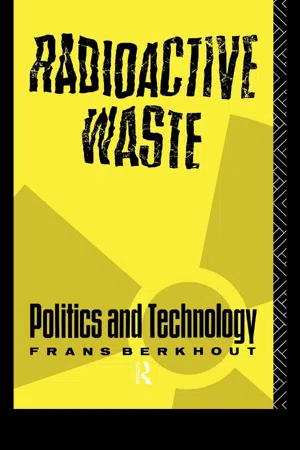
Radioactive Waste provides a detailed historical account of the policy and practice of radwaste management in Britain, Sweden and the Federal Republic of Germany. In their differing approaches, these three countries define the parameters of civil nuclear strategy in Europe. The comparative analysis of the evolution of policy clarifies the context of political and technical decision-making. Assessing the varying degrees of influence which the public, the industry and the government exercise over these actions, Frans Berkhout applies the concept of boundaries of control', questioning the extent to which such control can be relinquished. This analysis of nuclear strategy, the politics of nuclear power and the shifting emphasis of government regulation redefines the issue of radwaste management and sets it at the centre of the current debate about power, the environment and society.
Information
Chapter one
Managing radioactivity
1.1 Radioactive wastes and public concern
On 31 March 1959 police in the Lanarkshire village of Wishaw traced three boys who were believed to have been contaminated with radiation while playing in an ash pit in the village. A nearby clock factory had been dumping wastes from its luminizing workshop at the pit and by chance somebody from the factory had seen the children there some days earlier. The boys were taken down to the Radiological Protection Centre at Sutton in Surrey the following day for a check-up and later pronounced to be ‘out of danger’. The Times reported that there were ‘nervous smiles all round’.1
Four days later the member for South Lanark, Mrs Judith Hart, led a debate at the Scottish Labour Party Conference which called for a strengthening of safeguards against the ‘growing danger’ of the industrial use of radioactive materials. She claimed that the few safeguards which existed were administered in a context of ‘complete chaos’, and that no fewer than eleven agencies had responsibilities for the matter without any one of them holding final authority.2 The debate had been prompted by the Wishaw incident.
In the House of Commons debate about the Radioactive Substances Bill 11 months later, the Wishaw incident, and another which similarly involved the accidental contamination of children, were cited as proof of the urgent need for new legislation.3 Besides these specific cases of negligence, more general concerns also hung over the parliamentary discussions. Increased levels of atmospheric radiation in Britain caused by the atomic weapons tests in the Pacific and recent memories of the Windscale fire had brought home to the British public the reality of radiation in the environment for the first time. Moreover, a growing body of medical opinion in the 1950s had become concerned over the potentially catastrophic genetic effects of low-level radiation.
The Wishaw incident shows that public opinion has been sensitive about the control of radioactive waste materials since the beginning of the nuclear enterprise. Public controversy around this aspect of atomic power predates the later conflicts which came to be known as ‘the nuclear controversy’.4 While the technical arguments have changed, managing radioactivity presents some basic difficulties which invite social disputes. Like all other social disputes, these questions must be addressed through a complex process of political negotiation. Conventional approaches to scientific and technical problem-solving can seldom provide acceptable and lasting resolutions.
Ionizing radiations are beyond the senses. Their mere perception requires scientific knowledge, instrumentation and trained personnel. From the outset, therefore, the control of radiation demands institutional investments in expertise and regulatory effort. This regulatory regime is given an absolute responsibility to minimize the health effects induced by radiations. Regulatory authority is centralized in state bureaucracies, and their care applies across whole populations. We are all constantly being exposed to doses of ionizing radiation. The objective of radwaste management is to reduce the proportion of that dose which is caused by the use of radioactive materials.
Absolute authority can be onerous and fragile, as the Wishaw incident, and many others since then, demonstrate. A small fissure in the regulatory shield can lead to the whole basis and practice of regulation being called into question. The public’s trust in centralized regulatory authority is guaranteed only so long as it is believed to be effective and functioning with integrity.
The belief in institutional integrity cannot be split from the belief in its competence. Public trust depends on perceptions of who is acting in whose interest, and under whose instructions. If regulatory authorities claim superior scientific wisdom in the pursuit of sectional interests, they undermine confidence in the whole institutional framework and the scientific rationalities deployed in justifying decisions. To avoid these suspicions, agencies are forced into actively promoting their own integrity, usually by demonstrating their independence from the industry they regulate. For the large and frequently monolithic nuclear industry, historically a creature of state intervention, such demonstrations of independence may easily be regarded as disingenuous by those outside the regulatory process.
The political viability of the autonomous framework of institutional control described above—a small clique of experts and technicians regulating the exposure of whole populations to an invisible toxic material, employing science and an array of other devices to secure public confidence—appears to be at odds with a basic attribute of radiation protection. Absolute protection or safety cannot be assured, and at base there is something illogical in such an effort. All doses of ionizing radiation, however small, represent a risk to health. The uncertainties inherent in radiobiology are resolved in practice by the pervasive use of the risk concept, and this idea is necessarily carried over into administration of regulatory authority. Radiation-dose limits are set according to what is deemed to be a socially acceptable level of risk—usually a probability of death in any one year of between 1:100,000 and 1:1,000,000.5
But a risk to individuals is translated in the collective anonymity of populations into manifest effects on health. Broadly, it is the tension between the demands of the bearers of radiation risks for an absolute standard of protection, the probabilistic nature of scientific knowledge in this area, and the pressures to sustain investments in nuclear energy which animates the complex controversy which justifies this book. Risk is a very anodyne word. When its effects on the actions of individuals, organizations and governments are scrutinized, it turns out to hide a Pandora’s box full of complications.
1.2 The need for the study
Why is a review of British radwaste policy necessary? When work on this research began in late 1985, the disposal of radioactive waste was near the top of media editors’ lists of newsworthy items. Public controversy is not always a sufficient reason for academic study, but this case seemed to be different. A succession of reversals of government policy and operational errors over the previous 4 years had cast many doubts about the management of radwaste in Britain.
In December 1981, Tom King, the then Secretary for the Environment, had announced that a drilling programme connected with research into the disposal of high-level wastes was to be abandoned. Six months later an industry-sponsored body, Nirex, was set up to develop new disposal routes for low- and intermediate-level wastes. High-level wastes had been consigned to long-term storage at the Sellafield works of British Nuclear Fuels Ltd, effectively postponing final decisions for at least two generations. This site, already notorious, was brought into further ill-repute by allegations of increased levels of child cancer in its vicinity and a large accidental discharge of radioactivity down its sea pipeline during November 1983.
In that year the annual sea-dumping operation had been boycotted by the National Union of Seamen, and Nirex had made the first of a series of doomed proposals for new repositories. Early in 1985 a site investigation of a worked-out anhydrite mine at Billingham was curtailed. During the course of this study two further, associated, strategy reversals have befallen Nirex. In July 1986 it was decided after parliamentary pressure to redesignate a future, shallow land-burial site as being for low-level radwastes only, so contradicting the original purpose of the site-search programme which was urgently to find a disposal route for intermediate-level wastes. Just prior to the general election of May 1987, the hard-fought investigation programme was dropped altogether out of fear of electoral defeat in Tory constituencies where the sites were located.
This apparent chaos required some explanation. In fact we find that crisis is a not uncommon characteristic of radwaste policy in other countries. What is distinctive about the British context is that crisis has not produced new commitments to resolving the problems of radwaste management. In Sweden and West Germany we see these commitments as originating in the politically difficult reviews of policy for the whole of the back-end of the nuclear-fuel cycle. This restructuring of industrial, strategic and political commitments has allowed a real dynamism to be injected into programmes for waste management and disposal. In both cases the state has been instrumental in forcing these arrangements on the nuclear industry, and has adjusted its regulatory role accordingly. Governments in the UK have never been forced to reassess British commitments with regard to the back-end. I will trace this resistance to change, and hence the lack of reform of the state’s regulatory role in relation to radwaste management, to the continued importance of spent-fuel reprocessing to military and civil nuclear policy.
In arguing this, I want to show that a review of back-end policy appears to be one requirement for a robust radwaste policy. Radioactive wastes cannot be regarded merely as side products or ‘externalities’ of the fuel cycle. Their control, technically as well as politically, sits right at the centre of the nuclear enterprise.
Within environmental protection, technological change is closely related to developments in the political sphere. Technology policy always has to grapple with the problems of how to innovate within uncertainty. In other fields, however, innovation is usually taken to mean technical innovation, and uncertainty to mean the uncertainty of future markets and economic returns. In this context innovation is more problematic. It must encompass innovation in institutional and regulatory settings, and the bargains struck between institutions and between them and the public at large. Such uncertainties will always remain within the project of radiation protection and are inherent to the negotiation of consent for technical measures in society. Innovation in radwaste management is therefore much more explicitly a social and political process, and one involving the whole community. For this reason it can never be regarded as ‘completed’. There will always be new wells of instrumentally-based uncertainty and politically-rooted doubt.
A perception of these problems in the radwaste management field has predated very similar sensitivities to other waste-management problems which are now confronting us, from toxic wastes to acid rain and vehicle emissions. Although I will not consider these any further, the study has broader implications for the environmental debate.
There is ...
Table of contents
- Cover Page
- Title Page
- Copyright Page
- Dedication
- Epigraph
- Figures and Tables
- Chapter One: Managing Radioactivity
- Chapter Two: Time and the Boundary of Control
- Chapter Three: The Federal Republic of Germany
- Chapter Four: Sweden
- Chapter Five: The United Kingdom
- Chapter Six: Industry, Regulation and the State: Historical Themes
- Chapter Seven: The Construction of Consent
- Chapter Eight: Conclusions
- Appendix I: Glossary of Technical Terms
- Appendix II: Acronyms and Abbreviations
- Bibliography
Trusted by 375,005 students
Access to over 1.5 million titles for a fair monthly price.
Study more efficiently using our study tools.
Frequently asked questions
Yes, you can cancel anytime from the Subscription tab in your account settings on the Perlego website. Your subscription will stay active until the end of your current billing period. Learn how to cancel your subscription
No, books cannot be downloaded as external files, such as PDFs, for use outside of Perlego. However, you can download books within the Perlego app for offline reading on mobile or tablet. Learn how to download books offline
We are an online textbook subscription service, where you can get access to an entire online library for less than the price of a single book per month. With over 1.5 million books across 990+ topics, we’ve got you covered! Learn about our mission
Look out for the read-aloud symbol on your next book to see if you can listen to it. The read-aloud tool reads text aloud for you, highlighting the text as it is being read. You can pause it, speed it up and slow it down. Learn more about Read Aloud
Yes! You can use the Perlego app on both iOS and Android devices to read anytime, anywhere — even offline. Perfect for commutes or when you’re on the go.
Please note we cannot support devices running on iOS 13 and Android 7 or earlier. Learn more about using the app
Please note we cannot support devices running on iOS 13 and Android 7 or earlier. Learn more about using the app
Yes, you can access Radioactive Waste by Frans Berkhout in PDF and/or ePUB format, as well as other popular books in Politics & International Relations & Environment & Energy Policy. We have over 1.5 million books available in our catalogue for you to explore.