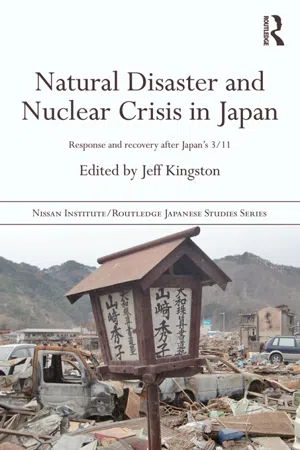
There are towns along the Pacific coast in Tōhoku, the region northeast of Tokyo, with names like Ōfunato and Rikuzen Takata in Iwate prefecture, and Minami Sanriku, Kesennuma, and Watari in Miyagi prefecture that until March 11 of this year meant little more to most Japanese than the names of towns along the Maine coast mean to most Americans. Many people knew little more about these towns than that they were places where Japanese got a lot of their fish, and that they have a harsh winter climate and hardworking people of few words.
The 9.0 magnitude earthquake and the tsunami that struck Tōhoku on that day in March changed all that. Now the names of these towns, towns that I visited over several days at the beginning of May, and others on the northeast coast, evoke images of miles upon miles of devastation where houses, ports, fishing boats, merchant shops and small factories, rice fields and hot houses for vegetables and strawberries have disappeared, turning the landscape into an endless vista of debris punctuated by the occasional presence of a boat or car perched on the roof of some concrete structure that did not collapse under the incredible force of the tsunami.
Earthquake damage to the train station at Sendai, Miyagi prefecture’s capital, had been repaired by the time I got there on May 4, a few days after bullet train service resumed along the entire Tokyo-Aomori route. Neither at the train station nor anywhere else in the city center was there evidence that Sendai had been violently shaken by the strongest earthquake in its history.
In Tokyo high-rise buildings swayed, and did so for so many minutes that it made some people feel as though they were seasick, but none collapsed. Falling objects killed or injured several people but overall damage was minimal. In the north the earthquake knocked out electricity, gas, and water lines, but power was restored relatively quickly in areas that were beyond the reach of the tsunami, and deaths and injuries were few.
I stayed one night at an old inn in Ichinoseki in Iwate prefecture, one of the inland cities hard hit by the earthquake. There were cracks in the walls of the inn but there was electricity and gas and running water. The owner told me that her elderly mother, who was standing at the entrance looking confused and anxious, became so frightened by the intensity of the earthquake that she completely lost her hearing. The owner said that she was putting off fixing the cracks and repairing other damage that the earthquake had caused because she assumed that at some point there will be a much more powerful aftershock than any they had experienced so far. The only question was when it would come. If the inn survived that quake, she would make repairs then. Lying on my futon on the second floor, I fell asleep hoping that we would not find out the answer about the inn’s survival that night. We didn’t. If there had not been the tsunami, the lead story about March 11 would have been about the remarkably successful earthquake disaster prevention measures Japan has adopted.
After arriving in Sendai and checking into the hotel, I headed out to the Sendai airport. Driving toward the ocean from the city center, everything looked normal for the first ten kilometers or so. Then the scenery suddenly turned bizarre: a smashed car sitting in the middle of a rice field, wood, metal and other debris scattered here and there. The closer I got to the ocean the more destruction I saw: a two-story building for example whose walls were still intact but without any windows left on either the first or second floor. The tsunami had blown them out, washing away most of the things that had been inside and drowning people who were living there. I could see large characters painted at the top of what had been the building’s entrance. They indicated that this had been a community old age home.
There was an incredible number of cars tossed about helter-skelter throughout the area along the coast, many so crushed and mangled that it looked as though they had been involved in head-on collisions. One car was perpendicular with the front half of its hood buried in the ground, looking as though someone had tried to plant it. Others were upside down and one looked as though it was trying to climb a tree. The Self Defense Forces have been collecting and sorting the debris and piling it up – wood here, scrap metal there – for eventual disposal. Every so often along the side of a road there would be a stack of ruined automobiles piled on top of each other and taking up the equivalent of half a New York city block. Since automobiles are virtually the sole mode of transportation for people who live in this coastal part of Sendai, it is not unusual for a household to have several cars for family members to commute to work. Never have I seen so many ruined automobiles.
It is going to take imagination, money, bold planning, and strong political leadership to rebuild this area. The rice fields have been inundated with salt water and the land in many places has sunk 70–80 centimeters. Restoring this land to agricultural use will be difficult and expensive. The port will be restored and airport repairs will be completed, but in the absence of some development scheme that at the present time seems to be nowhere in sight, the population of this corner of Sendai and even more so in the affected towns along the coast undoubtedly will decline, leaving behind mostly elderly people who cannot or do not want to leave the only place they have ever known, even if there is nothing there.
The tsunami rolled across the Sendai airport, washing mud and debris onto the runways and doing extensive damage to the terminal building. With the bullet train system down, the airport not functioning, boats unable to enter the Sendai port, and roadways cracked and covered with debris, it was a monumental task to get relief supplies and rescue workers into the region.
In the days immediately following the earthquake, the US military in Japan launched “Operation Tomodachi” (tomodachi meaning friend), ferrying supplies by helicopter from the aircraft carrier Ronald Reagan, which had changed course to go to Japanese waters to assist the humanitarian effort. A team of Air Force special forces flew from Okinawa to a Japanese Self Defense Force (SDF) airbase near Sendai and then travelled to the airport in Humvees they had brought in with them. Within a few hours the team had enough of one of the runways cleared for C-130s to land with emergency supplies. When I got to the airport a month and a half later, the runways were open for limited domestic civilian traffic, but the passenger terminal building had been so badly damaged that there was only one small area being used for ticketing and passenger check in.
The Japanese press and television, unlike the US media, gave prominent coverage to the activities of the American troops. The favorable publicity no doubt reinforced Japanese public support for alliance with the United States, which was strong to begin with. Whether that will change anything about issues that the US military cares about is another matter. Operation Tomodachi is not going to make it any easier to solve the problem of what to do with the Marine Corp’s Futenma air station in Okinawa. Building a new base at Henoko off Okinawa’s northeast coast does not appear to be a viable option. Staying put at Futenma is an option, but hardly a desirable one. This base sits smack in the middle of Ginowan city where the eardrum-breaking noise of fighter jets and other planes taking off and landing and the ever-present danger of a major accident are what led the US and Japanese governments to decide more than a decade ago to close it down.
In the aftermath of the earthquake, three influential US Senators – Democrats Carl Levin and Jim Webb and Republican John McCain – publicly called on President Obama to abandon the Henoko option, saying that it was unrealistic to expect Japan to provide the funding needed to build the base at Henoko when it faced a huge reconstruction bill in Tōhoku. They proposed closing the Futenma base and moving the Marines that are stationed there to the Kadena air force base, the largest US military base in Okinawa.
Even if the US air force were to agree to joint use with the Marines and the Obama Administration were to abandon its commitment to the Henoko relocation, the Japanese government would still face the formidable task of convincing the Okinawa government to go along. Okinawans want less of a US military presence on their island, where most US bases in Japan are located. As for Japanese living on Japan’s main islands, appreciation of the US military effort in Tōhoku is heartfelt but it has not changed their Not In My Backyard attitude toward the disposition of US military bases in their country.
US military personnel, in addition to their work in opening the airport and ferrying in supplies, worked with the SDF in the offshore search for victims. They also cleared the debris at one of the many damaged train stations. I met with a US army major stationed in Sendai who serves as liaison between US Forces Japan, which now have returned to their bases elsewhere in Japan, and the Self Defense Forces’ Northeast Army. Major Brooke took me to the Nobiru train station to show me the work the US military did in cleaning up debris from the platform and the adjacent tracks. Visiting this site as well as seeing the damage done to railway tracks, stations, bridges, and trains throughout the disaster area left me dubious that this effort was of much more than symbolic value. The debris at Nobiru station was gone, but the tracks were bent and half buried in sand and mud, a train that had been at the station looked beyond repair, and you could not see the tracks for more than a few hundred yards beyond the station platform in either direction because of all the detritus that has yet to be cleared away.
It is doubtful that restoring the Nobiru station and the railroad bridges and tunnels along the battered coast makes much sense. Many of the people whose homes were swallowed up by the tsunami are going to relocate to higher ground away from the current rail lines. The destruction offers an opportunity to build a new railway system that could take advantage of the latest technology and be designed more rationally than the one that now is in ruins. But to do that would require quick and decisive action by the government, an unlikely prospect.
American participation in efforts to help people in Tōhoku has not been limited to the military. There are American and other foreign volunteers working with Japanese and international NGOs throughout the disaster zone. One of these is an international disaster relief organization called All Hands that is active in Ōfunato city in Iwate prefecture. What the American volunteers working with All Hands are doing is a reminder that the US-Japan relationship is far more than a military alliance. The great majority of Americans working in Tōhoku with All Hands and with other NGOs are people who are living in Japan. A typical case is that of a businessman who has been in Kanazawa for more than 15 years who took time off from work to volunteer with All Hands, saying that after all Japan has done for him he could not stay away and do nothing.
Another American there turned out to be my student from 20 years ago. (Teach long enough and former students show up in all sorts of unexpected places.) Having gone from Columbia to a successful career as an investment banker, he became prosperous and was enjoying retired life in Tokyo until the earthquake struck. Able to set his schedule as he likes, he decided to do volunteer work with All Hands. This subsequently became his new calling. He heads the All Hands operation in Tōhoku, and when he is not shoveling mud and debris along with other volunteers he gives financial advice to local government leaders and businessmen and fishermen trying to get their businesses up and running again.
An American woman who runs a consulting company in Boston was there working with the volunteers as a translator. Born in Tokyo and having lived there through high school, she said that for her Japan is home. She felt that she had to come to do something to help.
When I caught up with the All Hands volunteers, they were working on a house that had been badly damaged by the tsunami but was repairable. Mrs. Chiba, the owner of the house, was watching them work when I got there. She was staying in an evacuation center with her husband, who is confined to a wheelchair, and her son. She said that a couple of nights earlier she had slept soundly through the night for the first time in the nearly two months that she has been at the evacuation center. “I went to bed thinking that in the morning those nice volunteers would be back at my house,” she said. “I felt so relieved.”
There are countless uplifting stories about the foreign volunteers and the reception they have found, but there also have been problems with government bureaucrats telling volunteer organizations that their help wasn’t needed or that there were no accommodations for them. It would be a mistake simply to chalk this up to xenophobia or to conclude that it is typical of the government’s response. Rather, these frazzled functionaries seem incapable of doing anything for which there is no precedent, to think “outside the box,” and they find dealing with NGOs, Japanese or foreign, to be more trouble than it is worth.
All Hands got lucky in Ōfunato. The mayor, who had worked for the Shimizu Corporation before deciding to run for mayor of his hometown, had spent time at the architecture school at Harvard. He met with the representative of All Hands, discussed the situation with him in English, and not only welcomed the volunteers to his city but found a place for them to live. Although there have been glitches, on the whole the Japanese government and local communities have welcomed foreign volunteers and have been grateful for their help.
There has been an outpouring of sympathy for Tōhoku’s victims from across Japan. Innumerable ad hoc groups have emerged to collect donations of money and of clothing and other needed items. Many Japanese have been volunteering. Estimates of the number of volunteers who have gone to Tōhoku during the first three months range from half to three-quarters of a million people. The number is impressive especially when you consider how much time it takes to reach the devastated areas from Tokyo and the lack of adequate accommodations.
It is difficult to take unscheduled vacation time in the typical Japanese company, especially on short notice, but many companies are making special arrangements to make it easier for their employees to take time off to do volunteer work. The Mitsubishi Corporation, for example, has established an employee volunteer program whereby employees go to Tōhoku in groups of ten for three nights and four days. They receive their regular salaries during this time. This program is scheduled to run for one year initially.
Relief activities in Tōhoku, whether removing debris, providing psychological counseling, or rebuilding damaged facilities, are hampered by the lack of a sufficient infrastructure and of people with the management skills needed to coordinate these kinds of activities. Finding housing for volunteers, for example, and putting them in touch with reliable organizations requires having people on the ground tasked with these responsibilities. Tōhoku’s recovery is a long-term challenge that will require continued assistance of various kinds. Along with all the other problems they face, prefectural authorities and the national government need to build an infrastructure to facilitate and coordinate the help that so many individuals and organizations would like to offer.
I met many people and heard many terribly sad and terrifying stories. I spent a couple of hours with Mayor Sato of Minami Sanriku town. He was in the town office with more than 30 town officials when the earthquake struck. They all ran up to the roof, anticipating that a tsunami would come. What they could not know was that this tsunami would be so powerful – it was measured at one location at 39 meters and it wrought its destruction as far as six miles inland – that it would be higher than the town hall. Sato and a few others were thrown by the wave toward one end of the roof where he was able to grab onto a steel pole. He managed to hold on as the tsunami washed over him. Most of the others were pushed to the other side where there was only a flimsy metal fence. The fence broke under the force of the water and they were swept away to their death. Only ten people working in the town office including the mayor survived.
Photographs and television footage do not do justice to the incredible scale of the devastation that struck Minami Sanriku town. There is almost nothing left of the homes and businesses that were there. The fish market, the seafood processing plants and canneries along the wharves, and almost all the boats that had anchored in its harbors were badly damaged or destroyed. (According to the Miyagi prefectural government, about 90 percent of the 13,400 fishing boats in the prefecture were damaged or destroyed. Most of the boats that survived were those that fishermen sailed out into the open ocean as soon as the earthquake struck to ride out the tsunami.)
When I visited evacuation centers in Minami Sanriku and other towns the first thing that struck me, and that is immediately apparent to anyone who has seen television footage of the evacuation centers, is how orderly they are. This is Japan after all and people are incredibly – that is incredibly to someone who is not Japanese – neat and polite. Of course shoes are taken off before entering the room, there are special slippers to wear at the bathrooms, which are immaculate, there is no one playing loud music that might disturb someone else and people keep their voices down so as not to bother their neighbors. Their neighbors in this case are people living on the other side of a cardboard partition. Whatever meager belongings they have are arranged neatly along the outer perimeter of the small space that these people have had to live in for the past months, ever since their homes and possessions and in all too many cases their loved ones perished.
At the end of June there were still just under 90,000 people living in evacuation centers. The government has promised that by August it will complete the building of temporary housing where people can stay for up to two years while they make arrangements for their permanent relocation. But moving homeless and elderly people – an estimated 30 percent or more of the population in the tsunami affected areas is over 65 years old – into temporary housing is not a simple matter.
The government has been building housing blocks on public land outside the tsunami zone, mostly on the soccer fields and baseball diamonds of local elementary and middle schools and on land adjacent to community and town-run cultural centers. But there is not enough of this kind of land available for the more than 72,000 temporary housing units the government plans to construct in Iwate, Miyagi and Fukushima prefectures. In many of the towns along the coast, higher elevation land is too steep to build on or it is privately owned. The government has to negotiate lease arrangements with private landowners and it also has to level some mountainous land, processes that take both time and money.
The effort to build temporary housing as quickly as possible and move people out of the evacuation centers has created problems of its own. The government has adopted a lottery system to determine who should be eligible to move into these housing units as they become available. While that may seem fair, it has created considerable anxiety among people who have lived their entire lives in the hamlets that are the basic units of rural Japanese society.
One elderly lady drove the point home to me. She does not want to leave the evacuation center, she said, if it means moving to temporary housing somewhere where she is separated from her friends in the village where she has lived all her life. She would prefer to stay there until all the people in her village could be resettled together. She is afraid of the loneliness and worries about becoming entirely dependent on her son to drive to wherever she might be relocated to take her to her doctor. She was not alone in this view: I heard the same lament from others as well.
A misguided desire to be equitable has collided with the norm of community solidarity that remains so pervasive in isolated, poor areas in rural Japan. (In terms of per capita GDP, Miyagi ranks number 32 of Japan’s 47 prefectures and Iwate number 39.) Even more, government policy seems oblivious to the special problems faced by the elderly. I was told of a landowner in Ōfunato who donated hilltop land he owns to be used for temporary housing but in doing so insisted that the agreement with the city stipulate that all the residents of the local hamlet would be offered the oppo...