Sexuality and sexual politics have been much debated over the last 20 years and feminists, in particular, have been responsible for politicising the debate, pointing out how something which is usually regarded as private and personal is, in fact, a public and political issue. This text illustrates the diversity and excitement of debates about sexuality in women's studies and feminism today, and points to new paths for feminist analysis, thinking and action. In particular, heterosexuality can no longer be taken for granted and must, along with other forms of sexuality, be explicitly addressed. The volume is divided into three sections: "Analysing (Hetero)sexuality" is concerned with exploring some of the complexities of the material aspects of sexual relations between men and women; "Media Discourses of Sexuality" contains analyses derived from women's magazines, television and newspapers; and "Practising Sexual Politics" focuses on the reflexive awareness of sexual politics in the framing of methodological issues in research.
- 220 pages
- English
- ePUB (mobile friendly)
- Available on iOS & Android
eBook - ePub
HeteroSexual Politics
About this book
Information
Publisher
Taylor & FrancisYear
2003Print ISBN
9780748402960
9780748402953
Edition
1eBook ISBN
9781135746773
Practising Sexual Politics
Chapter 8
Writing Women’s Friendship: An Intimate Experience?
If we look… we may find an untold story of friendship between women, sustaining but secret.
(Heilbrun, 1989, p. 98)
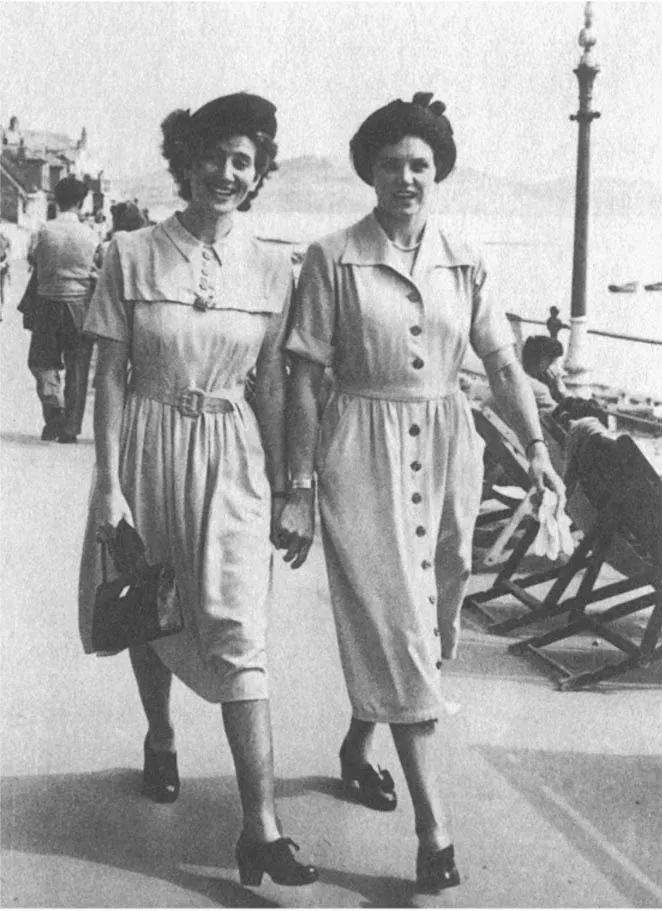
In front of me, above my desk, hangs a photograph. Two young women, immaculately dressed and carrying gloves and handbags, walk along the seafront holding hands. They are laughing, happy and confident. The photo is dated 1949, the year before I was born; yet I have become another figure in this picture. I set out to record and explore the life history of this one friendship. Where should I place myself: following behind, watching? Facing them as they walk towards me? Or walking with them hand-in-hand? Looking at this photograph will no doubt elicit varied responses, depending on the viewpoint of the spectator. The nature of the relationship will be constructed according to the observer’s particular frame of reference. Different words and perceptions spring to mind. I wanted the women to speak for themselves, to tell me their story as they see it. My initial aim was to hear their experience and how they conceptualized it.
Iris was my mother’s sister. Aged 79 when I began this story, both she and her friend Joan, ten years younger, were part of my family background; from childhood I was aware that they belonged together and loved each other. They met during the war, were close friends for nearly half a century and for twenty-five years shared a house together. Neither ever married: for most of their lives they lived in London, travelling into the city every day to pursue careers within commercial shipping companies. When I approached them about this study, they were living quietly in a Buckinghamshire cottage where Joan made home-made bread and jam and cared for Iris, disabled through arthritis. I found them hand-in-hand, a rug over their knees, watching snooker on the television. They agreed to tell me the story of their lives.
As They Walk Towards Me: Women’s History and Women’s Friendship
When I first read Heilbrun’s words, quoted above, I was coming to the end of my research. In writing women’s history, we are told, we ‘have the task of making women visible where they have been hidden in the past’ (Purvis, 1992, p. 274). The study of oral history is an area of contemporary interest not confined to Women’s Studies. The Handbook of Oral History, published in 1984, expresses the hope that ‘In re-writing history “from below”, oral history can create a more accurate and authentic picture of the past. It can give back to people a sense of the historical significance of their own lives’ (Humphries, 1984, p. x). Women are acknowledged amongst those whose history has been little heard, and in the past decade, women ranging from academics to community groups have attempted to redress this neglect. There are, however, questions to be asked about our use and understanding of women’s historical experiences. Deirdre Beddoe warns against looking to the past only to seek ‘explanations for the present’ (Beddoe, 1983, p. 3), and as feminist debates become increasingly complex, remaining clear-sighted about our work is not always easy. We have to make ‘the knife edge decision…between using feminist insights to analyse women’ s lives and avoiding the danger of projecting present ideals and values back in the past’ (Purvis, 1992, p. 277). How can we be sure that our interpretations represent the intentions behind the words we are given? We ourselves are positioned in the research, and must recall Liz Stanley’s words, ‘we can now never understand the past as it was understood by those who lived it’ (Stanley, 1992, p. 169). Further, in using reminiscence, there are questions related to memory, which, rather than being a mirror image, is surely reshaped and reconstructed over the years as we assimilate new perspectives and attitudes: ‘the past that is constructed orally can never be fixed; it will change to the degree that the present changes’ (Cornwell and Gearing, 1989, p. 43).
In addition to these considerations, current debates about the possibility/desirability of ‘objectivity’, of keeping a distance between the researcher and the researched, become key issues in relation to studying friendship. From the outset I recognized that experiences and feelings which have shaped my life would be part of my research: as women we all have experiences of friendships with other women, both positive and negative. These informed not only the reasons behind my decision to study women’s friendship, but also my methodology. At the same time, the actual process of the work I carried out, the sharing of stories and confidences, enriched and changed those experiences and understandings.
If women’s history generally has remained hidden, friendship between women has been particularly well-concealed or even ignored. However, on Easter Monday 1994, an article on women’ s friendship appeared in the Guardian, bringing some significant comments on the subject into the public arena:
Despite its key roles in most women’ s lives…friendship between women has been consistently overlooked by historians, philosophers and artists Women’s friendships have always been depicted as peripheral to their roles as wife and mother. The tendency to define women in relation to men and to children, rather than to one another, has meant that their friendships have been persistently trivialised, eroticised or marginalised.
(Abrams, 1992)
The definition of friend in my English dictionary reads: ‘a person with whom one enjoys mutual affection and regard (usually exclusive of sexual or family bonds)’ (Concise Oxford Dictionary) whilst Maggie Humm, in The Dictionary of Feminist Theory, defines friendship as ‘a form of women’s emotional bonding’ (Humm, 1989, p. 81). Other feminists would want to label relationships between women in different ways and despite Abrams’ claims in the newspaper article cited above, it is not always evident that feminism has clarified what friendship between women means and how it is experienced. Labelling and categorization are undoubtedly difficult but I believe this should not deter us from exploring women’s friendship or recognizing its importance. Pat O’connor claims that ‘work on friendship between women can be said to lie at the heart of our understanding of key issues in women’s lives’ (O’connor, 1992, p. 193).
Despite assertions from within Women’s Studies about the importance of female friendship, I found comparatively little research into the subject. In fiction, however, friendships between women have often assumed a high profile, from the schoolgirl genre onward. Rosemary Auchmuty, citing reasons for the popularity of school stories well into the 1960s, suggests that the girls portrayed provided strong role models and a temporary escape from the male world. Friendship not only between schoolgirls but between adult women too is ‘comfortable, constant, supportive and accepted’ (Auchmuty, 1992, p. 133). As a child I was an avid reader of schoolgirl fiction. As a student of Women’s Studies, reading women’s fiction in which friendship played a significant part provided an incentive for further study, uncovering the potential of women’s friendship in a multiplicity of situations. I went on to discover a certain amount of biographical writing of women friends, though these of course tend to follow the normal pattern of our culture in valuing what is public and successful; the private lives of hidden women have continued to remain largely unexplored. Other texts around women’s friendship are theoretical studies of women’s friendship as it is portrayed in fiction—literary criticism. This seemed to me to be looking at the image, rather than the experience. Whilst I accept the importance of images in informing my own ideology and expectations, creating role models, they cannot be substituted for real experience, what actually happens for women.
The tendency of male-based society to trivialize women’s friendships is one explanation for the lack of texts in this area, but I believe there are problems of definition and understanding amongst women themselves, which problematize such research.
Following Behind: Lesbian Issues in History and Friendship
The recent work of Pat O’connor acknowledges the problematizing of the word ‘lesbian’ in studying friendships between women. Indeed, many writers of texts on female friendship are lesbians who are searching for a lesbian history and identity. Lillian Faderman, for example, in Surpassing the Love of Men, uses a variety of historical resources, including letters, diaries and fiction, to uncover a world apparently full of close emotional and romantic relationships between women. Both she and others have argued that such friendships in the past were both common and accepted within society but have become hidden and ‘suspect’ since the work of the sexologists and Freud at the beginning of this century. Others have explored all-women communities within history. Janice Raymond argues that within such communities the true history of women can be found and that we need to restore what she terms the ‘prime order’ in women’s lives, where women’s affections are self directed and where women put each other first (Raymond, 1986, p. 43). She makes it very clear that she is talking here about friendship relationships, not about sexually based love relationships, and speaks out against the tendency in some lesbian groups to emphasize the sexual aspect.
Martha Vicinus, writing recently in Feminist Studies, openly pursues lesbian-centred research but in doing so criticizes others, such as Faderman, for being less clear-sighted in their work. ‘Historians’, she writes, ‘are more confined to their evidence than writers of fiction and cannot create utopias, but they can and do create myths’ (Vicinus, 1992, p. 490). This is echoed by Lisa Moore: ‘Faderman’s…studies obscure the wariness and even prohibition that sometimes surrounded women’s friendships’ (Moore, 1992, p. 501). But whilst attempting a critique of a certain brand of lesbian-based history, Vicinus and Moore are themselves still part of that type of research. Moore uses the term ‘friendship’ in the context of arguments about sexuality. Lesbian writers seem to be making assumptions that friendships between women are to be identified as lesbian. At one point Vicinus states: ‘By the 1950s, everyone knew what a lesbian was’ (p. 489). We need to understand that whilst this may be true as part of her own history, it may not be part of others’ reality.
Is it possible to look at history and not to create our own myths? In exploring epistemological issues related to lesbian history, Liz Stanley addresses problems raised in studies of ‘romantic friendship’. According to her, scholars have begun with theories and ‘the nature of actual friendship is then deduced from the theory’ (1992, p. 161). She argues that we should listen to what women actually say, rather than look for what we expect them to say. Her argument is made in the context of her own recognized desire to build a lesbian history. In her vision of female friendship, Raymond too claims to be looking for a balance, where women’s friendship is seen not as a poor alternative to heterosexual relationships, nor as ‘lesbian’ in a prescribed sense, but as a chosen, carefully considered existence, which allows women to be free for themselves and live fulfilled lives (1986, p. 239). Both Stanley and Raymond are involved here not only in an investigation of other women’s lives and history, but in labelling and identifying themselves and their own position. Stanley, in her criticism of Faderman’s labels, imposes her own; for example, her definition of Faderman’s creation of an age of ‘innocence’ was more probably seen by Faderman herself as an age of ‘ignorance’. In expressing my intention of using an open approach, I needed to recognize similar factors. The women I talked to have labels and definitions both for themselves and for other women. And as I listened to them I had my own understanding and application of the word ‘friendship’ to negotiate, not only in interpreting their story, but in my own life.
I was concerned to avoid an essentialist approach in classifying Iris and Joan. Issues around sexuality and identity undoubtedly need to be explored, as do the contexts within which relationships between women are played out, but rigid categorization is one of the criticisms that we in Women’s Studies have levelled at the male world; we view the need to compartmentalize and label as a male paradigm. ‘Lesbian’, ‘gyn-affection’ or ‘friendship’ are equally forms of labelling. However, I recognize that the purpose of language is to name and categorize, so that in attempting to interpret the narrative as it was told to me, I have been linguistically defining these women’s lives. I sought definitions, for example, for areas such as their class and their sexuality; I attempted to explain their childhood experiences and represent their developing relationship. My work is a construct of their life stories through language and, as such, inevitably uses labels. I hope, though, that in exposing contradictions between their lives and existing texts and theories around unmarried women, I have raised questions about the ways in which women’s lives are categorized. My aim has been ‘the recovery of women’s experiences’ (Lubelska, 1991, p. 44), to discover what women themselves say about their friendship.
Hand-in-hand: Feminist Methodology
It was suggested to me by other Women’s Studies students that knowing these two women was a problem, that their position as ‘relatives’ made them too close for objects/subjects of research. I felt, though, that this was a positive aspect, an opportunity to practise feminist principles of research. Ann Oakley, for example, argued over a decade ago that ‘A feminist interviewing women is by definition both “inside” the culture and participating in that which she is observing’ (Oakley, 1981, p. 57). Given the direction of my own study, it is interesting to note in her chapter outlining her objectives for feminist interviewers, a subheading, ‘The transition to friendship?’. This reminded me of an essay by Elizabeth Minnich which I discovered whilst reviewing literature on women’s friendship. She suggests that the relationship between author, subject and reader in biographies of women offers a model of friendship. It seems that, according to feminist epistemology, in researching the life story of a friendship between two women, I myself take on the role of friend, an ‘achieved and genuine reciprocity’ (Minnich, 1985, p. 287). Knowing them already should facilitate and enrich this process, I felt. At the same time, I recognized the need for sensitivity in working with older members of my family. They were not familiar with feminist ideas nor with academic terminology. As a friend, awareness of their perceptions and feelings was important; to push for more than they were willing to tell me, to interpret according only to my own understanding, might contravene all ideas of friendship between women. I needed, from a position of understanding my own Self, to me...
Table of contents
- Cover
- Halftitle
- Title
- Copyright
- Contents
- Introduction: A Context for (Hetero)sexual Politics
- SECTION I. Analysing (Hetero)sexuality
- SECTION II. Media Discourses of Sexuality
- SECTION III. Practising Sexual Politics
- Notes on Contributors
- Index
Trusted by 375,005 students
Access to over 1.5 million titles for a fair monthly price.
Study more efficiently using our study tools.
Frequently asked questions
Yes, you can cancel anytime from the Subscription tab in your account settings on the Perlego website. Your subscription will stay active until the end of your current billing period. Learn how to cancel your subscription
No, books cannot be downloaded as external files, such as PDFs, for use outside of Perlego. However, you can download books within the Perlego app for offline reading on mobile or tablet. Learn how to download books offline
Perlego offers two plans: Essential and Complete
- Essential is ideal for learners and professionals who enjoy exploring a wide range of subjects. Access the Essential Library with 800,000+ trusted titles and best-sellers across business, personal growth, and the humanities. Includes unlimited reading time and Standard Read Aloud voice.
- Complete: Perfect for advanced learners and researchers needing full, unrestricted access. Unlock 1.5M+ books across hundreds of subjects, including academic and specialized titles. The Complete Plan also includes advanced features like Premium Read Aloud and Research Assistant.
We are an online textbook subscription service, where you can get access to an entire online library for less than the price of a single book per month. With over 1.5 million books across 990+ topics, we’ve got you covered! Learn about our mission
Look out for the read-aloud symbol on your next book to see if you can listen to it. The read-aloud tool reads text aloud for you, highlighting the text as it is being read. You can pause it, speed it up and slow it down. Learn more about Read Aloud
Yes! You can use the Perlego app on both iOS and Android devices to read anytime, anywhere — even offline. Perfect for commutes or when you’re on the go.
Please note we cannot support devices running on iOS 13 and Android 7 or earlier. Learn more about using the app
Please note we cannot support devices running on iOS 13 and Android 7 or earlier. Learn more about using the app
Yes, you can access HeteroSexual Politics by Mary Maynard,June Purvis in PDF and/or ePUB format, as well as other popular books in Social Sciences & Feminism & Feminist Theory. We have over 1.5 million books available in our catalogue for you to explore.