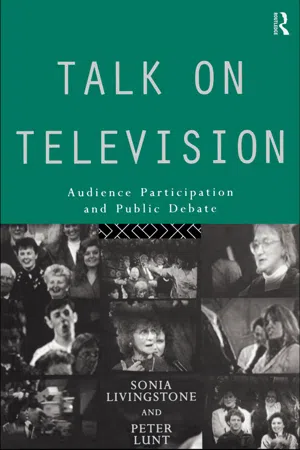
Not only is everyday conversation increasingly dependent on television, but more and more people are appearing on television to discuss social and personal issues. Is any public good served by these programmes or are they simply trashy entertainment which fills the schedules cheaply? Talk on Television examines the value and significance of televised public debate. Analysing a wide range of programmes including Kilroy, Donohue and The Oprah Winfrey Show, the authors draw on interviews with both the studio participants and with those watching at home. They ask how the media manage discussion programmes and whether the programmes really are providing new 'spaces' for public participators. They find out how audiences interpret the programmes when they appear on the screen themselves, and they unravel the conventions - debate, romance, therapy - which make up the genre. They also consider TV's function as a medium of education and information, finally discussing the dangers and opportunities the genre holds for audience participation and public debate in the future.
- 216 pages
- English
- ePUB (mobile friendly)
- Available on iOS & Android
eBook - ePub
About this book
Information
Chapter 1
Television talk and talking about television
OVERVIEW OF THE BOOK
In this book we examine the value and significance of public discussion and debate on television. More and more people, members of the general public and so-called experts, are appearing on television and radio to discuss and debate issues of the day. Is any purpose served by these discussions or are they simply entertainment programmes designed to fill the schedules? Why do people go on television and what kinds of discussion and debate result? Why do the broadcast media increasingly offer opportunities for participation and how do they manage the arguments which take place?
We have selected audience discussion programmes for particular attention. As cheap daytime television they are easily dismissed and they have received little critical analysis. However, through these and other forms of participatory or access programming, the broadcast media may be seen to offer new opportunities for the public to debate a wide range of political, social and moral issues on television. The opinions of viewers, participants and critics are divided over these programmes. Is this a new form of public space or forum, part of a media public sphere? Or is this a travesty of real political debate with no ‘real’ consequences? Do such programmes offer new opportunities to the public to question established power or are the programmes part of a media diversion from the real political and social action? In order to address such questions, we talk to viewers and programme participants in the context of an interdisciplinary analysis which raises questions about the changing role of the mass media in political discussion, participatory democracy and public discourse.
In audience discussion programmes, a studio is filled with invited lay people and experts who discuss a topical question, social problem or matter of human interest under the direction of a programme host. The experts and ordinary people are generally seated together and can each make a contribution if they get the attention or invitation of the host. The host keeps the programme moving and stops
particular individuals dominating, roving among the studio audience with a microphone. Often no conclusions are reached but a range of opinions and experiences are discussed, together with the expression of strong and varied emotions. The audience discussion programme draws on several genres – the talk show, open access programming and current and consumer affairs. We ask what it would mean for this genre to match up to its own claims for making a serious contribution to public debate.
For some, it is obvious that the mass media are the only institution which can provide a space for public debate in modern society. Others argue that even if a genuine public sphere is possible, and even if the media can contribute to it positively rather than simply undermining it, then these programmes are not where this will happen. Isn’t the audience too small, isn’t it just composed of bored housewives, aren’t the programmes too trashy and cheap? Surely it’s just entertainment, not intended to be taken seriously? People are often confident in their judgements about television’s supposed significance or irrelevance. However, the social scientist’s concern is that any new form should be studied for its own sake:
the familiar must be defamiliarized through critical analysis before we can claim to understand it.
the familiar must be defamiliarized through critical analysis before we can claim to understand it.
Nonetheless, let us consider these initial criticisms of the genre. The audience for discussion programmes may be small in comparison with soap operas or situation comedies, but still it must be counted in its millions, especially if we consider the reach of programmes over one month instead of audience size on one day. Also, as economic pressures for popular and cheap television grow, audience discussion programmes may be expected to occupy an expanding slice of the schedules. Further, surprising to some, around 40 per cent of the British population is available to watch television first thing in the morning, when some of the main discussion programmes are shown, including one-fifth of full-time workers as well as the retired, the unemployed, shift-workers, students, part-time workers and housewives (Chapter 3).
The cheap-and-trashy argument has been critically reappraised in relation to the soap opera (Livingstone, 1990), where the intentions of producers have been separated from the experience of and effects on viewers. The ridiculing of soap operas by academic critics has been reappraised as often elitist and sexist. For those who watch or take part in audience discussion programmes, they may offer a constructive experience which demands analysis rather than dismissal. Finally, whatever the intentions of broadcasters in making these programmes, these do not determine the nature of the product. This must be revealed through textual analysis, and the programmes have many unintended consequences which only audience research can discover.
The original empirical research reported in this book is based on a multi-method project on the structure and reception of television audience discussion programmes conducted between 1989 and 1992. The research consisted of 12 focus
group discussions following viewing of an episode of an audience discussion programme, 16 individual in-depth interviews with viewers and programme participants, textual analysis of a wide range of discussion programmes, and a survey questionnaire from some 500 respondents from a diary panel (BBC/BRB for BARB; see Chapter 3). All interviews and discussions were conducted by the authors and were taped and transcribed for analysis. Each focus group discussion was content analysed. Throughout this book, extracts from individual and group discussions are labelled to indicate the category of interview (expert or lay) or, for quotations from focus-group discussions, the group and statement code (see Appendices for further details). Extracts from programmes are transcribed verbatim.
The ideas expressed in this book have evolved gradually through many reformulations and qualifications as we watched numerous audience discussion programmes. We allowed our themes to emerge from viewing while also listening to many hours of participant and viewer interviews. The analysis is also informed by an interdisciplinary research literature which links diverse theoretical debates.
The research is restricted to television programmes, but as the meaning of texts depends significantly on how viewers make sense of them, the research includes texts, viewers and participants. Few have considered this genre of television programmes and to our knowledge no research has yet interviewed either the viewers of these programmes or, more generally, those who appear on television.
The book is divided into six substantive chapters, each of which combines analysis of viewers’ and participants’ talk about the genre with analysis of the programmes themselves, in the context of broader theoretical debates.Chapter 2 considers recent debates over the role of the mass media in the public sphere, raising issues of the relations between participation and democracy, discourse and action, media and everyday life, citizenship and public opinion. In Chapter 3 we focus specifically on the genre of audience discussion programmes, revealing that their conventions are drawn from different discursive domains such as the debate, the romance and therapy. Through the idea of participation framework, we analyse what it means to participate either in the studio or at home, and ask about the meanings generated through such participation.
The research is restricted to television programmes, but as the meaning of texts depends significantly on how viewers make sense of them, the research includes texts, viewers and participants. Few have considered this genre of television programmes and to our knowledge no research has yet interviewed either the viewers of these programmes or, more generally, those who appear on television.
The book is divided into six substantive chapters, each of which combines analysis of viewers’ and participants’ talk about the genre with analysis of the programmes themselves, in the context of broader theoretical debates.Chapter 2 considers recent debates over the role of the mass media in the public sphere, raising issues of the relations between participation and democracy, discourse and action, media and everyday life, citizenship and public opinion. In Chapter 3 we focus specifically on the genre of audience discussion programmes, revealing that their conventions are drawn from different discursive domains such as the debate, the romance and therapy. Through the idea of participation framework, we analyse what it means to participate either in the studio or at home, and ask about the meanings generated through such participation.
In Chapter 4 we consider debates in audience research about the critical viewer, asking how viewers respond to television programmes, what critical resources they bring to bear when making sense of programmes, and in what ways critical reception is social rather than cognitive. The relationship between expertise and common sense, as represented in discussions between experts and the public in discussion programmes, is addressed in Chapter 5. Interviews with experts and ordinary people are contrasted and the assumptions about knowledge and knowing which guide the media’s management of this relationship is examined. Next we analyse the arguments that make up the discussions in relation to research on argumentation and rhetoric: what forms of argument are used and how successful
are they? Finally, we return to the question of the public sphere, asking about the kind of social space in which these arguments and discussions take place. Does ‘real conversation’ take place in these discussions and does this produce a community of citizens talking among themselves about issues of public concern?
The studio is the institutional discursive space of radio and television. It is a public space in which and from which institutional authority is maintained and displayed [and in which] it can define the terms of social interaction in its own domain by pre-allocating social roles and statuses, and by controlling the content, style and duration of its events.
Throughout the book we are concerned with the ways in which certain forms – of organizing political debate, of genre, of knowledge, of argument and of social arrangement – continually escape classification. Empirical analysis of audience discussion programmes reveals a plurality of classifications or ways of understanding which coexist in a local and provisional manner. Rather than adding up, jigsaw fashion, to a complete picture of a television genre and its organization of discursive relations among participants, our analysis reveals the tensions and flux, the conflicts and mutual dependencies, of these different forms. We trace this through the issues of political debate, genre, knowledge, argument and social space, as they are illustrated by the interaction of voices participating and talking about audience discussion programmes.
THEORETICAL APPROACH
How shall we understand social communication and political action in a symbolic, media-dominated society? If talk is action, is the talk show also action-forming public opinion, making visible society’s plural or marginal voices? An understanding of the media as separate from, indeed as reporting or reflecting on, political life is increasingly untenable. Whether we see the media in optimistic or pessimistic terms, we must recognize that they play a growing role in public discourse, including political participation and election campaigns. Political life is constituted through its immersion in a media-dominated world. It becomes critical to ask who has, and should have, access to and control over mediated public debate.
Is open-access programming a democratic opening up of elite broadcasting practices, facilitating the contribution of special interest groups among the public to general debate? Is the viewer a member of the public (a citizen), or part of a mass audience (a consumer)? Over 20 years ago, Blumler (1970) discussed four potential roles for television current affairs programmes: acting as spokesmen for the government; conveying information to the public; providing independent comment and criticism; editorializing on behalf of preferred policies or parties. Blumler argued that
Is open-access programming a democratic opening up of elite broadcasting practices, facilitating the contribution of special interest groups among the public to general debate? Is the viewer a member of the public (a citizen), or part of a mass audience (a consumer)? Over 20 years ago, Blumler (1970) discussed four potential roles for television current affairs programmes: acting as spokesmen for the government; conveying information to the public; providing independent comment and criticism; editorializing on behalf of preferred policies or parties. Blumler argued that
(Scannell, 1991: 2)political television in Britain was moving from an emphasis on the second, informational function of disseminating expertise and representing issues of public concerns to the viewing audience, towards the third, critical function, thereby raising controversies over the media’s interpretation of critical judgement, civic participation and dispassionate debate. Moreover, television has taken on an additional, populist role concerned with accountability as ‘it sets out to hold politicians to account for their policies and decisions on behalf of the public by proxy’ (Blumler, 1970: 97).
These controversies over critical judgement, civic participation, populism and accountability are still current. Furthermore, we suggest that, with the growth of access and discussion programmes, the mass media are now attempting three additional roles. They can act as spokesmen for the people to both government and experts, conveying opinions, experiences, information and criticism ‘upwards’ to the elite. They can allow the public to hold politicians and experts to account directly, rather than by proxy (raising questions not of whether the media represent public concerns without bias but of whether studio audiences are representative of the public). And they can provide a social space for communication among the lay public itself, both in the form of the studio audience and in the relation between studio and home audiences, and thus give everyday experiences and opinions a new and powerful legitimation. Thus ‘in the British case, there has been a significant shift in the communicative ethos of broadcasting from an earlier authoritarian model to a more populist and democratic manner and style’ (Scannell, 1991: 10) and, as Scannell also notes, from a monologic to a dialogic mode of talk. It is probably true that American broadcasting has always been more populist and conversational, having fewer elitist, Reithian restrictions on who is allowed to speak and who, supposedly, is worth hearing.
Mass media public discussions construct a role for the ordinary person who participates in them, a role which affects our understanding of the public–as citizen, consumer, client, social problem, individual or mass. They affect our expectations of social debate, our understandings of its rules and goals, and our skills in taking part. As we become increasingly familiar with the everbroadening range of media technology and open access forms, the media become more deeply integrated into everyday life. Both cultural optimists and pessimists have discussed the role of the media in these symbolic processes in our culture. As television gives ever more space to public discussion, television itself enters into these debates, framing the discussions, offering its own perspectives and opinions, moulding the discussion to meet its own demands and purposes. Public debate, previously managed elsewhere, increasingly occurs within a media context. This context is itself discursive and is both tailored to, and simultaneously, transforms the conventions of public discourse. Through the construction of social identities and the circulation of arguments and rhetoric, mediation also transforms ordinary, private discourse.
How people talk about television affects much in our daily lives. It may direct viewing behaviour – we watch what our friends watch. It may direct our habits – we plan our meals and phone calls as well as viewing around the television schedule.
It may frame programme interpretations – we negotiate which pop stars we admire, which comedies we find funny, which news we most trust. It may set conversation topics: Hobson (1982) reports discussions about last night’s soap operas among women at work; Goodman (1983) discusses how families interact around the set.
Anecdotally, we understand ‘did you see?’ as a conversational opening which may be about, or merely triggered by, a recent television programme.
It may frame programme interpretations – we negotiate which pop stars we admire, which comedies we find funny, which news we most trust. It may set conversation topics: Hobson (1982) reports discussions about last night’s soap operas among women at work; Goodman (1983) discusses how families interact around the set.
Anecdotally, we understand ‘did you see?’ as a conversational opening which may be about, or merely triggered by, a recent television programme.
Thus in many ways, talk about television may frame social relations – we negotiate our identities through talking about programme content and may reject people who make different interpretations. The effects of television depend on television talk, for example, on how parents discuss programmes with their children after viewing (Huesmann et al. 1983). No-one knows how much conversation is implicitly or explicitly triggered by television viewing, for naturally occurring conversation is notoriously hard to record (Heritage, 1991). But we know that television sets the agenda for people’s concerns, that it is the major source of information for facts which are new or unavailable from the immediate environment, and that television dominates most people’s leisure hours.
Relating talk on and talk about television, Scannell (1991) argues that there are considerable similarities between broadcast and face-to-face talk: both are communicative interactions intended to be heard by their audiences which are either live or simulate liveness and which may or may not permit responses (direct or simulated) from their audiences. Through everyday talk, ‘individuals hold each other accountable and responsible for the maintenance of the self- evident nature of the world’ (ibid: 4); through broadcast talk, the self-evident nature of the world is produced and reproduced.
The communicative interaction between programme and audience depends crucially upon the ways in which audience interests and understandings are anticipated in the construction of the programmes (through the ‘model reader’: Eco, 1979).
It also depends on their reception by audiences. Audience reception occurs under diverse and unpredictable social conditions and these contexts of viewing, as well as the structures of the text, influences the meanings which circulate. The relationship between audience and programme or genre may be seen as contractual in that the construction of meaning is not only negotiated on-line during viewing, but is also determined in advance by a set of conventions, frameworks and expectations which each party holds of the other, formulated on the basis of past experience. While aberrant or diverse forms (of either text or reception) may occur, in general, audience and programmes operate within a fairly predictable framework of mutual expectations, for example, a framework of known genre conventions.
It also depends on their reception by audiences. Audience reception occurs under diverse and unpredictable social conditions and these contexts of viewing, as well as the structures of the text, influences the meanings which circulate. The relationship between audience and programme or genre may be seen as contractual in that the construction of meaning is not only negotiated on-line during viewing, but is also determined in advance by a set of conventions, frameworks and expectations which each party holds of the other, formulated on the basis of past experience. While aberrant or diverse forms (of either text or reception) may occur, in general, audience and programmes operate within a fairly predictable framework of mutual expectations, for example, a framework of known genre conventions.
The evolution of a new genre, such as that of the audience discussion programme, results in unstable and diverse expectations from viewers: as we show, viewers understand this genre in different ways, resulting in different relationships between text and viewer. The programmes frequently move between diverse generic forms (see especially Chapters 3 and 6). This is not simply because the genre is at a formative stage of development but because it is inherently unstable, drawing on a variety of generic conventions in a provisional manner in order to achieve a diversity of sometimes contradictory aims: we can ‘identify a selfreflexive playfulness–with language, with identity– as central characteristics of contemporary television and radio’ (Scannell, 1991: 9).
Forester (1985) suggests that Habermas’s theory of communicative action can be used to explore contemporary social issues, for it concerns five themes which may guide critical research:
(1) the phenomenologically meaningful experience of social action; (2) the structural staging of that action; (3) the institutional contingencies of practical actions; (4) relations of control, authority and power; and (5) the requirements and possibilities of resistance, of social action cast not simply as instrumental politics but as emancipatory political praxis.
(Forester, 1985: x)
These themes capture the approach we take to audience discussion programmes. We regard such programmes as meaningful experiences for participants and viewers, as staged by mass media institutions, as actions which have an institutional ‘place’ in contemporary society, as situations which involve relations of control, authority and power, and as possible sites of resistance. While Habermas’s theory (1987b, 1989) proves central to our analysis of these programmes, we would also hope that our analysis may inform critical exploration of these five themes more generally.
Recent social theory has been concerned with the relations between action and social structure, discourse and power: ‘how does the play of power depend on and work through the fragmentation of meaning and sense, the confusion of issues, the silencing of voice?’ (Forester, 1985: x). We assume that television debates and audience discussion programmes cannot be understood as social practices without considering the sense-making activities of participants and the institutional context in which they are produced. An understanding of their social and political significance must encompass an account of the programmes as meaningful social practice.
The underlying political issue is the ‘...
Table of contents
- Cover Page
- Communication and Society General Editor: James Curran
- Title Page
- Copyright
- Tables
- Acknowledgements
- Chapter 1: Television talk and talking about television
- Chapter 2: The mass media, democracy and the public sphere
- Chapter 3: Studio debates and audience discussions: A television genre
- Chapter 4: The critical viewer
- Chapter 5: Media constructions of expertise and common sense
- Chapter 6: Media management of argument and rhetoric
- Chapter 7: Studio discussions, social spaces and postmodernity
- Appendix 1: Data collection
- Appendix 2: Programme selection
- Appendix 3: Coding focus group discussions
- References
Trusted by 375,005 students
Access to over 1.5 million titles for a fair monthly price.
Study more efficiently using our study tools.
Frequently asked questions
Yes, you can cancel anytime from the Subscription tab in your account settings on the Perlego website. Your subscription will stay active until the end of your current billing period. Learn how to cancel your subscription
No, books cannot be downloaded as external files, such as PDFs, for use outside of Perlego. However, you can download books within the Perlego app for offline reading on mobile or tablet. Learn how to download books offline
Perlego offers two plans: Essential and Complete
- Essential is ideal for learners and professionals who enjoy exploring a wide range of subjects. Access the Essential Library with 800,000+ trusted titles and best-sellers across business, personal growth, and the humanities. Includes unlimited reading time and Standard Read Aloud voice.
- Complete: Perfect for advanced learners and researchers needing full, unrestricted access. Unlock 1.5M+ books across hundreds of subjects, including academic and specialized titles. The Complete Plan also includes advanced features like Premium Read Aloud and Research Assistant.
We are an online textbook subscription service, where you can get access to an entire online library for less than the price of a single book per month. With over 1.5 million books across 990+ topics, we’ve got you covered! Learn about our mission
Look out for the read-aloud symbol on your next book to see if you can listen to it. The read-aloud tool reads text aloud for you, highlighting the text as it is being read. You can pause it, speed it up and slow it down. Learn more about Read Aloud
Yes! You can use the Perlego app on both iOS and Android devices to read anytime, anywhere — even offline. Perfect for commutes or when you’re on the go.
Please note we cannot support devices running on iOS 13 and Android 7 or earlier. Learn more about using the app
Please note we cannot support devices running on iOS 13 and Android 7 or earlier. Learn more about using the app
Yes, you can access Talk on Television by Sonia Livingstone,Peter Lunt in PDF and/or ePUB format, as well as other popular books in Social Sciences & Media Studies. We have over 1.5 million books available in our catalogue for you to explore.