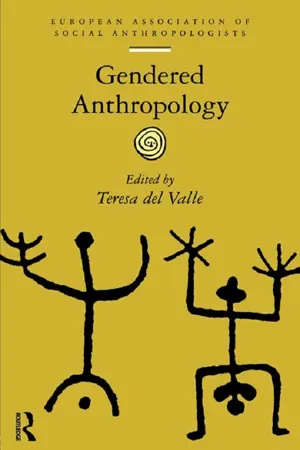
In the last three decades, a remarkable degree of progress has occurred in the study of gender within anthropology. Gendered Anthropology offers a thought-provoking, lively examination of current debates focusing on sex and gender, race, ethnicity, politics and economics and provides insights which are still too often lacking in mainstream anthropology.
Gendered Anthropology will be of particular value to undergraduates and lecturers in social anthropology and gender studies.
- 240 pages
- English
- ePUB (mobile friendly)
- Available on iOS & Android
eBook - ePub
Gendered Anthropology
About this book
Information
1 Is sex to gender as race is to ethnicity?
Verena Stolcke
La coustume est une seconde nature qui destruit la première. Mais qu’est que nature, pourquoy la coustume n’est elle pas naturelle? J’ai grand peur que cette nature ne suit elle-mêsme qu’une première coustume, comme la coustume est une seconde nature.
(Pascal, Pensée, 1670, quoted by Lévi-Strauss, 1985:1)
The uterus is to the Race what the heart is to the individual: it is the organ of circulation to the species.
(W.Tyler Smith, Manual of Obstetrics, 1847, quoted by Poovey, 1986:145)
Western common sense distinguishes nature from culture as two self-evidently distinct aspects of human experience. This chapter challenges such a dualist perspective. My aim is two-fold. As long as they are not endowed with social meaning, nature and culture might be conceived as two distinct re alms. Often, however, social orders are presented as natural facts. Here I want to explore how, in class society, social inequalities tend to be marked and legitimated by construing them as rooted in natural differences. This is not a one-way conceptual procedure. In addition, I want to pick up Pascal’s point that these ‘natural facts’ may themselves turn out to be cultural constructs.
The image of women reflected in Dr Smith’s assertion quoted above is a case in point. It is exemplary of the way in which the nineteenth-century medical profession conceptualized women on the basis of a very particular notion of their nature. A few decades later, another medical man elaborated further on this view of women: it was, he argued, ‘as if the Almighty, in creating the female sex, had taken the uterus and built up a woman around it’ (Poovey 1986:145). Women’s essence resided in their womb. Yet, perhaps inadvertently, Dr Smith added yet another idea. Not only did their womb define womanhood. The uterus and hence its bearer had a specific function, namely that of reproducing the race. In this chapter I propose to provide an explanation for this biologist’s natural notion of women’s role in Western culture and to suggest what ‘race’ has to do with it. The aim is to develop a theory of inequality in class society which will account for the relatedness of both phenomena.
Hitherto, feminist theory has envisaged women largely as an undifferentiated social category. In recent years, black women’s dissatisfaction with what they felt to be white feminists’ lack of sensibility for their specific forms of oppression has added, however, a new issue to the feminist agenda, namely how to address the way gender, class and race intersect in creating commonalities but also differences in the experience of women. As Moore insists, it is high time that we pay special attention to the differences among women:
This phase will involve the building of theoretical constructs which deal with difference, and will be crucially concerned with looking at how racial difference is constructed through gender, how racism divides gender identity and experience, and how class is shaped by gender and race.
(Moore, 1988:11)
I want to go a step further and ask why there are these intersections between gender, race and class.
There is also another reason that adds urgency to this inquiry, namely certain demographic arguments and policies that accompany the building of the European Community. Widespread alarm among European politicians over declining birth rates and their alleged consequences for the future financing of the Welfare state, and a pronatalist offensive to curtail the often limited gains made by women with regard to free abortion, go hand in hand with an increasingly explicit racism directed against so-called non-Europeans.
I do not pretend, however, to formulate a universal theory that accounts for cross-cultural variations in gender inequalities. To begin with, I only hope to elucidate the political processes and ideological justifications which, in an interdependent and dynamic manner, structure gender and ‘racial’ inequalities in bourgeois class society. The crucial phenomenon in this connection is the tendency in class society to ideologically ‘naturalize’ social inequalities. The central question is why, beside class, it is especially ‘sexual’ and ‘racial’ differences that stand out among other available characteristics of human beings (for example, body height) as significant markers of social inequality, and how these interact in reproducing women’s oppression in general and the particular differences between them in class society.
Initially, I survey the diverse ways in which feminist theory has addressed the social construction of gender hierarchies. The human species reproduces itself bi-sexually; I focus especially on the controversial causal nexus between the natural fact of biological sexual differences between human males and females and the engendered symbolic meanings which structure inequalities between women and men as social agents. As a next step, I discuss some of the vast literature on race and ethnic relations of the past three decades. Here, my focus will be mainly on British and some North American studies of race relations. I deal with notions of ethnicity and ethnic group only insofar as the terminological disagreements and the uneasy conceptual shifts in these studies between the terms ‘race’ and ‘ethnicity’ exhibit specific theoretical problems similar to those entailed in the analysis of gender relations. The main question refers to the very ‘nature’ of the supposedly natural differences which are endowed with social meaning to mark relations of inequality. Note, however, that my approach is neither construedvist nor relativist but anthropological-historical. As I argue, gender inequality in class society results from a historically specific tendency to ideologically ‘naturalize’ prevailing socio-economic inequalities. As I see it, this ‘naturalization’ is an ideological subterfuge intended to reconcile the irreconcilable, namely a pervasisve ethos of equality of opportunity of all human beings born equal and free with really existing socio-economic inequality in the interest of the latter’s beneficiaries. It is this ideological ‘naturalization’ of social condition, which plays such a fundamental role in the reproduction of class society, that accounts for the specific importance attached to sexual differences.
FROM SEX TO GENDER
The term ‘gender’ as a category of analysis was introduced into feminist studies in the 1970s. Feminist research had demonstrated that what were then called sexual roles varied widely cross-culturally (Moore 1988: especially Chapter 2). Hence, these could not be simply reduced to the inevitable natural and universal fact of sex differences.
The analytic concept of ‘gender’ is meant to challenge the essentialist and universalist dictum that ‘biology is destiny’. It transcends biological reductionism by intepreting the relationships between women and men as cultural constructs which result from imposing social, cultural and psychological meanings upon biological sexual identities. As a consequence, it became necessary to distinguish between ‘gender’ as a symbolic creation, ‘sex’ which refers to the biological fact of being female or male, and ‘sexuality’ which has to do with sexual preferences and behaviour (Caplan 1987; Showalter 1989). In order to explain these cross-cultural variations in the relationships between women and men, the historical and social roots of these variations needed to be sought.
Upon the introduction of the concept of ‘gender’ followed the development of gender theory. It is not devoid of disagreements. Although the theorization of gender as a social creation has gained ground progressively, as yet feminist theory neither provides an undisputed model for its analysis nor is there consensus about the concept of gender itself (e.g. Jaggar 1983; Moore 1988). Gender has become a kind of academic shorthand that stands for socially defined relationships between women and men, but its political meaning and implications are not always clear. The categorical approach characteristic of women’s studies, because it focused attention on experiences—be they disadvantages or achievements—primarily of women per se, found political expression in the struggle for equal rights to men. Gender theory, by contrast, introduced a relational approach that involved the study of women in their relationships with men. It is not always self-evident, however, that this opened the way for the analysis of culturally diverse forms of male power and domination over women and of what caused them historically. Only from this perspective does gender theory imply a new, subversive gender politics that challenged not only male power but also the socio-political roots of gender inequality. Moreover, from this vantage point, the goal is no longer to become as alike as possible to men, but to radically transform gender relationships, a political project which, in turn, requires overcoming all forms of social inequality (at this point admittedly a Utopian dream).
Theorizing gender relations as cultural constructs entails at least two sets of analytical questions. Because gender theory challenges earlier biological essentialisms, it problematizes and opens for new scrutiny the manner in which the natural facts of sex differences are related to gender constructs. Simultaneously, the concept of gender as a socio-historical form of inequality between women and men draws attention to other categories of difference which are translated into inequality, such as race and class, and poses the question as to how they intersect (Stolcke 1981; Signs 1987; Showalter 1989:3).
One crucial contentious issue in gender analysis refers to whether, and if so how, the biological facts of sex differences are interconnected with gender categories cross-culturally. In other words, what are the factual differences out of which genders are construed? Or, even more radically, does gender as a cultural construct always necessarily have something to do with the natural facts of sex differences?
Already in the early 1980s, Judith shapiro perceived the conceptual difficulties involved in separating gender from sex.
Sex and gender serve a useful analytic purpose in contrasting a set of biological facts with a set of cultural facts. Were I to be scrupulous in my use of terms, I would use the term ‘sex’ only when I was speaking of biological differences between males and females, and use ‘gender’ whenever I was referring to the social, cultural, psychological constructs that are imposed upon these biological differences… Gender…designates a set of categories to which we can give the same label cross-linguistically, or cross-culturally, because they have some connection to sex differences. These categories are, however, conventional or arbitrary insofar as they are not reducible to, or directly derivative of, natural, biological facts; they vary from one language to another, one culture to another, in the way in which they order experience and action.
(Shapiro 1981, quoted by Collier and Yanagisako, 1987a:33)
Collier and Yanagisako, (1987a), by contrast, have more recently defied the necessary link between sex and gender by challenging the persistent tendency in comparative studies to attribute the cultural organization of gender to the ‘biological difference in the roles of women and men in sexual reproduction’. They see this as being analogous to the genealogical reifications so characteristic of conventional anthropological studies of kinship systems which Schneider (1985), for example, challenged in the United States some time ago, and of which another example is the extraordinary anthropological controversy over the alleged ignorantia paternitatis of certain ‘primitive’ peoples (Leach 1966; Delaney 1986). But while anthropologists nowadays generally acknowledge that theories of conception and kinship systems are cultural rather than biological phenomena, to question the connection between sex and gender is very novel. Collier and Yanagisako, in effect, suggest that instead of taking for granted the biological roots of gender categories, whatever their culturally specific realizations may be, we ought to start out by questioning such a universal connection: ‘we argue against the notion that cross-cultural variations in gender categories and inequalities are merely diverse elaborations and extensions of the same natural fact’ (1987a:15).
Still, whereas Collier and Yanagisako question the biological rooting of gender, they take for granted sex differences as natural facts. McDonald (1989:310) has rightly pointed out, however, that even views of biology and of physiology, and for that matter of nature as such, are socio-political conceptualizations. A cursory review of the history of biology, of embryology and of images of the body, provides abundant evidence of this (for example, see Mayr 1982; Bridenthal et al. 1984; Martin 1987a; Hubbard 1990; Laqueur 1991). At this point, the reader may be invaded by an eerie feeling of rootlessness. In order not to be trapped in an endless constructivist spiral, which can never provide an explanation for why certain ‘natural’ facts are conceptualized in culturally specific ways, what needs to be done is to examine the historical background which accounts for particular views of biology and nature and vice versa, i.e. to ask why particular social relationships are conceptualized in natural terms.
Challenges to established wisdom, such as that by Collier and Yanagisako, have a liberating effect for future cross-cultural research, even if, as they are well aware, we cannot easily jump over our own culture’s conceptual shadows. But precisely for this reason, we ought to analyse also our own preconceptions. That is what I want to do here, namely to unpack and examine the cultural assumptions which inform conceptualizations of biogenetic substance and inheritance and gender constructs in bourgeois class society. This is a necessary step toward elucidating how and why class, race and sex intersect in structuring gender relations. The interpenetration of ‘natural’, supposedly biological facts, ‘cultural’ meanings and socio-economic relationships is the crucial point.
FROM RACE TO ETHNICITY AND BACK
Harding (1986) has recently drawn attention to the intersection between gender and race to show how these different forms of domination affect women and men or whites by contrast with blacks in particular ways: ‘in cultures stratified by both gender and race, gender is always also a racial category and race a gender category’ (Harding (1986:18); for further references to the links between gender, class and race see Gordon (1977); Carby (1985); Haraway (1989)). For the most part, however, the interplay between gender, class and race has hitherto eluded a clear conceptualization and explanation. Analyses tend to focus on the differing socio-economic effects for women of these categorizations rather than on the roots of, and links between, these combined systems of inequality. One exception is Gordon’s (1974) beautiful and early study of birth control in America. As Gordon showed, doctrines of social-cumracial purity were the result of a particular socio-economic structure and decisively informed notions of gender and hence women’s experience. Moore (1988:86), on the other hand, has rightly insisted that the issue is not one of a mere convergence or ‘coalescence’, a kind of adding-up process, of several forms of oppression in the configuration of women’s social condition and of gender relationships. The actual interconnections between gender, race and class remain, none the less, unclear.
By contrast with feminist scholars’ awareness of ‘race’, a concern with gender is conspicuously absent from the recent literature on race and ethnicity. Highly politicized polemics over the conceptual meanings and social implications of race, ethnicity and racism occupy a prominent place instead. I will deal with this debate on three grounds: first, to establish the development of the contemporary usage of ‘ethnicity’ in addition to or replacement of ‘race’ in research on so-called race relations; second, to disentangle the ambivalent meaning of ‘ethnicity’ and ‘ethnic group’; and third, to suggest that despite this conceptual shift, a continuity can be detected between what some authors in the past three decades—when analysing racial tensions in the United Kingdom and more recently in Europe—have designated the ‘new racism’, and older racist doctrines and discriminations.
With rare exceptions (for example, M.G.Smith 1986; van den Berghe 1986), it is now acknowledged among scholars that in biosocial terms ‘races’ do not exist among human beings. The alleged ‘natural’ basis of cultural diversity in ‘race’, no less than the systems of inequality and exclusion predicated on racial differences, are socio-historical constructs. On the one hand, phenotypical characteristics which tend to be interpreted as indicators of racial difference and are used to legitimate racial prejudice and discrimination reflect only a fraction of a group’s genotype. On the other, there are well known instances of racism where there are not even visible and coherent phenotypical differences. To emphasize this ideological character of ‘racial’ discrimination, the concepts of ‘ethnicity’ or ‘ethnic group’, in the sense of cultural identity, have recently been substituted for the term ‘race’.
The usage of the terms ‘ethnicity’ and ‘ethnic group’ to designate a category of people bounded by a number of common traits...
Table of contents
- Cover
- Title
- Copyright
- Contents
- List of illustrations
- Notes on contributors
- Preface
- Acknowledgements
- Introduction
- 1. Is sex to gender as race is to ethnicity?
- 2. The study of kinship; the study of person; a study of gender?
- 3. The illusion of dualism in Samoa. ‘Brothers-and-sisters’ are not ‘men-and-women’
- 4. Blood, sperm, soul and the mountain. Gender relations, kinship and cosmovision among the Khumbo (N.E. Nepal)
- 5. Home decoration as popular culture. Constructing homes, genders and classes in Norway
- 6. Impure or fertile? Two essays on the crossing of frontiers through anthropology and feminism
- 7. The differences within and the differences between
- References
- Name index
- Subject index
Trusted by 375,005 students
Access to over 1.5 million titles for a fair monthly price.
Study more efficiently using our study tools.
Frequently asked questions
Yes, you can cancel anytime from the Subscription tab in your account settings on the Perlego website. Your subscription will stay active until the end of your current billing period. Learn how to cancel your subscription
No, books cannot be downloaded as external files, such as PDFs, for use outside of Perlego. However, you can download books within the Perlego app for offline reading on mobile or tablet. Learn how to download books offline
Perlego offers two plans: Essential and Complete
- Essential is ideal for learners and professionals who enjoy exploring a wide range of subjects. Access the Essential Library with 800,000+ trusted titles and best-sellers across business, personal growth, and the humanities. Includes unlimited reading time and Standard Read Aloud voice.
- Complete: Perfect for advanced learners and researchers needing full, unrestricted access. Unlock 1.5M+ books across hundreds of subjects, including academic and specialized titles. The Complete Plan also includes advanced features like Premium Read Aloud and Research Assistant.
We are an online textbook subscription service, where you can get access to an entire online library for less than the price of a single book per month. With over 1.5 million books across 990+ topics, we’ve got you covered! Learn about our mission
Look out for the read-aloud symbol on your next book to see if you can listen to it. The read-aloud tool reads text aloud for you, highlighting the text as it is being read. You can pause it, speed it up and slow it down. Learn more about Read Aloud
Yes! You can use the Perlego app on both iOS and Android devices to read anytime, anywhere — even offline. Perfect for commutes or when you’re on the go.
Please note we cannot support devices running on iOS 13 and Android 7 or earlier. Learn more about using the app
Please note we cannot support devices running on iOS 13 and Android 7 or earlier. Learn more about using the app
Yes, you can access Gendered Anthropology by Teresa del Valle in PDF and/or ePUB format, as well as other popular books in Social Sciences & Anthropology. We have over 1.5 million books available in our catalogue for you to explore.