Appropriating Gender explores the paradoxical relationship of women to religious politics in India, Pakistan, Sri Lanka, and Bangladesh. Contrary to the hopes of feminists, many women have responded to religious nationalist appeals; contrary to the hopes of religious nationalists, they have also asserted their gender, class, caste, and religious identities; contrary to the hopes of nation states, they have often challenged state policies and practices. Through a comparative South Asia perspective, Appropriating Gender explores the varied meanings and expressions of gender identity through time, by location, and according to political context.
The first work to focus on women's agency and activism within the South Asian context, Appropriating Gender is an outstanding contribution to the field of gender studies.
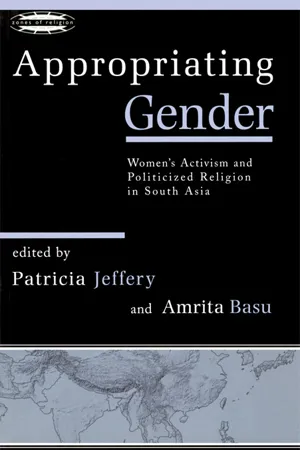
eBook - ePub
Appropriating Gender
Women's Activism and Politicized Religion in South Asia
- 288 pages
- English
- ePUB (mobile friendly)
- Available on iOS & Android
eBook - ePub
Appropriating Gender
Women's Activism and Politicized Religion in South Asia
About this book
Information
Part I
Gender, Nation, State
Chapter One
Appropriating Gender
IN THE PAST DECADE OR so, religion and gender have become increasingly intertwined in the political turmoil that envelops South Asia. Religion has provided a vehicle through which the state has sought legitimacy, political parties have contested the state, and social movements have organized. The forces that are most committed to politicizing gender have treated women as the repositories of religious beliefs and the keepers of the purity and integrity of the community. Women have engaged in activism within and against “communal” politics.
Until quite recently, the scholarly literature tended to treat gender, religious, and community identities as static and unchanging. A preoccupation with religious doctrine, public policy, and legal processes supplanted an interest in lived experience. Reflecting colonial, Orientalist assumptions about the privileged place of religion and of women's piety, scholars ignored the ways in which states, parties, and women themselves strategically appropriated gender to achieve social change. In the process they ignored the complicated forms of women's agency that emerged from the interplay of gendered, class, and religious identities. Women were assumed to lack political consciousness entirely or in adequate measure. Such views have been challenged by numerous, varied instances of women's activism in religious politics. Consider the militant Hindu ideologues Uma Bharati and Sādhvī Rithambara in India, or the woman from the Liberation Tigers of Tamil Eelam (LTTE) Tamil separatist movement in Sri Lanka whose suicide bomb killed the then prime minister of India, Rajiv Gandhi. Or consider female heads of state like Benazir Bhutto of Pakistan and Khaleda Zia of Bangladesh, who both fortify and defy Islamic strictures on women's freedom. By exploring diverse forms of women's agency, we investigate how women construct individual selves and collective identities.
The relationship of women to politicized religion is paradoxical and complex. Religious politics has created opportunities for women's activism while simultaneously undermining women's autonomy. Contrary to the hopes of most feminists, women have not always opposed religious nationalist appeals; contrary to the hopes of religious nationalists, religious identities have not negated women's gender, caste, class, and regional identities; contrary to the appeals of nation-states, women have often dispelled the assumption that their primary identities are as self-sacrificing mothers and wives. To appreciate the complexities of women's gendered, religious, and community identities, Appropriating Gender engages in comparative analysis of women in leadership positions and of ordinary women, of the local against the national state, and of textual religious traditions against everyday practice. It analyzes episodic moments of upheaval, like the destruction of the Babari Masjid in Ayodhya on 6 December 1992, the place of religion in people's daily lives, and the implications for women of the “communalization” of routine state services.
The opportunity that this volume affords, of a comparative South Asian perspective, checks tendencies toward oversimplification. We are cautioned against generalizing about—say—“the Muslim woman,” when her experiences are so diverse in India, Pakistan, and Bangladesh. Through comparative analysis, we seek to discern the varied meaning of gender identity and politics through time, by location, and according to political context. Although there have been some important additions to the scholarly literature on women, religion, and politics in India over the past few years (e.g., Hasan (ed.), 1994; Sarkar and Butalia (eds.), 1995), none of these works provides the comparative perspective of Appropriating Gender.
We are struck by how states, movements, and parties have fallen back on religious—and often gendered—appeals when their legitimacy has foundered. Yet we are also struck by differences in the strength of religious forces in India, Pakistan, Bangladesh, and Sri Lanka, the four South Asian nations that we explore in this volume. At one end of the continuum is Pakistan, where the relationship between religion and politics has been closest. Indeed, under the Zia ul Haq regime (1977–1988) the state was the prime proponent of Islamization. At the other end of the continuum is India, where the state in theory upholds secularism but has inadvertently strengthened religious nationalism. At intermediate points on the continuum are Bangladesh and Sri Lanka, where ethnic and religious definitions of national identities have competed, and movements like the Tablīghī Jama‘at have generated community identities independent of the state.
The remainder of this chapter lays out the three central themes that run through the volume. First, it explores how gender constitutes a sphere of contestation involving women, the state, parties, and organizations that employ religious appeals. Second, it asks how our understandings of community and religious identities change when viewed from the vantage point of the everyday and the local. The third and most important theme running through the volume, to which we return in the concluding chapter, concerns the implications of women's agency for their emancipation and empowerment. If one objective of the volume is to provide a full, rich account of women's agency, another is to assess the disjunctions between women's agency and activism on the one hand and their emancipation on the other.
The Organization of the Volume
The chapters in this volume are arranged in three parts. The first “Gender, Nation, State,” explores the ways in which the state and religious communities influence the construction of gendered identities. The second, “The Everyday and the Local,” considers the meaning of religion in women's everyday lives at the local level. The third, “Agency and Activism,” analyzes women's complicated expressions of resistance within and against religious and ethnic movements.
If the delineation of sections is artificial, in that several of the chapters speak to more than one theme, it helps to identify some broad areas of convergence and divergence among the authors. For example, the chapters in Part I tend to focus on the actions of the nation state or, in one case, a national political party in order to delineate the broadest contours of the political and economic context. By contrast, the chapters in Part II argue that this vantage point is partial and sometimes misleading. Reflecting the biases of nation states and parties themselves, it neglects the more complicated reality of lived experience on the ground. The chapters in Part III suggest that national/local, everyday/episodic distinctions are much less significant than a focus on agency and activism at each of these levels, for crystallized within women's agency and activism are clues to the complex, contradictory nature of the structures of domination and the possibilities of resistance.
Gender, Nation, State
Scholars who study identity construction often focus on the social and cultural domain rather than on the state. Students of the state, on the other hand, tend to be disinterested in processes of identity formation. However, the chapters in Part I (Menon, Feldman, Rouse, Hasan, and Sarkar) show that it is impossible to understand identities without exploring the ways in which states, parties, and movements contribute to their construction.
Gender provides an extremely fruitful lens through which to interpret the actions of the state and of ethnic and religious communities. In the South Asian context, the nation is represented as a motherland and the state as father. In some cases the patriarchal state exercises control with benevolent paternalism and in others, in an authoritarian fashion. The paternalistic state offers protection to “its” women and children on the assumption that they cannot protect themselves. In return for this protection, it demands control over women's sexuality. Ritu Menon's characterization of the state as abductor during the postpartition era illuminates the paternalism of the Indian state. Women exercised unusual freedom to determine their marital partners when national boundaries were in flux, but after the rupture between India and Pakistan, the Indian state took on the role of protector and provider and insisted on determining where women and their children belonged. Although one might have predicted that Pakistan, which was formed as a Muslim homeland, would have been more anxious to reclaim Muslim women than secular India would be to reclaim Hindu women, the reverse was true. Having experienced Pakistan's creation as a loss of its territory, India was determined to recover its “moveable property.”
State intervention often complements, upholds, and reinforces the interests of patriarchal communities by disregarding or denigrating women's attempts to free themselves from community sanctions. Menon's exploration of “abducted women” reveals that while the Indian state proclaimed its secular character, in practice it defined membership in the national community on religious lines.
Even when the national state acts in a benevolently paternalistic fashion, local administrators have been complicit in violence against minorities amid riots in India. Institutional communalism in patterns of health and education, as Patricia and Roger Jeffery point out, are part of the context in which violence between Hindus and Muslims took place in Bijnor. In other South Asian countries, the authoritarian face of the patriarchal state is even more pronounced than in India. In Sri Lanka, the state assumed its most authoritarian role between 1988 and 1990, when it murdered or abducted anyone whom it suspected of subversive activities. The Pakistani state assumed the role of authoritarian patriarch during the Zia ul Haq regime.
Opposition to the state often emerges when the state fails to exercise its authority in a benevolently paternalistic fashion. Shahnaz Rouse argues that some secular groups in Pakistan have tried to hold the state to its promises by demanding that it maintain women's izzat (honor) in the public domain. In India, Hindu nationalists have mobilized opposition to the state for upholding religious law. As Malathi de Alwis argues, the failures of the paternalistic Sri Lankan state to protect families prompted the Mothers’ Front to launch a peace movement.
Religious and ethnic communities alike have also employed sexual and gendered imagery to characterize themselves and their hated “others.” Paradoxically, such images have their roots in colonial ideology. British colonialism drew invidious distinctions between the so-called martial and the nonmartial races, whom it differentiated according to gender attributes. Whereas the martial races were masculine—strong, virile, and aggressive—the nonmartial races were “effeminate”—passive, weak, and impotent. Today we hear echoes of this approach in Hindu nationalists’ depictions of Muslim men as violent aggressors, often rapists, and of Hindus as passive victims. The Pakistani state has upheld these very images, Rouse argues, while reversing the values that Hindu nationalists affix to them. Tanika Sarkar argues that upper-caste Hindus first turned their attention to women in the late nineteenth century, when they worried about the loss of their privileges both to other religious communities and to the lower castes and classes; they conferred on Hindu women a key role in safeguarding community identity through their roles as wives and mothers. Her depiction of Hindu nationalists’ fixation on controlling women's bodies, which continued well into the twentieth century, is reminiscent of Menons depiction of the state's anxiety to recover Hindu mothers and their children from Pakistan.
Shelley Feldman argues that the growth of Islamization in Bangladesh, and its particular concern with reprivatizing women's roles, can be explained by changes in the state's class alliances, growth strategies, and relationship to the global political economy. She suggests that General Ziaur Rahman (1975–1981) contributed to women's growing visibility by supporting nongovernmental organizations that provided women with new opportunities for education and employment. This challenged the interests of the Jama'at-i-Islami (an Islamist political party) and the military, which brought about Zia's overthrow. General Ershad (1982–1990), who succeeded him, strengthened the links between the state and religious forces. Depicting publicly visible women as symbols of Bangladesh's capitulation to modernizing, Westernizing forces, Ershad went so far as to instruct the police to tar the midriffs of middle-class women who were wearing their saris in a supposedly immodest fashion. Feldman notes that the state considered women symbolic of the newly empowered middle classes at the expense of rural elites. Like Sarkar, who presents Hindu nationalists’ attempts to limit women's freedoms as a response to the strains on patriarchal control that result from the growth of capitalist markets and urban consumerism, Feldman links Bangladesh's integration into the global capitalist economy with the growth of religious fundamentalism. Similarly in Pakistan, the state has sought to make religion a paramount feature of women's identities. Rouse argues that the Pakistani state used to delegate the task of regulating women's sexuality to the family. However, in the aftermath of Zia ul Haq's martial law regime, it assumed this responsibility itself—thus the growing incidence of state-sanctioned violence against women.
Zoya Hasan explores another important instance of the state's compromise of its secular principles: the landmark Shah Bano case in India. An elderly Muslim woman's demands for maintenance from her former husband reached the Supreme Court. Rajiv Gandhi, then prime minister, overruled the Court's positive decision in order to assuage conservative Muslim opinion. By treating Muslims as a homogeneous and monolithic group and disregarding the interests of Muslim women, the state strengthened conservative Hindu and Muslim groups at the expense above all of Muslim women.
The Everyday and the Local
Our picture of South Asia would be highly distorted if we focused exclusively on parties and the state at the national level. We would be left with the sense that South Asia is in a perpetual state of crisis as a result of the growth of religious violence. We would assume that the only roles available to women are either as victims or as agents. Several chapters in this volume (those by Metcalf, Shaheed, and Jeffery and Jeffery) challenge these assumptions by focusing on the local and the everyday, and exploring the meaning of religion as lived experience. Implicit within this approach is a critique of scholarship that confines its attention to the national state and to episodic moments of violence.
Patricia and Roger Jeffery argue that a focus on the national state is misleading for two seemingly opposite reasons. On the one hand, scholars often draw upon the state's own account of its activities and thus exaggerate its commitments to secularism, democracy, and social justice. On the other hand, accounts of the state's role in crisis management tend to ignore the grinding, routine aspects of institutionalized communal, class, and gender inequality. By focusing on the formation of Hindu and Muslim identities in rural Bijnor, they explore the interplay between communalism that is fostered by the state and by everyday social relations.
Farida Shaheed argues that women at the local level in Pakistan are less preoccupied with the state and religion than feminists tend to assume. Activism that focuses exclusively on repealing Islamic law depicts the state as more powerful than it really is and neglects the forms of oppression that emanate from the family. She suggests that scholars and activists should devote more attention to women's lived experience and question their own urban-middle-class assumptions.
Barbara Metcalf draws attention to an Islamic organization that provides a refreshing contrast with fundamentalist groups. She argues that the Tablīghī Jama‘at, a proselytizing religious reform movement which is active in South Asia, has positively influenced gender relations and women's position within the community. This is not apparent from a focus on its formal pronouncements or from women's participation in its organized activities and pilgrimages. However, men's attitudes toward women and relations between men and women are extremely egalitarian, for the Tablīgh rejects many of the institutions and practices that foster gender asymmetry.
Some of the authors contend that the influence of religion, particularly of religious doctrine, on women's daily lives has been greatly exaggerated. In Katy Gardner's account, religion is less significant than class in explaining the meaning and significance of pardā for Muslim women in Bangladesh. Moreover, pardā itself is less a religious institution than a facet of the social structure. Jeffery and Jeffery argue that gender relationships among Muslims and Hindus are very similar. Shaheed notes that religious influences are so deeply interwoven in people's lives that the women she interviewed did not differentiate religion from other forces. In analyzing a religious movement, Metcalf focuses on lived experience rather than religious doctrine.
Nor do these authors find religious influences necessarily an oppressive force in women's lives. Shaheed speaks of the positive aspects of religious faith in its capacity to affirm both individual self-worth and membership in the community. This sense of belonging, which is readily available to men, is otherwise less common for women. Metcalf argues that the religious tour suspends the division between public and private spheres that normally underlies gender inequality, thereby relaxing the sexual division of labor. Although women do not participate actively in the public arena, men take on many domestic responsibilities. Gardner argues that middle-class women who don the veil thereby acquire opportunities to venture into the public domain without fear of harassment.
A few papers analyze the relationship between religious and political life. Metcalf emphatically argues that the Tablīghī movement exists outside the political domain. Shaheed, like Metcalf, sharply demarcates the spheres of public and private life and argues that most women experience control by their families and not by the state. For both Metcalf and Shaheed, religion does not undermine women's power when it is disassociated from state power. Their views partially conflict with those of Jeffery and Jeffery, who show that many aspects of social life are also influenced by state policy.
The differences between the positions of Metcalf and the Jefferys might be partially explained by the differences in the vantage points they adopt. The Tablīghī Jama‘at's ability to transcend the public-private divide might be attributed to its liminality: the act of joining a religious tour entails breaking regular routines to enter a world in which social hierarchies are muted. The fact that the movement transcends national boundaries no doubt contributes to the apparent absence of the state. Those who participate in the tour do so as members of a religious community, not as national citizens.
In contrast to the liminal space of the Tablīghī movement, Bijnoris’ lives are spatially delimited and subject to greater state influence. Patricia and Roger Jeffery speak of the way state decisions about the siting of schools and health clinics widen communal cleavages. Differences between Metcalf and Jeffery and Jeffery on the Tablīghī Jama‘at are particularly revealing. Because they situate the Tablīghī Jama‘at's activities within villages composed of Hindus and Muslims, the Jefferys fear that the Tablīghī Jama‘at's efforts at purifying Islam will entail eliminating Hindu influences, which will in turn exacerbate the Hindu-Muslim divide. By contrast, in the self-enclosed space ...
Table of contents
- Front Cover
- Half Title
- Title Page
- Copyright
- Dedication
- Contents
- Preface and Acknowledgments
- Part I. Gender, Nation, State
- Part II. The Everyday And The Local
- Part III. Agency And Activism
- Bibliography
- Contributors
- Index
Trusted by 375,005 students
Access to over 1.5 million titles for a fair monthly price.
Study more efficiently using our study tools.
Frequently asked questions
Yes, you can cancel anytime from the Subscription tab in your account settings on the Perlego website. Your subscription will stay active until the end of your current billing period. Learn how to cancel your subscription
No, books cannot be downloaded as external files, such as PDFs, for use outside of Perlego. However, you can download books within the Perlego app for offline reading on mobile or tablet. Learn how to download books offline
Perlego offers two plans: Essential and Complete
- Essential is ideal for learners and professionals who enjoy exploring a wide range of subjects. Access the Essential Library with 800,000+ trusted titles and best-sellers across business, personal growth, and the humanities. Includes unlimited reading time and Standard Read Aloud voice.
- Complete: Perfect for advanced learners and researchers needing full, unrestricted access. Unlock 1.5M+ books across hundreds of subjects, including academic and specialized titles. The Complete Plan also includes advanced features like Premium Read Aloud and Research Assistant.
We are an online textbook subscription service, where you can get access to an entire online library for less than the price of a single book per month. With over 1.5 million books across 990+ topics, we’ve got you covered! Learn about our mission
Look out for the read-aloud symbol on your next book to see if you can listen to it. The read-aloud tool reads text aloud for you, highlighting the text as it is being read. You can pause it, speed it up and slow it down. Learn more about Read Aloud
Yes! You can use the Perlego app on both iOS and Android devices to read anytime, anywhere — even offline. Perfect for commutes or when you’re on the go.
Please note we cannot support devices running on iOS 13 and Android 7 or earlier. Learn more about using the app
Please note we cannot support devices running on iOS 13 and Android 7 or earlier. Learn more about using the app
Yes, you can access Appropriating Gender by Patricia Jeffery,Amrita Basu in PDF and/or ePUB format, as well as other popular books in Social Sciences & Religion. We have over 1.5 million books available in our catalogue for you to explore.