- 346 pages
- English
- ePUB (mobile friendly)
- Available on iOS & Android
eBook - ePub
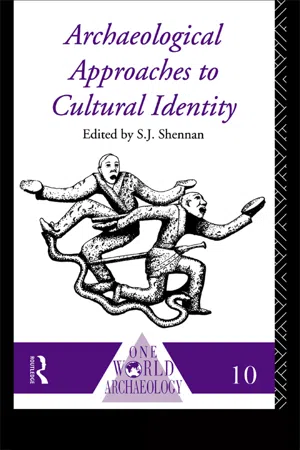
Archaeological Approaches to Cultural Identity
About this book
Examines the critical implications of cultural identity from a variety of perspectives. Questions the nature and limits of archaeological knowledge of the past and the relationship of material culture to cultural identity.
Information
1 Ethnic concepts in German
prehistory: a case study on the
relationship between cultural
identity and archaeological
objectivity
ULRICH VEIT
(translated by Stephen Shennan)
It is almost fashionable to be derogatory about Kossinna’s theories, but his methods were perhaps not as bad as the way he himself misused them.
(McWhite 1956, p. 7)
Historians of the development of anthropology seem to be united in the belief that the past decade has seen a major change in the whole scene. Just as there has been a trend in society as a whole towards a new traditionalism, so the science of man has largely said goodbye to modernism, and consequently to a belief in the progress of civilization and to the idea of a single world society (Friedman 1988). Thus, it is not surprising that in the field of prehistoric archaeology too the self-styled guardians of modernism are on the retreat.
In the 1960s the liberation of archaeology from the fetters of culture history was proclaimed under the banner of a ‘New Archaeology’. Today we can perceive an opposite trend. History has a future once more. It is no longer the pursuit of cultural universals that is at stake. It is the variety and specificity of cultural developments on which people’s efforts are focused. In the context of systems theoretical approaches the term ‘culture’ was at times reduced to the level of an extrasomatic means of adaptation to the natural environment. However, now there is a renewed interest in ‘cultures’ in the plural and not merely ‘culture’ in general. One result of this development is that ‘cultural identity’ is increasingly becoming a key term for the self-definition of a ‘post-processual’ archaeology. Questions about problems such as ethnicity and multiculturalism, which people long thought they could avoid by regarding them as unimportant, or even unscientific (for example, Hagen 1980, p. 8) are again open to archaeological debate.
In the light of these developments, it seems to me to be important to remember that there were areas of prehistoric research where problems of ethnicity and multiculturalism had always remained of interest. However, these lay outside the approaches mentioned above which have determined the direction of theoretical discussion in the subject since the 1960s. This is also true of prehistoric research in the German-speaking countries. Here the topic of cultures and ethnicity has traditionally had considerable significance, although specific academic and historical circumstances to which we will return below have meant that in recent decades this line of enquiry has not always been looked at with as much open-mindedness and soberness as one would wish.
Apart from language difficulties, historical circumstances may also be one of the reasons why, outside Germany, approaches to the question of ‘ethnic interpretations’ of archaeological data have not taken the corresponding German tradition into account. Remarkably enough, even in a recent work by McGuire (1982) on The study of ethnicity in historical archaeology’ one finds not a single reference to the old Central European research tradition concerning the ‘ethnic interpretation’ of archaeological data. On the other hand, German research since World War II has largely ignored such discussions going on outside Germany, and even more so outside Europe, although occasional forays over the language barrier convincingly demonstrate how profitable an argument with the other side can be (McWhite 1956, Cullberg 1977, Trigger 1978, 1984, Narr 1981, 1985). What follows below cannot in itself provide such an argument, but it does aim to make a contribution, mainly from the perspective of the history of research, as an attempt to provide admittedly subjective glimpses into the German tradition of the ethnic interpretation of archaeological finds. Thus, the following presentation is intended more as a discussion of some general theoretical and methodological problems in prehistoric archaeology (on the question of different technical terms in the German- and English-speaking archaeological traditions; see Narr 1966) than as a treatment of the problem of the Germani, which is, in fact, inseparable from the question of ethnic interpretation. However, this is not an area in which the author can claim the necessary factual knowledge and technical competence (for recent summaries of this topic, see Hachmann 1975, Mildenberger 1986, cf. Martens, Ch. 2, this volume).
The case of Kossinna and its consequences
As far as German research is concerned, the argument about the problem of ‘the ethnic interpretation of archaeological culture areas’ remains inseparably linked with the name of Gustaf Kossinna. Although competing with other schools of archaeological thought, such as the ‘Marburg school’, the fate of his teachings exemplifies the rise and fall of German archaeology in the first half of the 20th century. Indeed, in many respects, even today he casts a shadow over the subject, a phenomenon which Smolla (1979–1980, 1984–1985, 1986) recently characterized by the convenient term, ‘the Kossinna syndrome’. Therefore, it is necessary to start by at least spotlighting the causes and symptoms of this syndrome, which can serve us as a case study of the relationship between archaeological objectivity and cultural identity.
First it must be made clear that Gustaf Kossinna (b. 1858), who was originally trained in Germanic philology and entered prehistory via his antiquarian study of the Germani (see Stampfuß 1935, Schwerin von Krosigk 1982, Smolla 1978–1980, 1984–1985, 1986), was by no means the first person who attempted to ascribe archaeological finds to specific peoples (on the question of his predecessors see, for example, Wahle 1941, Eggers 1959, Meinander 1981, Hachmann 1987). Certainly today it is his name which is associated with this idea; this is because he, like no other person, brought the question of ethnic interpretation to the centre of prehistoric thought. In doing this he made a lasting contribution to the establishment of prehistory as an academic discipline. Undoubtedly, the rising tide of nationalism at the beginning of this century was remarkably convenient for him in this respect. Indeed, one could go so far as to say that it was this which made possible the rise in the status of prehistory to that of an independent academic subject (Smolla 1979–1980).
Kossinna first stepped on to the archaeological stage with a paper on ‘The prehistoric distribution of the Germani in Germany’, presented at a meeting of the Anthropological Society in Kassel in 1895 (Kossinna 1896). In this paper he had already sketched out the principles of his so-called ‘settlement archaeological method’. He continued to develop these in the following decades, and tried to apply them on a large scale to European prehistory. An extended presentation of his methodological basis combined with a polemical settling of accounts with his academic opponents appeared in 1911 under the title The origin of the Germani. On the settlement archaeological method (Kossinna 1911a). It was in this that he made his famous statement ‘Sharply defined archaeological culture areas correspond unquestionably with the areas of particular peoples or tribes’ (ibid., p. 3). Fifteen years later, after Kossinna had in the meantime succeeded in obtaining a professorship in German archaeology at the University of Berlin, a revised version of his volume on methods of 1911 appeared, under the title Origin and distribution of the Germani in the prehistoric and early historic periods (Kossinna 1926). Between these two dates lay a period of extremely intensive work as an author, as a university lecturer and as an organizer. The last of these applies especially to his presidency of the newly founded German Society for Prehistory, and his editorship of the journal Mannus and of the monograph series of the same name associated with it.
As well as academic publications in the strict sense, Kossinna produced a whole series of publications intended to influence a wider non-academic audience. The title of his popular book, German prehistory, a pre-eminently national discipline (Kossinna 1914) gives an adequate impression of the nationalistic, indeed racist, attitude which was inseparably associated with Kossinna’s work. In his concept of an Aryan, Nordic ideal race, superior to all other peoples—his Germani, or their supposedly even more upright predecessors the Indo-Europeans—he saw the key to an unwritten history, as it lay hidden in his prehistoric find groups. According to him, in ever-repeated advances towards the south these Germani gave the decisive push to the course of history (Schwerin von Krosigk 1982, p. 71)—a slim, tall, light-complexioned, blonde race, calm and firm in character, constantly striving, intellectually brilliant, with an almost ideal attitude towards the world and life in general.
In the light of these ideas, it comes as no surprise that Kossinna finally attempted to derive political demands from the results of his ethnohistoric research. Apart from his explicit war propaganda during World War I, these included as a political footnote his flawed attempt to influence the political decisions made at Versailles. His demands were laid down in his book The German Ostmark, a homeland of the Germani (Eggers 1959, pp. 231ff.)
Kossinna died in 1931, and did not live to experience the upsurge of his subject, and especially of his theories, which followed the seizure of power by the Nazis. However, it goes without saying that, had he still been alive, he would have hailed it with considerable satisfaction, even if the new propagandists did not do adequate justice to his work. Posthumously, Kossinna became, albeit less on the basis of his academic achievements and more because of his ‘political influence’, the conceptual father and the leading figure of a National Socialist popular (völkischen) prehistory (Stampfuß 1935). After the Nazi seizure of power its representatives occupied the key positions in the discipline, once the academic world of Germany had been brought into line according to the ideological prescriptions of the ‘Rosenberg office’ (Bolmus 1970, Kater 1974). Most members of the discipline, however, especially in those circles which had no direct connection with Kossinna and his school, behaved more discreetly and waited to see what would happen. More direct opposition to the ideological takeover of the discipline, which was connected with a vulgarization of the subject, is certainly not to be detected. The courageous methodological criticisms concerning the ‘Kossinna method’, raised by Wahle (1941), will be discussed below.
If the rise of Kossinna with the National Socialist takeover was logical, then his fall after 1945 was equally inevitable. Apart from a few of his pupils (Wahle 1950–1951, Jahn 1952), hardly any of those still using his methodological principles were prepared to take his side. The name Kossinna became a non-word. Enormous quantities of paper were printed with explanations that were supposed to demonstrate that the working methods of their respective authors had nothing to do with the Kossinna method, now fallen into disrepute.
However, inasmuch as people from now on anathematized Kossinna’s work, and thus did not subject it to a proper critique, they were committing the same mistake as in 1933, albeit with the opposite premises.With the verbal damnation of Kossinna’s method and his convenient branding as the only guilty party—a view which was also widely taken up outside Germany (for example, Clark 1957, Renfrew 1976, p. 38)—the reasons for the ideological misuse of his ideas, which were, after all, based on the nature of archaeological knowledge, remained largely unexplained.
On the other hand, most scholars continued to work with Kossinna’s principles, and not just in Germany (cf. Martens, Ch. 2, this volume). Probably the best-known pupil of Kossinna was no less than Childe, who had introduced Kossinna’s principles into Great Britain during the 1920s, but stripped of their ideological baggage (Childe 1927, 1929). In view of the political developments in Germany after 1933, this connection tended to be forgotten (Childe 1933). It was Childe himself who, late in life, pointed it out again (Childe 1958,Trigger 1980, McNairn 1980; also, in greater detail, Veit 1984).
‘Settlement archaeology’. Kossinna’s method and contemporary criticisms
It is now necessary to ask ourselves what there is really of consequence in the ‘Kossinna method’, much maligned but actually frequently used by its critics (in addition, see in detail Wahle 1941, Eggers 1959, Hachmann 1970, Klejn 1974a). The core of Kossinna’s methodological principles is summed up in his well-known axiom of 1911. In its expanded 1926 version this states: ‘Clearly defined, sharply distinctive, bounded archaeological provinces correspond unquestionably to the territories of particular peoples and tribes’ (Kossinna 1926, p. 21). This guiding principle is linked with the retrospective method, which involves using the (ethnic) conditions of the present (or the historically documented past) to infer the situation in prehistory. The two together make up the so-called ‘settlement archaeological method’. Working backwards from early historical times, Kossinna tried to throw light on the development of peoples in prehistory by tracing continuities within particular settlement areas. The basis for this was provided by the ‘typological method’, which he had taken over from Montelius. Typology enabled him to establish time horizons for the chronological ordering of the material remains of the past (although for Kossinna the principle of the closed find, which had been so important for Montelius, as well as the stratigraphic principle, were both less important than typology; Schwerin von Krosigk 1982, p. 35). Once these chronological horizons had been defined, Kossinna’s next step was to make use of the cartographic method in order to distinguish those specific spatial units— find areas or culture provinces—which were supposed to be characterized by the greatest possible homogeneity of material, but most of all by being sharply bounded from neighbouring culture provinces. Kossinna’s interpretation of these units had two aspects, which it is important to differentiate:
- on the one hand, they were regarded as an expression of ethnic groups, or peoples; and
- on the other hand, they were equated with the peoples ...
Table of contents
- Cover Page
- Title Page
- Copyright Page
- List of contributors
- Foreword
- Preface
- Introduction: archaeological approaches to cultural identity
- Objectivity, Interests And Cultural Difference In Archaeological Interpretation
- 1: Ethnic concepts in German prehistory: a case study on the relationship between cultural identity and archaeological objectivity
- 2: The Vandals: myths and facts about a Germanic tribe of the first half of the 1st millennium AD
- 3: Theory, profession, and the political rôle of archaeology
- 4: An epistemological enquiry into some archaeological and historical interpretations of 17th century Native American-European relations
- 5: Matters of fact and matters of interest
- 6: The rôle of ‘local knowledge’
- Cultural Identity and Its Material Expression in The Past and The Present
- 7: Material aspects of Limba, Yalunka and Kuranko ethnicity: archaeological research in northeastern Sierra Leone
- 8: Multiculturalism in the eastern Andes
- 9: The property of symmetry and the concept of ethnic style
- 10: Patterns of learning, residence and descent among potters in Ticul,Yucatan, Mexico
- 11: Some ethnospecific features in central and eastern European archaeology during the early Middle Ages: the case of Avars and Hungarians
- 12: Ancient ethnic groups as represented on bronzes from Yunnan, China
- 13: The archaeology of the Yoruba: problems and possibilities
- 14: Ethnicity and traditions in Mesolithic mortuary practices of southern Scandinavia
- 15: Detecting political units in archaeology—an Iron Age example
- The Genesis, Maintenance and Disappearance of Ethnicity and Cultural Zzvariation
- 16: Who is what? A preliminary enquiry into cultural and physical identity
- 17: Sociocultural and economic elements of the adaptation systems of the Argentine Toba: the Nacilamolek and Taksek cases of Formosa Province
- 18: Spatial heterogeneity in Fuego-Patagonia
- 19: Cultural and ethnic processes in prehistory as seen through the evidence of archaeology and related disciplines
- 20: Research with style: a case study from Australian rock art
- 21: Steppe traditions and cultural assimilation of a nomadic people: the Cumanians in Hungary in the 13th–14th century
- 22: An ethnic change or a socio-economic one? The 5th and 6th centuries AD in the Polish lands
Trusted by 375,005 students
Access to over 1.5 million titles for a fair monthly price.
Study more efficiently using our study tools.
Frequently asked questions
Yes, you can cancel anytime from the Subscription tab in your account settings on the Perlego website. Your subscription will stay active until the end of your current billing period. Learn how to cancel your subscription
No, books cannot be downloaded as external files, such as PDFs, for use outside of Perlego. However, you can download books within the Perlego app for offline reading on mobile or tablet. Learn how to download books offline
Perlego offers two plans: Essential and Complete
- Essential is ideal for learners and professionals who enjoy exploring a wide range of subjects. Access the Essential Library with 800,000+ trusted titles and best-sellers across business, personal growth, and the humanities. Includes unlimited reading time and Standard Read Aloud voice.
- Complete: Perfect for advanced learners and researchers needing full, unrestricted access. Unlock 1.5M+ books across hundreds of subjects, including academic and specialized titles. The Complete Plan also includes advanced features like Premium Read Aloud and Research Assistant.
We are an online textbook subscription service, where you can get access to an entire online library for less than the price of a single book per month. With over 1.5 million books across 990+ topics, we’ve got you covered! Learn about our mission
Look out for the read-aloud symbol on your next book to see if you can listen to it. The read-aloud tool reads text aloud for you, highlighting the text as it is being read. You can pause it, speed it up and slow it down. Learn more about Read Aloud
Yes! You can use the Perlego app on both iOS and Android devices to read anytime, anywhere — even offline. Perfect for commutes or when you’re on the go.
Please note we cannot support devices running on iOS 13 and Android 7 or earlier. Learn more about using the app
Please note we cannot support devices running on iOS 13 and Android 7 or earlier. Learn more about using the app
Yes, you can access Archaeological Approaches to Cultural Identity by S. J. Shennan in PDF and/or ePUB format, as well as other popular books in Social Sciences & Archaeology. We have over 1.5 million books available in our catalogue for you to explore.