The Primal Book of Psychoanalysis: Studies on Hysteria a hundred years on
I
The great French neuropathologist Jean-Martin Charcot died in the summer of 1893. When Sigmund Freud was not yet thirty, on his study trip to Paris, he had attended Charcot’s lectures at his Salpêtrière clinic for some months in 1885 and 1886 and become acquainted with the masters novel research on hysteria. It was an encounter which, as we know, was instrumental in the transition, in Freud’s intellectual development, from neuropathology to psychopathology. In his obituary 1 Freud describes how, through the authority of Charcot, hysteria had at a stroke become the focus of general attention. Charcot had restored dignity to the topic and vouched for the genuineness of the symptoms. Until then, such patients had been met with a scornful smile because they were considered to be malingerers. For the first time, what was in those days a widespread illness became an object of serious scientific concern.2
Freud goes on to outline the approach to solving the riddle of hysteria as follows:
A quite unbiassed [sic] observer might have arrived at this conclusion: if I find someone in a state which bears all the signs of a painful affect—weeping, screaming and raging—the conclusion seems probable that a mental process is going on in him of which those physical phenomena are the appropriate expression. A healthy person, if he were asked, would be in a position to say what impression it was that was tormenting him; but the hysteric would answer that he did not know. The problem would at once arise of how it is that a hysterical patient is overcome by an affect about whose cause he asserts that he knows nothing. If we keep to our conclusion that a corresponding psychical process must be present, and if nevertheless we believe the patient when he denies it; if we bring together the many indications that the patient is behaving as though he does know about it; and if we enter into the history of the patient’s life and find some occasion, some trauma, which would appropriately evoke precisely those expressions of feeling—then everything points to one solution: the patient is in a special state of mind in which all his impressions or his recollections of them are no longer held together by an associative chain, a state of mind in which it is possible for a recollection to express its affect by means of somatic phenomena without the group of the other mental processes, the ego, knowing about it or being able to intervene to prevent it. If we had called to mind the familiar psychological difference between sleep and waking, the strangeness of our hypothesis might have seemed less.3
Freud begins his next paragraph with the surprising observation: ‘Charcot, however, did not follow this path towards an explanation of hysteria […].’4 It is surprising because, in the standard rhetoric of obituaries, it is customary to trace the paths the deceased did follow. Freud admittedly continues by extolling in particular Charcot’s attainments in the field of the exact description of symptoms and of precise diagnostic classification, and gives him the credit for being the first to describe male hysterical pathology. At one point, furthermore, he emphasizes that his mentor did indeed take a step that went beyond mere nosography, a step that ‘assured him for all time, too, the fame of having been the first to explain hysteria’: he had succeeded in artificially inducing hysterical paralyses in hypnotized patients and in proving ‘that these paralyses were the result of ideas which had dominated the patient’s brain at moments of a special disposition. In this way, the mechanism of a hysterical phenomenon was explained for the first time. This incomparably fine piece of clinical research was afterwards taken up by his own pupil, Pierre Janet, as well as Breuer and others, who developed from it a theory of neurosis […]’.5
Astonishingly, Freud does not mention himself. What he had furnished by his somewhat convoluted description of the path that Charcot did not follow was in fact nothing other than a résumé of some of the main theses of the revolutionary ‘Preliminary communication’, which Breuer and he himself had published in the Neurologisches Zentralblatt with the title ‘On the Psychical Mechanism of Hysterical Phenomena’ in January 1893—i.e. only a few months before the composition of the Charcot obituary— and which, some two years later, was to form the first chapter of the Studies on Hysteria. Freud later concisely summarized the main elements of their joint theory as follows:
This asserted that hysterical symptoms arose when the affect of a mental process cathected with a strong affect was forcibly prevented from being worked over consciously in the normal way and was thus diverted into a wrong path. In cases of hysteria, according to this theory, the affect passed over into an unusual somatic innervation (‘conversion’), but could be given another direction and got rid of (‘abreacted’), if the experience were revived under hypnosis. The authors gave this procedure the name of’catharsis’ (purging, setting free of a strangulated affect).6
Even if Freud knew when he wrote the obituary that the downfall of Charcot’s conception of hysteria was imminent, he nevertheless unreservedly admired his teacher’s astounding capacity for clinical vision, which he appreciates in a much-quoted, unforgettable passage:
He was not a reflective man, not a thinker: he had the nature of an artist—he was, as he himself said, a ‘visuel’, a man who sees. Here is what he himself told us about his method of working. He used to look again and again at the things he did not understand, to deepen his impression of them day by day, till suddenly an understanding of them dawned on him. […]. He might be heard to say that the greatest satisfaction a man could have was to see something new— that is, to recognize it as new; and he remarked again and again on the difficulty and value of this kind of ‘seeing’.7
Not long after his return from Paris, Freud had already acknowledged without the slightest reservation, in a letter to Carl Koller dated 13 October 1886, that with Charcot he had ‘learned to see clinically’ for the first time.8 Furthermore, it may already be added here that this training was indispensable to the genesis of Studies on Hysteria with its wealth of new visions and insights, now in the course of gestation.
1 Freud 1893f.
2 Hysteria had in fact been a matter of serious scientific concern before Charcot, as Alan Gauld has recently shown in his monograph A History of Hypnotism (1992). (I am indebted to G.W.Pigman III for drawing my attention to this work.) Cf., for example, the in many respects astonishing papers published by C.M.E.E. Azam (1876a and b, 1877) on the then famous hysteria patient Félida X, whom he had carefully observed since as far back as 1858, as well as on a case of male hysteria, Albert X (1877:580f).
3 Freud 1893f:19f.
4 Ibid.: 20 (my italics).
5 Ibid.: 22.
6 Freud 1924f:194.
7 Freud 1893f:12.
8 Freud 1960a [1873–1939], new German edition 1968:228.,
II
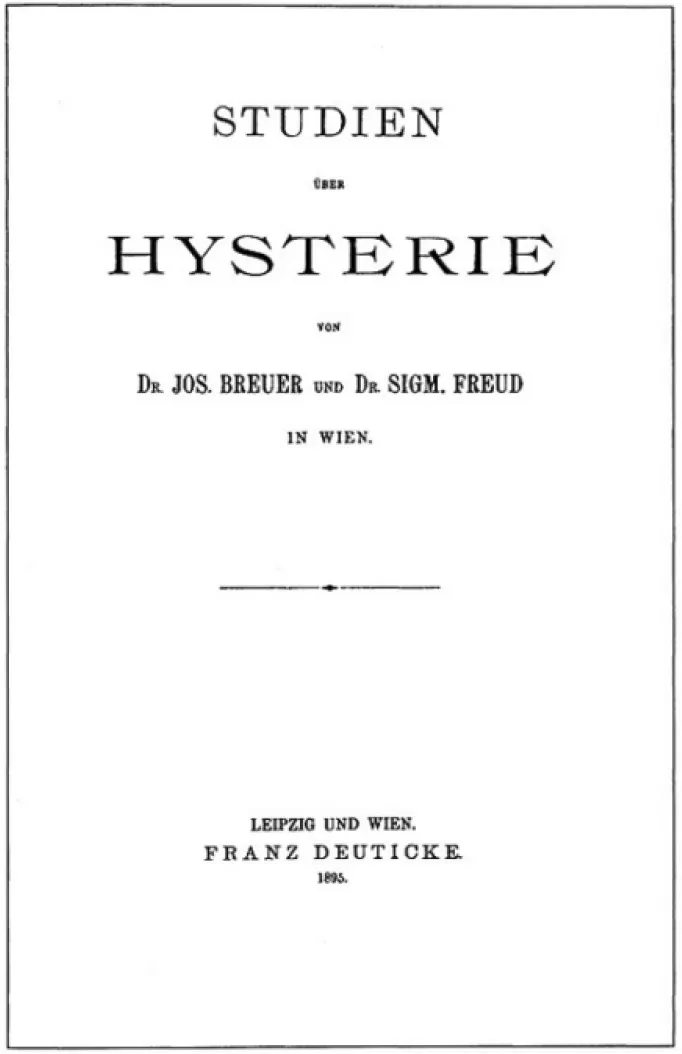
A hundred years have now elapsed since the publication in 1895—probably in May 1—of this primal book of psychoanalysis. Brought out by the publishing house of Franz Deuticke in Leipzig and Vienna, it had half-cloth binding with reinforced corners and was gold-blocked. However, a few rather differently bound copies of the first edition survive, which presumably owe their existence to the fact that in those days publishers would supply folded and gathered sheets to purchasers who wished to have their copies bound individually. At any rate, the text of all specimens is laid out identically in the classical typography used for scientific publications in the nineteenth century, set in narrow Antiqua. On the elegant title page,2 playful serifs impart a graceful, decorative charm to the accentuated word ‘Hysterie’, while the delicate ornamental rule emphasizes the proportions of the Golden Section.
Franz Deuticke was then a young, enterprising scientific publisher. Within just a few years, he had succeeded in attracting as authors, in particular, numerous members of the widely renowned Vienna medical faculty. However, he had not only made a name for himself in the established university subjects, but had also added to his list new fields and topics of current interest, for example from the young social and economic sciences.
Freud once called this agile-minded and dynamic entrepreneur, to whom he had already entrusted his monograph On Aphasia in 1891, his ‘primal publisher’.3
It was not by chance that Deuticke gave special prominence to the word ‘Hysterie’ on the title page, because the book came out not in a vacuum but in the context of a wellstructured publishing policy. Deuticke had a nose for important innovations and attentively observed the research on hysteria introduced by Charcot and his school, whose standard works he had brought out in German translation in quick succession. There were Charcots Leçons sur les maladies du système nerveux, which had already appeared in Freud’s German version in 1886, and his Leçons du mardi à la Salpêtrière (1887–8), which, partly also translated by Freud, came on to the market in instalments between 1892 and 1894. Works by outstanding pupils of Charcot, too, were presented in Deuticke’s list in 1894, namely the first volume of Traité clinique et thérapeutique de l’hystérie d’après l’enseignement de la Salpêtrière by Georges Gilles de la Tourette and Pierre Janet’s Etat mental des hystériques. Before that, Deuticke had even offered his publishing house as a platform for Charcot’s critic Hippolyte Bernheim; that had been in 1888–9, with the monograph De la suggestion et de ses applications à la thérapeutique, again partly translated by Freud, which had been followed in 1892, once more in Freud’s German version, by the same author’s Hypnotisme, suggestion et psychothérapie, études nouvelles.
The first edition of Breuer’s and Freud’s Studies on Hysteria comprised 800 copies. Almost fifteen years were to pass before the next printing in 1909; at any rate, no more than 626 copies are said to have been sold in thirteen years.4 So the Studies shared the fate of many an innovative work that initially enjoyed only limited dissemination.
Yet its appearance cannot be said to have gone unnoticed by the specialist press at the time. A review was printed in the Zeitschrift für Psychologie und Physiologie der Sinnesorgane before the year of the book’s publication was out.5 Although his remarks were somewhat patronizing, the unsuspecting commentator nevertheless stressed the differences between the conceptions of Breuer and Freud and the teachings of the Charcot school, noting in particular the more thoroughgoing psychologization of the concept of hysteria, as compared with the French emphasis on heredity. It was indeed noteworthy that attention was first drawn to the Studies in a predominantly psychological journal, because the discipline of psychopathology was in those days still deemed an exclusively medical one.
In the following year, two leading scholars in the relevant field took up their pens. One was the renowned Erlangen neurologist Adolf von Strümpell and the other Eugen Bleuler, soon to become professor of psychiatry at the University of Zurich and Director of the Burghölzli sanatorium, who was later, as we know, for many years a champion of psychoanalysis. Strümpell began his review, published in the Deutsche Zeitschrift für Nervenheilkunde,6 by noting that the book furnished gratifying evidence that the idea of the psychogenic nature of the symptoms of hysterical pathology was gaining more and more ground among physicians. However, he then took issue with Breuer’s theoretical chapter in particular, contending that its author had departed excessively from clinical empiricism. He had the following objection to a general application of the cathartic method: ‘I do not know whether such a penetration into someone’s most intimate private affairs may be deemed permissible even on the part of the most honourable doctor. I find this penetration most questionable where sexual matters are concerned […].’ He ended with the blunt assertion ‘that just the same can be achieved by a sensible, direct psychic treatment without any hypnosis and without delving in too much detail into the “strangulated affect”’.7 Eugen Bleuler, by contrast, began his review,8 published in the Münchener Medizinische Wochenschrift, with a clear and detached exposition of the book’s main theses. However, towards the end he did express doubts concerning the prevailing level of knowledge about hypnosis: the possibility could by no means be ruled out ‘that the therapeutic successes of the “cathartic method” might be attributable not to the abreaction of a suppressed affect but simply to suggestion’. But Bleuler’s final paragraph certainly betrays the fact that he had indeed understood something of the revolutionary character of the book, precisely in regard to its consequences for a general psychology of the unconscious: ‘[…] what the book actually contributes affords a completely new insight into the psychic mechanism and makes it one of the most important publications of the last few years in the field of normal or pathological psychology.’9
Figure 1 Title page of the first edition of Studien über Hysterie (1895)
The first English-language appreciation also dates from 1896, when the w...