- 288 pages
- English
- ePUB (mobile friendly)
- Available on iOS & Android
eBook - ePub
About this book
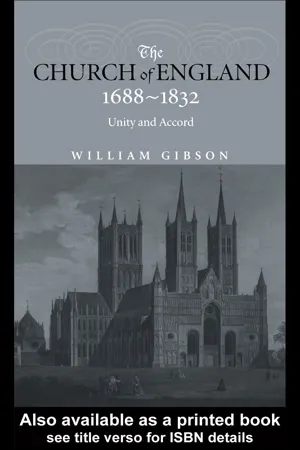
A wide ranging new history of a key period in the history of the church in England, from the 'Glorious Revolution' of 1688-89 to the Great Reform Act of 1832. This was a tumultuous time for both church and state, when the relationship between religion and politics was at its most fraught.
This book presents evidence of the widespread Anglican commitment to harmony between those of differing religious views and suggests that High and Low Churchmanship was less divergent than usually assumed.
Information
1
HISTORIANS AND THE EIGHTEENTH-CENTURY CHURCH
If the mantra of the post-modernist historian is ‘history is theory, theory is ideology and ideology is material interests’, a study of the eighteenth-century Church, superficially at least, is a model of postmodernist history. The historiography of the eighteenth-century Church is profoundly ideological: Victorian historians defended their class, professional and intellectual interests, and diverted attention from the need to change, by consciously depicting their predecessors as incapable of reaching Victorian standards. Even the most restrained critic of the Victorians conceded that what they wrote of the eighteenth-century Church was myth: ‘self-confident and self-assertive, they [the Victorians] developed a mythology about their Georgian predecessors, and this mythology has held sway since then’.1 Like a wilful child jealous of a sibling, the Victorian ecclesiastical establishment attracted attention to the achievements of its own age and intentionally suggested that the Georgians were hopelessly divided and turbulent. The Victorian view is particularly ideological since many nineteenth-century historians were clerical adherents of the Tractarian and Evangelical movements, which assailed their opponents as bitterly as any political party. Consequently there was more at stake than just an account of the past; the Victorians were writing a history which would defend their own ideology and the construction of their own religious establishment. It was as if Margaret Thatcher was writing the history of the post-war consensus.
To suggest that only postmodernist ‘interest’ conditioned the Victorian response to the eighteenth-century Church would however be an inadequate explanation. The Victorian world was one in which the sciences had come of age, and in which the changes engendered by urbanisation and industrialisation had effected an intellectual and cultural transformation. What Victorians did not recognise was that a judgement of the eighteenth century that did not acknowledge these changes was anachronistic. The core of the difference between the eighteenth-century world view and that of the Victorians was the collapse of hermeneutics and the division of knowledge. To the eighteenth-century mind, philosophy, science, religion, and politics could still be treated as a unity. As Thomas Sprat’s History of the Royal Society (1663) indicates, reason and unreason, mysticism and rationalism, had not formed into clear and discrete realms. Hence Isaac Newton was a brilliant physicist, but was also committed to notions of alchemy, millenarianism and the mysticism of freemasonry. Other scientists of the early eighteenth century, such as Boyle and Keill, moved easily between mysticism, natural religion and science. For Newton, Boyle and their contemporaries, the quantitative forces of a modern economy had not emerged, nor had its social instruments. Eighteenth-century concepts of education, advancement, merit and professional duty were largely those inherited from the Tudors and Stuarts. When Gladstone criticised the clergy of the eighteenth century for being ‘secular in their habits’2 he lapsed into anachronism by suggesting a division between the secular and the spiritual that had not emerged in the eighteenth century. In the eighteenth century there was no organised scepticism and no coherently developed sense of secularity, there was no division between the values and behaviour of laity and clergy. As a result, for example, bishops of the eighteenth century, among them Henry Compton, Gilbert Burnet, George Fleming, and Thomas Herring, saw no conflict between their role as clergy and taking to military service in 1689, 1715 and 1745 respectively. Bishop John Robinson of London saw no incongruence between service to the State as a diplomat at the Treaty of Utrecht and his episcopal status; nor did Francis Atterbury, who was intended for a ministerial post if the Hanoverian succession had been averted in 1714; or Edward Willes who was Decypherer to the King and bishop successively of St David’s and Bath and Wells. William Warburton was rare in regarding Church and State as in an alliance rather than a single entity, but many churchmen did not see the difference between religious and political matters in the way that Victorians had divided them. In Georgian England, as much as in the seventeenth century, politics was a branch of theology.
Brian Young has recently suggested the eighteenth century was an era in which society was only gradually becoming secularised, but the Victorian emphasis on progress intrinsically attacked it.3 The Victorian historian J.A. Froude’s attack typifies this:
the bishop, rector or vicar of the established Church in the eighteenth century is a byword in English ecclesiastical history. The exceptional distinction of a Warburton or a Wilson, a Butler or a Berkeley, points the contrast even more vividly with the worldliness of their brothers on the bench. The road to honours was through political subserviency. The prelates indemnified themselves for their ignominy by the abuse of their patronage, and nepotism, and simony were too common to be a reproach.4
For Froude, everything was black: the eighteenth-century clergy were lazy and ‘low’ in matters of doctrine, they were unversed in theology, class-ridden, debased and tolerant of abuses. He was anxious to promote the Whiggish idea of the progress of society from the depths to the sunny uplands; after all, the enlightenment of his own century could only mean that its precursor was inadequate and unworthy.
What gives the lie to the Victorian position is that even the reformers and apparent dissenters from the established ecclesiastical order in the eighteenth century were decried. Radical proponents of Church reform like Hoadly and Watson were attacked by Charles Abbey and John Overton as men in ‘want of spiritual depth’.5 Deists, Non-jurors, evangelicals and all shades of churchmen in between were excoriated for their views or actions. Consequently Young suggests that the Victorians were engaged in ‘present-centred history’, formulating prescriptions for their own age by a coloured view of the past:
in the process, history was inevitably distorted: heroes and villains were identified and religious and philosophical movements were measured against the requirements of the times…. In attempting to understand eighteenth-century thought, the late twentieth-century scholar has to engage with the…[Victorians’] prejudices and blindspots.…6
The Victorian age produced historians of widely differing perspectives: Leslie Stephen, Thomas Macaulay, Thomas Carlyle, W.H.Lecky, Mark Pattison, James Froude, W.H.Hutton, John Overton and Charles Abbey. These historians crossed a broad spectrum of political views, Tory and Whig; of religious views, Tractarian to agnostic; and of intellectual disciplines, historians, philosophers and theologians. But as laymen or clerics they shared a view of their own religious ideology as progressive and overcoming an inadequate system. They blamed the churchmen of 1689 and 1714 for much, including the failure of the Church and State in 1829 to defend an establishment which had united the two institutions. It was as if churchmen like Benjamin Hoadly had consciously sought to divide and marginalise the Church of England in order for it to become a single denomination among many a century later. As Tractarians and sceptics looked into the blazing flame of ritualist controversy, it affected their vision when they looked outward to the apparent darkness of the eighteenth century.
There is no doubt that this engendered a view of the past which was shrouded in a mythology, and which exaggerated the conflicts and disputes of the eighteenth century. High Churchmen viewed Charles I as an unavenged ‘King and Martyr’, they saw the Non-jurors as the lost tribe without which the Church wandered into error, and the churchmen of the eighteenth century as quarrelsome betrayers of their birthright.7 Sometimes historians like John Overton and Charles Abbey recognised this as mythology, and in flashes of perception suggested greater intellectual cohesion than they otherwise allowed. Thus in The English Church in the Eighteenth Century (1878) Abbey and Overton made the suggestion that Benjamin Hoadly and Thomas Sherlock were men of the same churchmanship. It was a view that they eradicated in the condensed single-volume edition of their work in 1887.8
In the same way, historians credulously treated Deism, Arianism and Socinianism as part of a Low-Church Anglican spectrum, which stretched into heresy and imported division and disagreement into the Church. They ignored the supreme driving belief in unity and accord which led Samuel Clarke to refuse two mitres to avert a division in the Church, and overlooked the staunch defence of orthodox Anglican doctrines by the leaders of the eighteenth-century Church, such as Wake, Gibson, Butler and Secker. Instead Overton treated William Law, the Non-juror, as the lost leader of eighteenth-century Anglicanism.9
Overton also advanced the muddled myths of the ritualists. In Life in the English Church 1660–1714 (1885) Overton seemed to point the finger of blame for the ills of the Church on the defining moment of 1714. Of the Anglican Church in the Commonwealth of the 1650s he wrote: ‘never was her life more vigorous than when she was spoken and thought of as dead and buried’.10 The Caroline Church and its divines were advanced as models of Anglican piety and even under Anne the popularity of the Church was noted. The implication of the book was clear: the rot set in during 1714, decline occurred under the house of Hanover.
Of course this further exposes the Victorian myth. In reality the Hanoverian succession changed very little in the Church, which was as immersed in politics before 1714 as after. The roots of Latitudinarianism were laid well before this date. Toleration of Dissent had been granted by the royal prerogative before 1688, and the Toleration Act was a result of the Glorious Revolution, not of the Hanoverian succession. Moreover the philosopher John Locke had suggested that the Church was a voluntary society well before 1714. The strengths of the Church—its scholarship, its growing status as a profession, its pastoral work and the support it attracted from the people—were all features that remained and broadened after 1714. On no rational grounds could 1714 be judged as a watershed for the Church. But Overton was not judging the history of the Church on rational grounds. The preface to Life in the English Church 1660–1714 indicates that some of his inspiration came from ‘Wednesday evening congregations at Epworth Church’, and one suspects that Overton sought to use his book to paint in the monochrome palate of religious edification and mortification.
The question is, why did the Victorian analysis of the eighteenth-century Church hold sway for so long? The question is especially pertinent, given the availability of opposing views. The Victorian position was undoubtedly challenged, and fairly quickly. John Wickham Legg’s English Church Life from the Restoration to the Tractarian Movement (1914) and Aldred Rowden’s Primates of the Four Georges (1916) were both admirable attempts to present balanced evidence of the eighteenth-century Church without the overlay of Victorian censoriousness. Both historians sought to judge the eighteenth-century Church by its own standards and to avoid anachronistic judgements. They also presented little-known evidence of the conscientiousness of churchmen of the period and their efforts to discharge their duty; both books have been unjustifiably neglected.11
Without doubt, Norman Sykes made the greatest contribution to the rehabilitation of the eighteenth century Church this century. Sykes’s study of Edmund Gibson (1926) and of Church and State in England in the Eighteenth Century (1934) developed a new view of the eighteenth-century Church. Both books were overtly sympathetic to the eighteenth-century Church, and sought to explain and understand the difficulties under which it laboured. In his later biographical study of William Wake (1957) Sykes also portrayed the Church as an institution in which clergy and bishops successfully discharged their duties. The strength of Sykes’s work is that it drew on a wide range of manuscript sources to defend the Church from the suggestion that it ignored reform and slumbered. The problem with Sykes’s biographical studies of Gibson and Wake, however, was that they were open to the imputation that their subjects were presented as exceptional rather than representative bishops. Moreover Sykes’s modesty and wide range of historical interests prevented him from founding a school of historians to promote his work. Even his pupil G.V.Bennett, whose biographical studies of White Kennett and Francis Atterbury12 followed in Sykes’s footsteps, recognised the limitations of Sykes’s influence. Sykes’s revisionism was also limited by the marginalisation of religious history and its separation from political and social history. In the sphere of political history the work of Sir Lewis Namier placed an emphasis on political structures, careers and patronage networks which underscored the Victorian analysis of the Church and did not connect with Sykes’s revisionism. It would have been impossible for historians of the sixteenth and seventeenth century to divorce religion from politics; but historians of the eighteenth century were able to effect this separation without challenge.
Other historians of the eighteenth-century Church did not take up the opportunitie...
Table of contents
- Cover
- Halftitle
- Title
- Copyright
- Contents
- Preface and Acknowledgements
- Introduction
- 1. Historians and the Eighteenth-Century Church
- 2. The Anglican Revolution
- 3. The Development of the Church’s Relations with the State: From the Convocation controversy to Catholic emancipation
- 4. Church Leadership in the Aftermath of Toleration
- 5. The Church and Culture
- 6. The Unity of Protestants
- 7. The Church and National Identity
- Conclusion
- Bibliography
- Index
Trusted by 375,005 students
Access to over 1.5 million titles for a fair monthly price.
Study more efficiently using our study tools.
Frequently asked questions
Yes, you can cancel anytime from the Subscription tab in your account settings on the Perlego website. Your subscription will stay active until the end of your current billing period. Learn how to cancel your subscription
No, books cannot be downloaded as external files, such as PDFs, for use outside of Perlego. However, you can download books within the Perlego app for offline reading on mobile or tablet. Learn how to download books offline
Perlego offers two plans: Essential and Complete
- Essential is ideal for learners and professionals who enjoy exploring a wide range of subjects. Access the Essential Library with 800,000+ trusted titles and best-sellers across business, personal growth, and the humanities. Includes unlimited reading time and Standard Read Aloud voice.
- Complete: Perfect for advanced learners and researchers needing full, unrestricted access. Unlock 1.5M+ books across hundreds of subjects, including academic and specialized titles. The Complete Plan also includes advanced features like Premium Read Aloud and Research Assistant.
We are an online textbook subscription service, where you can get access to an entire online library for less than the price of a single book per month. With over 1.5 million books across 990+ topics, we’ve got you covered! Learn about our mission
Look out for the read-aloud symbol on your next book to see if you can listen to it. The read-aloud tool reads text aloud for you, highlighting the text as it is being read. You can pause it, speed it up and slow it down. Learn more about Read Aloud
Yes! You can use the Perlego app on both iOS and Android devices to read anytime, anywhere — even offline. Perfect for commutes or when you’re on the go.
Please note we cannot support devices running on iOS 13 and Android 7 or earlier. Learn more about using the app
Please note we cannot support devices running on iOS 13 and Android 7 or earlier. Learn more about using the app
Yes, you can access The Church of England 1688-1832 by Dr William Gibson,William Gibson in PDF and/or ePUB format, as well as other popular books in Theology & Religion & British History. We have over 1.5 million books available in our catalogue for you to explore.