- 192 pages
- English
- ePUB (mobile friendly)
- Available on iOS & Android
eBook - ePub
About this book
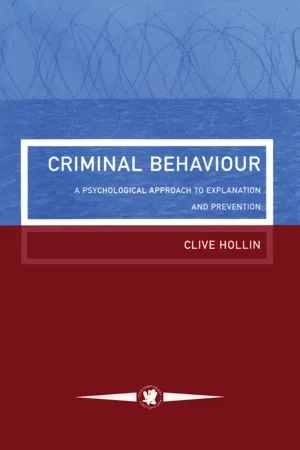
This study looks at contemporary psychological research and theory into criminal behaviour and considers the relationship between psychological and criminological theories. At the same time, the book examines the impact of psychology on strategies.
Information
Chapter 1

Criminal Behaviour: What Is It?
This book is about criminal behaviour, something that surrounds us constantly: we watch it on the television, hear about it on the radio, and read about it in our newspapers. Chances are that you know someone who has been the victim of a crime, or you may well have been a victim of a crime; you might even have committed one or more criminal behaviours. Criminal behaviour is part of our daily life, something with which we are all familiar, but pause for a moment to consider exactly what we mean by criminal behaviour. How can we arrive at a definition of those common words?
One straightforward way to solve the definitional problem is to look to the law: criminal behaviour can be defined as an act that violates criminal law and may therefore be followed by criminal proceedings and attract the appropriate punishment. (As will become clear in the next chapter, most criminal behaviour remains undetected but that should not be taken as meaning that undetected acts are not criminal behaviours. Those who break the law do not necessarily have to be caught to be considered as criminals; it is enough that they commit the act forbidden in law.)
The immediate impact of this definition is that the criminal law requires that an act takes place: this is termed actus reus (guilty act). I can think all I want about committing a criminal act and in so doing will not have done anything illegal; however as soon as I begin to translate my thoughts into actions then there is actus reus. In law, actus reus can be either an act against another person (e.g., assault), or against property (e.g., burglary), or not acting when legally required to do so (e.g., a medical doctor not acting to save a person’s life).
While there must be actus reus, this in itself is not sufficient for an act to constitute a criminal behaviour. For an act to be criminal, it must be carried out with criminal intent: this intent is termed mens rea (guilty mind). Thus, for an act to be a criminal act, there must be both actus reus and mens rea. However, there are a number of ways in which the act can be committed but the absence of intent means that the act is not deemed to be a crime. For instance, the person committing the criminal act may be below the age of criminal responsibility and therefore cannot be said to have acted with criminal intent: as there is no mens rea the act cannot be a criminal act. Of course, the age at which a child assumes responsibility for their actions is somewhat arbitrary. The age of criminal responsibility varies from country to country: for example, in Scotland the minimum age of criminal responsibility is 8 years, in England and Wales it is 10 years, in France 13 years, and in Sweden 15 years.
Another way in which the act can he committed but not be judged as criminal is when the perpetrator is unaware that they have broken the law. For example, in cases of unlawful sexual intercourse the defence has been offered that the adult was unaware that the victim (even a ‘willing victim’) was under age. In such cases it is for the court to decide, taking the facts of the case into account, whether the defence stands.
Yet another example of the absence of mens rea is to be found in those cases where the individual’s state of mind negates their responsibility for their actions. The person may have an impairment of mind so as not to know right from wrong; that is, they are of low intelligence. Alternatively, at the time of committing the act the person was suffering from a defect of mind so as not to know right from wrong; that is, a mental disturbance, such as schizophrenia or depression, impaired their ability to know the nature of their behaviour (see Chapter 6 for a discussion of both possibilities).
To complicate matters further, however, there are occasions when a crime is committed without specific intent but is nevertheless judged to be a crime. A drunken driver who injures or kills another person may not have had criminal intent, but is judged to have acted in an unreasonable and negligent manner. The law takes the position that a reasonable person would not elect to drive a vehicle when drunk and hence unable to drive in a safe manner. On the other hand, there may be instances where there is clear intent and action but no crime. If someone breaks into my house and attacks me, I might use force to defend myself and my family. In attacking the intruder it is my intention to inflict physical harm and my actions give vent to my intentions. The act of self-defence excuses the criminal act and it is unlikely that a court would find me guilty of an offence if I had used reasonable force. The catch lies in the term reasonable: what is reasonable force? In December 1984, Bernard Goetz shot four would-be muggers on a subway train in New York City. Two of them were shot in the back. As might be guessed from the popularity of films such as the Death Wish series, there was not inconsiderable public support for a plea of self-defence.
Thus there are a number of occasions when the court must decide whether there is actus reus and mens rea. In other instances there are crimes of strict liability as with, for example, health and safety regulations where there is a legal duty to ensure that certain commitments are met. For example, it is not an excuse to claim to be unaware that fire-doors are locked or barred. Those responsible must ensure that the doors are maintained in accordance with the law.
To return to the issue of definition, with exceptions of the type noted above, we can accept that criminal behaviour is that which is forbidden by the law of the land. Thus criminal law, it could be argued, identifies those behaviours which society will not tolerate. Such a definition immediately forces a distinction between criminal behaviour, as defined in law, and be haviours that are morally offensive but not enshrined in law. The distinction and overlap between law and morality is an important one and begins to introduce some of the complexities — not least that of whose morality and interests the law protects — underlying a ‘simple’ legal definition of criminal behaviour. What is the nature of the relationship between morality and criminal law?
Morality and Criminal Law
In essence there is a straightforward distinction to make: criminal behaviour is an act specifically forbidden by criminal law; antisocial or morally offensive behaviour is not criminal behaviour. For example, I find hunting animals for sport a highly repugnant form of behaviour, and I can muster a range of moral arguments to support my case. Conversely, those in favour of blood sports can advance arguments to support their position. Until there are criminal laws to forbid hunting animals, those who wish to do so can continue to kill foxes, deer, hares, and other animals without fear of penalty. Thus, while some people such as myself hold the opinion that hunting animals is morally wrong and a form of antisocial behaviour, it is not criminal behaviour.
I also hold the view, along with many other people, that a sexual relationship between an adult and a child is not in the child’s best interests and is morally wrong. There are other people who profess the belief that a sexual relationship between an adult and a child is natural, normal, teaches the child about sex and so is beneficial to the child’s development. However, unlike blood sports, sexual relationships between adults and children are expressly forbidden by law; an adult who has a sexual relationship with a child is therefore committing an act which many judge to be morally wrong and which is also criminal behaviour.
I incline to the view, as do others, that some soft drugs are probably less dangerous than alcohol and tobacco; I do not therefore consider that their use is antisocial nor am I morally offended by their use. However, regardless of my moral position, the possession and use of soft drugs is illegal and therefore by definition such actions constitute criminal behaviour.
Thus we see three contrasting examples of the relationship between morality and criminal behaviour: 1) where an act (e.g., blood sports) gives moral offence to some people but as no legislation exists it is not criminal behaviour; 2) where an act gives moral offence to some people (e.g., sexual relationships between an adult and a child) and legislation dictates that this is criminal behaviour; 3) where an act (e.g., using some soft drugs) causes some people no great moral panic yet laws are in force that make such an act a criminal behaviour. Why do these contrary positions exist?
Consensus Accounts
A consensus account of criminal behaviour is based on the view that the criminal law within a given society is a reflection of that society’s mutually agreed mores and associated codes of conduct. Thus criminal behaviour is to be understood as behaviour that the majority of people in a society find unacceptable and wish to outlaw. It is undoubtedly true that some acts are seen as violations of some natural moral or human law: these acts are termed mala in se crimes, behaviours that are literally ‘bad in themselves’. Mala in se crimes include acts against the person, such as inflicting injury as in the crimes of assault, murder, and rape; acts of acquisition of property, such as burglary and theft; and acts of destruction against property such as arson or malicious damage. These acts are judged to be abhorrent in many different societies and cultures and are forbidden, to a greater or lesser degree, in the laws of those societies. For these types of criminal acts there is agreement — as with the earlier example of sexual relationships between an adult and a child — between a general sense of what is morally right and what is forbidden in criminal law. In other words, for mala in se crimes, the criminal law probably does represent the consensus.
Another type of crime, referred to as statutory crime (or mala prohibitum), is not so much dependent on a natural law of right and wrong, but on current beliefs and opinions within society at any given period in history. This type of criminal behaviour can therefore pass into and out of extant criminal law. Sutherland and Cressey (1960) note how in past times acts such as printing a book, having gold in one’s house, and driving with reins have all been forbidden by criminal law. More recently, for example, in the United States of America it was perfectly legal to own and sell marijuana until federal law was changed in 1937. In Great Britain changes have been made to criminalize the sale of solvents to people of certain ages, and there has been clarification of the law to make rape within marriage a punishable act. On the other side of the coin, in recent times in Great Britain we have seen the decriminalization of various acts such as abortion and homosexual behaviour between consenting adults. In other instances criminal law is evolving in response to ‘high-tech crimes’ such as computer fraud, computer ‘hacking’, and video piracy.
Unlike mala in se crimes, statutory offences can pass in and out of law to accommodate changes in morality and public opinion. However, if mala in se crimes do represent a consensus opinion, is the same true of statutory crimes?
There are some apparent contradictions within a consensus approach with some statutory crimes. The topic of sexual pornography provides a good example. If such pornography is morally offensive to the majority, then why are ‘men’s magazines’ freely available and why do daily newspapers carry pictures of semi-nude women? Conversely, if sexual pornography is morally acceptable to the majority — as perhaps the contents of some newspapers, and the sales of magazines and videotapes might suggest — then why have regulatory laws about sexual pornography that must surely express the views of the minority? If sexual pornography is acceptable to the majority, why should it not be freely available? It could be convincingly argued, for example, that the laws forbidding the showing of certain films or programmes reflects not the views of the majority, but the moral codes and beliefs of those individuals who claim to know what is ‘right’ for the rest of us.
In the same vein (but from a very different moral stance), to return to one of my previous examples, it is probably the case that the majority of people wish to outlaw blood sports, yet the necessary legislation is being withheld to suit the interests of a minority. It is almost certainly true, however, that the majority would not wish to see soft drugs legalized and my own thoughts on this topic probably do not reflect the consensus. Yet I maintain that there is a contradiction: if marijuana and other ‘soft’ drugs are illegal, then why can we buy harmful drugs like tobacco and alcohol?
Finally, to extend the argument to mala in se crimes, we might ask if killing other people is illegal, then why do the perpetrators of large-scale industrial ‘accidents’ that pollute the environment and cause widespread death and destruction not face murder charges? A strong case could be made that even with the most heinous acts there is a mismatch between the consensus, that is the majority view of what is morally acceptable, and the criminal law.
In summary, if we accept a consensus approach to criminal behaviour, the purpose and function of criminal law is to protect the individual’s person and their property. Further, as Walker (1965) suggests, criminal laws also serve the wider interests of society and the defence of the realm. The criminal law therefore ensures the continuing stability of the society of which we all are members and within which we must live together. Those who step outside the law, those who transgress the consensual boundaries, face the retribution as laid down in law. It is generally maintained that the punishment should fit the consensual view of the seriousness of the type of crime. As explored later in this book, however, there are not only considerable disagreements over what constitutes an appropriate punishment, but a heated debate about whether punishment is a suitable response to criminal behaviour (see Chapters 7 and 8). As will also be discussed in great detail in later chapters, the acceptance of a consensual approach has had a great influence on attempts to explain criminal behaviour. It is inherent in a consensual approach that criminals are, by definition, those who behave differently to the non-criminal majority. The search for the cause of that difference has dominated psychological research into criminal behaviour.
If a consensual approach views society as an integrated functioning unit, in which the majority are working for the greater good, then the exact opposite is the case when we move to a second view of criminal behaviour — the conflict approach.
Conflict Approach
Directly opposed to a consensus approach to understanding criminal behaviour, a conflict approach views society as a collection of diverse and competing groups. According to a conflict analysis, these societal groups are not cooperating in harmony for the greater good, but are locked in a bitter struggle as witnessed throughout history in conflicts, for example, between employers and workers, between those of different races, and between religious and political factions. According to some commentators, the basis of this disharmony and hence the cause of the conflict is not a difference in morality between groups, but the unequal distribution of wealth and power within society. If we follow this line of thinking, then the purpose of the criminal law assumes a very different meaning from that of reflecting the consensus and protecting the majority. Those with political, economic, and legal power — power can be defined in this context as the ability to control and determine the behaviour of other people — are able to assert their will in order to protect and advance their own interests. In other words, the powerful minority within society is able to formulate and enact the law in order to consolidate and strengthen their own position and to weaken those who challenge their authority. Thus society divides into two camps — those with authority and those who obey — locked in struggle and conflict.
The immediate impact of this way of considering crime is to broaden the scope of analysis to include not only the behaviour of the individual law-breaker, but also the process by which judgments and definitions about what is criminal behaviour are made. The classic quotation in this context is taken from the book Criminality and the Legal Order by Austin Turk published in 1969:
Criminality is not a biological, psychological, or even behavioral phenomenon, but a social status defined by the way an individual is perceived, evaluated, and treated by legal authorities (p. 25).
Quinney (1970) wrote of the social reality of crime in which he crystallized a number of fundamental statements within a conflict perspective. Like Turk, Quinney argued that there is human behaviour, but the nomination of criminal behaviour is a creation of those with the power to formulate and enact such definitions. Further, Quinney suggests, public opinion and attitudes are heavily influenced by the social messages that permeate our everyday lives. As those with power control the media, so such individuals are in a position to advance their own definitions of crime, encouraging the public to come to agree with these definitions. In other words, the conceptions and definitions ...
Table of contents
- Cover
- Title
- Copyright
- Contents
- List of Tables and Figures
- Series Editor’s Preface
- Acknowledgments
- Chapter 1. Criminal Behaviour: What Is It?
- Chapter 2. Criminal Behaviour: How Much of It?
- Chapter 3. Explaining Criminal Behaviour: Biology and Personality
- Chapter 4. Explaining Criminal Behaviour: Learning, Cognition and Age
- Chapter 5. Explaining Criminal Behaviour: Social Factors
- Chapter 6. Explaining Criminal Behaviour: The Special Case of Mental Disorder
- Chapter 7. Preventing Criminal Behaviour: Punishment, Deterrence and Retribution
- Chapter 8. Preventing Criminal Behaviour: Rehabilitation
- Chapter 9. Criminal Behaviour, Explanation and Prevention: The Example of Violence
- Postscript
- References
- Note on the Author
- Index
Trusted by 375,005 students
Access to over 1.5 million titles for a fair monthly price.
Study more efficiently using our study tools.
Frequently asked questions
Yes, you can cancel anytime from the Subscription tab in your account settings on the Perlego website. Your subscription will stay active until the end of your current billing period. Learn how to cancel your subscription
No, books cannot be downloaded as external files, such as PDFs, for use outside of Perlego. However, you can download books within the Perlego app for offline reading on mobile or tablet. Learn how to download books offline
Perlego offers two plans: Essential and Complete
- Essential is ideal for learners and professionals who enjoy exploring a wide range of subjects. Access the Essential Library with 800,000+ trusted titles and best-sellers across business, personal growth, and the humanities. Includes unlimited reading time and Standard Read Aloud voice.
- Complete: Perfect for advanced learners and researchers needing full, unrestricted access. Unlock 1.5M+ books across hundreds of subjects, including academic and specialized titles. The Complete Plan also includes advanced features like Premium Read Aloud and Research Assistant.
We are an online textbook subscription service, where you can get access to an entire online library for less than the price of a single book per month. With over 1.5 million books across 990+ topics, we’ve got you covered! Learn about our mission
Look out for the read-aloud symbol on your next book to see if you can listen to it. The read-aloud tool reads text aloud for you, highlighting the text as it is being read. You can pause it, speed it up and slow it down. Learn more about Read Aloud
Yes! You can use the Perlego app on both iOS and Android devices to read anytime, anywhere — even offline. Perfect for commutes or when you’re on the go.
Please note we cannot support devices running on iOS 13 and Android 7 or earlier. Learn more about using the app
Please note we cannot support devices running on iOS 13 and Android 7 or earlier. Learn more about using the app
Yes, you can access Criminal Behaviour by Clive Hollin in PDF and/or ePUB format, as well as other popular books in Education & Education General. We have over 1.5 million books available in our catalogue for you to explore.