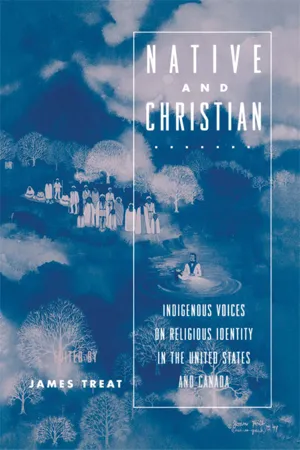
Native and Christian is an anthology of essays by indigenous writers in the United States and Canada on the problem of native Christian identity. This anthology documents the emergence of a significant new collective voice on the North American religious landscape. It brings together in one volume articles originally published in a variety of sources (many of them obscure or out-of-print) including religious magazines, scholarly journals, and native periodicals, along with one previously unpublished manuscript.
eBook - ePub
Native and Christian
Indigenous Voices on Religious Identity in the United States and Canada
- 256 pages
- English
- ePUB (mobile friendly)
- Available on iOS & Android
eBook - ePub
Native and Christian
Indigenous Voices on Religious Identity in the United States and Canada
About this book
Information

. . 1 . . . . . . . . . . . . . .
SPIRITUALITY AND HISTORY
. . . . . . . . . . . . . . . . . . . . . . . . . . . . . . . . . .
. . . . . . . . . . . . . . . . . . . . . . . . . . . . . . . . . .
. . . 1 . . . . . . . . . . . . . . . . . . . . . . . . . . . . . . . . . . . . . . .
JAMES L. WEST
INDIAN SPIRITUALITY
ANOTHER VISION
ANOTHER VISION
James West (Southern Cheyenne) is president of Okom Enterprises, a financial services company specializing in tribal economic development and based in Tijeras, New Mexico. An ordained American Baptist minister, he graduated from Andover Newton Theological School in 1971 and was a co-founder of the American Baptist Indian Caucus; he has served the denomination as president of the Board of National Ministries and as a member of the General Board Executive Committee. West has also held positions with the American Indian National Bank, Native American Research Associates, and the Interreligious Foundation for Community Organization, and has specialized in crisis intervention and arbitration in a variety of political and religious conflicts involving native communities. This essay was originally presented at a theological conference exploring cultural diversity within the American Baptist Churches, “Patterns of Faith: Woven Together in Life and Mission,” held at the American Baptist Seminary of the West in Berkeley, California. West introduces some of the key issues involved in relating native religious experiences to the Christian theological world, and he suggests an alternative paradigm for Christian mission based on the need for healing and reconciliation. His use of personal narratives to frame his theological reflections highlights the centrality and power of visionary experience in native Christian life.
A BEGINNING . . .
Iwalked with one of our old people in my mind’s eye; His name was Mutsiiuiv and He told me the story of the Medicine Wheel, the sacred circle of the Tsitsitas, the Cheyenne people. And then He told me that the circle had been broken; that the buffalo are gone and that this sacred circle, the symbol of the spiritual life of the Cheyenne people, could never again be as it was. And I was angry and I wanted to blame someone. He saw my anger, the anger of a young man, and He smiled and He told me that we have broken the circle, and I did not understand. He told me that we are responsible for the Medicine Wheel. It was given to us at Bear Butte by Grandfather and Grandmother, and only we can break the circle. No one can break it for us. He told me of the Cheyenne prophecy that one day we the red men and women, would walk with brothers and sisters who are black and brown and yellow and white. And then He gently sent me away, and I was afraid and did not want to go from Him. But, He sent me into the world to share the truth of Maheo’s love.
We are each here to search, to teach and to learn. The spirit has been at work here with us, and we have quickly joined to celebrate our diversity as Christians. I am amazed at how quickly Maheo’s love can weave a pattern of color together. Yet, as Kim Mammedaty pointed out this morning, sometimes we must unweave patterns and start again even though it is frustrating. Paul Nagano challenged us to look, even in this new moment of celebration, as the cloth of color in Christ is just forming, and to look beyond it out into the world where Maheo, where God is the weaver, and we in all our richness of Christian heritage and cultural color are merely threads. We must come to share our diversity, not as an end in itself; not only to seek the spirit of Christ among us, but to be open to the Spirit of God throughout the creation.
BASIC ASSUMPTIONS
The limited purpose of this essay is to outline and discuss briefly the theological issues of Christian mission, which have been barriers to spiritual growth as seen through the spiritual experience of the Native American, both traditional and Christian. If the richness of Indian tradition and personal testimony is to add to our praise of God’s name, then the pain of the Christian mission experience should inform our faith and our perception of God’s purpose in the creation.
Theo–logos or words about Maheo (God) as a discipline is a non-Indian concept. Indian people have a long tradition of words about Maheo. But, theology as an intellectual discipline, sometimes very separated from the everyday life of people, is a very foreign concept to most Indian tribal experience. Therefore, what will be discussed are certain aspects of the spiritual way-of-life of some Indian nations as well as comparisons between these ways-of-life and Christian theology . . .
There are several assumptions I must make in this essay. I must assume very limited knowledge of Indian traditional and Indian Christian spiritual life by most people in the United States. . . . I must make some generalizations about Indian spiritual life which will be broad and, therefore, inadequate since there are some 400 Indian nations in the continental United States, each with its separate culture, language, and spiritual way-of-life. I assume that people at this consultation might be able to agree that Maheo (translated from Cheyenne as “Great Mystery” or God) is an attempt to represent a fundamental concept of a transcendent being which is both within this world and, yet, beyond this world or supernatural. I understand the central problem of Christian theology to be the development and refining of criteria in regards to this fundamental concept, so that this concept can be compared, modified, and reshaped so that it is intelligible to people trying to understand it. Finally, I understand mythology to be an important task of spiritual understanding. I shall assume that mythology is the conception of spiritual ideas through images and symbols drawn from within this world and human experience.
With these very simplistic definitions and assumptions, I present this essay on “Indian Spirituality: Another Vision.”
REFLECTIONS ON INDIAN SPIRITUAL EXPERIENCE
The spiritual life of Native American peoples developed for thousands of years within the context of the tribe before any contact with non-Indian religions. There was also considerable interaction and dialogue among tribes about spiritual concepts. For instance, most tribes had a tradition of what could be compared to the law of reciprocal hospitality in the tribal history of the Hebrew people. Through the common language of sign-talk, ideas could be shared and compared among Indian tribes including the spiritual concepts that are an intricate part of the Indian’s everyday experience.
I characterize Indian spiritual experience in terms of a spiritual way-oflife because the concepts and rituals of this experience are not generally confined or even kept by an institution whose existence is defined for this purpose or in any way separated from other institutions. Traditional leaders of Indian tribes do not just play political, social, or legal roles, but are seen as leaders with spiritual power. Traditional understanding of health and medicine do not separate physical health from social, psychological, or spiritual health. Tribal ritual is not governed or controlled by a church. Socially and spiritually, the Indian experience is a unique combination of a fierce individualism within a tightly knit and communal society. Therefore, the vision or revelation of Maheo is a potential experience for any member of the tribe. Yet, to be born into the life of a certain tribe is to be born into the spiritual life of that people as revealed to them by Maheo or God.
Maheo is the Cheyenne word for Great Mystery and the symbol of the monism that has traditionally been characteristic of the spiritual understanding of most Indian people. One of the most important qualities that Indian people attribute to Maheo is the force of creativity; Maheo is creator. Almost all tribes had a mythology to describe the nature and chronology of the creation of this world, just as Christianity has built on the creation mythology of the early Hebrews. For the Cheyenne people, initial creation took place in four stages and is told in four creation legends.
There are two general understandings of creation shared by many Native American tribes which I would now like to discuss. First, creation is often characterized as a dynamic between Maheo and Escheheman (the earth-Mother of all creatures). Escheheman is characterized as an ongoing creation and, as the earth (or nature or the universe), is understood as a symbol to be loved and accepted, not to be manipulated by any creatures.
All creatures of Escheheman, of this world, share the relationship of brothers and sisters. “Two-leggeds” or human beings are not considered above other creatures. Our nature is different so each creature’s “story” focuses on that creature’s experience. As brothers and sisters, we accept the nature of Maheo’s creation as it is expressed through us. We share in Escheheman, and as brothers and sisters, we do not exploit or use each other or “our Mother.”
Indian people have often been characterized as being pantheistic by Christian writers. Christians often give spiritual qualities only to human beings, e.g., the soul or sainthood, yet, these are not considered qualities on the same level as those attributed to Maheo, but are considered a “reflection” or “image” of Maheo expressed by human beings only, and not other “animals.” In contrast, Indian people have developed an equal, horizontal, spiritual status for all creatures. Thus, all creatures express the spiritual image of Maheo in creation. This spiritual nature or soul for all creatures has often been misunderstood and thought of as pantheism.
The second concept which is generally shared by many Native American tribes and expressed in a myriad of ways, is that of the vision. The vision may be characterized as spiritual communication either within the experience of this world, Escheheman, or beyond it. In either case, it would be an experience which reveals something of Maheo directly to an individual. As such, it might be understood in Christian terms, as an experience of limited revelation. Each person is capable of achieving this spiritual experience, although many do not. One’s life is often characterized as a search for one’s vision. Visions are shared with an instructor or teacher who may recommend that the nature of a vision is such that it should be private, shared with another person, the family, or the whole tribe.
The vision experience of the Cheyenne is spiritual experience born of physical discipline through fasting. It represents the Cheyenne understanding that each creature is made up of a physical, intellectual, emotional, and spiritual essence in that ascending order. The spirit includes, but is not limited to, the former three aspects of oneself. Therefore, one’s physical, intellectual, and emotional capacities can be utilized to express or search for one’s spiritual life. The vision quest as a form of meditation would be similar to the meditation of the Zen Buddhist or the Tibetan Buddhist.
Certain visions have developed as revelations (a Christian theological term) for a given tribe or nation. As an example, Mutsiiuiv (Sweet Medicine or Sweet Root Standing) brought the Cheyenne much understanding of Maheo, Escheheman, and the sacred circle of the Cheyenne. (The sweet root is used to increase the flow of a mother’s milk.) Mutsiiuiv's teaching is the revelation by which the Cheyennes have grown in wisdom and is symbolized by the Mahuts or Sacred Arrows. Tradition says that, when Mutsiiuiv left the Cheyenne people, he was transformed into the sacred plant which bears his name. When Mutsiiuiv gave the People the Mahuts, He said, “Do not forget me. This is my body I am giving you. Always think of me.”
The vision of Mutsiiuiv is very important for “the people,” the Tsitsitas or Suhtaio (the Cheyenne). However, visions are an ongoing spiritual potential, a potential of each Cheyenne. Also, the Cheyenne recognize that each People have visions which have been given to them and which continue to guide them.
THE CHRISTIAN MISSION
Christian theology has often been expressed in symbols that are very personal. The personal acceptance of the Christian faith transcends the history and culture of the human being that is converted or changed. This conversion ethic has been expressed in a political, social, economic, and spiritual theory called “manifest destiny” in regards to the “discovery” or the conquest of the “new world.” This theory, simply put, states that God has destined the Christian world to conquer the rest of creation in His name. This has not been an expression of an inevitable fate, but rather a purpose or justification for historic events. The universality of Christ is the positive potential behind this more negative concept of manifest destiny.
Within this context, spiritual conversion is related to social, economic, and political conversion. But, most important for the work of this consultation, is the recognition of the many assumptions that accompany the Christian mission of converting or changing human beings. Conversion is a potential barrier. Conversion is seen as transcending the history and culture of the objects of conversion. Christian mission assumes that, whatever spiritual understandings non-Christian peoples have, they are, at least, inadequate, if not wrong or evil. It assumes that the mythology of the “pagan” is spiritual voodoo or, at most, the wild imaginings of primitive peoples. A mission built on the significant changing of a personal life over and above that person’s culture must assume that the spiritual understanding of that culture has not afforded its people communication with or revelation of God. If such revelation is even recognized, a mission of conversion must assume that the revelation is inadequate and/or in need of replacement.
These assumptions characterize the basis and purpose of mission as exemplified by the Christian mission history of the Church with my people. The “universality of Christ” has meant that the revelation of God by Jesus Christ can and should be applied to all of creation, which seems to reveal more about the nature of the Christian church than of Maheo. This revelation does not just reveal the truth about God but reveals it in some magic way that makes this truth “truer” or “truest” in comparison to other revelations of Maheo to other peoples. “I am the way, the truth and the life; no one comes unto the Father, but by me” (John 14:6). Salvation comes only to the truest. The Christian Church must struggle with the author of the Book of John. Therefore, for many Christians, evangelism has been measured by whether or not souls have been saved and, if so, how many. Despite the efforts of some within the Christian Church to broaden this concept and/or build on it, the assumptions stated above still seem to guide the Christian mission.
To exemplify this point, I would share a particular experience of dialogue with different non-Indian constituencies. Some people are able intellectually to recognize, feel guilty for, and work through the political, social, and economic imperialism which characterized the conquest of this land. However, only a few have ever understood the history and ongoing reality of the spiritual imperialism which is a fundamental part of the continued conquest of this land.
THE INDIAN CHRISTIAN
Simply stated, what this mission has usually meant for the Indian person who has converted to Christianity is a choice, a choice between Maheo or God; a choice between Mutsiiuiv or Jesus Christ; a choice between Christianity or our own people and our spiritual way-of-life. Obviously, not all Native Americans have converted from their tribes’ traditional spiritual way-of-life. Some newer expressions of traditional spiritual ways have incorporated parts of Christianity, e.g., the Peyote Religions of many tribes. Most traditional spiritual leaders, recognizing the potential of other truths, see no need for choice at all.
Indian Christians have attempted to face the spiritual dilemma of this choice in many different and individual ways. One is to reject “all except Christ” including their traditional way-of-life or their life as a part of their people. These Indian Christians have in general been unsuccessful in the complete divesting of their identity with their people, thus, the addition of many rich values and traditions into the life of the Christian church. Christian peoples are most familiar with these Indian Christians, who are usually held up as exemplary Indians and are often the subject of church films, filmstrips, books, and magazines.
Many Indian Christians secretly work at integrating the two truths of their life or more often just accepting the reality of two distinct truths within their spiritual experience. Secrecy has been the key to this Christian experience in the past. The experience of openness which has marked traditional Indian dialogue among the tribes has been matched most often in the Christian mission to Indian people by a refusal on the part of most Christians to dialogue at all. An Indian often shares his/her Christian experience in an Indian traditional spiritual context, but he/she is careful to guard the very existence of any Indian traditional spiritual experience from Christians.
The struggle for identity, for a theological understanding of Maheo and an individual role within creation is constant and ongoing for the Indian Christian. If an Indian is a Christian, above all, why does he/she have a special mission to Indian people? The struggle ...
Table of contents
- Front Cover
- Half Title
- Title Page
- Copyright
- CONTENTS
- Preface
- Introduction: Native Christian Narrative Discourse
- 1. SPIRITUALITY AND HISTORY
- 2. LIBERATION AND CULTURE
- 3. TRADITION AND COMMUNITY
- 4. TRANSFORMATION AND SURVIVAL
- Bibliography
Trusted by 375,005 students
Access to over 1.5 million titles for a fair monthly price.
Study more efficiently using our study tools.
Frequently asked questions
Yes, you can cancel anytime from the Subscription tab in your account settings on the Perlego website. Your subscription will stay active until the end of your current billing period. Learn how to cancel your subscription
No, books cannot be downloaded as external files, such as PDFs, for use outside of Perlego. However, you can download books within the Perlego app for offline reading on mobile or tablet. Learn how to download books offline
Perlego offers two plans: Essential and Complete
- Essential is ideal for learners and professionals who enjoy exploring a wide range of subjects. Access the Essential Library with 800,000+ trusted titles and best-sellers across business, personal growth, and the humanities. Includes unlimited reading time and Standard Read Aloud voice.
- Complete: Perfect for advanced learners and researchers needing full, unrestricted access. Unlock 1.5M+ books across hundreds of subjects, including academic and specialized titles. The Complete Plan also includes advanced features like Premium Read Aloud and Research Assistant.
We are an online textbook subscription service, where you can get access to an entire online library for less than the price of a single book per month. With over 1.5 million books across 990+ topics, we’ve got you covered! Learn about our mission
Look out for the read-aloud symbol on your next book to see if you can listen to it. The read-aloud tool reads text aloud for you, highlighting the text as it is being read. You can pause it, speed it up and slow it down. Learn more about Read Aloud
Yes! You can use the Perlego app on both iOS and Android devices to read anytime, anywhere — even offline. Perfect for commutes or when you’re on the go.
Please note we cannot support devices running on iOS 13 and Android 7 or earlier. Learn more about using the app
Please note we cannot support devices running on iOS 13 and Android 7 or earlier. Learn more about using the app
Yes, you can access Native and Christian by James Treat in PDF and/or ePUB format, as well as other popular books in Theology & Religion & Christian Rituals & Practice. We have over 1.5 million books available in our catalogue for you to explore.