eBook - ePub
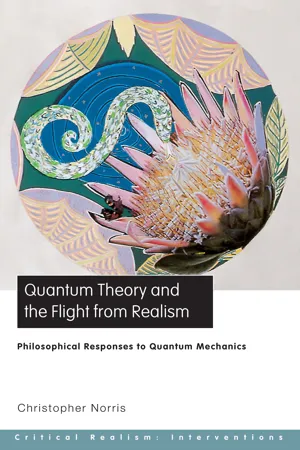
Quantum Theory and the Flight from Realism
Philosophical Responses to Quantum Mechanics
- 280 pages
- English
- ePUB (mobile friendly)
- Available on iOS & Android
eBook - ePub
Quantum Theory and the Flight from Realism
Philosophical Responses to Quantum Mechanics
About this book
This book is a critical introduction to the long-standing debate concerning the conceptual foundations of quantum mechanics and the problems it has posed for physicists and philosophers from Einstein to the present. Quantum theory has been a major infulence on postmodernism, and presents significant problems for realists. Keeping his own realist position in check, Christopher Norris subjects a wide range of key opponents and supporters of realism to a high and equal level of scrutiny. With a characteristic combination of rigour and intellectual generosity, he draws out the merits and weaknesses from opposing arguments. In a sequence of closely argued chapters, Norris examines the premises of orthodox quantum theory, as developed most influentially by Bohr and Heisenberg, and its impact on varous philosophical developments. These include the ideas developed by W.V Quine, Thomas Kuhn, Michael Dummett, Bas van Fraassen, and Hilary Puttnam. In each case, Norris argues, these thinkers have been influenced by the orthodox construal of quantum mechanics as requiring drastic revision of principles which had hitherto defined the very nature of scientific method, causal explanati and rational enquiry. Putting the case for a realist approach which adheres to well-tried scientific principles of causal reasoning and inference to the best explanation, Christopher Norris clarifies these debates to a non-specialist readership and scholars of philosophy, science studies and the philosophy of science alike. Quantum Theory and the Flight From Realism suggests that philosophical reflection can contribute to a better understanding of these crucial, current issues.
Information
1 Is it possible to be a realist about quantum mechanics?
I
Recent years have seen something of a growth industry in books on the topic of quantum mechanics, some of them unabashedly populist while others – often written by practising physicists – are pitched toward a ‘serious’ yet non-specialist readership.1 Much of this writing is highly impressive in its ability to convey quantum-theoretical ideas in a language that somehow overcomes the resistance created by a range of distinctly problematic and counter-intuitive arguments. Not that intuition is by any means a reliable guide in these matters. After all, many crucial advances in mathematics, geometry and physics over the past two centuries and more – indeed right back to Copernicus and Galileo – have involved a decisive (often difficult) break with certain kinds of common-sense knowledge, intuitive self-evidence, or supposed a priori truth.2 As Peter Holland remarks, ‘[t]he concept of “intuition” is like that of “human nature”: it is a function of history and not eternally frozen. The notion that a body persists in a state of uniform motion unless acted upon by a resultant force would be counter-intuitive to Aristotle but natural for Galileo. Quantum phenomena require the creation of quantum intuition.’3 Yet Holland himself writes from a realist standpoint and as one who firmly rejects the orthodox view – orthodox at least among many quantum physicists and philosophers of science – that whatever the notional reality ‘behind’ those phenomena it cannot be grasped, described, or represented in conceptual-intuitive terms. Such is the peculiar challenge of quantum mechanics, one that emerged during the early decades of this century and which continues to generate deep and widespread disagreement. My aim in this book is partly to clarify the various philosophic issues involved and to show how they have often been misunderstood by parties on both sides of the realism-anti-realism dispute. But it is also to argue – more constructively – that the case for realism with regard to quantum mechanics is a great deal stronger than is commonly thought by proponents of the received view and likewise by non-specialist readers whose grasp of those issues is very largely shaped by that same orthodox consensus.
What most interested lay persons will have gathered from the current literature can perhaps best be summarized as follows. (1) QM has given rise to a number of problems and paradoxes – among them the wave–particle dualism – as regards physical ‘reality’ and the kinds or degrees of exactitude in scientific knowledge that we can hope to gain concerning it. (2) Those problems have to do with certain limits that apply to the detection or measurement of quantum phenomena, such as the impossibility of assigning precise simultaneous values of location and momentum, or the fact – famously enshrined in Heisenberg’s uncertainty principle – that any observation of subatomic particles, for instance through an electron microscope, will involve their exposure to a stream of other such energy-bearing particles and will thus affect or in some sense determine what is ‘actually’ there to be observed. As for the quantum paradoxes (3), these take rise from the necessity, as it seems, of abandoning local realism (i.e. Einstein’s rule that no causal influence can propagate faster than the speed of light) in favour of remote superluminal interaction between particles at no matter how great a distance.4 For there is now a large body of experimental evidence that such nonlocal effects can indeed be shown to exist and that any realist interpretation will consequently need to take them on board, thus creating additional (some would say insoluble) problems for its own case.
That is, one can take a singlet-state pair of particles whose combined angular momentum is zero and then project them on divergent paths towards two detectors or measuring devices (in this case Stern–Gerlach magnets) set up to determine their spin-value with respect to some given orientation. Thereafter, if a measurement is carried out on particle A and produces the value ‘spin-up = +½’ for a given parameter, then any measurement conducted simultaneously on particle B will produce the inverse value ‘spin-up = −½. (Of course they might yield any range of likewise anti-correlated ‘up’ or ‘down’ spin-values depending on the polarization component which the device was set to detect.) This follows from orthodox quantum theory but also from the classical law concerning the conservation of energy as applied to angular momentum. In other words, it is known in advance that the two particles will always yield a sum-zero value for any given parameter if measured at any point in their trajectory and whatever the extent of space–time separation between them.5
So far there is nothing in the least paradoxical about this situation. After all, it is analogous to the case in which one tears a playing-card in two and sends each piece to a geographically remote correspondent, one of them (say) in London and the other in Christchurch, New Zealand. If they are aware by pre-arrangement of what’s going on, each will know with full certainty which half the other has received as soon as they examine the content of their own package. Where the paradox shows up is with the further requirement – again as specified by orthodox QM – that any results thus produced with respect to either particle will depend upon the kind of measurement carried out, i.e. the setting of the spin-detector and hence the particular outcome in this or that case. Moreover, that result will decide the outcome of any measurement which might be performed simultaneously on the other particle, since it follows – by the inverse-correlation rule – that this must always be the case for quantum-mechanical systems (or particle pairs) that have a common source or which have interacted at some previous stage.
But then, what precisely can be meant by the terms ‘simultaneous’ and ‘previous’, as used in the foregoing sentence or in any attempt to describe or explain what is happening here? For it also follows from orthodox QM that these events must transpire in a space–time framework that permits violations of special relativity, or which allows for superluminal (faster-than-light) interaction between particles at any distance from each other. In which case there can be no appeal to Einstein’s principle for establishing simultaneity relative to the speed of light, the latter taken as an absolute limit on causal propagations of whatever sort.6 Some commentators – Maudlin among them – have argued that this need not be the case since special relativity only requires that any space–time metric be Lorentz-invariant, which on a certain construal might allow for the existence of superluminal transmission.7 All the same, there is clearly a marked tension (if not perhaps a downright inescapable conflict) between the orthodox interpretation of quantum mechanics and Einsteinian relativity theory. Moreover, any talk of ‘previous’ states or events – such as the particles’ orientation when separated at source or the spin-values that might have been measured at some ‘earlier’ stage in their trajectory – is likewise rendered highly problematic. That is to say, it takes for granted the impossibility that those events could somehow be affected – or those measurements somehow retroactively determined – by whatever occurs at a ‘later’ stage in the system’s space–time evolution.
Such were some of Einstein’s chief objections in the famous series of debates with Niels Bohr, when he argued that the orthodox (Copenhagen) theory of quantum mechanics was necessarily ‘incomplete’ since it entailed the existence of unthinkable phenomena such as instantaneous remote correlation or ‘spooky action-at-a-distance’.8 Although he had been among the chief contributors to the early development of quantum mechanics, Einstein was by now deeply dissatisfied with what he saw as its failure to provide any adequate realist or causal-explanatory account of QM phenomena. This change of mind went along with his shift from a broadly positivist (or instrumentalist) approach according to which a scientific theory need achieve no more than empirical-observational and predictive accuracy to a realist position that entailed far more in the way of express ontological commitment. Hence the highly charged character of Einstein’s debates with Bohr, addressed as they were to such fundamental issues such as the limits of precise measurement, the observer-independent status (or otherwise) of physical reality, and the extent to which quantum theory entailed a radical break with existing ideas of scientific method and truth.
Thus Einstein maintained that orthodox QM was demonstrably ‘incomplete’ in so far as it failed in the basic task of providing a description of quantum phenomena that was consistent with the full range of observational-predictive results while also explaining those results in terms of a credible realist ontology and an account of the underlying causal mechanisms that produced them. Since the doctrine as it stood offered no such account – since it refused on principle to venture beyond the empirical evidence so as to avoid certain highly paradoxical or counter-intuitive consequences with regard to the supposed reality ‘behind’ quantum-phenomenal appearances – therefore (he argued) it fell far short of the requirements for an adequate physical theory. To Bohr’s way of thinking, conversely, orthodox QM was indeed ‘complete’ in all basic respects, and any problems had to do with the limits of our classical-realist concepts and categories when applied to quantum mechanics. Only by adopting an empiricist approach – one that sensibly acknowledged those limits and resisted the temptation to speculate on matters beyond its conceptual grasp – could thought be prevented from creating all manner of needless problems, dilemmas, or antinomies. Thus Bohr’s philosophy of science can be seen as a mixture of Kantian and pragmatist themes, one that confines knowledge to the realm of phenomenal appearances while quantum ‘reality’ is taken as belonging to a noumenal realm that lies beyond reach of any concepts we can frame concerning it, and which thereby justifies the pragmatist equation of truth with what effectively counts as such for all practical (predictive–observational) purposes.
This is why Bohr disagreed so sharply with Einstein on the issue of whether the orthodox theory might yet turn out to be ‘incomplete’, or to leave room for some future advance that would reconcile quantum mechanics with the aims and methods of classical physics, including – most importantly in this context – the special and general theories of relativity. For one major problem with orthodox QM was that it seemed to entail the existence of nonlocal simultaneous (faster-than-light) ‘communication’ between particles that had once interacted and then moved apart to whatever distance of space–time separation. This problem arose – ironically enough – as a consequence of Einstein’s last and most determined effort to refute Bohr on the measurement issue and to show that one could, at least in principle, obtain a full range of precise values for every component of the system. After all, it followed from orthodox QM (as well as from the classical conservation laws) that if two particles had once interacted and at that time possessed a sum-zero joint angular momentum then their combined angular momentum at every time thereafter – no matter how far from the point of interaction – would always necessarily be zero. In which case, Einstein reasoned, one could obtain a value for some given parameter (e.g. spin-component) on particle A of the separated pair and know for sure without conducting any physical measurement on it that particle B would possess an anti-correlated value for that same parameter. Meanwhile, one could carry out a physical measurement for the other parameter on particle B and thus establish – again by the conservation rule – a precise anti-correlated value for particle A. In other words, contrary to orthodox QM fiat, there was no reason in principle why one should not assign determinate (objective) values to every parameter despite Heisenberg’s uncertainty principle and the limits it placed on our capacity for physically observing or measuring those same values.
The crux of these debates – to Einstein’s way of thinking – was not so much the epistemological issue with regard to the problems of quantum observation-measurement but rather the ontological issue of whether such values could be thought to exist independently of the given experimental set-up or means of obtaining observational results. What he refused to accept in the orthodox (Bohr-Heisenberg) account was its idea that those results were actually produced – along with any notional quantum ‘reality’ beyond or behind appearances – by the very act of observation or the particular localized or momentary choice of measurement parameter. This seemed to Einstein a gross dereliction of basic scientific principles and one which effectively opened the way to all manner of pseudo-scientific speculation. Worst of all, it abandoned the belief in objective (observer-independent) truth and replaced it with the instrumentalist notion that truth just was whatever could be known from some partial perspective imposed upon us by the limits of our current observational means, technological resources, or powers of descriptive and conceptual-explanatory thought. Thus Einstein’s final response to Bohr – written up jointly with his colleagues Podolsky and Rosen, and thereafter known as the ‘EPR paper’ – took the form of this classic thought experiment which claimed to establish the existence of objective values for all components of a quantum system, and hence the error of supposing that the empirical limits of observation-measurement were also the limits of quantum ‘reality’ so far as we could possibly conceive it. To confuse these issues, so Einstein believed, was a category mistake of the worst sort since it left one with the choice between a doctrinaire empiricism that blocked any adequate (causal-explanatory) grasp of quantum phenomena or, on the other hand, a philosophy of quantum physics that could easily fall prey to all kinds of paradoxical, speculative, or even irrationalist and quasi-mystical ideas.
Hence Einstein’s series of attempts to prove that Bohr had ignored certain crucial factors which, if taken into account, would avoid the quantum paradoxes and deliver an alternative construal consistent with local realism and relativity theory. Yet at each stage Bohr produced yet more ingenious arguments showing – or purporting to show – that Einstein had himself overlooked some further, strictly unavoidable problem concerning (for instance) the limits of precise measurement, the impossibility of obtaining simultaneous independent values for both particles, or the lack of any shared (space–time invariant) coordinate system against which to determine their supposed trajectory from one measurement to the next. Einstein had failed to reckon with the nonlocal character of quantum interactive systems as required by orthodox (‘Copenhagen’) QM. Thus, he assumed that any causal influence – or any passage of mysterious ‘forces’ between particles – would have to occur within the framework of special relativity according to which nothing could propagate faster than the speed of light. However, it was just in order to accommodate the QM prediction of phenomena such as these that Bohr came up with his series of arguments against the possibility of a ‘classical’ (i.e. a local-realist and space–time invariant) interpretation of the evidence. In each case, he countered, Einstein had been working on assumptions which failed to carry across from the macro- to the microphysical domain, among them the separability principle and the putative existence of discrete measurable values for each particle.
There is an irony here which has not been lost on defenders of the standard (Bohr-derived) Copenhagen view. Einstein’s purpose was to prove that orthodox QM theory must be ‘incomplete’ since it ent...
Table of contents
- Cover
- Halftitle
- Title
- Copyright
- Dedication
- Contents
- Acknowledgements
- Introduction
- 1 Is it possible to be a realist about quantum mechanics?
- 2 Quantum theory and the logic of anti-realism
- 3 Bell, Bohm and the EPR debate: a case for nonlocal realism
- 4 Quantum worlds without end: the multiverse according to Deutsch
- 5 Should philosophers take lessons from quantum theory?
- 6 Putnam’s progress: quantum theory and the flight from realism
- 7 Can logic be quantum-relativized? Putnam, Dummett and the ‘great quantum muddle’
- 8 From Copenhagen to the stars: some ways of quantum worldmaking
- Index of names
Trusted by 375,005 students
Access to over 1.5 million titles for a fair monthly price.
Study more efficiently using our study tools.
Frequently asked questions
Yes, you can cancel anytime from the Subscription tab in your account settings on the Perlego website. Your subscription will stay active until the end of your current billing period. Learn how to cancel your subscription
No, books cannot be downloaded as external files, such as PDFs, for use outside of Perlego. However, you can download books within the Perlego app for offline reading on mobile or tablet. Learn how to download books offline
We are an online textbook subscription service, where you can get access to an entire online library for less than the price of a single book per month. With over 1.5 million books across 990+ topics, we’ve got you covered! Learn about our mission
Look out for the read-aloud symbol on your next book to see if you can listen to it. The read-aloud tool reads text aloud for you, highlighting the text as it is being read. You can pause it, speed it up and slow it down. Learn more about Read Aloud
Yes! You can use the Perlego app on both iOS and Android devices to read anytime, anywhere — even offline. Perfect for commutes or when you’re on the go.
Please note we cannot support devices running on iOS 13 and Android 7 or earlier. Learn more about using the app
Please note we cannot support devices running on iOS 13 and Android 7 or earlier. Learn more about using the app
Yes, you can access Quantum Theory and the Flight from Realism by Christopher Norris in PDF and/or ePUB format, as well as other popular books in Physical Sciences & Philosophy History & Theory. We have over 1.5 million books available in our catalogue for you to explore.