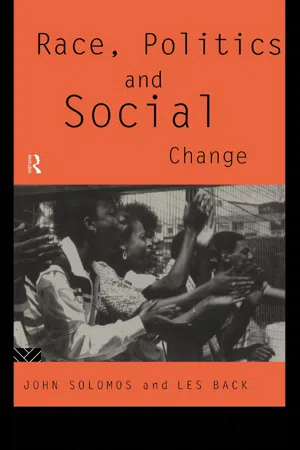
Drawing on a wealth of original sources, including interviews with politicians and activists this book explores the changing contours of the politics of race in the present social and political environment. The volume seeks to go beyond abstract generalisations in order to develop an account which takes seriously the everyday processes that have shaped social understandings of race and politics in British society. At the same time it links up to the broader debates about the impact of multiculturalism on contemporary politics, the role of minorities in political life and the limits of democratic government.
Its account of the role of black politicians within the context of party politics will be of particular appeal to those interested in the interplay between mobilisation and the development of racial justice and equality. Race, Politics and Social Change will appeal to students of British Politics and Society and to all those with interests in the politics of race.
- 248 pages
- English
- ePUB (mobile friendly)
- Available on iOS & Android
eBook - ePub
Race, Politics and Social Change
About this book
Information
1 Theoretical and conceptual issues
One of the most thorny problems in theorising about race and ethnicity is the question of how political identities are shaped and constructed through the meanings attributed to race, ethnicity and nation. This is partly because the question of how to conceptualise the interplay between race and political action is not purely an academic matter. It is connected with a wider political culture in any given historical conjuncture. Any book concerned with the politics of race and social change must come to terms with the highly politicised nature of this field and the problems that this gives rise to in developing a theory of the interrelationship between race, politics and society. It is perhaps not surprising, therefore, that we have seen a growing interest in this question in recent years at the same time as we have seen important changes in forms of political mobilisation among minorities in British society.
This growth of interest in the study of the politics of race has helped to clarify some questions, but others remain to be addressed. Take, for example, the following, seemingly simple, questions: What explains the role of race in political mobilisations and conflicts in contemporary advanced industrial societies? How does political agency connect with social structure in shaping what is popularly called the politics of race? These questions are also at the heart of the main theoretical debates about the changing politics of race and ethnicity which have developed in recent years. Such debates have focused particularly on how we can understand the relationship between race, politics and social change in the present environment. Yet despite some progress in clarifying issues raised by these questions, we still (i) lack a clear analytic framework for analysing the interrelationship between race, politics and social change, and (ii) know relatively little about key features of contemporary racialised politics.
This is why before moving on to developing our own account of the politics of race and social change it is important that we at least provide an outline of the theoretical framework we have used in dealing with these questions. This is what the rest of this chapter attempts to do. It begins by looking at some of the main bodies of work that have addressed this issue in the past two decades. It then moves on to recent criticisms of these perspectives and explores some of the gaps to be found in the dominant paradigms in this field. This links up with the analysis of Chapter 2, which outlines more explicitly our own analytic framework and the key issues that will be explored in the rest of the book.
RACE, POLITICS AND SOCIETY
Theorising about questions of race, ethnicity and nationhood has become a key concern of social theorists in recent years. Whereas critical theorists in the early 1980s were bemoaning the lack of analytical clarity about what constituted the politics of race or what was meant by the notion of racism in contemporary societies, today there is a wealth of theoretical and conceptual work going on in this field. This has taken various forms. First, there have been various attempts to construct theoretical models for explaining the increasing role of race as a symbol for political mobilisation, the role of racial ideologies in national and local agendas, and the impact of ideas about race on the development of government policies and programmes. This has led to the emergence of various schools of thought and there have been many valuable research studies produced in recent years. We shall be exploring some of the key approaches in the course of this chapter. Second, in recent years there has been a growing interest in the roles that race and ethnicity play in the affirmation of a politics of identity in advanced industrial societies. Stimulated to some extent by the growing literature on the condition of post-modernity, a number of writers have sought to go beyond the limits of existing theories in this field and explore the complex ways in which identities articulated in terms of race and ethnicity are expressed in contemporary social relations. This has led to important interventions from researchers working in the fields of cultural studies, literary theory and political theory.
In the midst of this growth of interest in the politics of race it is also clear that crucial theoretical and conceptual issues have remained untheorised and, perhaps most importantly, under-researched. Certainly, when we undertook this research we found relatively little previous material to guide us in our attempts to give some conceptual and analytical substance to our stated concern to study the politics of race and social change in Birmingham. Although in some of our previous work we had looked at the question of how to conceptualise the issue of racialised forms of political action and their changing expression in contemporary Britain (Solomos, 1988, 1993), we felt there was a need to develop a theoretically grounded analysis of the everyday processes through which race and ethnicity have become an integral part of political life. What little research there was we found to be both rather dated and lacking a strong theoretical framework. This situation is partly the result of (i) the abstract and generalised nature of many of the theoretical debates that have developed in recent years, and (ii) the lack of theoretically informed research on the dynamics of racialised politics in the contemporary period. Both of these points may seem surprising, at first sight, particularly when we take into account the highly politicised nature of research on race and ethnic issues in recent years. But these are not surprising when we take into account that much of the research on the politics of race in British society is relatively recent and has been concerned with either local case studies or very specific studies of policy formation and the impact of policies on ‘racial’ issues.
This picture changed somewhat when we broadened our search and took on board the wide range of research on race and politics in the United States of America. Here we found a wealth of research on key issues that tied up with our own concerns, in particular, urban politics and race, the role of minority politicians, race and public policy, and the dynamics of racialised politics. In this sense we found the American literature more relevant to our own concerns, although we were conscious that the issues and processes it addressed were in some sense specific to the political institutions and culture of American society and could not therefore be seen as directly relevant to the situation in Britain or other European societies. The earlier development of American research in this field can partly be explained by the impact of black and Hispanic politicians on political institutions in the United States since the mid-1960s (Marable, 1985). During the past three decades there has been a rapid growth in the number of elected black officials at all levels of American political life, leading to what some commentators have called a ‘new black politics’. Additionally, in recent years politicians such as Jesse Jackson have sought to use this growth of minority representation as one of the means of building a ‘rainbow coalition’ of various excluded groups in order to challenge the established political order.
It is in the context of this growth of a vibrant minority political culture that we have seen over the past two decades the development of an extensive body of research on black and minority political mobilisation in the United States. Much of this research has been concerned with two key issues. First, the growth of black political empowerment in the aftermath of the civil rights movement and the urban uprisings of the 1960s. Second, the emergence of new forms of black and minority political mobilisation in the United States, particularly during the 1980s and 1990s. Both of these trends have led to wide-ranging research on the dynamics of black and minority political mobilisations, the role of alliances in changing the relative powerlessness of minority communities and the growth and role of black political elites.
An influential American study that links up with some of our own concerns is that by Browning, Marshall and Tabb (1984) entitled Protest is Not Enough, which examines the politics of Hispanic and black mobilisation in ten northern Californian cities. The authors’ aim was to develop a ‘conception of minority political action and position that linked mobilisation to policy, that demonstrates the connection between the passions, interests and actions of mobilisation and the government response – if any’. Browning et al. (1984) suggest a simple sequence of political activity: mobilisation – incorporation – responsiveness. They identify two kinds of mobilisation: demand-led protest and electoral. Their model is concerned with the outcome of and response to political mobilisation. It is this perspective that is directly relevant to the Birmingham research. Their conclusion is provocative:
The key to higher levels of responsiveness was not representation but coalition: minority inclusion in a coalition that was able to dominate a city council produced a much more positive government response than the election of minority council members who were not part of the dominant coalition.
(Browning, Marshall and Tabb, 1986: 576)
They also point out that white support for minority incorporation was not a matter of benign altruism because the existence of these coalitions depended on the support of black and Hispanic politicians. The attraction of this model is that it focuses on the political system as a whole, rather than narrowly focusing on the activities of minority politicians. The responsibility for change is placed squarely within the political system itself. It also captures the dynamic nature of the political process where any advance may be subject to what they refer to as ‘roll backs’ (Browning, Marshall and Tabb, 1984: 262–263).
There are of course problems in applying the American experience to Britain. Perhaps the most important of these is the ideological character of party politics and individual parties’ preoccupation with discouraging caucusing along sectional interests. This is evident in the response of the Labour Party in the late 1980s to the black sections movement in the party. In this sense the pluralist model which is found within the American situation cannot simply be applied. Nevertheless, there are elements of the account given by Browning, Marshall and Tabb for American cities that link up with the transformations which we have seen over the past two decades in both national and local politics in British society. This is something that we shall return to in the course of the substantive discussion of political mobilisation in this study. Before doing so, however, it is necessary to look at some of the key themes to be found in research on race and politics in Britain.
RACE AND POLITICS IN BRITAIN
It is clear that from the 1950s onwards political processes and institutions have played a key role in the construction of racial and ethnic questions in British society. Research at both the national and local political level has highlighted the changing political strategies and ideologies that have helped to shape policies on issues such as housing, employment, education, policing and equal opportunities. This research has shown clearly that over the years political and ideological processes have played a very important role in the construction of popular images of minorities and in shaping the development of particular types of policy intervention. What has also become clear in recent years, however, is that minority groups are themselves playing an active role within national and local political institutions. This phenomenon has certainly become important at the level of local politics, with the election of a sizeable number of black local councillors over the past decade. But it is also becoming increasingly important within the context of national party politics and within Parliament (Solomos and Back, 1991b).
What is surprising at first sight, however, is that there have been few attempts to produce detailed accounts of the processes that may help to explain these changes. Our own awareness of the need for a fuller theorisation of these issues is related to our experience of attempting to develop a conceptual framework to research the relation between race, politics and social change. One of the starting points of this research was the hypothesis that race is first and foremost a political construct. From this starting point we wanted to locate the racialisation of politics within processes of social regulation and identity formation, within specific political cultures and discourses and within wider processes of social and economic change. In the course of our research, however, it became clear that ideas about race and ethnicity manifest themselves in plural and complex forms within political institutions. In this context, unitary or simplistic notions about race and political action become hard to sustain.
Yet it is clear that within the main strands of literature in this field little attempt has been made to develop a theoretical discussion of the processes through which ideas about race gain political salience and have an impact on patterns of political mobilisation. Most studies have been largely descriptive and atheoretical – they have not sought in any meaningful sense to provide a theoretical framework for the analysis of race and political action. This has resulted in a number of useful descriptive accounts of the role of race in electoral politics, the impact of racialised agendas on public policy and case studies of specific events or cities. But within this body of work the political processes involved in the making of racial politics have received little or no attention, either from a theoretical or empirical perspective. Indeed, it is surprising to see how little research has explored in any detail the contemporary dynamics of racial politics. This has resulted in serious lacunae in the analysis of racial politics in contemporary British society. More significantly, little attention has been paid either to forms of political and social mobilisation among minorities or to the responses of political institutions to minority struggles for empowerment.
RACE, COMMUNITY AND CONFLICT
There are some exceptions to this general trend. For example, the work of John Rex, to whom we have already referred in the Introduction, can be seen as an attempt to develop a political sociology of racial relations in British society. Rex and his associates have from the 1960s onwards attempted to analyse the politics of race in a systematic fashion. The empirical focus of Rex’s research has been on Birmingham and for this reason it is of direct relevance to our own work. But it is also important because it represents an early attempt to develop a conceptual framework for the analysis of the politics of race in contemporary Britain. Rex’s starting point in his early work was that the position of ethnic minority communities must be understood primarily in terms of their status as migrants. Rex combined a Weberian notion of class analysis with elements of the urban sociology developed by the Chicago School and what he has termed in his later work a ‘loose Marxism’ (Rex, 1989). He attempted to provide a sociologically based explanation for racial discrimination and conflict by identifying inequalities in ‘market situations’ which fuel conflicts between indigenous workers and newcomer populations (Rex, 1973: 32).
This approach was exemplified in his early work with Robert Moore in Sparkbrook, an inner city area of Birmingham. In this study they analysed the way in which differential access to housing provision created a hierarchy of class situations in the Weberian sense (Rex and Moore, 1967). These classes provided a basis for conflict between actors located in different market situations which were comparable to those that occur in the workplace (Rex and Moore, 1967: 273; Rex, 1968, 1973). The existence of exclusive allocation practices within council housing provision discriminated against newcomer populations. In addition, migrants were positioned in varying locations within this housing class system, e.g. ‘Pakistani landlords’ occupied a ‘pariah position’ in a different housing class to those who lodged with them, who were predominantly ‘West Indian’ (Rex and Moore, 1967: 165). Running alongside this process of housing discrimination was the development of ‘immigrant colonies’. The development of such colonies was a response to the ‘anomie’ and ‘personal demoralisation’ which migrants were subjected to in the city. It is in this context that community and immigrant organisation took on political meanings (Rex and Moore, 1967:277).
In a later study Rex refers to the political work that took place in (i) organisations within immigrant ‘colonies’ and (ii) the development of organisations which acted for housing class interests (Rex, 1973:4). He argues that it is through such forms of political mobilisation that minority communities attempted, in the period after their arrival in Britain, to establish their social and economic position, as well as to ensure a degree of access to political institutions.
In the study conducted by Rex and Tomlinson in Handsworth during the mid-1970s this type of analysis was further developed to take account of the changing social and political situation (Rex and Tomlinson, 1979). The basic research problem of this study was structured by the objective of researching the extent to which immigrant populations shared the class position of their white neighbours and white workers in general. The substance of the analysis outlined a class structure in which white workers had been granted certain rights which had been won through the working-class movement and the Labour Party. The result was, argued Rex and Tomlinson, that by the 1970s a situation of ‘class truce’ developed between white workers and the dominant social groups. Basing their analysis on Marshall’s account of the welfare state, in which the salience of a shared citizenship outweighed the political importance of class as a source of political action (Marshall, 1950), they argued that the development of welfare state institutions provided an important mechanism for shaping political mobilisation within the working class.
For Rex and Tomlinson the position of migrant workers and their communities was one where they were located outside this process of negotiation that had taken place between white workers and capital. They experienced discrimination in all the areas where the white workers had made significant gains, i.e. employment, education, housing. It followed from this that the position of migrant workers placed them outside the working class, in the position of an underclass:
The concept of underclass was intended to suggest . . . that the minorities were systematically at a disadvantage compared with their white peers and that, instead of identifying with working class culture, community and politics, they formed their own organisations and became effectively a separate underprivileged class.
(Rex and Tomlinson, 1979: 275)
From this point Rex and To...
Table of contents
- COVER PAGE
- TITLE PAGE
- COPYRIGHT PAGE
- DEDICATION
- PREFACE
- INTRODUCTION
- 1. THEORETICAL AND CONCEPTUAL ISSUES
- 2. RACE, POLITICS AND SOCIAL CHANGE
- 3. POWER, RACISM AND POLITICAL MOBILISATION
- 4. PARTIES, BLACK PARTICIPATION AND POLITICAL CHANGE
- 5. POLITICAL DISCOURSES AND RACE
- 6. THE NEW BLACK POLITICS
- 7. POLITICAL CHANGE AND POLICY AGENDAS
- 8. DEMOCRACY, CIVIL SOCIETY AND RACISM
- APPENDIX 1: RESEARCH STRATEGY AND SAMPLE
- APPENDIX 2: BLACK COUNCILLORS ON BIRMINGHAM CITY COUNCIL (1979–1994)
- BIBLIOGRAPHY
Trusted by 375,005 students
Access to over 1.5 million titles for a fair monthly price.
Study more efficiently using our study tools.
Frequently asked questions
Yes, you can cancel anytime from the Subscription tab in your account settings on the Perlego website. Your subscription will stay active until the end of your current billing period. Learn how to cancel your subscription
No, books cannot be downloaded as external files, such as PDFs, for use outside of Perlego. However, you can download books within the Perlego app for offline reading on mobile or tablet. Learn how to download books offline
Perlego offers two plans: Essential and Complete
- Essential is ideal for learners and professionals who enjoy exploring a wide range of subjects. Access the Essential Library with 800,000+ trusted titles and best-sellers across business, personal growth, and the humanities. Includes unlimited reading time and Standard Read Aloud voice.
- Complete: Perfect for advanced learners and researchers needing full, unrestricted access. Unlock 1.5M+ books across hundreds of subjects, including academic and specialized titles. The Complete Plan also includes advanced features like Premium Read Aloud and Research Assistant.
We are an online textbook subscription service, where you can get access to an entire online library for less than the price of a single book per month. With over 1.5 million books across 990+ topics, we’ve got you covered! Learn about our mission
Look out for the read-aloud symbol on your next book to see if you can listen to it. The read-aloud tool reads text aloud for you, highlighting the text as it is being read. You can pause it, speed it up and slow it down. Learn more about Read Aloud
Yes! You can use the Perlego app on both iOS and Android devices to read anytime, anywhere — even offline. Perfect for commutes or when you’re on the go.
Please note we cannot support devices running on iOS 13 and Android 7 or earlier. Learn more about using the app
Please note we cannot support devices running on iOS 13 and Android 7 or earlier. Learn more about using the app
Yes, you can access Race, Politics and Social Change by Les Back,John Solomos in PDF and/or ePUB format, as well as other popular books in Politics & International Relations & Civil Rights in Politics. We have over 1.5 million books available in our catalogue for you to explore.