This book examines factors surrounding the partnership between school-based training and mentoring in Physical Education.
Contributors look at all angles of the collaboration between schools and higher education institutions, including:
How mentor training programs are planned and the issues involved
*Trainees' experiences of school-based training and mentoring
*The needs of PE mentors in schools
*A full explanation of mentoring
Drawing on recent findings and the views of physical education teachers in the UK, Australia and the USA, the editor combines a wealth of information on factors which influence mentorship and the effectiveness of school-based partnership schemes.
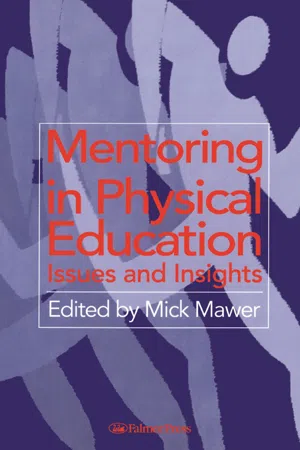
- 224 pages
- English
- ePUB (mobile friendly)
- Available on iOS & Android
eBook - ePub
About this book
Information
Part One
The Context
1 Partnerships in School-based Training: The Implications for Physical Education
Patricia Shenton and Elizabeth Murdoch
Introduction
The impact of the transfer of a more substantial part of initial teacher training (ITT) from university and college departments to schools is now beginning to be felt in both groups of institutions. The interpretation of partnerships is becoming increasingly more sophisticated and there is widespread support for the concept that teachers should be trained in the setting in which they will eventually work.
Much has been written recently about the process of preparing a trainee teacher for entry into the teaching profession but little of this refers directly to the preparation of teachers of physical education. Physical education has earned a reputation for not always fitting easily into patterns of professional practice enjoyed by other subjects, and the development of school partnerships, and all that this entails, is no exception. There is, therefore, a number of important issues which merit recognition as we stand back to review recent innovative practice in physical education both in schools and within ITT in universities and colleges. Reference will be made in more depth to a number of these issues in later chapters but there is value, at this stage, in looking broadly at the major challenges facing the trainers of new teachers.
The setting up of a joint research project between Liverpool John Moores University (IM Marsh Centre) and the University of Brighton (Chelsea School of Physical Education, Sports, Science, Dance and Leisure) has enabled us to collect valuable data from the first two years of operation of the enhanced school involvement in ITT. This chapter offers the opportunity for some critical conceptual issues to be explored. In other chapters, it is hoped that evidence of these issues in practice will be incorporated.
Partnerships—Are they Working?
The most significant question to be asked at this stage is:
Do we all share the same view of partnership and what it means?
The way in which these reforms in initial teacher training were introduced resulted in very hasty and limited planning and implementation in the first instance to allow responses to the Department for Education Circular 9/92 (DFE, 1992) to be made. This central directive with its significant proposals for the future of teacher training set a very short timeframe for its implementation. As a result, early responses were not based on careful and appropriate consultation and planning nor did they allow time for the physical education profession to give systematic thought to the full impact of these changes on the subject as well as on tutors, teachers and students.
The initial reaction of all parties to the proposals was largely one of suspicion born of a level of ignorance that could not be easily rectified owing to lack of joint preparation time. The true potential, and therefore form, of partnerships was still to be considered, realized and appreciated by the partners involved. An early priority in the implementation process, that bordered on the obsessive, was related to the financial implications of transferring appropriate funds from university to schools. This tended to obscure what should have been the main focus—that of building a professional partnership for teacher education in making full use of the relative strengths of each partner in joint, strategic planning. Thus the first cohorts of students came quickly into a system hardly ready for them. It is to the credit of all concerned that they emerged from the experience with positive responses and a remarkable professional confidence.
It is worthwhile at this point to consider briefly the context of teacher training in general within which the changes were to be introduced. Education was going through an unprecedented period of government intervention which had already affected substantially the roles and functions of schools and local authorities. Higher education could not have expected to escape from the radical reforms that were changing the face of education but there was little warning as to the exact nature of the proposals for the shake up in this sector.
Margaret Wilkin (1993) makes reference to three, more specific, conditions in teacher education prior to the advent of Circular 9/92 all of which are particularly relevant to physical education. Firstly, she proposes that there has been, for some time, a reduction in educational theorizing within training courses and that the focus of understanding the process is now much more on personal and reflective experience of the student as teacher than understanding and application of relevant theories. Secondly, she notes a significant change in the balance of theory to practice. A marked reduction in the reliance on the disciplines of education has meant that there is less status given to the student’s ability to argue and defend a discipline-rooted viewpoint than to competence in the classroom. Lastly, she recognizes that there has been a ‘merging equivalence of status of tutors and teachers’ (see page) as school-based work came to be valued more and more.
In retrospect, it is interesting to note how these changes have set the scene for and contributed to, the concept of the ‘new model of the teacher’ that is sought by the Teacher Training Agency. There is neither time nor space in this chapter to pursue in detail the implications of these changes for physical education except to note that, for those who consider physical education to be an almost solely ‘practical’ subject, the apparent change in balance from theory to practice, with an emphasis on competences, could be seen to be a move in the right direction.
Margaret Wilkin warns that
Personal theorizing per se provides an insecure basis for practice, yet individual interpretation cannot be disregarded if participation and commitment are to be wholehearted. Although reference to the views of other individuals extends one’s vision, reference to established research, for all its weaknesses, offers the sounder means of verifying one’s assumptions, (ibid, see page)
and
it entails engaging the student on an intellectual journey from a particular to a general form of theorizing for the purposes of confirming or disconfirming or clarifying or extending his/her original assumptions, (ibid, see page)
Setting out together on this journey must be the essence of good partnerships and must challenge the nature of teacher (mentor)/tutor/student relationships and call for a greater degree of joint planning of university courses and school based experience.
To do this, places an emphasis on one of the most critical questions yet to be fully answered:
Who is responsible for what, in terms of actual practice in schools, professional preparation and subject knowledge?
The following model based on the interaction of theory with practice may help to clarify different aspects of the approach to producing a teacher, and in particular a teacher of physical education, who is competent and yet at the same time has the ability to be reflectively intelligent
See Table
This echoes very closely the work of Maynard and Furlong (1993) in which they propose that professional training happens at 4 levels:
See Table
All of the above can involve tutor, teacher and student in a contribution to the student’s development. The planning of a good partnership must involve the decision about which member(s) of the partnership have the knowledge, skills and resources to make the best contribution at the time.
This will work best when the tutor and mentor share the same subject/ discipline. Where the tutor does not come from the same area of study, the role of the mentor in supporting subject development for the student becomes more critical and the relationship with subject based tutors in the pre-planning of courses becomes even more important.
This could give rise to different models of mentorship in practice. For example, the mentor may arrange workshop sessions where the student could experiment within a teaching episode with pupils while, at another time, the tutor may be engaging the student on reflection on the theoretical principles involved and on the practical outcome.
That the student should be fully involved in the planning of his/her progress and mode of learning is of vital importance and this brings us to another issue within partnership structures. The student should be seen wherever possible as a full member of the team and as such expected to take major responsibility for as much of the partnership as possible alongside the rest of the team. The traditional view of the student as being one who brings nothing or little to the education setting is no longer tenable. Many students bring much experience with them and are capable in many situations of functioning in a fully professional way. This can be particularly true of the physical education student who has many opportunities to gain relevant experience through personal interests such as involvement with children or a coaching qualification, How far this is realized will be dictated largely by the attitudes of the tutor, teacher and most importantly the student.
As the dust settles from the early days of change, it would seem that the time is right for some critical decisions to be made as to what is the real nature of the best partnership for such an important task as preparing for the future of the physical education profession.
In attempting to do this, some assumptions will need to be made that may uncomfortably challenge some long established patterns of practice:
- that this is a real partnership based on collaborative planning, and not merely one partner taking over part of the job of another;
- that the process of training a teacher is a continuum from initial to continuing professional development and not focussed solely on the traditional undergraduate ‘supervised teaching practice’ in a school;
- that such a continuum will expect that all teachers will show a steadily developing set of competences appropriate for each stage in the process of their careers;
- that students of physical education (many more of whom are mature) bring with them many personal skills and are capable of taking on an immediate, responsible and active role within a school and thus making a significant contribution to the work of the school and the physical education department while at the same time adopting the more traditional role of the new student teacher.
What are the major issues that need to be addressed if partnerships between schools and HE institutions are going to develop?
Quality assurance and quality control are high on the agenda in all sectors of education. Ultimately, the maintenance of quality in relation to all partners is what will ensure good partnerships. What criteria can be proposed that will allow for a measure of quality control in the partnership between schools (and especially their physical education departments) and the providers of ITT within HE? What factors, if any, militate against the provision of the highest quality of training for students?
It has been recognized that the process of the Office for Standards in Education (OFSTED) inspections in relation to physical education in schools, particularly primary schools, has been less uniformly rigorous than we as a profession would have wished as there are very few inspectors available who have sufficient knowledge of physical education for the subject to be adequately inspected. At this moment a group of physical education advisers and inspectors are meeting with HMI to consider the needs of physical education within an inspection. The group will be addressing, among other areas, the criteria of good partnerships between schools and HE institutions and it is hoped that this will do much to raise awareness of the large variation in standard of the student experience from one school to another, which is the first step towards having a significant improvement.
HMI (1995) recognized this when they suggested that,
Quality control across HE and schools is a major challenge…models of good practice involving partnerships of varying numbers of schools were observed. Successful provision usually reflected long established and effective relationships between the schools and HEIs; a great deal of co-operation and flexibility by all concerned; and a willingness to ensure that the combined expertise of school teachers and HEI tutors was carefully co-ordinated and deployed.
One of the expected outcomes of the joint IM Marsh/Chelsea research project will be to devise appropriate instruments for assessing quality in the delivery of ITT within established partnerships.
For the purposes of this chapter, quality and its achievement within good partnerships will be addressed under the following headings. These cannot be considered as independent of each other in practice but, explored separately, will provide a framework that allows for recognition of the significance of the roles of the main providers:
- the contribution of the mentor;
- continuity and relevance of the student’s experience;
- continuing professional development.
The Contribution of the Mentor
From observation of current practice of mentorship in physical education, within an established school/HE partnership, the following would seem to be critical to the assurance of a good and fair experience for students:
- that the mentor has time and status to allow the job to be done well and this will call for a clear commitment from headteachers and governors to see ITT and mentoring in physical education as a significant part of the school’s work and also recognition of the value of physical education to the school;
- that the mentor has access to a good personal developmental programme that is well planned as a corporate exercise and includes knowledge of, and significant input into, university courses experienced by students; awareness of assessment procedures, rules and regulations that pertain in the student’s course and how to relate them to the school context; understanding of the Circular 9/ 92 competences and how to recognize and develop them in a student; an awareness of the competences that are critical for good mentoring and how to improve on these;
- that agreement is reached between the mentor and the university tutor about the most appropriate model of divided responsibility that will allow them to address who is responsible for which aspects of content, teaching and learning processes, assessment etc.; how is the integration of theory and practice accomplished; how much content/subject material can realistically be taught in the school during the student placement; who will decide on the underlying philosophy of the placement period with clear objectives or learning outcomes as appropriate.
McIntyre and Hagger (1993), in supporting the strong case for practising teachers being better equipped to provide the ‘supervision’ of beginning teachers practice, suggest that they must develop to a high level the skills of supervision that tutors in universities and colleges already have, capitalize on the distinctive opportunities available to them and avoid the dangers. Among the distinctive opportunities that mentors have they cite information, continuity and validity. The mentors know more about the school and the people in it; they can provide a much greater consistency, regularity and continuity than a tutor whose visits are infrequent; support for the student does not have the ethos of special occasion about it but is seen as part of normal everyday experience.
McIntyre and Hagger warn us also of dangers. The most significant of these is a combination of arbitrariness and idiosyncrasy. This is a particular danger within physical education where styles of teaching and modes of working have been developed as highly personal and also where areas of expertise within subject knowledge are, in many cases, highly specialist. It has been noted on numerous occasions that young teachers, coming for the first time into a physical education department, with enthusiasm for what was learned in ITT have been firmly told to ‘forget all that and realize that this is the real thing!’ It is here that negative attitudes to ‘all that theory’ can be found where practice alone for some is seen to be the nature of the real job. It will be a challenge for many mentors to appreciate the range and width of strategies and styles within which a young teacher must experiment in relation to children’s learning and also the breadth of content that has to be mastered.
Another danger cited by McIntyre and Hagger is that of the closeness of the relationship between mentor and student. It is a relationship within which mutual respect is fundamental.
The role of the mentor is one which carries a number of polarities which can lead to tension both for student and mentor.
For example, the mentor is both:
See Table
The mentor, in attempting to satisfy all demands, can face difficult decisions. Parents are beginning to ask what effect this new role of mentoring is likely to have on the quality of education that will be received by their children. In some cases, parents feel strongly in some cases that teachers are there to teach children and should not be putting their energies into such demanding tasks as mentoring and where the children may have the student teacher ‘experimenting’ on them. There is no doubt that this will be seen to be of great significance in the core subjects but there is evidence also of some concern being expressed within physical education also.
Structu...
Table of contents
- Cover Page
- Dedication
- Title Page
- Copyright Page
- Introduction
- Part One: The Context
- Part Two: An Insight into the Trainee’s Perspective
- Part Three: Issues Concerning the Role of the Mentor
- Part Four: An International Perspective
- List of Contributors
Trusted by 375,005 students
Access to over 1.5 million titles for a fair monthly price.
Study more efficiently using our study tools.
Frequently asked questions
Yes, you can cancel anytime from the Subscription tab in your account settings on the Perlego website. Your subscription will stay active until the end of your current billing period. Learn how to cancel your subscription
No, books cannot be downloaded as external files, such as PDFs, for use outside of Perlego. However, you can download books within the Perlego app for offline reading on mobile or tablet. Learn how to download books offline
Perlego offers two plans: Essential and Complete
- Essential is ideal for learners and professionals who enjoy exploring a wide range of subjects. Access the Essential Library with 800,000+ trusted titles and best-sellers across business, personal growth, and the humanities. Includes unlimited reading time and Standard Read Aloud voice.
- Complete: Perfect for advanced learners and researchers needing full, unrestricted access. Unlock 1.5M+ books across hundreds of subjects, including academic and specialized titles. The Complete Plan also includes advanced features like Premium Read Aloud and Research Assistant.
We are an online textbook subscription service, where you can get access to an entire online library for less than the price of a single book per month. With over 1.5 million books across 990+ topics, we’ve got you covered! Learn about our mission
Look out for the read-aloud symbol on your next book to see if you can listen to it. The read-aloud tool reads text aloud for you, highlighting the text as it is being read. You can pause it, speed it up and slow it down. Learn more about Read Aloud
Yes! You can use the Perlego app on both iOS and Android devices to read anytime, anywhere — even offline. Perfect for commutes or when you’re on the go.
Please note we cannot support devices running on iOS 13 and Android 7 or earlier. Learn more about using the app
Please note we cannot support devices running on iOS 13 and Android 7 or earlier. Learn more about using the app
Yes, you can access Mentoring in Physical Education by Mick Mawer in PDF and/or ePUB format, as well as other popular books in Education & Education General. We have over 1.5 million books available in our catalogue for you to explore.