In a representative study made of European workers, twenty-eight per cent of employees reported that stress affects their health and their performance at work. Occupational stress is a serious problem for the performance of individuals, organisations and as a consequence, for national economies. Preventing Stress, Improving Productivity investigates the ways in which companies can combat stress by changing the working environment rather than only treating individual employees with stress symptoms.
Costs and benefits of stress prevention are discussed, with an emphasis on appraoches that involve both the work situation and the individual worker. The heart of the book consists of eleven European country chapters, each overviewing the current status with respect to occupational stress and its prevention in that country and then presenting one detailed case study an example of good preventive practice.
Preventing Stress, Improving Productivity identifies five factors that are critical for a stress reduction programme to work, both in terms of employee health and well-being and from a financial point of view. Successful strategies combine participation from workers and support from top management. Useful as a reference for psychologists, human resource managers, occupational physicians, ergonomists and consultants, this book will also be an invaluable aid to managers in the day-to-day running of organisations.
eBook - ePub
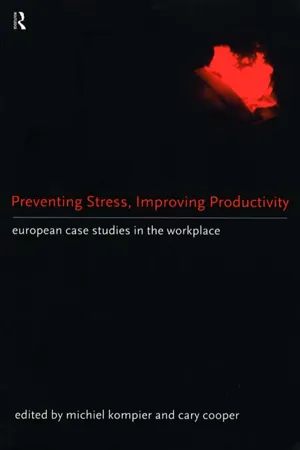
Preventing Stress, Improving Productivity
European Case-Studies in the Workplace
- 368 pages
- English
- ePUB (mobile friendly)
- Available on iOS & Android
eBook - ePub
Preventing Stress, Improving Productivity
European Case-Studies in the Workplace
About this book
Information
Chapter 1
Introduction: Improving work, health and productivity through stress prevention
As the nature of work in the developed world undergoes more and more change, as organisations downsize, de-layer and out source, so the stresses and strains on employees increase. In the United States, it is estimated that 54 per cent of sickness absence is in some way stress related (Elkin and Rosch, 1990). In Europe as well, the costs are high. From a recent study by the European Foundation for the Improvement of Living and Working Conditions (Paoli, 1997) it appears that 28 per cent of over 15,000 European workers report that stress is a work-related health problem. In many developed countries the total cost of workplace pressure has been estimated at roughly 10 per cent of gross national product (Cartwright and Cooper, 1997; Cooper et al., 1996; Karasek and Theorell, 1990), stemming from sickness absence, labour turnover, premature retirement due to ill health, escalating health insurance and expenditure on treatment of the consequences of stress.
While a great deal of research (for example, Cooper, 1995) has been devoted to identifying the sources of workplace stress and its links to adverse health and organisational outcomes, little has been done to focus on interventions to improve working environments. In reviewing the practice overall of stress prevention and intervention at the workplace, three conclusions may be drawn. First, although there is a considerable amount of activity in the field of stress management, it is disproportionally concentrated on reducing the effects of stress, rather than reducing the presence of stressors at work (Cooper and Payne, 1988; Cox, 1993; ILO, 1992; Kahn and Byosiere, 1992; Murphy, 1984, 1986, 1996; Quick and Quick, 1984). To put it differently, stress management activities focus on secondary and tertiary prevention, rather than primary prevention (Kompier and Marcelissen, 1990; Kompier et al., 1998; Murphy, 1984, 1986; Quick and Quick, 1984). Whereas the latter involves interventions aimed at eliminating, reducing or altering stressors in the working situation, the former two are aimed at the effects of stress, with secondary prevention concerning the helping of employees (who are already showing signs of stress) from getting sick (for example, by increasing their coping capacity); and tertiary prevention concerning treatment activities for employees with serious stress-related health problems (for example, stress counselling/employee assistance programmes, the rehabilitation after longterm absenteeism). Second, most activities are primarily aimed at the individual rather than at the workplace or the organisation, in other words, a worker-oriented approach, for instance, by improving employees’ skills to manage, resist or reduce stress (Ivancevich and Matteson, 1987; McLeroy et al., 1988; Murphy, 1996), as opposed to a job or organisation-oriented approach, for instance, by job redesign or in some way changing the corporate culture or management style (Kelly, 1992; Kopelman, 1985). Moreover, as Kahn and Byosiere (1992) conclude in their literature review: ‘Even the programs that aim at stress inhibition tend to address subjective rather than objective aspects of the stress sequence; almost none consider the organisational antecedents (policy and structure) that intensify or reduce the presence of objective stressors’ (p. 633).
A third peculiarity in the practice of stress prevention concerns the lack of a systematic risk assessment (‘stress audit’, identifying risk factors and risk groups) as well as of serious research into the effects of all these activities (Kahn and Byosiere, 1992). In the words of Kahn and Byosiere (1992): ‘The programs in stress management that are sold to companies show a suspicious pattern of variance; they differ more by practitioner than by company. When practitioners in any field offer sovereign remedies regardless of the presenting symptoms, patients should be wary’ (p. 623).
Against the background of (1) clear evidence of the relationship between psychosocial work characteristics and health (Cartwright and Cooper, 1997; Cooper and Marshall, 1976; Cox, 1988; Johnson, 1986; Karasek and Theorell, 1990; Siegrist et al., 1990; Uehata, 1991; Vaernes et al., 1991), (2) national and international legislation that put the emphasis on risk assessment and combating risks by changing the stressful situation (Cooper et al., 1996; Cox, 1993; Kompier et al., 1994), and (3) the basic idea of prevention, that is, eliminating the stress producing situation (prevention at the source), the current practice of stress prevention and intervention seems disappointing.
Given the current status of stress prevention, a question that deserves attention is why it is that companies express a preference for ‘post hoc’ individual-directed interventions, as opposed to primary or job/organisational interventions. At least four factors seem to contribute to this rather one-sided ‘individual’-oriented approach (see Kompier et al., 1998):
1 Senior managers are often inclined to blame personality and lifestyle factors of employees who are absent from work or report health complaints, rather than the job or organisational factors, for which they are responsible. Senior management also often point to the potential role of stressful life events (family problems such as a divorce or the loss of a beloved), or responsibilities and obligations in the family life (raising children for example). Of course, on the micro-level (i.e. on the level of the individual employee) stressors at work are often accompanied by stressors in one's family situation (Evans and Bartolomé, 1984; Frone et al., 1992; Watkins and Subich, 1995), but because of the mutual influence and spill-over between both domains, the causes and consequences can hardly be disentangled. Furthermore, holding individual character istics responsible for differences in experienced stress, one cannot explain why some occupations show significantly more stress complaints and higher sickness absence rates than others (for example, Cooper and Payne, 1988). A risk attached to this view is that the employee is regarded as being ‘guilty’ of his or her own health problems, that is ‘blaming the victim’ (McLeroy et al., 1988), with the potential threat in the workplace being overlooked. Logically, this approach also leads to one-sided recommendations to reduce stress, that is, concentrating more on the individual employee than on changing the stressful working conditions.
2 The second reason may be found in the nature of psychology itself, with its emphasis on subjective and individual phenomena. Many psychology-oriented stress researchers are primarily interested in stress as a subjective and individual phenomenon. To some extent, this may be a legacy of the strong tradition in psychology to focus on individual differences (i.e. differential psychology), and on individual counselling and therapy (i.e. clinical psychology). In this context, a warning seems appropriate against ‘psychologism’, that is, the explanation of (a sequence of) societal events from an individual-psychic point of view. Because of this orientation, the potential impact of more ‘objective’ or ‘collective’ risk factors in the work situation (e.g. poor management, work-overload and bullying), may go unnoticed and untreated (see Frese and Zapf, 1988).
3 The third reason is of a methodological nature. In stress research, there is a gap between what ‘theory’ preaches (that is, properly designed longitudinal studies, involving a randomised control group, collecting both subjective and objective measures that are analysed properly with statistical techniques), and what is possible in practice (Kahn and Byosiere, 1992; Murphy, 1996). One of the main reasons for this gap is the difficulty of conducting methodological ‘sound’ interventions and evaluation studies in an ever-changing organisational environment. In the 1990s, not only the context of work is rapidly changing, but also ‘work’ itself. Work organisations are in a constant state of change, due, in part, to new production concepts (for example, team based work, lean production methods, telework), ‘the flexible workforce’ concept, the 24-hour economy, the increased utilisation of information technology, and the changing structure of the work force (for example, more women working). These changes clearly affect the work behaviour of employees, work group processes, as well as the organisational structure and culture. As a consequence, it is practically impossible to find two companies with comparable stress problems at the beginning of any intervention programme, of which the control company agrees not to undertake any action for a period of three or four years (the period a researcher might like to choose for an intervention project). A related problem is that it is often not in a company's interest to facilitate ‘sound scientific research’ in the context of an ongoing business, involving interlopers from outside (i.e. researchers) and detailed data collection on the scene of sometimes confidential information. Senior managers can regard research of this kind as a nuisance to the primary organisational processes and objectives.
4 A fourth factor may be found in the discipline segregation within stress research, with a tendency of researching to neglect the collection of more objective data on the impact of stress and its prevention. Work and organisational psychologists concentrate primarily on ‘soft’ outcome variables (e.g. motivation, satisfaction, effect and health complaints), and are well-known for their questionnaire-oriented approach. Traditionally, it has been rather unusual for stress researchers to co-operate with economists, for example, in order to study the potential ‘hard’ outcome measures (e.g. productivity, sickness absence rates and accident rates), as well as the financial effects of interventions. To put it differently, a history of gaining empirical insight in costs and benefits is merely lacking in stress research.
Research in the field should in the future include some of the following: first, stress researchers should not only address ‘soft’ outcome variables (for example, motivation and satisfaction), but extend their focus to also include ‘hard’ outcome variables (for example, productivity and sickness absenteeism). Whereas work and organisational psychologists have often stated that an adequate stress prevention programme may positively affect productivity and sickness absenteeism, until now they have not laid down a sufficiently strong em...
Table of contents
- Front Cover
- Half Title
- Title Page
- Copyright
- Contents
- List of figures
- List of tables
- List of contributors
- Foreword
- 1 Introduction: Improving work, health and productivitythrough stress prevention
- 2 Workplace stress and stress prevention in Europe
- 3 Costs and benefits of stress prevention in organisations: Review and new methodology
- 4 Finland: Organisational well-being. Ten years of research and development in a forest industry corporation
- 5 The Netherlands: A hospital, ‘Healthy Working for Health’
- 6 Belgium: A pharmaceutical company
- 7 United Kingdom: Evaluation of a stress management programme in the public sector
- 8 Denmark: Self-rule on route 166. An intervention study among bus drivers
- 9 Sweden: Mail processing
- 10 Germany: Reduction of stress by health circles
- 11 Ireland: Stress prevention in an airport management company
- 12 Portugal: Preventing occupational stress in a bank organisation
- 13 Greece: Stress management in the health care sector
- 14 Italy: A school of nursing
- 15 Stress prevention: European countries and European cases compared
- Index
Trusted by 375,005 students
Access to over 1.5 million titles for a fair monthly price.
Study more efficiently using our study tools.
Frequently asked questions
Yes, you can cancel anytime from the Subscription tab in your account settings on the Perlego website. Your subscription will stay active until the end of your current billing period. Learn how to cancel your subscription
No, books cannot be downloaded as external files, such as PDFs, for use outside of Perlego. However, you can download books within the Perlego app for offline reading on mobile or tablet. Learn how to download books offline
Perlego offers two plans: Essential and Complete
- Essential is ideal for learners and professionals who enjoy exploring a wide range of subjects. Access the Essential Library with 800,000+ trusted titles and best-sellers across business, personal growth, and the humanities. Includes unlimited reading time and Standard Read Aloud voice.
- Complete: Perfect for advanced learners and researchers needing full, unrestricted access. Unlock 1.5M+ books across hundreds of subjects, including academic and specialized titles. The Complete Plan also includes advanced features like Premium Read Aloud and Research Assistant.
We are an online textbook subscription service, where you can get access to an entire online library for less than the price of a single book per month. With over 1.5 million books across 990+ topics, we’ve got you covered! Learn about our mission
Look out for the read-aloud symbol on your next book to see if you can listen to it. The read-aloud tool reads text aloud for you, highlighting the text as it is being read. You can pause it, speed it up and slow it down. Learn more about Read Aloud
Yes! You can use the Perlego app on both iOS and Android devices to read anytime, anywhere — even offline. Perfect for commutes or when you’re on the go.
Please note we cannot support devices running on iOS 13 and Android 7 or earlier. Learn more about using the app
Please note we cannot support devices running on iOS 13 and Android 7 or earlier. Learn more about using the app
Yes, you can access Preventing Stress, Improving Productivity by Cary Cooper,Michiel Kompier in PDF and/or ePUB format, as well as other popular books in Psychology & History & Theory in Psychology. We have over 1.5 million books available in our catalogue for you to explore.