- 420 pages
- English
- ePUB (mobile friendly)
- Available on iOS & Android
eBook - ePub
About this book
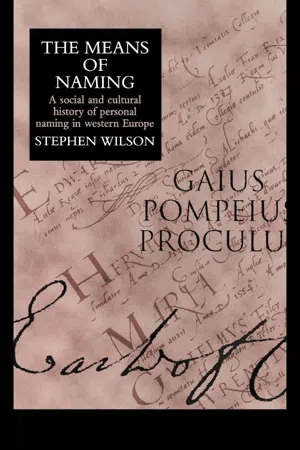
Names are never given accidentally; they are chosen and bestowed according to rules that reflect fundamental features of the society and culture concerned. This is a study of the nature and history of naming practices in Western Europe.
Trusted by 375,005 students
Access to over 1.5 million titles for a fair monthly price.
Study more efficiently using our study tools.
Information
Subtopic
European HistoryIndex
HistoryPART I
Ancient Rome
CHAPTER ONE
The name system:
individual and family
We know more about the names of ancient Romans than those of many other historical societies as a result of what has been called their “epigraphic habit”.1 The Romans liked to place inscriptions on buildings, on statues, at shrines and on tombs, paying honour to or commemorating particular people. These individuals’ full names were inscribed, and on monuments so were those of the persons who had erected them. Indeed the name of the commemorator was frequently more prominent that that of the commemorated, since it was the duty of heirs to put up tombstones and to show that they had done so. Monuments were usually in durable stone, and over 300,000 inscriptions are known from all over the Roman Empire and from most periods. Inscriptions have been widely and ingeniously used by historians to investigate different aspects of Roman society, starting with naming practices.
Of course, the evidence of inscriptions can be misleading. Most are from Italy and from the first and second centuries AD, leaving other places and times underrepresented. Again, some people, some classes of people, were much more likely to have inscriptions made than others, most obviously those with something to boast about and those who could afford to pay a stone-cutter. So the rich and famous are more likely to have their names recorded than the poor and the obscure; men more likely than women; Latins than Greeks. The upwardly mobile, as we should say, seem also to have been especially anxious to record their successful ascent of the slippery pole. Freed slaves and new provincial citizens particularly wanted to have their new names recorded, while those who had already made it, whether high aristocrats or ordinary free-born proletarians, were less interested. But with these caveats inscriptions are a marvellous source of information and may be complemented by literary material. What do both tell us about Roman names?
The tria nomina
As every schoolboy used to know, the Romans had three names, the tria nomina, for example Gaius Julius Caesar, the Dictator; Marcus Tullius Cicero, the orator; or Quintus Horatius Flaccus, the poet. All these three lived in the first century BC when this classic system was firmly established and legally prescribed. Roman citizens were officially registered in this style, together with the all-important filiation indicating their fathers and even grandfathers or great-grandfathers, and the tribe or voting district to which they belonged. So Cicero’s full official name was Marcus Tullius Marci filius Cornelia Cicero, Marcus being also his father’s name and Cornelia his tribe. This would all usually have been abbreviated to M.Tullius M.f.Cor. Cicero.
Of the three elements of the name proper, the first was known as the praenomen and was a man’s personal given name; the second, known as the nomen or gentilicium, placed him in his gens or kinship group; and the third, the cognomen, was either a personal nickname or epithet acquired during a man’s lifetime or an inherited name indicating a branch within the wider kinship group or clan. So by 200 BC the large gens Cornelia (distinct from the tribe of the same name) was divided into a number of branches, whose members were called Cornelii Cethegi, Cornelii Lentuli, Cornelii Scipii, and so on.
Much ink has been used to account for this supposedly unique Roman system of nomenclature. Where did it come from? When and why did the Romans adopt it? Given the paucity of evidence before about 200 BC, any answers to these questions must be mainly speculative, but some things one can say. First, other three-name systems have existed and do exist in other parts of the world. Secondly, it seems reasonably certain that originally Romans did have single names like other Indo-European peoples. “As to names”, Appian wrote in the second century AD, “Roman citizens formerly had only one each; afterwards they took a second, and not much later, for easier recognition, there was given to some of them a third.”2 Livy’s Histories and other evidence confirm that a two-name system of praenomen plus gentilicium predated the three-name system at Rome and in other areas of central Italy from the sixth century BC. It seems that the Romans developed a more complex nomenclature as their society became more complex and as they developed a powerful and expansionist state. Having two and then three names was a mark of social distinction, as it had been among the Etruscans from whom the Romans borrowed much, and it became a privilege of citizens. At the same time the tria nomina, carefully recorded by officials in five-yearly censuses, served the interests of the state, facilitating the task of recruiting soldiers, taxing and arranging elections among growing numbers of citizens. “Easier recognition” was essential to the functioning of Roman society, and nowhere more so than in the city of Rome itself, whose population grew rapidly in the last two centuries BC to reach around a million by the first century AD. One must add that the tria nomina were especially characteristic of the Roman Republic and its participatory political system and tended to die out when that was replaced by the authoritarian Empire.
The nineteenth-century German historian Theodor Mommsen believed that Rome’s political bias was reflected in the uniform and limited style of Roman names (nearly all ending in -us) and their restricted stock, which he contrasted with “the luxuriant and poetical fullness of those of the ancient Greeks”3 This restraint is never more obvious than with the praenomen.
Praenomina
Exhaustive trawls of literature and inscriptions have yielded 64 known praenomina, but in practice this total should be greatly scaled down. The unknown author of a book on names written in the first century AD said that there were about 30 and half this number were in common use. As we have seen, the commonest praenomina were usually abbreviated when placed with other parts of the name: A. for Aulus; M. for Marcus; T. for Titus; C. for Gaius; Cn. for Gnaeus, and so on. The last two incidentally show the great age of praenomina, since they refer to a time when these names were spelled with C.
There is no doubt that in the Republican period the praenomen was a real personal name. It was bestowed shortly after birth; it always came first in the order of a man’s names; and it was used to address him and to refer to him either alone or in combination with one of his other names. Romans themselves, like Varro, believed that praenomina originally had a meaning and were chosen by parents for their children for this reason. So a Manius was born mane or in the morning; a Lucius luci or at dawn; while a Marcus was born in March. These sound like folk etymology, or explanations invented after the fact, though some praenomina clearly do refer to birth circumstances. Postumus was a child born after his father’s death, for example; Vopiscus was the sole survivor of twins. Spurius had been a respectable praenomen used by consular families in the second century BC, but it acquired the meaning “illegitimate” in the first century, apparently because its abbreviation Sp. was so similar to that for “sine patre filii” or “without a father”. Ordinals may once have indicated real birth order, though, if so, it is hard to see why Quintus and Sextus should have become the most common.
Other praenomina were wish-names or names aimed at giving protection. It has been argued that both Lucius and Marcus really mean “bright” or “renowned”, while Gaius expressed the “joy” of parents at their child’s advent. Servius, a name which later fell into disuse, meant “protected”. Other names suggest a link with the ancestors, and perhaps the idea, common elsewhere, that the new-born replaced or reincarnated a past member of the family. So Aulus may mean “little grandfather”, and Manius may be related to the Maniac or spirits of the dead.
The choice of praenomina also had geographical and social dimensions. Many originated in particular areas of Italy, though they lost their ethnic flavour in time. Again, certain names/“belonged” to particular aristocratic families. So Caeso was used in the early Republic by the Fabii and then from around 200 BC became almost a monopoly of the Quinctii. Appius was especially associated with the Claudian gens, even being used to designate public works and monuments for which they had been responsible: the via Appia (Appian Way), the acqua Appia (Appian aqueduct), the forum Appii. Another rare aristocratic praenomen was Nero, of which only three examples appear in Republican inscriptions. The future emperor took the name when he was adopted by his uncle Claudius in AD 50. It had been the praenomen of his grand-uncle, consul in 9 BC, though it was also used as a cognomen by the Claudii. Such aristocratic praenomina were rarely abbreviated and some, like Appius, were not transmitted to emancipated slaves as most praenomina were.
Sometimes particular praenomina were avoided by families. Marcus Manlius, who saved the Capitol from being taken by the Gauls in 390 BC, was subsequently condemned to death on a charge of sedition and flung from the Tarpeian rock. According to Livy, following this disgrace to the family, “the Manlian gens made a decree forbidding anyone henceforth to bear the name Marcus” and no patrician member subsequently did.4 Marcus was banned later for the Antonii and Lucius for the Claudii in similar circumstances.
Not only was the stock of praenomina in common use very small, but of those used an even smaller number greatly predominated over the others. Of the seventeen appearing more than ten times in Republican inscriptions, six or seven appeared over a hundred times and two, Lucius and Gaius, over five hundred times. Families habitually used only a few praenomina and the choice became more restricted over time. Under the Republic it was usual for the eldest son to have the same praenomen as his father but for other sons to have different ones. From the mid first century AD, however, the custom had developed of giving the same praenomen to several sons. This meant that uncles and nephews, cousins, and then fathers and sons and brothers, came to have the same praenomina. At the same time emancipated slaves and new citizens took the praenomina of their masters, patrons or sponsors. The first name therefore lost any distinguishing function it may have had.
One reaction to this situation on the part of great families was to adopt new praenomina from their stock of other names. Africanus Fabius Maximus and Paullus Fabius Maximus, brothers who were consuls in 10 and 11 BC, had famous family cognomina as their praenomina. The younger Pompey similarly had his father’s cognomen Magnus. More generally, the praenomen tended to die out, being replaced by the cognomen as the significant personal name. The praenomen was less used in literature in the first century AD. It was omitted from lists of soldiers in the second century AD, and it began to disappear from inscriptions of the lower classes at the same time. Only the high aristocracy clung to the praenomen as a badge of rank, and some of them continued to do so down to the end of the Roman Empire.
Gentilicia
The gentilicium or nomen was a man’s most important public name during the Republic and early Empire. Gentilicia took a number of forms but nearly all were adjectival in style, ending in -ius, for example, Antonius, Aurelius, Sempronius. Many had specific meanings and probably derived from nicknames: Cassius from cassus (empty); Fabius from faba (bean); Curtius from curtus (short); but such meanings were almost certainly not something that anyone was aware of after the name became established. Similarly some gentilicia indicate a particular geographical or ethnic origin. Oppius, Tittius and Tattius are Sabine; Caecina, Maecenas and Spurinna Etruscan. But these associations were again forgotten in time. There were about 150 gentilicia in use in the Republican period, but with the expansion of Roman rule and the extension of citizenship, thousands of new ones were added to the original corpus. A recent compendium lists over 10,000.
There is evidence that the gentilicium was originally a patronymic, that is a name taken from the father’s name. By the classical period, however, it was an authentic hereditary family name and indicated membership of a gens or clan. Both men and women took the gentilicium, and it was transmitted in the male line. The gens in turn derived its name from a real or supposed agnatic ancestor: “the Claudii are descended from a Clausus; the Caeculi honoured as chief of their race the hero Caeculus; the Calpurnii, a Calpus; the Julii, a Julus”.5 Fifty of the gentes were believed to be descended from the Trojans, though few of these survived into the historical period. Sixteen of the rural tribes had the names of gentes, for example Aemilia, Claudia, Cornelia, suggesting an ancient identity between them. Some of these ancient gentes remained undivided down to the time of the later Republic and they had many functions: religious, legal, social and political. They performed rites related to their clan founders. Livy relates, for example, that during the occupation of the Quirinal Hill by the Gauls in 390 BC a member of the Fabian gens still went there in ceremonial dress to sacrifice on the appointed day. Much later, according to Ovid and Macrobius, the cult of ancestors was confined to agnatic kin.
Gentes owned property in common, and intestate succession still devolved on the gens in later Roman law. The famed authority of the paterfamilias over his children was tempered by the requirement that he consult a family council before taking any drastic steps, particularly with implications for inheritance. This may indeed reflect an earlier situation in which he was the head of a co-resident family grouping, and there is evidence of agnatic relations living together much later on. Incest prohibitions and the pattern of marriage also reflect the strength of agnatic ties. Roman girls married young—in their mid to late teens—a phenomenon usually associated with extended kindreds. Restrictions on who could marry whom operated until the mid third century BC within the agnatic group to the seventh degree, that is all the descendants in the male line from the same great-grandfather; but they did not extend to maternal relatives to the same degree or to kin in the female line. Much later, a woman’s male relatives retained some controls over her even after she married. Guardianship over women without immediate kin was entrusted to agnatic clansmen; and women could not make legacies without consulting the same relatives.
When Marcus Manlius was indicted in 384 BC, the fact that he was not supported by his kinsmen was much remarked upon, according to Livy. People recalled that in similar circumstances Appius Claudius had been helped by “all the Claudian gens”.6 Modern historians have followed in this track, analyzing politics in the later Republican period in terms of interest groups based on extended kinship ties. The importance of maintaining the gentilicium may also be seen in the prevalence of adoption among the childless, and the practice of making a son-in-law marrying an heiress take his wife’s family name. The gentilicium, in short, reflected the general saliency of the gens. It defined the circle of kin”,7 and defined it widely.
The structure of Roman families changed from the later Republican period, and this changed the significance of the gentilicium. First, cognatic ties came to supersede the traditional agnatic ones. Most obviously the incest rules were changed, reducing th...
Table of contents
- Cover Page
- Title Page
- Copyright Page
- Preface
- Part I: Ancient Rome
- Part II: The Middle Ages
- Part III: Modern Times
- Conclusion
- Notes
- Glossary
- Bibliography
Frequently asked questions
Yes, you can cancel anytime from the Subscription tab in your account settings on the Perlego website. Your subscription will stay active until the end of your current billing period. Learn how to cancel your subscription
No, books cannot be downloaded as external files, such as PDFs, for use outside of Perlego. However, you can download books within the Perlego app for offline reading on mobile or tablet. Learn how to download books offline
Perlego offers two plans: Essential and Complete
- Essential is ideal for learners and professionals who enjoy exploring a wide range of subjects. Access the Essential Library with 800,000+ trusted titles and best-sellers across business, personal growth, and the humanities. Includes unlimited reading time and Standard Read Aloud voice.
- Complete: Perfect for advanced learners and researchers needing full, unrestricted access. Unlock 1.5M+ books across hundreds of subjects, including academic and specialized titles. The Complete Plan also includes advanced features like Premium Read Aloud and Research Assistant.
We are an online textbook subscription service, where you can get access to an entire online library for less than the price of a single book per month. With over 1.5 million books across 990+ topics, we’ve got you covered! Learn about our mission
Look out for the read-aloud symbol on your next book to see if you can listen to it. The read-aloud tool reads text aloud for you, highlighting the text as it is being read. You can pause it, speed it up and slow it down. Learn more about Read Aloud
Yes! You can use the Perlego app on both iOS and Android devices to read anytime, anywhere — even offline. Perfect for commutes or when you’re on the go.
Please note we cannot support devices running on iOS 13 and Android 7 or earlier. Learn more about using the app
Please note we cannot support devices running on iOS 13 and Android 7 or earlier. Learn more about using the app
Yes, you can access The Means Of Naming by Stephen Wilson in PDF and/or ePUB format, as well as other popular books in History & European History. We have over 1.5 million books available in our catalogue for you to explore.