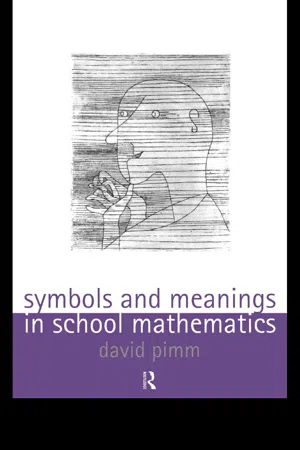
Symbols and Meanings in School Mathematics explores the various uses and aspects of symbols in school mathematics and also examines the notion of mathematical meaning. It is concerned with the power of language which enables us to do mathematics, giving us the ability to name and rename, to transform names and to use names and descriptions to conjure, communicate and control our images. It is in the interplay between language, image and object that mathematics is created and can be communicated to others.
The book also addresses a set of questions of particular relevance to the last decade of the twentieth century, which arise due to the proliferation of machines offering mathematical functioning.
- 234 pages
- English
- ePUB (mobile friendly)
- Available on iOS & Android
eBook - ePub
Symbols and Meanings in School Mathematics
About this book
Information
1
INTRODUCTION
Before anyone can reach spoken speech, he must already have access to meanings or he could retain nothing. No object has a name per se, and the name of an object means only something in the code (the language) that one has accpeted. But an object, name aside, has a meaning of its own, and all of us have had the good sense from our crib and later on, even without speech, to recognize meaning, to gain access to meaning. And once we have a general access to meaning, then we can put different labels on it, and the labels will stick to the meaning. Speech can come only after we have grasped the existence of meanings.
(Gattegno, 1970, pp. 17–18)
I begin with an anecdote. I was visiting friends in America and it had been some years since I had seen them. In the intervening space of time, their daughter, Lynn, had been born: she was now nearly two. My plane was delayed, so I arrived after Lynn was in bed, although she knew I was coming. The next morning, I awoke and, from the next room, I heard Lynn calling: “Mummy, Daddy, David, David, David. David, come here, come here now, I want you”. I was summoned; I could only obey! I went into her room and saw a little girl standing up in her cot, half-excited and half-frightened by my image, an image she had conjured up by the use of language, and by the use of names in particular. Naming gives you a certain power over the external world.
This is a book about mathematics and language. It is the power of language in enabling us to do mathematics which I have chosen to focus on: a power we all share to a greater or lesser extent by having access to the resources of our native tongues. Having recourse to a language affords a power to name and rename, to transform names, to use names and descriptions to conjure, communicate and control our images, our mental worlds. Caleb Gattegno has written: “We live in our images and in this sense there is no reality that is not human” (cited in Beeney et al. 1982, p. 4). Images are also a major part of the stuff of mathematics, and consequently images as well as names will be in focus during the course of this book.
It is in the interplay among and substitution between language (including those designating words that name), image (including illustrative drawings that represent) and thing, between symbol and referent, that mathematics is created and can be communicated to others. The artist René Magritte wrote: “Sometimes the name of an object takes the place of an image. A word can take the place of an object in reality. An image can take the place of a word in a proposition” (cited in Foucault 1983, p. 38). Although not talking specifically about mathematics, he could very well have been. Zoltan Dienes (1963, p. 163) has provocatively claimed: “The process of connecting symbolism to imagery is at the heart of mathematics learning. It can be done by means of ‘cover stories’ or embodiments.” Dienes’ claim seems to imply there is no means by which this fusion can be made directly. We shall see.
But ‘cover stories’, those accounts we tell ourselves and others about what we are doing, as well as physical embodiments (often called ‘manipulatives’ in North America), will also be brought into play, offering vivid mementos and sometimes meaning by embedding accounts of what is to be done in everyday objects and practices. In algebra, talk of apples and oranges among pupils is common. With negative number operations, discussion might involve debits and credits, temperatures, or even time running forwards and backwards. Bob Davis’s ingeniously contrived story of people jumping into (positive) and out of a pool combined with running the film forwards (positive) and backwards as the two operations, does indeed predict that running the film backwards of someone jumping out shows someone jumping in (‘a minus times a minus makes a plus’).
Despite the ingenuity of this account, however, it seems unclear to me whether this adds to a pupil’s understanding or store of meanings for multiplication of negative numbers. It is more as if the vivid story serves as a mnemonic device for recalling (or possibly reconstructing) what happens, rather than explaining or accounting for it.1 These examples make me wonder about the images offered for mathematical processes and the terms in which accounts are given for justifying why certain things are as they are.
Certain images deliberately offered or unwittingly invoked when talking about what we are doing in mathematics can be quite curious. When subtracting, the operation of ‘carrying’ is sometimes talked about in terms of milk bottles and ‘paying back on the doorstep’ or ‘borrowing’ from the ‘next door’ or ‘neighbouring’ column as one might a bowl of sugar. Do these classroom ways of speaking sometimes get the better of us? Why do we continue to use them?
Mathematics educators also make use of cover stories, those conventional terms and language patterns for discussing the teaching andlearning of mathematics in schools. These, too, are worthy of more than a passing glance, though I only do this systematically in the penultimate chapter. But two key terms in this lexicon are unquestionably ‘understanding’ and ‘meaning’.
What we variously understand by ‘understanding’ and mean by ‘meaning’ is far from obvious or clear, despite these being two central terms in any discussion of the learning and teaching of mathematics at whatever level. Understanding can arise from the creative use of language (particularly metaphor), and from images offering sudden illumination. Meaning seems, in part at least, to be more concerned with reference, hence more specific, more local; understanding seems less concerned with such particularities. Yet meaning can also come about from associations and connections (such as that between the last number said when counting and the number of objects in a set, or, going to extremes, the play on words which links ‘pie’ charts to ‘pi’), as well as from a more direct sense of reference, of knowing ‘what the fraction 2/7 refers to’ in some particular context. As the linguist Paul Zipf has claimed: “Meaning is slippery stuff”.
One continuing source of difficulty in learning mathematics comes from confusion of senses of words and other symbols which have particular and (often) variant meanings. Within mathematical language itself, there are questions about the choices of particular words that are conventionally employed. Why do we use the same word, ‘multiplication’, for quite different operations: between whole numbers, between negative numbers, between fractions and between matrices? Why do we call the first three of these ‘numbers’, but not the last?
In many cases, however, confusion has to do with a word having two or more senses in different contexts, and one sense being stronger. There are also instances where the word is similar in sound or spelling to another and gets absorbed into it, despite the meanings having no apparent connection. (If the same word is used in two different settings, it is usually possible to find some connection, over and above the fact that the same word symbol has been used.) Valerie Walkerdine (1982, p. 152) cites the example of a child in an infant class where, when asked what they were doing, replied, “You have to colour all the evil numbers in. First you have to write it up to a hundred and then you colour all the evil numbers in”. Hassler Whitney (1973) has remarked on the closeness of the words ‘fraction’ and ‘fracture’ and suggests a possible sliding connection at the verbal level and a consequent accretion of senses. Many young children will have heard over and over the story of The Gingerbread Boy. This too may contribute to their sense of fraction.
He [the fox] tossed the Gingerbread Boy into the air. The fox opened his mouth and snap went his teeth. ‘Oh dear’, said the little Gingerbread Boy, ‘I am one-quarter gone’. Then he cried, ‘I am half gone’. Then he cried, ‘I am three-quarters gone’. And after that, the little Gingerbread Boy said nothing more, at all.
The connections pupils make in mathematics, when the teacher may only be aware of the customary mathematical sense of a particular word or phrase, can be fascinating. An instance of such connections surfacing came from a class exercise where a researcher invited twelve-year-old pupils with whom he had been working to write about their favourite fraction and to say why (Kieren, 1991). One pupil wrote:
My favourite fraction is 4/5. This is my favourite fraction because it gives me a lot of things to remember. Because there are five people in my family and only four of them are living in my house. My mom is the fifth person. She’s the one that is gone.2
As my title suggests, this book is concerned with various uses and aspects of symbols in school mathematics, and also looks at the notion of mathematical meaning. The opening quotation from Gattegno makes a claim that meanings somehow exist prior to their being named. I have certainly had the experience of being in a foreign country and because I understood the situation could attend to the language to find out how to say what I already knew how to do. Margaret Donaldson’s work (1979) on the greater sophistication of thinking exhibited by young children when offered versions of Piagetian tasks embedded in situations that made what she terms ‘human sense’ is also consonant with this.
However, I additionally wish to explore how names and other symbols can also bring meanings into being, reversing that sense of antecedent priority. At times, the form of the words can give rise to meaning, to understanding, making links across the symbolic gulf in the reverse direction. This is particularly so in mathematics, when the symbols may at the very least mediate our contact with the ‘objects’, and at times provide the primary experience. Stravinsky once insisted that it was words not meanings that he needed, when queried about his use of an obscure Russian poem as a vocal text. Mathematics too can, at times, need symbols not meanings.
The mathematician Rene Thorn (1973, p. 202) has claimed: “The real problem that confronts mathematics teaching is…the development of “meaning”, of the “existence” of mathematical objects”. In addition to looking at the nature and role of symbols in mathematics (of which words form an important part), one general question I shall explore is: what are some of the central sources of mathematical meaning and what roles do symbols play in its generation?
Augmenting this diversity of sources, while being closely allied to it, is therefore the uneasy, complex set of relations (‘the intolerable wrestle’) between mathematical symbols and their meanings. Of all the schoolsubjects, mathematics is the one where the interplay of symbols and meanings is intentionally the loosest. Much creative work is done by means of using the ‘same’ symbol for different things (for instance, the variety of operations that are indicated by ‘×’ and consistently referred to as ‘multiplication’), under the pseudo-implication ‘same word, so same object’. This process, which in psychology goes by the name of condensation, may be variously seen as a source of confusion and conflict or a potential site of richness and powerful connection.
Conversely, but in a similar vein, how can ‘square’ and ‘diamond’ be the same thing: they have different names? Names reveal—they often indicate a stance with respect to the thing named. But names, including number names, can also conceal. Multiplicity of names, often deemed equivalent for our purposes (such as 2(x+1) and 2x+2), is a core phenomenon in mathematics. The belief that ‘a rose by any other name would smell as sweet’ misses a central part of the experience of ‘doing’ mathematics, that of using the variability of name and form as both a thinking tool and a strategic aid: formulae are about forms. By slipping from one form to another we move away from our starting point: displacement, too, is a psychological process, one complementary to condensation.3 Bill Higginson has mentioned to me that to rename is frequently to re-mean, not least because of the connotations that all words and other symbols accrete. And Yves Chevallard (1990, p. 8) has perceptively proposed: “Mathematics is a perfect example on which a celebration of ambiguity could be founded”.
Very early on, we learn to use words. Words are symbols too, whether spoken sounds or written marks, but are frequently so familiar to us as adults that we fail to notice them as symbols. We are so ‘at home’ with them that, as we speak and write, ‘the words don’t get in the way’. Anyone who has struggled to generate expressions or sentences in a foreign language in which they are not very fluent will appreciate the reverse situation. It is said that playwright Samuel Beckett preferred writing in his second language, French, since this forced him into greater precision than using English, his native tongue.
No symbol is truly empty, devoid of connections. To be recognised as a symbol, it needs to have a stable, repeatable form: to function successfully as one, my attention cannot be on how to form it. Italo Calvino (1988, p. 29) writes of the literary value of lightness, claiming of something that “the fuller it is, the less it will be able to fly”. The lightness of symbols allows transformations that the things themselves would discourage or prevent. For instance, I believe if we fail to offer pupils the transformative power of algebra, we prevent them from flying.
Symbols are often contrasted with objects. The actual objects may be a long way away (e.g. the moon), too large or small (e.g. a bacterium) or not physical at all (e.g. an idea, such as a number or a triangle). All of the‘objects’ of mathematics (such as numbers, equations, functions, circles) are not part of the physical world and therefore cannot be directly manipulated physically. Yet mathematics seems to be portrayed as a very active subject, something you do. For instance, we talk about certain individuals being able to ‘handle numbers’, yet how do we ‘manipulate’ numbers in order to perform computations? We symbolise them, either with materials, using Smarties or counters, perhaps Dienes apparatus or Unifix cubes, or by marks on paper, in order that we may see to ‘get our hands on them’.
One linking theme throughout this book, then, is provided by the core metaphor for doing mathematics, that of ‘manipulation’ in its various incarnations. Practical apparatus in North America is known as ‘manipulatives’, some recent computer software is called a ‘symbolic manipulator’. We are taught to manipulate numbers (or is it figures that we actually rearrange—do we actually move anything?), to manipulate algebraic expressions and also, though less commonly, to manipulate geometric figures and images. Lurking behind all this is the negative connotation of ‘manipulation of others’ with its sense of imposition of another’s will and control. There has also been recent unease expressed about the role mathematics can play in ‘formatting’ our society, (see Skovsmose 1992, p. 6) even to the point where discussions of thinking and even rationality itself are conducted in terms of mathematical thought and activity (see Chapter 8).
I shall also be exploring a related set of questions of particular relevance to the last decade of the twentieth century, ones which arise due to the rapidly increasing proliferation of machines offering mathematical functionings. What are some of the new features that symbolic manipulation technology offers us? What new constraints, what new vistas and at what cost—and most interestingly, what new light do such machines throw on age-old discussions of the teaching and learning of mathematics? What new senses, for example, do the terms ‘efficiency’ and ‘automation’ acquire, as well as what new perspective is cast on the question not of ‘what is there to be known?’, but of ‘what is worth knowing?’ in mathematics?
It is becoming clearer daily that the incursion of technology (particularly calculators and computers, and the considerable blurring of boundaries between these two devices) is markedly changing our relation to symbols and operating with/through them. Exploration of issues arising from electronic sy...
Table of contents
- COVER PAGE
- TITLE PAGE
- COPYRIGHT PAGE
- IN ACKNOWLEDGEMENT: NAMING NAMES
- AN IDIOSYNCRATIC PREFACE
- 1: INTRODUCTION
- 2: MANIPULATIVES AS SYMBOLS
- 3: GEOMETRIC IMAGES AND SYMBOLS
- 4: WHAT COUNTS AS A NUMBER?
- 5: ALGEBRA TRANSFORMING
- 6: MAKING REPRESENTATIONS AND INTERPRETATIONS
- 7: SYMBOLS AND MEASURES
- 8: LIVING IN THE MATERIAL WORLD: SYMBOLS IN CONTEXTS
- 9 ON FLUENCY AND UNDERSTANDING
- 10: ON MANIPULATION
- NOTES
- REFERENCES
Trusted by 375,005 students
Access to over 1.5 million titles for a fair monthly price.
Study more efficiently using our study tools.
Frequently asked questions
Yes, you can cancel anytime from the Subscription tab in your account settings on the Perlego website. Your subscription will stay active until the end of your current billing period. Learn how to cancel your subscription
No, books cannot be downloaded as external files, such as PDFs, for use outside of Perlego. However, you can download books within the Perlego app for offline reading on mobile or tablet. Learn how to download books offline
Perlego offers two plans: Essential and Complete
- Essential is ideal for learners and professionals who enjoy exploring a wide range of subjects. Access the Essential Library with 800,000+ trusted titles and best-sellers across business, personal growth, and the humanities. Includes unlimited reading time and Standard Read Aloud voice.
- Complete: Perfect for advanced learners and researchers needing full, unrestricted access. Unlock 1.5M+ books across hundreds of subjects, including academic and specialized titles. The Complete Plan also includes advanced features like Premium Read Aloud and Research Assistant.
We are an online textbook subscription service, where you can get access to an entire online library for less than the price of a single book per month. With over 1.5 million books across 990+ topics, we’ve got you covered! Learn about our mission
Look out for the read-aloud symbol on your next book to see if you can listen to it. The read-aloud tool reads text aloud for you, highlighting the text as it is being read. You can pause it, speed it up and slow it down. Learn more about Read Aloud
Yes! You can use the Perlego app on both iOS and Android devices to read anytime, anywhere — even offline. Perfect for commutes or when you’re on the go.
Please note we cannot support devices running on iOS 13 and Android 7 or earlier. Learn more about using the app
Please note we cannot support devices running on iOS 13 and Android 7 or earlier. Learn more about using the app
Yes, you can access Symbols and Meanings in School Mathematics by David Pimm in PDF and/or ePUB format, as well as other popular books in Education & Education General. We have over 1.5 million books available in our catalogue for you to explore.