- 288 pages
- English
- ePUB (mobile friendly)
- Available on iOS & Android
eBook - ePub
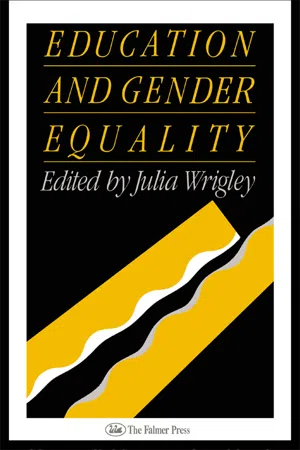
Education and Gender Equality
About this book
First Published in 1992. This book grew out of a special issue of the journal Sociology of Education. There is no simple relation between education and gender equality. As with social class relations, schools both reinforce subordination and create new possibilities for liberation, and these contradictions occur at every level and in every aspect of education. Schools are sites of pervasive gender socialization, but they offer girls a chance to use their brains and develop their skills. To explore education and gender is to examine the bridge between the public world of occupations and the private world of families. Schools link the families from which young children come and the sex- and race-segregated occupational worlds to which they are sent. Because schools link public and private worlds, help to form consciousness, and structure inequalities, there are many ways to look at gender and education. In this book, the chapters break into four major topic areas. The first section analyzes gender and education from a comparative and historical perspective, the second section on 'Diversity, Social Control, and Resistance in Classrooms', third section, on 'Gender and Knowledge' and the final section on 'families and school'.
Information
Section 1
Gender, the State, and Education
1
Gender and Education in the Welfare State
Julia Wrigley
In varying degrees, Western industrial societies have developed social welfare programs which protect citizens over the life course. All provide pensions for the aged, income protection for the unemployed, and some form of assistance for impoverished families with children. With the exception of the United States, they also provide national health care systems or insurance. This vast expansion of the state role means that gender relations no longer play themselves out mainly within family and market contexts. State social policy is shaped by gender assumptions and in turn affects women’s degree of social and economic independence from men. Feminists have argued that programs have often been designed which reinforce women’s subordination and, while feminist writers differ greatly among themselves, they have developed a critique both of social welfare policy and of scholarship about it (Nelson 1990; Linda Gordon 1990). It is my purpose in this chapter to extend the analysis to gender and social policy in the educational sphere.
Feminist writers on both sides of the Atlantic have criticized the vast literature on the welfare state for ignoring gender in the shaping of social provision (Linda Gordon 1990; Sapiro 1990). Theorists have long debated the role of social class in accounting for the different trajectories of welfare state development, but most paid no attention to gender. They did not focus on the frequent division of social welfare payments into what has been called a ‘male channel’ and a ‘female channel’, with men receiving more generous benefits than women (Nelson 1990). To the feminist writers, this is not a small or accidental feature of social welfare programs, but goes to their heart. The ‘family wage’ ideology, the notion that a male worker should receive enough to support a dependent wife and children, not only governed trade union strategy but also helped account for the scope and form of government benefit programs. Women have received benefits based on family status rather than based on a concept of earned right, such as applied to male workers (Quadagno 1990). Virginia Sapiro puts the point succinctly: ‘Most social policy aimed at women has been designed explicitly to benefit them in their capacity as wives and mothers and more particularly, to benefit those who depend upon them for nurturance and domestic service: husbands, children, and elderly relatives’ (1990, p. 45). When women and their dependents lacked the support of a male breadwinner, they could turn to aid from the state. While countries differ in their social provision, most have not allowed women sufficient income or freedom to become independent of paternalistic authority, whether that authority has been exercised by individual men or by state agencies.
Those stressing gender have made many astute observations about government social policy. They have pointed out that men have not only received more generous benefits than women, but have generally experienced less bureaucratic harassment in the social welfare system. Men seldom face moral tests of their character, as women receiving public assistance often do. Women on welfare have had to endure government surveillance and intrusion, while men receiving unemployment insurance have not expected administrators to pry into their personal lives. Critics have pointed out that it is not ‘gender neutral’ to tie benefit programs to jobs, as men have had privileged access to the most secure and best-paying jobs. They have also noted that programs primarily serving women and children have more often been means-tested than those programs more geared to men. Further, in the United States, Social Security, the premier social welfare program, operates on a national basis and with national standards, while programs with a more heavily female constituency tend to be operated on state and local bases. Local administration allows for pronounced expression of racial and gender biases and for widely varying levels of provision (Abramovitz 1988).
The differences between male and female benefits can in part be quantified: on average, for example, women receive only two-thirds the old age insurance received by men (Quadagno 1990, p. 14). Beyond this, there are qualitative differences in the treatment experienced by men and women. It adds up to a pattern of profound gender bias in state social provision. It should be noted that the feminist analysis is itself not fully developed. Some feminists and social theorists have a straightforward social control theory, seeing expanded welfare services as coopting recipients and fragmenting the working class along lines of race, class, and gender. Others contend that public programs have operated overall to expand women’s opportunities and to reduce their dependence on individual men. Women have also gained from their extensive employment in the public sphere (Piven 1990). These authors challenge the notion that expanded social provision has reduced women’s power (Pascall 1986).
Many questions need to be answered about how social class and race fit in with a gender-based analysis. With stable jobs being the key to receiving good benefits, men as well as women have suffered from benefit limitations and exclusions. The racial biases in the US social welfare system have been glaringly evident, with a conservative Southern white elite historically keeping a stranglehold over benefits for black men and women in order to preserve a low-wage labor force (Amott 1990). Some analysts try to integrate race and gender in their discussions of social welfare programs (e.g., Quadagno 1990; Mink 1990; Piven 1990) and many also recognize the social class aspects of benefit differences. On the whole, though, the interplay of race, class, and gender factors has undoubtedly been more complex than has been captured by either traditional writers on the welfare state or by feminist critics.
In the large literature on the welfare state, most authors discuss pensions, family assistance programs, unemployment insurance, and other types of income transfer mechanisms. As one notes, ‘By convention, in the United States welfare policy consists of those public programs providing money, goods in kind, or services that are made available to offset regularly occurring events outside the control of individuals’ (Nelson 1990, p. 126). Education does not fit within this definition, yet in a larger sense education can be considered a social welfare pro gram. It is, at least, as Barbara Nelson puts it, one of the ‘flanking subsystems’ of welfare policies (1990, p. 127). Government entry into the educational sphere and the establishment of income transfer programs both represent major expansions of state roles in ways that profoundly affect the welfare of individual citizens. In the one case, income transfer programs help safeguard living standards over the life cycle; in the other, education helps govern individuals’ chances for jobs, their places in the marriage market (Mare 1991), and their economic rewards. The transition of states from ‘night watchman’ roles to broad social ones has involved proactive policies in the educational sector as well as in narrower kinds of social welfare provision.
In the United States, the major social policy initiatives of state and local governments prior to the 1930s involved commitment to mass public education (Weir, Orloff and Skocpol 1988a, p. 6). These initiatives gave a distinctive cast to American policy development; in Germany, government commitment to social security programs predated expansion of the educational system by several decades, while in the United States the reverse held true (Heidenheimer 1981, p. 295). Analysts have suggested that governments in effect made choices between fostering educational entitlement and social security entitlement (Kaelbe 1981; Heidenheimer 1981). By the 1960s, the United States and Western European countries had developed rather more similar policy profiles, as education expanded in Europe and social welfare programs became more extensive and inclusive in the United States. Debates over why governments began investing heavily in education parallel debates over why they established old age pensions and unemployment insurance. In each case, some argue that these programs have primarily served the purposes of state-building elites, while others have contended that they arose in response to working-class pressure.
In this chapter, I will suggest that there are analytic parallels to be drawn between gender biases in the educational and social welfare systems. While feminists have written a great deal on gender discrimination in schools, they have focused on classroom practices, textbook biases, and the gender values of teachers; M. Sadker, D. Sadker and Klein (1991) provide an excellent review of this literature. This research has sensitized us to the many subtle and not-so-subtle ways girls get messages of subordination, and to issues of feminist pedagogy (see Gardner, Dean and McKaig, this volume), but it has paid less attention to larger structural inequalities and how they affect women’s education. While theorists have developed broad arguments about how race and class interact to affect children’s educational prospects (Ogbu 1978), feminist work has been narrower. In connecting gender inequality in education to the new and rapidly expanding literature on gender inequality in state programs, we can go further in developing a structural view of how inequalities between men and women arise and are maintained.
In this chapter, I shall outline main elements in the feminist analysis of gender-based social welfare provision, and shall assess the extent to which these apply in the educational sector. While those who study gender and the welfare state vary in their emphases, there are some common points in their work. Typically, they stress disparities in state resources received by men and women, with women receiving fewer resources and more moral scrutiny than men. They argue that tying benefits to work history privileges men and assumes women’s dependence. They also analyze how women’s caregiving work has restricted their labor market opportunity and attendant social welfare benefits. Several such writers have stressed how women have played central roles in staffing and reforming social welfare programs (Piven 1990; Sapiro 1990). I shall take up each of these points in regard to gender and the educational system. The chapter will conclude with a discussion of possible changes in the importance of gender as an axis of educational inequality. Throughout, I shall draw upon the work of contributors to this volume, showing how their work, diverse as it is in method and theme, clarifies many different aspects of the relation between gender, education, and state policy.
State Provision and Gender Bias in Education
The US social welfare system rests on a mixture of public and private resources. The Scandinavian social democracies have created social welfare systems designed to protect people from the vagaries of the market, but the United States has followed a quite different path. Social welfare programs are designed to strengthen, not undermine or replace, the market (Esping-Andersen 1990). Those with good jobs rely on private pensions and private health insurance to augment limited government benefits. For the average wage earner, Social Security payments replace only about two-fifths of preretirement income, necessitating private supplement for those wanting to preserve their living standards (Rosenbaum 1991, p. A10).1 The social welfare system’s orientation toward the market has been particularly damaging to women and to minorities; their labor market disadvantages are compounded because benefits are tied to jobs. They receive lower government benefits than those with steady, high-paying work; they also generate fewer private resources with which to supplement their public benefits.
In addition to their liabilities in the social welfare system, women have suffered disadvantages in state educational provision. These disadvantages arise at every level of schooling, although they are most pronounced at the point where education becomes relevant for occupational preparation (Pascall 1986, p. 115). The different likely occupational destinies of males and females have historically served as warrants for their different treatment (and unequal receipt of state resources) in the educational system, whether in high school up through the mid-twentieth century or in college during the postwar era. The sex-segregated labor market helps produce gender-defined schooling.
There are many ways in which state resources can be distributed unequally in the educational system. Inequalities accepted as politically legitimate in one era can become suspect in another, generally through political mobilization of those being shortchanged. The maintenance of racially segregated school systems in the South facilitated unequal spending on black and white students; in the North, as ghettoization intensified in big cities, resource disparities between black and white schools increased (Homel 1984). In the United States, schools have been segregated much more frequently by race than by gender, which made it hard to provide grossly unequal resources for the sexes as was done for the races. In a comprehensive study of coeducation in American schools, Tyack and Hansot argue that, throughout its educational history, the United States has been conspicuous for the widespread gender equality to be found in its public schools (1990). Boys and girls usually attended the same schools, worked from the same books, and had the same teachers. Children’s shared educational experiences limited sex-based spending disparities.
Coeducation undoubtedly constrained public authorities, but expenditure disparities did exist and they were important. They were most pronounced in school vocational and sports programs. In the early 1900s, high school vocational education programs were almost entirely sex segregated. Training for skilled trades was reserved for boys, while girls took courses in home economics or garment work (Tyack and Hansot 1990, p. 210). African- American girls fared even worse than white girls; schools often trained them to be servants or laundry workers. Such courses were cheap for school districts to run, no expensive equipment was required, and schools made only minimal investment in instruction.
Girls gained no occupational advantage from home economics courses, but business courses prepared them for jobs in the expanding white-collar sector. High school education mattered more for girls than it did for boys (Carter and Prus 1982). Employers invested in boys’ on-the-job training, while girls applying for clerical jobs were expected to arrive with skills. This explains why many more girls than boys stayed in high school, even at the cost of foregone wages. They (and their families) had to bear the cost of their skill development. Girls got an economic payoff from commercial courses, but school districts did not have to spend heavily on girls’ training. Tyack and Hansot note that ‘The most popular subjects—bookkeeping, shorthand, and typing—were relatively cheap and easy to start up’ (1990, p. 214). Many girls and their families also invested in private commercial courses, paying from their own resources for occupational training that boys could expect to receive on the job.
Schools spent more on boys outside as well as inside the classroom, most particularly on sports programs. Competitive school sports teams took root in America’s schools in the first several decades of the 1900s. They bound local communities to the schools and created a male sports culture. Girls remained on the sidelines, cheering on male athletes. The passage of Title IX of the 1972 Education Amendments, which required schools to equalize ...
Table of contents
- Cover Page
- Title Page
- Copyright Page
- Preface
- Section 1: Gender, the State, and Education
- Section 2: Diversity, Social Control, and Resistance in Classrooms
- Section 3: Gender and Knowledge
- Section 4: Families and Schools
- Notes on Contributors
Trusted by 375,005 students
Access to over 1.5 million titles for a fair monthly price.
Study more efficiently using our study tools.
Frequently asked questions
Yes, you can cancel anytime from the Subscription tab in your account settings on the Perlego website. Your subscription will stay active until the end of your current billing period. Learn how to cancel your subscription
No, books cannot be downloaded as external files, such as PDFs, for use outside of Perlego. However, you can download books within the Perlego app for offline reading on mobile or tablet. Learn how to download books offline
Perlego offers two plans: Essential and Complete
- Essential is ideal for learners and professionals who enjoy exploring a wide range of subjects. Access the Essential Library with 800,000+ trusted titles and best-sellers across business, personal growth, and the humanities. Includes unlimited reading time and Standard Read Aloud voice.
- Complete: Perfect for advanced learners and researchers needing full, unrestricted access. Unlock 1.5M+ books across hundreds of subjects, including academic and specialized titles. The Complete Plan also includes advanced features like Premium Read Aloud and Research Assistant.
We are an online textbook subscription service, where you can get access to an entire online library for less than the price of a single book per month. With over 1.5 million books across 990+ topics, we’ve got you covered! Learn about our mission
Look out for the read-aloud symbol on your next book to see if you can listen to it. The read-aloud tool reads text aloud for you, highlighting the text as it is being read. You can pause it, speed it up and slow it down. Learn more about Read Aloud
Yes! You can use the Perlego app on both iOS and Android devices to read anytime, anywhere — even offline. Perfect for commutes or when you’re on the go.
Please note we cannot support devices running on iOS 13 and Android 7 or earlier. Learn more about using the app
Please note we cannot support devices running on iOS 13 and Android 7 or earlier. Learn more about using the app
Yes, you can access Education and Gender Equality by Julia Wrigley in PDF and/or ePUB format, as well as other popular books in Education & Education General. We have over 1.5 million books available in our catalogue for you to explore.