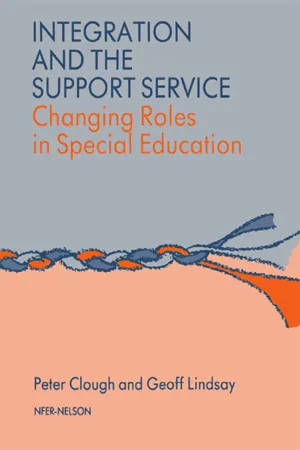
The integration of children with special needs into mainstream schools demands a reorganisation of staff and support levels both in schools and in the advisory services. Integration and the Support Service, illustrated with examples from a detailed case study of one Local Education Authority, shows how support services can most effectively be matched to needs and how new strategies for integration can be developed.
eBook - ePub
Integration and the Support Service
Changing Roles in Special Education
- 174 pages
- English
- ePUB (mobile friendly)
- Available on iOS & Android
eBook - ePub
Integration and the Support Service
Changing Roles in Special Education
About this book
Information
Topic
DidatticaSubtopic
Didattica generaleChapter 1
The Supportive Principle
‘Support’ is now a commonplace term in providing for learners with special educational needs (SEN): support for both pupils and their teachers by staff from within and without the school. The principle behind supportive structures established at school and local education authority (LEA) levels is that, whatever their difficulties, all learners should participate as far as possible in the mainstream of ‘ordinary’ school culture and curricula; this is their entitlement, and supportive education is about organizing help appropriate to the special needs of those learners and, indeed, appropriate to the needs of their ‘regular’ teachers. In this sense, the supportive principle calls for the removal of all sorts of barriers to education in the classroom and the school—instead of removing the children themselvs.
In this book we are specifically concerned with the role within this broad initiative of the support service, and this chapter considers how such a service can develop an accountable structure for working with schools that is responsive to particular school needs, and yet provocative of new developments. It discusses some of the difficulties that face these innovations, tracing those difficulties to the traditions of practice that have determined current organization, and highlighting the ideology of the 1981 Education Act (GB.DES, 1981) as a new principle of organization.
Constructions of Special Educational Need
How do support teachers and services know what to do when they go into school? How do they know what the school wants? How do they set about delivering what is wanted, particularly if it is not in their immediate repertoire? How do they know if what they have done is acceptable? How do they know what to do next?
Behind every decision made in response to a special educational need, there lie traditions of practice that more or less evidently affect the processes and outcomes of that action. How the individual teacher, the department, the school and the LEA construct and respond to a problem situation is determined by the habits of interpretation characteristic to each of them at their different levels in the overall structure. The sum of these constructions of SEN—whether they operate at the individual or the LEA level—makes up a particular special educational needs community.
This is also a community with wide and diverse views on what SEN are, and on how they should be dealt with, and not all these views are made explicit as statements. They are more likely to be inferred from particular organizational structures: this LEA has closed all its special schools, while that one is actually still building them; this school has a rigidly structured remedial department, while that one has a subject-based learning resource team, and so on. But in each case, and at every level, these responses to difficulty or disability express, if only implicitly, a particular construction of special educational needs.
For a support service, this range of interpretations may make an equally broad range of demands on its resources; different schools may want different things from the service, according to the dominant construction of special educational needs within the school. How the school sees its problems and needs, and how it has typically been organized to meet them in the past will condition the demands made on an external support service.
However, the support service itself operates as an equally important conditioner of the school’s demand. In the interaction between the school and the support service, the school is constrained in the demand it makes not only by its own construction of the problems, but by what it perceives as being on offer from the service; and in the same way the service is limited both by its own resources and by the degrees of flexiblity it perceives in the school. To a large extent, what the support teacher decides to do will be determined by traditions of practice that in turn quickly suggest a course of action. The teacher’s own experience and the school’s familiar system collude—often inexplicitly—to select a technique from a range of possibilities. In this way the school and the support service find themselves in a potentially dynamic interaction attempting to match resource to demand within the limits of their perceived established practice.
But this dynamism is often only potential; for the action a support service can take arises from a repertoire of habitual contact with the school. More frequently, the habitual interactions between the school and the support service serve to delimit the options open in any given instance; thus a school that has typically used its fortnightly visiting support teacher in one particular way—say, for intensive reading work with whichever child appeared to need it at that time—is, in the normal run of things, unlikely to ask for anything else, nor is the support teacher very likely to offer other alternatives. In this way a mutually validating and often harmonious practice becomes a tradition.
In the old dispensation, remedial departments and support services were made for each other in this rather obvious way. The prevalent construction of learning difficulty that they shared saw a deficit in the child as the organizing principle of their relationship. This construction concentrated largely on reading difficulty as the source of school failure, and saw remedial action on the child—rather than on his or her environment—as the only appropriate solution. Thus problems became largely technical ones, in the sense that they called for special techniques (which were readily, if unwittingly, legitimated by educational psychological services—themselves effectively organized by a theory of child-deficit) (Clough, 1988).
This easy characterization of a learning difficulty being independent of its learning context thus created a technical solution for specific problems; for the problems come as it were with their solution implicit, or at least with some outline or guarantee of a remedial response already implicit in their diagnosis. We take for granted that technical solutions are available for technically identified problems; it is ultimately a question of running through the repertoire until the appropriate one is found. And in this way the system of referral characteristic of special education is created, as children appear to call for ever more specialized techniques. Thus Dessent has written:
Whatever else education involves it is first and foremost an administrative and organisational system whereby one group of professionals are invested with responsibility for handicapped and ‘difficult-to-teach’ children. At the same time other groups are absolved from such responsibility. Special education has come to be described and justified…in terms of its small teaching groups, special curricula, expertise and methods, but its historical roots lie in the need to remove responsibility for teaching children with special needs from class teachers in normal schools. (Dessent, 1983, p. 90)
Remedial support services have in the past played an important role in this process, often validating through their support the tendency of schools to separate their ‘difficult-to-teach’ children.
As is well documented elsewhere (see Gross and Gipps, 1987; Moses et al., 1988; etc.), this situation changed greatly, often radically, over the 1980s, and has done so increasingly as ‘new’ constructions of special educational need have emerged in keeping with the spirit of the 1981 legislation. At the centre of the Act is a view of SEN as relative phenomena—specific events tied to particular learning environments rather than enduring conditions reflecting stable abilities and disabilities. The perceived source of difficulty is moved outside of the learner’s head, as it were, to his or her learning environment; while action on those difficulties moves correspondingly from the child to the curriculum against which those difficulties are noticeable. As Wedell (1985) puts it:
The concept of special educational need is a relative one, and need is seen as the outcome of the interaction between the resources and deficiencies of the child, and the resources and deficiencies of his [sic] environment.
Such a shift in construction has obviously made many, often threatening, demands on schools and teachers and, not least, on traditionally organized support services.
Supporting change
The changes which LEAs are occupied with in this way are very complex, and they depend as much on the education of attitudes as on structural rearrangement. While this must be true for all changes, it is of particular importance in the realization of the 1981 Act that in its strongest spirit seeks to shift the whole axis of our understanding of special educational needs; the structural changes it entails are minor by comparison. The structures of organization for learning difficulty and ‘failure’ reflect and reproduce attitudes that are part of a much larger, and even more deeply sedimented, tradition of social order and organization. The task of redefinition of special education is as much a social as an educational one.
Change itself does not happen simply, immediately and unilaterally, but is a much more awkward, less predictable and often painful affair. For the ‘old’ constructions are embedded deeply in how schools and support services alike typically operate and how they are organized in traditions of practice. Insights are often espoused as functions of policy by LEA members and officers who are relatively ignorant not so much of the facts of school practice as of the attitudes and experiences which lie tacitly at the heart of those practices. In any event, they will not themselves be direct agents of change; this role is likely to fall to advisers and advisory teachers, perhaps to agencies such as the Schools’ Psychological Service, and certainly to the support services themselves.
In any LEA reorganizing in this way, the support service is central to these changes, and has a peculiarly complex task. It must both step outside of its own tradition of practice, and persuade others in school to do the same. It must at once educate itself in a new way of working, and schools into different expectations. This is essentially an experimental role, and one concerned with mutual redefinition.
The nature of the task
At the beginning of this chapter, we outlined some of the historical conditions which lie behind the operation of a support service, emphasizing particularly the ‘deficit’ model of learning (which was usually reading) difficulty which led to a characteristic role for support teachers. Moses et al. (1988) provide a sketch of the features typical of these services before the redefinitions of the Warnock Report (GB.DES, 1978) and the 1981 legislation, and the reorganization that followed them. These are:
• the concentration was exclusively, or at least predominantly, upon reading problems;
• the service was principally for primary schools;
• most, if not all, staff of the service taught children with reading problems directly, usually in small groups but sometimes individually;
• children were withdrawn from the classroom for this extra help, which was usually given within the school but sometimes at a separate reading centre. (Moses et al., 1988, p. 74)
In a similar summary of broadly corresponding changes to support services for students with learning difficulties in ordinary schools, they point out that:
the teacher is now a client of the service as well as [is] the pupil; there is a greater orientation towards offering help in the classroom as opposed to withdrawing pupils from it; and a wider range of special [educational] needs than simply reading difficulties are being dealt with, (ibid., p. 84)
The purpose of this section is to consider these shifts in practice as they affect and are affected by the support team itself: What traditions determine its role? How can it develop its options? What are the problems in such developments?
Ten years ago teachers entering a support service for students with learning difficulties knew what to expect, and what was expected of them; they were essentially reading specialists—organizationally located somewhere towards the end of Dessent’s line of referred responsibility (see above)—brought in to attend to the special problems of literacy that teachers and their schools could not cope with in the ordinary run of things. Being specialists, they brought with them their battery of instruments: technical devices for assessing, diagnosing and remediating technically identified difficulties. These both justified their presence and created a professional divide between the school and the support teachers. The ‘teams’ in which they were organized were largely administrative units through which particular support teachers were assigned to particular schools; their tasks were given with the assignment. These tactical responses were characterized by Golby and Gulliver (1979) as an ‘ambulance service’; the strategy they thus served was an offensive on individual failure.
Golby and Gulliver’s paper was among the first signals of a change in direction for learning support. ‘Whose remedies, whose ills?’—as it was called—directed attention explicity to the curriculum as both a source of, and a means of meeting, individual difficulties. There have been various developments of this argument (for example, Swann, 1983; Widlake, 1984; Clough and Thompson, 1987) but the central thesis is a common one: look only slightly beyond the presenting difficulty—the thesis goes—and you will see features of the curriculum closely, and sometimes causally correlated with those problems. As Widlake puts it:
When ‘normal’ individuals show an inability to learn in school, yet are perfectly capable of learning in other situations, one should be driven to consider what aspects of the society are creating negative attitudes…any regime which concentrates on their difficulties and ignores their reactions to the turmoil around them is unlikely to be effective, even if feasible. (Widlake, 1984, p. 13)
The focus of activity of the last ten years has thus moved towards ‘the turmoil’; moved, that is, to the curriculum and to the significance of instances of ‘failure’ as responses to that curriculum.
The Options for Reorganization
The ‘new’ support service has its orgins in these ideological developments and its new activities can be seen to express a change in the climate of educational thinking. As they were generally constituted before the 1981 Education Act, the support services had a key role in maintaining the model of institutional segregation as they strove to contain low-achieving children within mainstream education. The growing dissatisfaction with this distinction, and the growing evidence of its arbitrary educational and moral basis, threw into question the role of a service inherently involved in ever-presenting individual difficulties unrelated to their broader curricular context. New opportunities for support services follow immediately after blurring of the distinctions between ‘ordinary’, ‘remedial’ and ‘special’ education; the sort of activities that are becoming characteristic of the redefined support services are natural expressions of the redefinitions of learning difficulty and special educational need.
Three interrelated features of the 1981 legislation are particularly relevant. Firstly, the abolition of the statutory categories of handicap, and their replacement with the relative notion of learning difficulties; secondly, the requirement to integrate students with learning difficulties as far as possible within mainstream settings; and thirdly, the recognition of the curriculum as a context for understanding and meeting special educational needs. In each case these elements of policy lead directly to the practical roles which we see emerging in the new support services. Thus the new tasks of the support service are to provide help not so much for individual students as for the institutions and staff involved in realising these changes.
The options available for developing support services in this spirit are not new in themselves; what is novel, however, is the emphasis which is placed on their relative importance. The axes in Figures 1.1 represent the twin continua of the nature and the focus of support se...
Table of contents
- Cover
- Halftitle
- Title
- Copyright
- Contents
- List of Tables and Figures
- Preface
- Acknowledgements
- Chapter 1 The Supportive Principle
- Chapter 2 City LEA Integration Support Service
- Chapter 3 Developing the Support Team
- Chapter 4 Gathering Information
- Chapter 5 The Coordination of Services
- Chapter 6 Contracts for Change
- Chapter 7 Providing INSET
- Chapter 8 Direct Teaching
- Chapter 9 Support Assistants
- Chapter 10 City Integration Support Service in Action
- Chapter 11 Attitudes to Integration and Support
- Chapter 12 Looking Forward to Supportive Education in the 1990s
- References
- Subject Index
- Author Index
Trusted by 375,005 students
Access to over 1.5 million titles for a fair monthly price.
Study more efficiently using our study tools.
Frequently asked questions
Yes, you can cancel anytime from the Subscription tab in your account settings on the Perlego website. Your subscription will stay active until the end of your current billing period. Learn how to cancel your subscription
No, books cannot be downloaded as external files, such as PDFs, for use outside of Perlego. However, you can download books within the Perlego app for offline reading on mobile or tablet. Learn how to download books offline
Perlego offers two plans: Essential and Complete
- Essential is ideal for learners and professionals who enjoy exploring a wide range of subjects. Access the Essential Library with 800,000+ trusted titles and best-sellers across business, personal growth, and the humanities. Includes unlimited reading time and Standard Read Aloud voice.
- Complete: Perfect for advanced learners and researchers needing full, unrestricted access. Unlock 1.5M+ books across hundreds of subjects, including academic and specialized titles. The Complete Plan also includes advanced features like Premium Read Aloud and Research Assistant.
We are an online textbook subscription service, where you can get access to an entire online library for less than the price of a single book per month. With over 1.5 million books across 990+ topics, we’ve got you covered! Learn about our mission
Look out for the read-aloud symbol on your next book to see if you can listen to it. The read-aloud tool reads text aloud for you, highlighting the text as it is being read. You can pause it, speed it up and slow it down. Learn more about Read Aloud
Yes! You can use the Perlego app on both iOS and Android devices to read anytime, anywhere — even offline. Perfect for commutes or when you’re on the go.
Please note we cannot support devices running on iOS 13 and Android 7 or earlier. Learn more about using the app
Please note we cannot support devices running on iOS 13 and Android 7 or earlier. Learn more about using the app
Yes, you can access Integration and the Support Service by Dr Peter Clough,Peter Clough,Geoff Lindsay in PDF and/or ePUB format, as well as other popular books in Didattica & Didattica generale. We have over 1.5 million books available in our catalogue for you to explore.