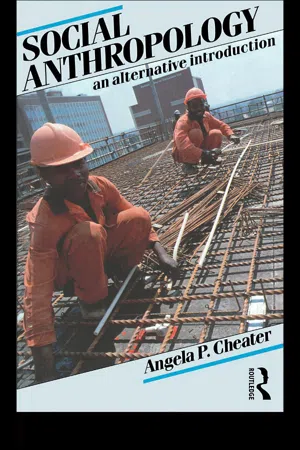
An introduction to the central concerns of social anthropology, presenting an alternative to standard texts. More concerned with the life-worlds of underdevelopment than the primitive or the exotic, it draws on material which evokes current problems of policy and administration in the Third World. The author raises questions of vital importance to contemporary investigation and analysis, and pointers to the future for anthropology.
- 312 pages
- English
- ePUB (mobile friendly)
- Available on iOS & Android
eBook - ePub
About this book
Information
1
Theoretical Underpinnings
The birth of a discipline
Anthropology was born in the nineteenth century. In France and the UK its original designation was ‘ethnology’, as in the Société Ethnologique de Paris (founded in 1839) and the Ethnological Society of London (dating from 1843). ‘Anthropology’, until the 1870s, referred more narrowly to what is today called physical anthropology, but with the formation of the (Royal) Anthropological Institute of Great Britain and Ireland in 1871, this name replaced the older ‘ethnology’. It was under the name ‘anthropology’ that the first formal teaching in this discipline began at Oxford University in 1884, with the first (honorary) British chair of anthropology being created at the University of Liverpool in 1908, to which Sir James George Frazer was appointed.
The Greek roots of anthropology (‘anthropos’ and logos’) suggest that it is ‘the study of man’. However, this transliteration is too broad to be useful as an academic definition: many university disciplines study man in one way or another. We might therefore go back to its eighteenth-century precursors to pin down more carefully what anthropology is and does. During this period of the European ‘enlightenment’, there was a widespread concern to explain, as Europe learned more about the rest of the world, why other people and other societies were not the same as those of Europe. Europeans were of course aware of their own internal differences from one another, but these were minor compared to the descriptions of, say, China emanating from Marco Polo and the Jesuits, or of the South Seas coming from Captain Cook, of Africa as experienced by Portuguese missionaries, or of the Americas seen through the eyes of the Spanish explorers and conquistadors. These large cultural differences were seen, by European intellectuals, as problematic, to be explained rather than merely accepted.
Eighteenth-century European explanations for these cultural differences ranged very widely between the romantic view associated especially with Rousseau that ‘the noble savage’ could be equated in Christian theology with man before Adam’s fall from grace, and the Hobbesian characterisation of savage life as ‘solitary, poor, nasty, brutish, and short’ by comparison with that of Europe. The romantics lost the fight to those who believed that Europe had experienced ‘progress’ through the changes that had built on the early Greek and Roman social foundations. These changes were seen to be cumulative and beneficial in many different spheres—technological, economic, legal, political. It is in this eighteenth-century notion of ‘progess’, then, that we find the origin of European ethnocentrism, which became reflected later, in the nineteenth century, in schemas of societal evolution which always placed contemporary European practice at the most advanced level. Although Darwin’s views on biological evolution undoubtedly influenced social thinkers in the nineteenth century, it is important to note that evolutionary schemas pertaining to society (such as Comte’s (1853) view that all knowledge advanced from theological to metaphysical assumptions before becoming ‘positivist’ in its search for causal regularity) were floated long before The Origin of Species was published in 1859.
Evolutionary perspectives
In reality, then, evolutionary perspectives in anthropology perhaps date back to the eighteenth-century French social philosophers such as Montesquieu, Condorcet and Rousseau, rather than to Darwin’s ideas which were contemporaneous with the emergence of anthropology under that name. Evolutionary ideas have changed considerably in the intervening years, but still inform other approaches, even when they are not—as they sometimes are—espoused as theories in their own right. No anthropologist today attempts to reconstruct social history with reference either to items of material culture such as pottery, or to social institutions such as marriage. However, the notion of stages of development, ordered in an evolutionary sequence, is still important to Marxism, while Radcliffe-Brown (1957, 1958), the founder of ‘structural-functionalism’, was at his death still trying to construct a model of social change within an evolutionary framework. Malinowski (1944), who is normally remembered as the arch-functionalist who publicly demolished the ‘diffusionist’ thinking which, for a while, succeeded evolutionism in anthropology, was nonetheless in sympathy with many of the basic evolutionist ideas of Frazer. And in the twentieth century, there have also been Americans, such as Leslie White and Julian Steward, who have tried to construct ‘neoevolutionist’ models of societal development on the basis of more sophisticated indicators, such as energy usage. The idea of evolution, based on the older notion of ‘progress’, remains a powerful influence on anthropological theory generally.
Evolution, as a technical concept, comprises two fundamental aspects: the ideas that a common form becomes differentiated, and that a simple form becomes more complex. These twin notions of differentiation and increasing complexity underlie all anthropological applications of evolutionary reasoning, including those of the nineteenth century. Technological differentiation and complexity, for example, were the criteria used to distinguish ‘savage’ from ‘barbarous’ culture (and both from ‘civilisation’), ‘barbarians’ having discovered the techniques of pottery and metallurgy while remaining illiterate. Lewis Henry Morgan (1871), the ‘father’ of American cultural anthropology, who influenced Frederick Engels’ views on the family, traced the increasing complexity of sexual and family relationships from promiscuity, through 15 stages of group marriage and polygamy, to monogamy. Patriliny (the system of tracing relationships through men) was thought, by McLennan (1865), to have developed, via polyandry (the marriage of one woman to a number of men), from matriliny (where descent is traced through women), which in turn had emerged from pristine promiscuity via female infanticide and exogamy (which caused men to seek women from groups other than their own). Maine (1861) argued that legal systems based on contracts between individuals reflected greater social variety and complexity than systems which fixed the individual’s rights in law on the basis of his or her prior status in respect of age, sex or kinship. Enhanced knowledge, leading to better control of the environment, was used by Frazer (1890) to explain why, having failed to manipulate the physical world through magical means, people turned to the religious postulate that unseen suprahuman forces controlled this physical world; and also why, when their knowledge of the physical world increased still further through the development of science, religion lost at least some of its attraction.
The difficulty with many if not all of these arguments is that they arguably tell us more about the thought processes of their proponents than about the evolution of society. Particularly where such arguments were based on logical thought from the comfort of an armchair in an intellectual’s study, rather than on direct observation of what happened in other societies, we should be suspicious of their relevance to reallife. These and otherevolutionary schemas have been characterised as ‘intellectualist’ rather than ‘empiricist’ in their orientation. A prominent twentieth-century anthropologist, Radcliffe-Brown (as reported in Gluckman (1965:2)), alleged that their authors should be compared to the American farmer who, having found his paddock empty, ambled to the gate, chewing grass, and asked himself ‘Now, if I were that horse, where would I have gone?’ Yet there is a problem with this criticism, for anthropologists do in fact try, along with some other social scientists, to place themselves in the position of those they study, in order to understand empirically as well as intellectually what life is like from a different perspective. That is what ‘participant observation’ is all about. That is why anthropologists do fieldwork in the Malinowskian tradition. But the current mix of logic and empiricism in anthropology was achieved only slowly and with difficulty.
The evolutionary schemas of nineteenth-century anthropology were speculative attempts to reconstruct the lost past of society’s origins. Yet they were based on some substantive evidence, such as the pottery fragments recovered by archaeologists, and the reports of missionaries, traders and travellers about contemporary behaviour in foreign places. They were also complicated by the interests of other intellectual disciplines (notably biology and medicine) and politically liberal, philanthropic organisations (such as the Aboriginals’ Protection Society), in the emerging field of anthropology. The emotive issues of race and the extermination of indigenous populations became inextricably part of the intellectual problem of how to explain social and cultural differences. In particular, the question of whether man had a single biological origin (the thesis of ‘monogenesis’) or whether different races of homo sapiens had separate origins (‘polygenesis’), plagued the related issue of cultural differences. Although polygenesis faded from the debate by the end of the nineteenth century, the general confusion was resolved only much later, in the twentieth century, through the separation of physical from social and cultural anthropology, with archaeology and palaeontology distancing themselves from all of the anthropological sub-disciplines and addressing themselves specifically to the past. Social anthropology came to focus on the contemporary organisation of society, while cultural anthropology concerned itself with the differences among human cultures. The tangled interrelationships of these different disciplines, and others such as linguistics, serology and genetics, are still reflected in the coverage of Man, the prestigious journal of the Royal Anthropological Institute.
The development of empiricism
In part, it was the collection of more and more empirical data in these different fields that made their separation possible. In the area of social and cultural anthropology, this information was generated first by the systematisation of questions. Nineteenth-century anthropologists such as Morgan and Frazer, and later the Royal Anthropological Institute itself, circulated lists of questions to those in a position to collect the answers to them, in an attempt to draw (rather superficial) comparisons between different societies. Later, towards the close of the nineteenth century, anthropologists themselves went out to seek the answers to their own questions. (The Russian naturalist, Nikolai Miklouho-Maclay (1982) spent some three years, between 1871 and 1882, studying the people as well as the natural history of the ‘Maclay coast’ of the Madang district of New Guinea. Despite his political representations to the British government on behalf of those he studied, and his fame in Australia, for some peculiar reason he is never regarded as the founder of the fieldwork tradition in anthropology.) For a while, the expedition in 1898-9 of Cambridge academics to the Torres Straits (separating Australia from Papua-New Guinea) became the model for such investigations. Later, following the example of Boas in North America, Seligmann, Rivers and Radcliffe-Brown undertook individual research respectively in Africa, India and the Andaman Islands (off the Burmese coast). But these early field trips (unlike Miklouho-Maclay’s) were generally short, a few weeks or months at the most. Perhaps for this reason, they did not revolutionise anthropology in the way that Malinowski’s later ‘internment’ on the Trobriand Islands was to do. Instead, they reinforced the ‘comparative method’ of the evolutionists.
By the turn of the twentieth century, as more and more factual information piled up, the older monogenetic arguments in favour of a single origin for all races and all cultures, as opposed to a number of distinct origins, were being reinforced by the ‘diffusionists’, who demonstrated that items of material culture found in widely-dispersed localities could indeed have travelled outwards from a central source. Some, such as Elliot-Smith in the UK, identified this original source as Egypt. Anthropology for a short while became entangled in the fad of Egyptology which was popularised by archaeological discoveries. However, while pyramidal edifices and mummification may indeed have been transported to Central America by the type of papyrus boat in which Thor Heyerdahl crossed the Atlantic in the 1970s, anthropologists were beginning to realise, from their own personal investigations into foreign life-styles, that such uses of the comparative method were relatively unrewarding. Much more can be known by looking at a custom in its normal social context than by ripping it out of that context and comparing it with another custom similarly isolated from some other society. The mere fact that pyramidal structures are found in both Mayan and Egyptian cultures, tells us nothing of what they are used for in these different societies, their relative aesthetic appeal, or indeed how they are constructed. The answers to these questions are likely to yield a greater understanding of cultural differences than is the speculation about common origins. This revolutionary theoretical insight was a direct result of the experiences of an ‘enemy alien’ during the first world war.
Early functionalism
Bronislaw Malinowski (1884-1942) was born and studied physics, mathematics and philosophy in Poland before going to England in 1910 to read anthropology. His doctoral thesis in anthropology, presented to the London School of Economics, concerned aboriginal family organisation in Australia and was based on limited fieldwork. At the outbreak of the first world war, he was again in Australia. As an Austrian subject he was technically at war with the British Empire, but the imperial and dominion bureaucracies permitted him to proceed with his research plans in the Trobriand Islands off the south-east coast of New Guinea. He was not interned on the Trobriands: during the war years he made a number of trips to the Australian mainland. But he did spend two and a half years living in island villages, about ten times the duration of any previous anthropological field trip, and came to know Trobriand society and culture much more intimately than any previous anthropologists had been able to know other systems. During the 1920s, back at the London School of Economics, Malinowski demolished the diffusionists’ arguments in public polemics and popularised through his postgraduate anthropology seminar his own new ‘functionalist’ approach. As a charismatic teacher with students from China, Europe and the British Empire, including Africa, and access to Rockerfeller funding for field research, Malinowski’s intellectual influence spread very rapidly.
Malinowski’s functionalism started from the premiss that human beings must do certain fundamental things in order to survive. Their ‘basic’ or ‘biological’ needs include eating, drinking, excreting, and reproducing. If any of these activities is not done, humankind will not survive. But it is possible to meet these basic needs in many different ways, and that is what culture is all about. Different cultures lay down different rules concerning approved ways of meeting these fundamental requirements, thus creating a secondary level of ‘cultural’ or ‘derived’ needs in society. The individual, in meeting his basic needs, conforms to his society’s cultural expectations of his behaviour. Indeed, he has a vested interest in co-operating with and conforming to the expectations of others, because many of his objectives (including at least reproduction from the list of basic needs), he cannot achieve alone.
Such co-operation with others creates ‘institutions’ in society, which are concerned with organising the activities for which they are responsible. Malinowski (1944) identified seven principles by which activities are integrated in many specific types of institution: reproductive; territorial; physiological; voluntarily associated; those based on occupation or profession; on rank and status; and on what he called the ‘comprehensive’ principle. He noted, too, that there is no simple one-to-one relationship between a social institution and either the basic or the derived needs which it functions to satisfy, because any given institution may be responsible for meeting a number of different needs, at least in part. For example, the family may be geared mainly towards the need to reproduce, but it is also involved in meeting other physiological needs and has territorial and economic implications. Institutions are, therefore, interconnected : what happens in one affects others, either directly or indirectly, and this can be shown visually on charts, such as those Malinowski used to order his own data from the Trobriands, which cross-tabulate institutions and needs.
Finally, Malinowski noted that a culture is welded together not merely by the interconnections between the institutions which are instrumental in meeting individual needs in society, but also by additional ‘integrative’ devices such as language (in which all of life is conceptualised), knowledge itself, and religion. To be understood fully, therefore, any culture must be analysed at the three different levels of the individual, the institutions, and the culture as an integrated whole.
Malinowski described his new approach as ‘functionalist’, analysing the needs satisfied by customs in a living society. All customs, he argued, had contemporary functions, even if these were only vaguely concerned with reinforcing the importance of traditional ways of behaving. Culture was not an historical thing of ‘shreds and patches’, but an integrated, working, contemporary whole. There were no ‘survivals’ of the kind Tylor (1871) had identified as cultural hangovers from the past, lacking contemporary relevance. If behaviour ceased to have contemporary relevance, it would die out. Therefore, present customs cannot be used as indicators of past conditions. They must be seen in their existing social context to be understood.
This argument undermined very fundamentally evolutionist and diffusionist approaches which sought to draw comparisons between different societies, in different historical periods, on the basis of isolated customs or artefacts that were apparently common to both. Malinowski’s functionalism concentrated attention on the present, arguing that in preliterate societies the past was essentially unknowable, and speculation about the unknowable was academically unprofitable. History was fine, but conjectural history was unacceptable. Into the category of conjectural history he placed verbal accounts of the past, which then had to be treated as mythical. However, the functions of myths (for example, of origin, or of governance) were clearly contemporary, designed to explain and justify the existence and distribution of political power in the present. So oral history was not discounted, but it was treated as having merely contemporary relevance, not as being an accurate record of the past. In this approach lies the criticism of functionalism that it is ‘ahistorical’, lacking a sense of history.
Of greater importance, perhaps, is the criticism that functionalist theory is incapable of explaining change. This criticism arose from Malinowski’s eagerness to demonstrate the contemporary relevance of all components of an existing society, on the one hand, and on the other, his argument that each component is essential to the smooth operation of that society. In Malinowski’s (1944:40, 142) own words: ‘…no invention, no revolution, no social or intellectual change, ever occurs except when new needs are created…no crucial system of activities can persist without being connected, directly or indirectly, with human needs and their satisfaction.’
The criticism that functionalism is incapable of explaining change, also indicts Durkheim’s (1895) view that dissent from ‘collective representations’ and societal norms is dysfunctional. However, Malinowski’s own view of individual eccentricity was much more flexible than that of Durkheim. Malinowski (1926) saw the constraint on the individual to conform to society’s expectations, as lying primarily in his own long-term self-interest, rather than in the normative force of institutionalised arrangements. But although Malinowski’s ideas concerning the individual proved inspiring to a later generation of ‘transactionalist’ ant...
Table of contents
- Cover Page
- Title Page
- Copyright Page
- Foreword
- Author’s Note
- 1. Theoretical Underpinnings
- 2. Marginalised Economic Activities In the World System
- 3. Relations of Production In Peasant and Commercial Agriculture
- 4. Industrialisation and Proletarianisation
- 5. Relations of Appropriation In Systems of Exchang
- 6. Ascriptive Social Relations
- 7. Voluntary Social Relations
- 8. The Political Dimension
- 9. Issues of Law and Social Control
- 10. Ideology and Social Control
- 11. Ideology and the State
- References
Trusted by 375,005 students
Access to over 1.5 million titles for a fair monthly price.
Study more efficiently using our study tools.
Frequently asked questions
Yes, you can cancel anytime from the Subscription tab in your account settings on the Perlego website. Your subscription will stay active until the end of your current billing period. Learn how to cancel your subscription
No, books cannot be downloaded as external files, such as PDFs, for use outside of Perlego. However, you can download books within the Perlego app for offline reading on mobile or tablet. Learn how to download books offline
Perlego offers two plans: Essential and Complete
- Essential is ideal for learners and professionals who enjoy exploring a wide range of subjects. Access the Essential Library with 800,000+ trusted titles and best-sellers across business, personal growth, and the humanities. Includes unlimited reading time and Standard Read Aloud voice.
- Complete: Perfect for advanced learners and researchers needing full, unrestricted access. Unlock 1.5M+ books across hundreds of subjects, including academic and specialized titles. The Complete Plan also includes advanced features like Premium Read Aloud and Research Assistant.
We are an online textbook subscription service, where you can get access to an entire online library for less than the price of a single book per month. With over 1.5 million books across 990+ topics, we’ve got you covered! Learn about our mission
Look out for the read-aloud symbol on your next book to see if you can listen to it. The read-aloud tool reads text aloud for you, highlighting the text as it is being read. You can pause it, speed it up and slow it down. Learn more about Read Aloud
Yes! You can use the Perlego app on both iOS and Android devices to read anytime, anywhere — even offline. Perfect for commutes or when you’re on the go.
Please note we cannot support devices running on iOS 13 and Android 7 or earlier. Learn more about using the app
Please note we cannot support devices running on iOS 13 and Android 7 or earlier. Learn more about using the app
Yes, you can access Social Anthropology by Angela P. Cheater in PDF and/or ePUB format, as well as other popular books in Social Sciences & Anthropology. We have over 1.5 million books available in our catalogue for you to explore.