- 180 pages
- English
- ePUB (mobile friendly)
- Available on iOS & Android
eBook - ePub
About this book
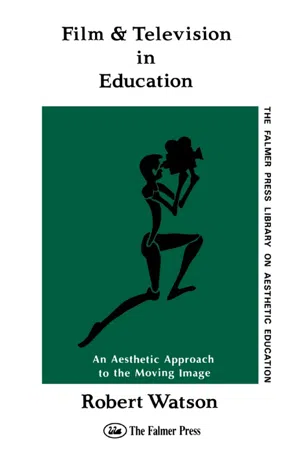
First published in 1990. The aim of the series is to define and defend a comprehensive aesthetic, both theoretical and practical for the teaching of the arts. There can be little doubt that of the six great arts which the Library of Aesthetic Education is committed to defending and defining, film has been the most ignored in the curriculum of our schools. There is a grand irony in this for film is not only the one unique art form developed in our own century but also the most unequivocally popular. Film was envisaged as part of a system of communications which had to be decoded in terms of ideology and contextualized in terms of power and control. Robert Watson's Film and Television in Education with its telling subtitle An Aesthetic Approach to the Moving Image sets out to remedy the neglect.
Information
Topic
EducationSubtopic
Education GeneralChapter 1
Education: The Legacy of the 1960s
The film is the art form of the first half of our century.
Berger, J. (1965)
…film is by any standards today, of entirely marginal intellectual interest per se. It cannot possibly justify itself as the basis for a substantive discipline or field of study.
Garnham, N. (1981)
Media education…seeks to increase children’s critical understanding of the media—namely, television, film, video, radio, photography, popular music, printed materials, and computer software.
Bazalgette, C. (1989)1
Whatever became of the art form of the first half of our century over the last twentyfive years? It appears to have been mugged by the media.
…what we also did in the ’70s was to jettison theories we never thought we’d have to rework. Aesthetics was élitist; production merely creative; pedagogy took care of itself. In fact, these never really had the status of theories anyway: part of the politics of that period was precisely to discard ‘atheoretical’ notions that were being used to justify a contempt for politics and for history. But just because we may have been right then, does not mean that aesthetics, production and pedagogy will never be needed, cannot be theorized. If we really want to make sense of the media, we need these theories too. (1986)2
I don’t believe such a puritanical and philistine politics was right then; part of its legacy can be seen in the curious collocation of eight named media which, if not quite gratuitous, seems to be based on little more than the opportunist notion that if the word Media is repeated often and firmly enough it may be taken to constitute a subject area. I don’t underestimate the importance of inculcating a ‘critical understanding of the media’, but they are not homogeneous; corralling them into an already crowded curriculum must result either in superficial study or in the selection of optional choices—that, of course, could mean that film, or television, or radio (any of them), might simply disappear.The assumption that all these media are equally important will not be questioned here, but the assumption that an education in any one must be comparable to, or even synonymous with, any others is false. How has the situation arisen in which ‘the art form of the first half of our century’, in John Berger’s words, has been assimilated into such a heterogeneous selection of media? A partial answer can be found in my essay in Living Powers, which includes a chronological account of significant educational developments, but I think the question is better served if we recall something of the mood of the time when Berger was writing.3
Film in the 1960s
The 1960s was, inter alia, the period of the French New Wave, when each new film by Godard was a cultural event that seemed to reshape the language in ways that dismayed some and exhilarated others. Conventions were being challenged, broken down and re-assembled. Part of the value of this process was that it helped those of us who were only just discovering the language to understand that it was in fact composed of conventions, evolved traditions and distinctive national, generic and individual styles. References to the cinema of the past, particularly to Hollywood, were sometimes affectionate, sometimes scathing, but either way called for revaluations—making it new meant recognizing the past in order to respond to the present. Retrospectives made, say, Renoir’s films of the thirties as immediate as those of Godard, Truffaut, Resnais, Marker and the rest; young film makers from Eastern Europe were emerging—Jiri Menzel, Milos Forman—and from elsewhere established directors seemed to be joining the onward rush of the new wave—Bergman, Bunuel, Fellini, Antonioni, Kurosawa, Satyajit Ray. The veteran director, Fritz Lang, turned up in one of Godard’s films, so did Samuel Fuller. It was an extraordinarily fraternal period and it didn’t matter very much that England contributed little creatively, or was unable to sustain the impetus of directors like Lindsay Anderson, because England was at least very receptive.
In addition to Sight and Sound and Films and Filming, Movie magazine had started in the summer of 1962, blasting British cinema, praising American and giving some attention to the rest; Studio Vista started a series of Movie paperbacks; Lorrimer began publishing screenplays; Secker commenced their Cinema One series; Zwemmer and Tantivy also ran series of film books, and these publications were so profuse that the impression was of a single international film culture that was tangibly and vitally present, and this presence was of course reinforced by the range of old and new films available in cinemas, film societies and, to a lesser degree then, on television.
It was a period when Film was part of what it meant to be young and intellectually curious. Film was not an academic discipline, nor yet a forbidding zone where competing theoretical discourses were elaborated; it was, or appeared to be, part of a more generous and openly enthusiastic culture. Film was a vibrant source of energy, and it exemplified what the phrase ‘a living art’ is supposed to mean.
Film and Television in Education
Given the demonstrable surge of interest in the art it is not unreasonable to look for comparable new initiatives in film teaching. The main positive thrust in earlier decades had come from the theoretical work of Pudovkin and Eisenstein, and had centred on the art of editing, or montage, and that had been combined with the influence of Grierson and the Documentary movement of the thirties. That was fairly spartan stuff compared to the broader but more negative appeal of work such as Leavis and Thompson’s Culture and the Environment (1933), much of which could be implemented within English teaching. As late as 1950, the Wheare Report (the report of the Home Office’s Committee on Children and the Cinema) saw film much as Leavis and Thompson had, as a harmful influence:
A large number of films are exposing children regularly to the suggestion that the highest values in life are riches, power, luxury and public adulation and that it does not matter very much how these are attained or used. According to these films, you can eat your cake and have it too.4
By implication, the only reason for teaching film would be to inoculate the young against it. But by 1963 the Newsom Report, Half Our Future, was, if not exactly endorsing film as a mature art at the centre of cultural discourse, at least acknowledging its power over the young without adding the customarily overt judgmental tone:
The culture provided by all the mass media, but particularly by film and television, represents the most significant environmental factor that teachers have to take into account.5
So film and television were not to be ignored—they weren’t going to go away— and yet the tone of the passage is not encouraging: an ‘environmental factor’, however significant, doesn’t really convey the ‘Bliss was it in that dawn to be alive’ feeling which was not uncommon in the sixties. People whose job is ‘to take into account’ an ‘environmental factor’ are presumably unaffected by it themselves; instead of responding critically to a vital experience in their own lives, seeking ways of sharing their perceptions with pupils, they are detaching themselves from their culture and looking on from outside, or down from above, and with the best of intentions—often starting where the children are—they discard their own insights and intuitions and set about constructing a subject that is socially relevant. Intense as it may be, their commitment is to an abstraction, an ideology, and not to the concrete problems inherent in an education in art.
Newsom’s terms of reference were in themselves significant—the remit was to consider the education of 13–16 year olds of average and less than average ability. The recognition that established subjects, conventionally taught, were not always appropriate to the needs of large number of pupils was to be welcomed, but the opening it helped to create for film, television and other media was limiting and clearly did not reflect the way that film was perceived in the world outside educational establishments.That these media could appeal usefully to less academic children is undeniable, but so could other subjects if taught more imaginatively; similarly, film and the other media could be taught to the most academic students without lowering their standards, but the Newsom Report helped fix the perception of film as one of the mass media, and of mass media as an environmental factor to which the young of average and less than average ability were particularly susceptible.
A year after Newsom, the British Film Institute (BFI) began what turned out to be a very short series of books by teachers describing their work in film and television studies. Film Teaching (1964), gave four accounts of work in Adult and Higher Education; Talking about Television, (1966), described work with secondary school pupils ‘ranging in ability from far below to slightly above average’; Talking about the Cinema (1966), recorded courses taught in further education, while its supplement, Film and General Studies, summarized courses for students who were ‘well within the Newsom Report’s frame of reference. The great majority left school at fifteen. Many of the girls are telephonists, punch-board operators, file clerks; the boys, craft apprentices, dental technicians, office assistants’. All these publications were concerned with appreciation, tending towards a thematic approach and an interest in social problems. (Other influential books of the period that should be mentioned are Raymond Williams, Communications (1962), Denys Thompson (Ed), Discrimination and Popular Culture (1964), and Stuart Hall and Paddy Whannel, The Popular Arts (1964).) A quotation from the supplement to Talking about the Cinema reveals something of the way in which film appreciation was adapted for the children identified by Newsom:
Occurring at the lowest level of abstraction of all the arts, film can provide a strong shared group experience. Given its illusion of actuality and its emotional powers, film can serve to stimulate discussion as perhaps no other medium can.6
These courses were certainly, and I’m sure usefully, about talking, and about writing, but because the ‘illusion of actuality’ was a largely unexplored, unquestioned phenomenon films could be used as virtually unmediated, or transparent, communications of attitudes, situations, themes—the discussion centred on dramatized social issues rather than the art that enabled them to find whatever distinctive expressive form and power they conveyed.
In 1966 the BFI also made available, in a somewhat cheaper format, Film Making in Schools and Colleges, but there seems to have been little attempt to make a connection between the development of practical and creative skills—the language in use—and studying the films made by professionals. Apart from Douglas Lowndes’ excellent Film Making in Schools (1968) there was no further substantial contribution to film as an expressive art that children might articulate their own ideas in, at least not during this period (Keith Kennedy’s Film in Teaching followed Lowndes in 1972 but was markedly inferior). Consequently, the dominant approach—‘film can serve to stimulate discussion…’—failed to bring anything new to the curriculum.
One aspect of film was exploited, its immediacy of impact. It was ‘at the lowest level of abstraction of all the arts’, so easy to read that its language could be ignored. Film’s contribution, then, was primarily as a substitute for English for those who had difficulties with the abstractions of the written word. By stimulating talk and writing, film was developing English skills, and English was at the same time moving away from literature towards theme and topic work, towards ‘extracts’ rather than works, chosen for their relevance to issues around which projects could be based. For this was also the period of the Dartmouth Seminar and the revaluation of language in use. Much of what emerged from that is still in use, of course, though the arguments are increasingly being questioned (see, for example, David Allen’s English Teaching since 1965 and Edwin Webb’s chapter in Living Powers).
Questioning the ‘sociolinguistic’ approach which has characterized much English teaching since the late sixties, Webb writes, in defence of literature, that it provides, arguably,
significant voices; mature voices which articulate experience in an achieved form; and which are grounded in that accumulation of collective experience which we call culture. Is literature to be provided because it offers opportunities for the study of ‘language-situations’? or does some other purpose inform its use? Does literature have ‘values’ not necessarily shared by other languageproductions?7
The same questions could be asked of film, other media, and other media productions, but they weren’t being asked in schools in the sixties, and when television, radio and newspapers proved even easier to handle (cropping and captioning photographs, simulating radio broadcasts with tape recorders, making newspapers, and so on), such questions could hardly arise. Film was quietly marginalized. The subject had not been formulated on the basis of its aesthetic but according to its utility, and that was shared by most communications media. But in the next decade media teaching too became problematical for those who were in the business of offering guidance:
By 1970 it was generally recognized that it was impossible to write and teach coherently about a subject area—film—that didn’t possess a rigorously theorized body of knowledge, hence Screen. The same is true about teaching and education—an analysis of education and the education system is required before it is possible to understand either the position the teacher currently has to adopt or to conceive of an alternative, more useful construction of that position. Having outlined possible areas for work within the constellation film/television/media/image studies over the past six years it has become increasingly clear to the editorial board of Screen Education that…it is difficult to offer even tentative strategies for teaching those areas.8
When one gets so far up an ideological cul de sac that it is impossible to proceed with any kind of education, the time has probably come to question the efficacy of the ideological framework; but the BFI’s Educational Advisory Service was able to move ahead almost immediately, and almost as if ideology could be sidestepped:
Partly, we have felt it necessary to emphasize film and television as media rather than as merely ‘arts’…along with this shift towards film and television as media among other media has been a complementary shift…towards a general concern with all communication through images.… But how are images understood? What do we understand and how is it that we do understand? If images are seen as constructed through the use of certain devices within the context of certain conventions, then our attention as educators is drawn towards the ways in which meanings are constructed and towards the uses to which the image is put in society. Who is saying what? to whom?
how? why?9
how? why?9
These fine questions should have been asked by students Talking about the Cinema in the mid-sixties. Now they were being asked about ‘all communication through images’ but, curiously, they were being asked in a discourse that wanted to deny itself access to ‘arts’.
By almost any standards one can apply, television is now at least as important as film: more people spend more time watching it, more people are involved in making it, its effects (insofar as they can be ascertained) are more pervasive. Only from the narrow perspective of artistic quality—a perspective which our January column indicated we did not think the most fruitful for media studies—is it possible to argue for the supremacy of film, and even this can hardly be argued in respect of current British production.10
Albeit grudgingly, film is granted its importance ‘from the narrow perspective of artistic quality’, but that perspective is not ‘fruitful’—mass appeal is the criterion of real importance. But if that criterion is applied seriously it will not make television per se the main subject of study, for th...
Table of contents
- Cover Page
- Title Page
- Copyright Page
- List of Figures
- Acknowledgments
- Preface
- Chapter 1
- Chapter 2
- Chapter 3
- Chapter 4
- Chapter 5
- Chapter 6
- Bibliography
Trusted by 375,005 students
Access to over 1.5 million titles for a fair monthly price.
Study more efficiently using our study tools.
Frequently asked questions
Yes, you can cancel anytime from the Subscription tab in your account settings on the Perlego website. Your subscription will stay active until the end of your current billing period. Learn how to cancel your subscription
No, books cannot be downloaded as external files, such as PDFs, for use outside of Perlego. However, you can download books within the Perlego app for offline reading on mobile or tablet. Learn how to download books offline
Perlego offers two plans: Essential and Complete
- Essential is ideal for learners and professionals who enjoy exploring a wide range of subjects. Access the Essential Library with 800,000+ trusted titles and best-sellers across business, personal growth, and the humanities. Includes unlimited reading time and Standard Read Aloud voice.
- Complete: Perfect for advanced learners and researchers needing full, unrestricted access. Unlock 1.5M+ books across hundreds of subjects, including academic and specialized titles. The Complete Plan also includes advanced features like Premium Read Aloud and Research Assistant.
We are an online textbook subscription service, where you can get access to an entire online library for less than the price of a single book per month. With over 1.5 million books across 990+ topics, we’ve got you covered! Learn about our mission
Look out for the read-aloud symbol on your next book to see if you can listen to it. The read-aloud tool reads text aloud for you, highlighting the text as it is being read. You can pause it, speed it up and slow it down. Learn more about Read Aloud
Yes! You can use the Perlego app on both iOS and Android devices to read anytime, anywhere — even offline. Perfect for commutes or when you’re on the go.
Please note we cannot support devices running on iOS 13 and Android 7 or earlier. Learn more about using the app
Please note we cannot support devices running on iOS 13 and Android 7 or earlier. Learn more about using the app
Yes, you can access Film And Television In Education by Robert Watson in PDF and/or ePUB format, as well as other popular books in Education & Education General. We have over 1.5 million books available in our catalogue for you to explore.