- 336 pages
- English
- ePUB (mobile friendly)
- Available on iOS & Android
eBook - ePub
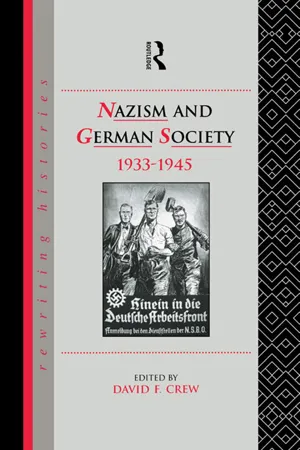
Nazism and German Society, 1933-1945
About this book
The image of the Third Reich as a monolithic state presiding over the brainwashed, fanatical masses, retains a tenacious grip on the general public's imagination. However, a growing body of research on the social history of the Nazi years has revealed the variety and complexity of the relationships between the Nazi regime and the German people. This volume makes this new research accessible to undergraduate and graduate students alike.
Part I
“Victims” or “Perpetrators?”
The German people and the Nazi regime
1
The Missing Years
German workers, German soldiers
More research has been devoted to the working class than to almost any other social group in the Third Reich. Yet historians have generally failed to follow workers from the shopfloor to the frontline, even though millions of young, male workers were conscripted for military service in “Hitler’s Army.” Despite the claims of German generals after 1945 that the army was innocent of Hitler’s crimes, many ordinary soldiers participated in the barbarities of racial war in the Soviet Union. The fact that large numbers of German workers were also soldiers must clearly influence the way that we think about the role of German workers in Nazi society.
In the following article, Omer Bartov argues that after over a decade of Nazi indoctrination many young workers came to their military service prepared to embrace the racist goals of the Nazi regime. Their admiration for the Führer, their pride in Germany’s military power and their own racial prejudices turned these young recruits into the “tenacious, increasingly brutalized and fanaticized soldiers” (p. 46) who made possible the implementation of Hitler’s murderous policies in the east.
Bartov’s article demonstrates the value of paying much closer attention to the war years than most social historians have been prepared to do until now.* Readers may, however, want to ask whether Bartov’s broad generalizations about the mentalities of millions of German soldiers in “Hitler’s Army” can be adequately sustained by the limited range of individual memoirs and autobiographies which he cites.†
* * *
I
Though conveniently well-defined chronologically, the Third Reich has never ceased to present scholars and laymen alike with disturbing questions of definition. Indeed, it has proved excessively difficult to fit the “Hitler State” into an historical context. While the search for the roots of National Socialism has encumbered German (and to some extent European) historiography as a whole with the burden of hindsight, on the one hand, the attempt to “come to terms with the past” in the post-Nazi era has left deep marks of disconcerting amnesia and empty rhetoric, on the other hand. Just as many of the “ideas” enthusiastically propagated and ruthlessly put into practice by the Nazis predate Hitler’s “seizure of power” and even the founding of the NSDAP, so too Germany’s Stunde Null has failed to erase the past and allow the two new republics which had emerged out of the debris of the Reich to set off on their diametrically opposed Neubeginnen as if nothing had happened. Too many people who had experienced Hitler’s twelve-year rule were still alive, too many minds were still filled to the brim with terrible (though for some also pleasant) memories, for that era of great hopes and deep disillusions, vast conquests and bitter defeats simply to vanish. A glimpse at the dust-jacket biographies of books published in the Federal Republic, for instance, will easily demonstrate the glaring absence of the years 1933–45 from the lives of Germany’s literati.1
The question of continuity and discontinuity has thus remained at the core of German history ever since the “catastrophe” of 1945, with the Third Reich, its actual brief tenure notwithstanding, stubbornly casting a long shadow over periods both preceding its conception and stretching far beyond its demise. The view of Nazism as an aberration, a society inexplicably gone mad, or taken over by a “criminal clique” against its will, has not been corroborated by the historical evidence.2 Moreover, rather like the claim regarding the “uniqueness” of the Holocaust, it has always suffered from being entirely ahistorical, in that it attempted to lift a significant chunk of history out of the general stream of events and to discard it as not belonging to the “real” Germany, a monstrous Mr Hyde who has fortunately been forced back into the test-tube whence he had sprung. A characteristic example of what such artificial detachment from recent events can lead to is to be found in the East Berlin Museum for German History where, for instance, the caption under the photograph of a Wehrmacht officer, killed in front of the Reichstag building in May 1945, describes him as a “dead fascist soldier.” Apparently, whereas those (communist workers) who opposed Hitler were German, those (other classes) who fought for him were merely “fascists,” though once they changed into Volksheer uniforms (or joined the Bundeswehr in the case of the FRG), they inevitably regained their national identity.
Conversely, it has generally been acknowledged that excavating the roots of Nazism far into the Dark Ages has had a major distorting effect on historiography, often obscuring other social, political, religious, and cultural currents which had contributed to making European civilization what it is today, for better or worse. Consequently, some scholars have recently proposed to “normalize” the historical position of the Third Reich by locating it within a wider context, and at the same time to “historicize” the writing of its history by doing away with the hitherto almost obligatory rhetoric and examining its various aspects with the proper mixture of objectivity and empathy. Indeed, it has been said that instead of concentrating mainly on the criminality of the rulers, the suffering of the victims, and the heroism of the resisters, more attention should be given to contemporary social phenomena relatively unrelated to the regime, as well as for instance to legislative and organizational initiatives which, though carried out at the time, have since made an impact on post-Nazi society, not all of it necessarily negative.3
Attempts to point out that in its foreign relations the Third Reich behaved quite “normally,” both in comparison with other powers and as far as its own predecessors and successors were concerned, have, however, proved far from uncontroversial.4 Similarly, on the domestic front too, it has been aptly pointed out that what may have seemed to many good German citizens a “normalization” of their society under Nazism, following a period of political and economic crisis, was actually achieved by ruthlessly “uprooting” the representatives of “abnormality.” With the disappearance of the insane, beggars, handicapped, Gypsies, Jews, and so forth, and the enforcement of strict order and discipline, many an average “Aryan” must have felt that the situation had indeed been pleasantly “normalized,” at least as far as her or his own, often self-willed narrow view was concerned.5 Moreover, once Nazi rule was over, its memory too had to be “normalized.” Thus we should not simply speak of “missing years,” but rather of a period in the lives of people in whose memory much was repressed, and much else given a “normalizing” interpretation, enabling them to live with its recollection and even cherish some of its more enjoyable moments, particularly as it had all happened when they were young, healthy, and for a while also relatively well-off and members of a great power ruling over vast territories. Only in this manner can both individual and national history follow their uninterrupted course, so necessary if one is to make some sense out of the chaos of events.6 This, it will be argued below, applies not only to those small-town, white-collar, Protestant Germans who are said to have constituted Hitler’s strongest supporters,7 but also, though not precisely in the same sense, to the working class, generally considered to have remained least susceptible to Nazism.
II
In recent years it has been convincingly shown that far from conforming to the totalitarian image it strove to project, the “Hitler State” was in fact made up of a chaotic conglomeration of competing, overlapping, and often superfluous institutions, with only the Führer, himself described by some historians as a “weak dictator” with limited powers, to divide and rule over it.8 Moreover, the Nazi ideal of establishing a so-called “Volksgemeinschaft” is also said to have failed miserably, with German society, though submitting to a terroristic police state, remaining riven by conflicting class interests.9 Similarly, while the “Hitler Myth” retained its hold as a unifying concept for a growing proportion of the German population until very late in the war, the NSDAP, which in any case had never achieved even a simple majority, lost much of its popularity in the early years following the “seizure of power.”10
The German working class is probably the most significant case in point as regards the Nazi regime’s failure – or unwillingness – to break down those very class barriers against which the party had allegedly fought and whose disappearance in an idyllic Volksgemeinschaft should have legitimized the replacement of the Weimar Republic by a ruthless dictatorship. Extensive research into this issue has indeed demonstrated that quite apart from outright resistance to the regime, mostly by former socialist and communist activists, workers had shown a surprising degree of opposition to attempts by the employers and the state to limit their gains, made following the rapid shift in the 1930s from unemployment to manpower shortage as a result of massive rearmament. The workers’ struggle, involving an array of industrial actions such as strikes, go-slows, frequent changes of work-places, and lowered productivity, has been presented as a clear sign of the regime’s failure to create a totalitarian “people’s community,” based not just on fear and suppression, but also on acceptance of the new political system and creed. Social structures inherited from pre-Nazi times are thus said to have persisted under Hitler’s rule and to have evolved gradually only after the fall of the Third Reich, owing both to the terrible destruction of the war and the political upheavals which followed it.11 Nevertheless, while on the one hand it may astonish us that there actually was such interest-group pressure from the working class under the Nazi dictatorship, on the other hand there is also room to inquire why this domestic tension rarely transformed itself into political resistance, and why the regime, though making a few temporary concessions to the workers (as it also did to the churches), does not seem to have been seriously threatened by the working class at any time, and could by and large pursue expansionist policies with no hindrance from within, indeed, with a great measure of support.12
Findings regarding industrial unrest in Germany in the late 1930s have significantly influenced views on some major issues of the period, such as the debate over the origins of the Second World War, the inquiry into the deeper causes and wider implications of the Blitzkrieg strategy, as well as the historical value of earlier theories of fascism and totalitarianism.13 At the same time, it has also become necessary to define more precisely the meaning and applicability of such terms as “resistance” and “opposition,” both as regards the working class, and in the case of other groups hovering between collaboration and resistance, such as the churches, the military, and the traditional liberal-conservative elites.14
Yet precisely because of the centrality of this issue and the wide range of its implications, it may be of some interest to stress one of its aspects which does not seem to have received appropriate attention hitherto. The point is that in September 1939 Germany launched what turned out to be a world war, and although initially its people marched to battle without much enthusiasm, and its resources were not totally mobilized, as of winter 1941 Hitler’s Reich found itself up to its neck in a vast military confrontation, fielding millions of soldiers, and straining both its physical and its mental capacities to the limit. Ultimately, the mass of Germany’s population became involved in one way or another in the war, and a growing proportion of its men, young, middle-aged, and old, workers, bourgeois, and aristocrats, Nazis and former socialists and communists, were recruited and sent to the front, turning miraculously into Europe’s toughest and most determined troops, mostly fighting with extraordinary cohesion almost until the bitter end. For throughout the war, combat morale in the Wehrmacht generally remained extremely high, mutinies were almost unknown, and an excellent system of manpower organization, draconian punishment, and extensive indoctrination combined to hold combat units tightly together, while a series of astonishing victories made it easier to withstand even greater defeats in the hope of fortune’s wheel turning once more in Germany’s favour.15
The question to be asked is thus, how did it come about that men who had been recruited from the mines and factories, who had demonstrated their capacity to oppose at least the social and economic policies of the regime, and some of whom may well have still remembered their former trade-union, SPD...
Table of contents
- Cover Page
- Half Title Page
- Title Page
- Copyright Page
- Table of Contents
- List of tables
- Editor’s preface
- General Introduction
- Part I “Victims” or “perpetrators?” The German people and the Nazi regime
- Part II The “racial community” and its enemies
- Suggestions for further reading
Trusted by 375,005 students
Access to over 1.5 million titles for a fair monthly price.
Study more efficiently using our study tools.
Frequently asked questions
Yes, you can cancel anytime from the Subscription tab in your account settings on the Perlego website. Your subscription will stay active until the end of your current billing period. Learn how to cancel your subscription
No, books cannot be downloaded as external files, such as PDFs, for use outside of Perlego. However, you can download books within the Perlego app for offline reading on mobile or tablet. Learn how to download books offline
Perlego offers two plans: Essential and Complete
- Essential is ideal for learners and professionals who enjoy exploring a wide range of subjects. Access the Essential Library with 800,000+ trusted titles and best-sellers across business, personal growth, and the humanities. Includes unlimited reading time and Standard Read Aloud voice.
- Complete: Perfect for advanced learners and researchers needing full, unrestricted access. Unlock 1.5M+ books across hundreds of subjects, including academic and specialized titles. The Complete Plan also includes advanced features like Premium Read Aloud and Research Assistant.
We are an online textbook subscription service, where you can get access to an entire online library for less than the price of a single book per month. With over 1.5 million books across 990+ topics, we’ve got you covered! Learn about our mission
Look out for the read-aloud symbol on your next book to see if you can listen to it. The read-aloud tool reads text aloud for you, highlighting the text as it is being read. You can pause it, speed it up and slow it down. Learn more about Read Aloud
Yes! You can use the Perlego app on both iOS and Android devices to read anytime, anywhere — even offline. Perfect for commutes or when you’re on the go.
Please note we cannot support devices running on iOS 13 and Android 7 or earlier. Learn more about using the app
Please note we cannot support devices running on iOS 13 and Android 7 or earlier. Learn more about using the app
Yes, you can access Nazism and German Society, 1933-1945 by David Crew in PDF and/or ePUB format, as well as other popular books in History & German History. We have over 1.5 million books available in our catalogue for you to explore.