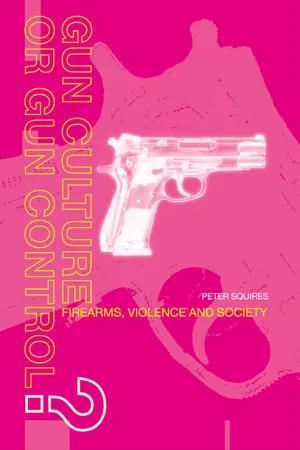
n 1996 the shooting and killing of 16 young children in a Dunblane primary school provoked wide reaching parliamentary reform to British gun laws. Within months virtually all privately owned handguns had been outlawed. Gun Culture or Gun Control? presents the first substantial analysis of the social and political reactions to events in Dunblane and also examines many of the wider issues relating to gun control in the United Kingdom.
Rigorously comparative throughout, Peter Squires provides a non-partisan exploration of the differences between attitudes to firearms and their control in Britain and in the United States. Amongst the topics the author considers are:
* the social history of firearms on both sides of the atlantic
* the differing policy directions adopted in Britain and the USA
* media coverage of the gun question
* firearms and policing
* the future of the gun in society.
- 272 pages
- English
- ePUB (mobile friendly)
- Available on iOS & Android
eBook - ePub
About this book
Information
1 Introduction
Why guns?
Opening shots
Guns are an unusual subject for a British social scientist and a fairly infrequent topic among British criminologists. Things are obviously quite different in the USA. My exploration of the ‘sociology of the gun’ began somewhat by chance. I was actually researching in the crime prevention field, but noticed a headline: ‘Home defence choices’ on the front cover of the American Guns & Ammo magazine at a newsagent. An article in the magazine profiled a number of handguns said to be particularly suitable for guarding your home against intruders and a companion article ran through a number of tips on ‘defensive handgun combat tactics’. Included here was advice on weapon availability and access, speed and accurate shooting, and concealment and cover.
Although the article carried advice on safe storage of guns in the home, particularly homes containing children, none of the weapons pictured in the photographs accompanying the text were shown in any way locked or disabled. One was in a bedside cabinet, another in the half-open drawer of a coffee table. There is, clearly, something of a dilemma here. A gun which is locked away, disabled, or perhaps just unloaded, is not as rapidly available as one left loaded and ready. According to critics, the American firearms industry exploits fear, which stimulates gun purchases in the first place (Diaz, 1999) and then, fear of an immediately life-threatening worst case scenario disinclines many American gun owners from paying very much attention to gun safety advice (Weil and Hemenway, 1992). The results are fairly predictable. Proponents of handgun control in the USA argue that fifteen children and young people are killed by guns each day, most of them in or around their own homes. An episode of the American syndicated Court TV series broadcast by the BBC during 1996 illustrated the dilemma. The programme was devoted to a 1992 case in Jacksonville, Florida, in which a 3-year-old boy had shot his 2-year-old sister with a handgun he had found in his parents’ bed. Florida state law requires that gun owners store their weapons safely and beyond the reach of children. However, central to this case was not just the 3-year-old’s easy access to the .357 revolver in the bed, but the nine other guns in the household, four more of them (two loaded) in the bedroom alone. Taken together, the prosecution argued, so many firearms left lying around the house suggested wanton negligence on the part of the otherwise respectable, white, lower-middle-class, church-going parents. The case was apparently the first of its kind in which parents were successfully prosecuted for their culpability in a homicide. It was something of a test case in the developing gun control debate.
The reason an article on the cover of an American gun magazine caught my eye had to do with some very domestic issues. I had recently been involved in a research project investigating burglary, harassment and victimisation on a ‘problem’ social housing estate. The very first interviewee told of how she had had to take her cat to the vet after it had been shot by an air rifle. A number of other interviewees told of how ‘kids up here’ play with air guns and a couple pointed out to me the small round holes that air pellets had made in the glass of their doors or windows. Later I conducted an interview over the kitchen table with a man and his partner. Leaning against a corner kitchen unit was an air rifle. A few interviews later a man in his thirties gave the following, candid, response to my question about whether he had any fears or concerns about crime on the estate. ‘I’ve got a gun cabinet back there, you know. Two shotguns and a .22 rifle. And if anybody breaks in here, they can have some of that.’
Not long afterwards, another man explained how he had bought a plastic replica, semi-automatic pellet pistol because, ‘it didn’t cost much, and I thought that, you know, if anyone, got in here, I could threaten them with it because, you know, unless you look very close, it looks quite real’. Replica weapons do look quite real, they now feature in a significant percentage of opportunist ‘armed’ robberies at post offices, building societies and similar business premises (Matthews, 1996). Certainly, the staff working in such businesses and at whom such weapons are pointed often think them to be real. These ‘lethal looks’ were what prompted a woman interviewed on a TV documentary about ‘road rage’ to purchase an imitation handgun. She had previously been attacked while driving and bought the blank-firing revolver to point at any would-be assailants in the future. Unfortunately for her, the police confiscated the gun and the woman faced prosecution for carrying it in her car. A similar fate befell the householder who had detained two men with an imitation firearm after he discovered them burgling his home. Having called the police he was promptly arrested when they arrived and charged with a firearms offence. Coincidentally, new legislation, in the shape of the Firearms Amendment Bill 1994, strengthening the law in cases where an imitation firearm was used to threaten or intimidate, was currently before parliament. Guns Review claimed that both the incident and the proposed new legislation were typical of a British tendency to punish the innocent in matters of firearms control (Guns Review, August 1994: 579).
In 1995, reacting to a growing concern about individuals using weapons for self-defence purposes, the Home Office minister, David MacLean wrote that, ‘tackling crime and protecting citizens are primarily jobs for the police. … I would discourage anyone from keeping an imitation firearm to ward off intruders. This could well increase the risk of violence’ (‘Cadmus’, 1995a: 670). Shooting commentators were outraged and saw the Home Office position as yet further evidence of British society ‘gone soft’ by allowing criminals to walk all over the law-abiding with impunity. Instead, they argued,
the right to own a firearm within one’s own home and to use it against an intruder when the householder feels endangered … is a right at common law and a right in common decency. The current trend in sympathising with the criminal and penalising the victim must end. It is now time to start exerting pressure on Parliament to state the law clearly so that we may all sleep more soundly in our beds.
(‘Cadmus’, 1995b: 751)
The gun question
But what does this all add up to? What processes might have been driving this apparent resort to weapons, even replica weapons? What did it say about our fears, our sense of personal security or our confidence in the public institutions of criminal justice and law enforcement? The word from the streets of New York, according to Geoffrey Canada was that ‘it is better to be judged by twelve than carried by six’ (Canada, 1995). Is that it? Is society becoming more dangerous and are guns part of the solution or part of the problem? Has sports shooting served primarily as a cover for many people who really wanted – or even believed in their inherent right – to own firearms for other purposes? If the choice of public protection firearms pointed to a lack of confidence in the existing political authorities to deliver public order, is this best interpreted as further evidence of an individualistic, libertarian strain of thought eating its way through our traditional ‘social contract’? Is it evidence of an increasingly marketised and individualised conception of personal security as a consumer good? (Christie, 1993; Taylor, 1999).
Alternatively, does widespread firearms ownership represent a positive shift in modes of governance, delegating authority over fundamentals of life, death and personal security to the citizenry at large. As Law and Brookesmith would have it, ‘modern fighting handguns’ have three main groups of users, the police and the military use them in the course of their work, ‘while the ordinary citizen, in civilised countries, keeps them to defend his home and his person … in recognition of the fact that the police cannot be everywhere to protect everyone all the time and that the citizen has to take some responsibility for his own safety.’ (Law and Brookesmith, 1996: 159, 170; emphasis added). It is sometimes suggested, usually in respect of the USA (though somewhat in the face of American homicide statistics), that ‘an armed society is a polite society’. So might gun ownership be seen as a positive, socially disciplining influence? After all, such a relationship, originating alongside the post-revolutionary notions of the ‘citizen-militia’ has often been asserted. Handling the responsibility of lethal firepower, it is suggested, builds character and teaches respect. Is this, now, simply another part of a world we have lost? Finally, might we interpret these changes in the light of post-modern discourses: the fragmentation of confidence in political systems and the disconnectedness of social values, policy objectives and institutional achievements?
Raising such dilemmas some years ago in a discussion of the future of crime prevention, British criminologist Tony Bottoms laid his emphasis on the strand of virulent individualism he saw ‘invading’ Western societies and concluded in the following terms: ‘I profoundly hope that this … interpretation of our own situation is an over-pessimistic one. For if individualism really is unstoppable, the end result, or nightmare, could ultimately be a society with massive security hardware protecting individual homes, streets, and shops, while all adult citizens would carry personal alarms, and perhaps guns, for individual protection while moving from place to place’ (Bottoms, 1990: 20).
Emerging issues
The issues raised here have their parallels on either side of the Atlantic. Despite elements of convergence, however, the UK and the USA do tend to approach firearms rather differently. Yet during recent years, both cultures have seen firearms assume centre stage as major problems of public policy. The USA saw the sharpening of a long-running debate on firearms in American life in the wake of the political assassinations of the 1960s. More recently, the growing toll of gun homicides has combined with a series of confrontational debates about guns in the USA. These debates, often arising following particularly harrowing shooting incidents, have concerned: civilian ownership of military-style ‘assault weapons’; proposed bans on small cheap handguns (‘Saturday night specials’); school shooting incidents; waiting periods and national firearms registration (the Brady Bill); particular types of ammunition, such as the so-called ‘cop-killer’ bullets or other expanding ‘injury-maximising’ rounds, and the emergence of a number of right-wing, anti-governmental paramilitary militias ‘tooling up for Armageddon’ for whom the ‘right to bear arms’ seems nothing short of a sacred creed. The emergence of such issues and concerns have provided lobbying opportunities for a number of recently established gun control campaign organisations such as Handgun Control Inc., the Coalition to Stop Gun Violence and the Violence Policy Center (Carter, 1997).
On the other side of the coin, however lies the USA’s history and ‘gunculture’ (Hofstadter, 1970), a civilian gun stock exceeding 200 million (Kleck, 1991), and the influential National Rifle Association, the staunch defender of what it believes to be the USA’s Second Amendment rights. Despite the American gun lobby being kept somewhat on the defensive by the series of issues referred to earlier, the Reagan and Bush administrations provided a more sympathetic climate for shooters’ rights. In 1986, in a victory for the gun lobby, the Firearm Owners Protection Act was passed, dismantling somewhat a number of controls set in place almost two decades earlier in the 1968 Federal Gun Control Act. Then, in a development of potentially greater significance, the early 1990s saw an increasing number of states, now numbering over thirty, adopting what are known as ‘shall issue’ concealed carry laws. The new laws entitle ordinary citizens to apply for a permit to carry a concealed handgun outside their home or business. The laws have been passed in reaction to epidemic-level fears about violent crime and insecurity across the USA and as a direct response to gun lobby pressure at the state level. The laws have also provided a lucrative market for gun manufacturers, and it is this confluence of interests, the gun lobby, gun owners and the gun industry, that is now coming under increasing scrutiny.
The concealed carry laws are the focus of a sharp debate between the pro-gun and anti-gun lobbies. The gun control lobby, on the other hand, finding the political route to policy change often blocked in a stalemated political process, has recently turned to the courts. Rather like the cigarette industry a decade ago, the gun industry now faces a host of product liability, public health and safety law suits brought by, among others, crime victims, gun control groups, municipal authorities and police departments. Some commentators argue that the cases have been brought less with a realistic aim of winning and more with a view to keeping the gun control issue high up the political agenda. However if the gun manufacturers and distributors lose these actions they are likely to cost them millions (Diaz, 1999: 12–14).
For all the hostile words comprising the slow war of attrition on the American gun debate, relatively little has really been achieved. The NRA and it allies are, above all, defending a principle and see the thin end of a long wedge in almost every gun control measure proposed. By contrast the pro-control groups are struggling for apparently fairly marginal and, it seems, often easily circumvented, policy measures (waiting periods, ‘one gun per month’ purchasing limits). Yet in these practical details lies the gun controllers’ deeper motive. They too are fighting for a principle, the principle that society should take responsibility for the effective regulation of an item as dangerous as a firearm. It is, they claim, not an issue that can simply be left to the good sense of individual citizens. Indeed, at the very heart of the gun control debate there lie some fundamentally opposed conceptions of citizenship. Neo-liberals argue that the ‘right to bear arms’ is an essential precondition of free citizenship, whilst more left-leaning and ‘social democratic’ commentators insist upon gun regulation as a means of protecting the wider ‘social’ interest.
Opposing camps
The slow grind of the American gun control debate contrasts markedly with the British experience. Seven months after the terrible shootings at Dunblane Primary School during March 1996, in which sixteen young children and their teacher were killed and ten further children and three teachers wounded, the government resolved upon a ban on the private ownership of all large calibre handguns. Even this did not satisfy the UK’s newly established gun control movement and, a few months later, implementing a manifesto pledge introduced to capitalise upon a wave of public outrage, the recently elected Blair government extended the ban to virtually all privately owned handguns of any calibre. (Exceptions applied in the case of certain antique or historic weapons, muzzle-loaded weapons and gas-powered handguns.) The British gun lobby, notwith-standing initial denials that there even was a British ‘gun lobby’, were caught on the back foot.
Once thought powerful and well-connected, the gun lobby had successfully blunted the political momentum on gun control which followed the Hungerford massacre of August 1987. Even amidst the controversy following the killing of sixteen people and the wounding of a further twelve by a man dressed in paramilitary fatigues and carrying, among other weapons, an AK47 military assault rifle, members of parliament with shooting connections were able to secure important amendments to what became the Firearms (Amendment) Act of 1988. Semi-automatic rifles, burst-firing weapons and ‘pump-action’ shotguns all became prohibited weapons but no additional measures to restrict the availability of the type of semi-automatic pistol, with which half of the Hungerford victims were shot, were proposed. Amendments to the new legislation also established a new advisory body, the Firearms Consultative Committee, comprised of shooting sports, firearms industry and policing interests with whom the Home Office were expected to consult over any future firearms control proposals. As we shall see later, while many commentators from within the shooting fraternity came to see the FCC as ‘their’ committee, critics came to view the FCC as playing a more effective role in representing shooting interests than in promoting the cause of public safety (Mills and Arlidge, 1996).
Despite the relative success of the shooting lobby’s rearguard action after Hungerford, this ‘victory’ rather obscured certain divisions appearing within the representative bodies of the UK’s different shooting ‘disciplines’. After Hungerford, a series of ‘un-British’ weapons were prohibited and the more traditional shooting disciplines protected. Strenuous efforts were made to associate the shotgun, in particular, with rural tradition and nature conservation – agricultural pest control and the ‘glorious twelfth’.
Handgunning, however, had no similar pedigree to draw upon, but had become a recognised sport (using .22 calibre single shot pistols) in the Olympic and Commonwealth Games where valuable personal qualities of concentration, discipline and precision were said to be tested. Although the overall number of firearm certificates (rifles and handguns) issued had fallen significantly since the 1960s, handgun shooting was becoming an increasingly popular participation sport, the number of certificates issued beginning to rise, once more, in the early 1990s. However, as we shall see later, the growing popularity of the handgun was not based upon enthusiasm for the .22 calibre single-shot pistols such as used in the Commonwealth Games but rather it reflected a growing interest in the larger, more powerful, higher calibre, revolvers and semi-automatics increasingly popular across the Atlantic. Newer shooting competitions placed rather less emphasis upon the disciplined aesthetic of single-shot precision and more upon what was known as ‘practical shooting’ or ‘police pistol’ competitions. Targets were often humanoid silhouettes and the competitions might simulate combat-style conditions where speed and firepower, rather than simple accuracy, were called for.
Enthusiasts of the newer shooting disciplines were less content to try to shield their sport behind the more traditional forms of shooting. Rifts began to appear in the ‘shooting lobby’. After Hungerford, a fairly new organisation, the Shooters’ Rights Association (first established in 1973 to lobby against gun control proposals floated in a government Green Paper of that year) roused itself once again. Although directing its criticisms specifically at the Firearms (Amendment) Bill, then before parliament, the SRA’s true objective appeared to lie in the restoration of a British ‘right to bear arms’. This ancient right, it argued, was not simply a component of true democratic freedom but, equally, a legitimate form of sporting self-expression and a positive national asset in the event of military mobilisation. ‘Our fear [of firearms]’ opined the authors of the SRA report, ‘has emerged, not from growing risks, but from a changed philosophy’ (Yardley and Stevenson, 1988: 124). The appearance of an American-inflected discourse on firearm ri...
Table of contents
- Cover
- Halftitle
- Title Page
- Copyright
- Dedication
- Contents
- List of figures
- Preface
- 1 Introduction: why guns?
- 2 The spectre of the gun: historical and cultural perspectives
- 3 The making of the American ‘gun culture’
- 4 Discovery and construction: media coverage of the ‘gun question’
- 5 Tragedy, aftermath and politics
- 6 Taking stock of the gun control arguments
- 7 Conclusions: culture and ricochets
- Bibliography
- Index
Trusted by 375,005 students
Access to over 1.5 million titles for a fair monthly price.
Study more efficiently using our study tools.
Frequently asked questions
Yes, you can cancel anytime from the Subscription tab in your account settings on the Perlego website. Your subscription will stay active until the end of your current billing period. Learn how to cancel your subscription
No, books cannot be downloaded as external files, such as PDFs, for use outside of Perlego. However, you can download books within the Perlego app for offline reading on mobile or tablet. Learn how to download books offline
Perlego offers two plans: Essential and Complete
- Essential is ideal for learners and professionals who enjoy exploring a wide range of subjects. Access the Essential Library with 800,000+ trusted titles and best-sellers across business, personal growth, and the humanities. Includes unlimited reading time and Standard Read Aloud voice.
- Complete: Perfect for advanced learners and researchers needing full, unrestricted access. Unlock 1.5M+ books across hundreds of subjects, including academic and specialized titles. The Complete Plan also includes advanced features like Premium Read Aloud and Research Assistant.
We are an online textbook subscription service, where you can get access to an entire online library for less than the price of a single book per month. With over 1.5 million books across 990+ topics, we’ve got you covered! Learn about our mission
Look out for the read-aloud symbol on your next book to see if you can listen to it. The read-aloud tool reads text aloud for you, highlighting the text as it is being read. You can pause it, speed it up and slow it down. Learn more about Read Aloud
Yes! You can use the Perlego app on both iOS and Android devices to read anytime, anywhere — even offline. Perfect for commutes or when you’re on the go.
Please note we cannot support devices running on iOS 13 and Android 7 or earlier. Learn more about using the app
Please note we cannot support devices running on iOS 13 and Android 7 or earlier. Learn more about using the app
Yes, you can access Gun Culture or Gun Control? by Peter Squires in PDF and/or ePUB format, as well as other popular books in Social Sciences & Sociology. We have over 1.5 million books available in our catalogue for you to explore.