![]()
1
Introduction to Renewable Energy Technologies for the Home and Business
The world is undergoing a revolutionary resurgence in the use of renewable energy for generating electricity, heat and cooling. This phenomenon can be seen as a result of diminishing fossil-fuel resources, and, particularly in the last decade, as a logical reaction to the reality of climate change, which stems in large part from the use of coal, oil and gas.
Renewable energy has been used in some forms – especially wood heating, passive solar, wind and hydro – for thousands of years in homes, public spaces, work situations and for agricultural processes. Technological development has been rapid since the 1970s providing new opportunities and greater efficiencies for renewable installations. This fact, combined with an increasing range of government and energy utility incentives, has created a highly positive new scenario for the implementation of renewables not just at an industrial scale but also at the domestic and small- to medium-sized business levels.
Many householders, energy managers and decision makers in businesses or public services are turning to renewable energy sources in order to contribute to the mitigation of climate change. Many are also switching to renewables because it makes economic sense. Others have made the move simply because it’s such a positive personal or commercial statement. Central and regional governments across the world are taking actions to encourage the uptake of renewables at the domestic- and large-building level.
In 2008, Governor Arnold Schwarzenegger signed an executive order (S-14–08) requiring that retail sellers of electricity should provide 33 per cent of their load with renewable energy by 2020. Furthermore, the California Energy Commission’s New Solar Homes Partnership (NSHP) – a $400 million program – offers incentives to encourage solar installations, with high levels of energy efficiency, in the residential new construction market for investor-owned electric utility service areas. The goal of the NSHP is to install 400 MW of capacity by 2016.
Meanwhile, in Chicago, a Clean & Renewable Energy Strategy within the Chicago Climate Action Plan identifies a goal of reducing greenhouse gas (GHG) emissions by 5.33 MMTCO2e by 2020 through the implementation of clean and renewable energy sources. One of the main strands for achieving this is through the promotion of household and institutional renewable power. The UK’s Department of Trade and Industry commissioned a report in 2004 which suggested that by 2050, microgeneration – the production of heat (less than 45 kW capacity) and/or electricity (less than 50 kW capacity) from zero or low-carbon source technologies – could provide 30–40 per cent of the UK’s electricity needs and help to reduce household carbon emissions by 15 per cent per annum.
Space heating and cooling are the largest consumers of energy in most homes and offices, accounting for almost 45 per cent of total domestic energy use in the US and over 55 per cent in the UK. In business premises the percentages vary but are also significant. With this in mind, household or business decision makers interested in minimising their contribution to global warming should logically look into the technologies which offset the use of fossil fuel in the provision of heating or cooling. Water heating accounts for an average of 14 per cent of total energy use in US households and a massive 26 per cent in UK homes, so renewable energy technologies which can provide all or part of this requirement are also obvious priorities. Cooking, lighting and appliances account for over 40 per cent in the US, so are an obvious priority there for offsetting, where possible with renewable energy sources.
In this book we explain the main renewable energy technologies that are compatible with domestic or business applications in simple terms, but we start with a chapter outlining the need and options for ensuring that a building is as energy efficient as possible. Maximising the energy efficiency of a property which is to be heated or powered by renewables means that the renewable energy system output and costs can be kept to a minimum.
The book’s main focus is on grid-connected situations since this is the situation faced by the vast majority of the English-speaking world. We avoid promoting one technology over another because selecting between renewables depends on a range of factors: primarily access to the appropriate renewable resource. Other factors, such as the availability of financial incentives for renewable energy generation or implementation, are secondary but still important criteria to help choose the right technology.
It’s rare to find a house or work premises which has equal access to all the main renewable energy resources: good solar radiation, strong and relatively constant winds, an all-year-round stream or river and locally available biomass for example. In terms of heat-pump technologies (ground, water or air source), while most of us have access to air, this is rarely the most carbon- or cost-efficient option and to install a ground sourced heat-pump requires access to suitable land or ponds.
Choosing the right renewable energy for a particular home or business premises should be based principally on a set of criteria such as those outlined below, but every situation is unique so the technologies are explained individually in the main chapters of this book (Chapters 3 to 8). In Chapter 9 we take a look at a range of relevant case studies, covering each of the technologies. Annex 1 is dedicated to the financing of and financial incentives for renewables, while Annex 2 lists a set of resources for finding out more about the renewable technologies discussed.
Environmental Factors
Appropriate Technologies: Available Resources and Associated Social Issues
If you haven’t got sufficient access to the right renewable resource, then the technology dependent on that resource automatically excludes itself as an option. All renewable resources are inevitably site-specific and so the first step in selecting the appropriate technology is to get a good estimation of the resource. How to do this is explained in the relevant technology-based chapters. The social factors include issues such as the potential for obtaining planning permission if this is required in the region for certain technology installations (e.g. wind turbines and their towers) and the likelihood or not of upsetting the neighbours. In Table 1.1 we offer a summary of what to look for in terms of the resource for each of the main technologies described.
In terms of the available resources, hydropower is probably the least widely applicable. Very few properties have legitimate access to the right flow of water and gross head (i.e. the vertical difference between a hydro system’s intake and the turbine located below in a powerhouse). This is unfortunate in that, given a good hydro-resource, this is probably the preferred renewable technology for generating electricity. Despite having relatively high initial capital-investment costs, hydro systems (like streams and rivers) are typically designed to run 24 hours a day, seven days a week, all year round. You can’t say the same for wind or solar resources in most locations.
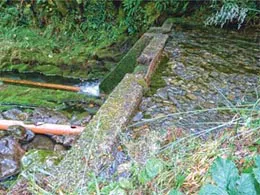
Figure 1.1 2 kW micro hydro intake showing small reservoir, intake and penstock (pipe taking water to turbine lower down the stream’s course)
Table 1.1 Summary of renewable resources required for each type of renewable energy
| Renewable energy technology | Access to the essential resource | Site suitability | Other environmental issues |
|
| Wood heating | Access to reasonably priced wood logs, wood chips or wood pellets | Chimney or flue system available at the property or possible to install | Local planning regulations allow wood heating systems (e.g. some inner-city areas have smoke or emissions regulations) |
| Solar thermal | Sufficient solar radiation (compatible with property’s thermal requirements/use patterns) | The orientation of property (usually but not exclusively a building’s roof) faces the direction of the sun (i.e. roughly south in the Northern Hemisphere and north in the Southern Hemisphere) | No significant shading of solar installation (e.g. from nearby trees or other buildings) |
| GSHP (geothemal/ground or water source heat pumps) | Access to land and subsoil or large-enough pond or watercourse | Suitability of subterranean soil type or water resource | Proximity of land or pond to the property |
| ASHP (air source heat pumps) for heating or cooling | In this case, the essential resource is ‘air’ within the appropriate temperatures (8°C/ 17°F or above for optimum carbon efficiency) | Suitable external wall is needed (however, almost all properties will have this, except some high rise buildings) | Local planning regulations relating to external wall fixings (e.g. in historic town centres) |
| Solar photovoltaic | Sufficient solar radiation | The orientation of property (usually but not exclusively a building’s roof) faces the direction of the sun | No significant shading of solar installation (e.g. from nearby trees or other buildings) |
| Wind energy | High windspeeds with enough consistency throughout the year to cover electricity needs (for own use and/or export to the grid) | Availability of and legitimate access to a suitable site for locating wind turbine and its tower (they cannot be located close to obstructions like buildings or trees which can cause turbulence affecting turbine efficiency) | Proximity of site to property or grid connection (the latter, if the system is just designed for grid power sales) and planning permission (if required) for turbine and tower is possible for the location and neighbours are unlikely to be effected adversely (or object) |
| Hydropower | The available watercourse has sufficient flow and is constant enough to cover electricity needs (for own use and/or export to the grid) | There is legitimate access to the part of the watercourse that offers enough ‘gross head’ (i.e. the vertical height difference between the hydro system intake and the hydro turbine) | Proximity of site to property or grid connection (the latter, if the system is just designed for grid power sales) and also planning permission (if required) |
Not everyone will live or work in a location which has sufficient wind resources; but even where the resource may exist, few individual properties have access to the right spot for locating a wind turbine on a sufficiently tall tower. Firstly, there are problems of access to an area of land where one would be allowed to erect a turbine. Secondly, there are issues of local wind turbulence, which can impede the efficient functioning of a wind turbine. Thirdly, even if the immediate neighbours don’t object to the installation, it...