- 208 pages
- English
- ePUB (mobile friendly)
- Available on iOS & Android
eBook - ePub
About this book
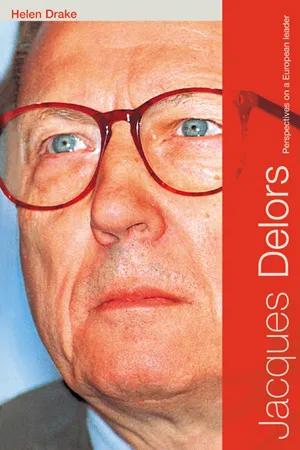
Drawing on exclusive interviews with Jacques Delors himself, this comprehensive, accessibly written study of his life and Commission presidency is an invaluable resource for all those interested in European and French Politics. Debunking populist images and myths about him, this book presents a balanced examination of a widely misinterpreted political figure. This book also raises important issues such as:
the role of individual leaders in contemporary politics
the legitimacy of the European Union as a political system.
Information
1 Jacques Delors, 1985–95
Images of a Leader
Introduction: The Delors Factor
For ten years and three weeks from 6 January 1985 to 23 January 1995, Jacques Lucien Jean Delors, President of the European Commission, provided a form of European leadership which in its duration and imagery was unprecedented in the history of European integration. During Delors’ decade, European integration was characterised by treaty revision, institutional change, budgetary reform, policy deepening, completion and innovation, two rounds of enlargement, and the beginnings of common policies in European security and defence. By the time Delors left office in January 1995, the European Communities had become the European Community (EC), the European Community had itself been subsumed into the newly-formed European Union (EU), and an Economic and Monetary Union (EMU) was only a few years away.
President Delors acquired celebrity and notoriety for his association with many of the developments of the decade 1985–95. He also literally became a household name throughout the EU member states, and even beyond. The degree to which he personified ‘Europe’ was evident in the labels assigned to him by the world’s media—’Mr Europe’,1 the ‘Czar’ of Europe,2 and so on. During Delors’ presidency, the number of accredited news correspondents to Brussels soared, and it was a source of satisfaction to Delors that the news and analysis of his successors’ appointments (Jacques Santer in 1994; Romano Prodi in 1999) received far more media column inches and pages than had his own in late 1984.3 An inevitable consequence of Delors’ public profile was the stimulation of interest in the precise nature of his impact on events during his decade as Commission President, particularly amongst academics numbed by the relative stagnation and vagaries of leadership of the previous decade.
Many authors have argued that Delors played a key role in shaping the events of his decade in office. Charles Grant, working from an insider’s position as the accredited correspondent for The Economist in Brussels for much of Delors’ decade, argued that ‘no politician since the war has made a greater impact on Western Europe’ (cited in Radice, 1994:96). Grant took the single market, the Single European Act (SEA), the Social Charter, Social Chapter, the Delors Committee’s report on EMU, and ‘advocacy of the European economic area’ as Delors’ most memorable achievements. (Grant’s account of the Delors decade, moreover, is Delors’ favoured rendering of his decade in Brussels.) George Ross, similarly, is credited as having demonstrated ‘the importance of the Commission as a highly original and dynamic institution, as a source of ideas, initiatives, and policies—when it is headed by a driven and inspired leader’, namely Delors (Hoffmann, 1995:98). Ross, who is suspected of some overstatement of Delors’ significance (Peterson, 1999:51), is surpassed in his assessment of Delors as ‘the most successful Commission leader in the history of the Community’ (Ross, 1994:14–15) by Hurwitz, who claims that ‘Jacques Delors’s success transcends the commission, and he will join the select group of those who rediscovered Europe’. (Hurwitz, 1996:705.) Whether saint, sinner, or statesman of interdependence, President Delors certainly revived interest from many quarters in Europe’s ‘supranational entrepreneurs’ (Moravcsik, 1999).
In 1994, François Duchêne argued that one of Delors’ predecessors, Jean Monnet, was a pure expression of the ‘transforming’ leadership associated with historic leaders such as Gandhi (Duchêne, 1994:390). Duchêne was using the terminology of J.M.Burns (1978) whereby, in contrast with ‘transactiona’ leadership, which ‘is the art of tying up compromises between political forces in the normal operation of a settled system’ (Duchêne, 1994:390), ‘transforming leadership requires a much rarer capacity—to renew the terms in which the political debate are [sic] conducted.’ Although Monnet did not have the ‘contact with the masses’ usually associated with transforming leaders such as Gandhi, Monnet’s ‘view of changing the context by injecting a new vision, through a new entity, into the status quo, a “ferment” of change, puts him in the same category.’ (ibid.)
In very different circumstances, but having inherited the Monnet method and institutions of integration, Delors certainly contributed to renewing the terms of some of the political debates of his day, beginning with the slogans linked to the completion of the internal market ‘without frontiers’ by 1992, whilst his daily activity involved many of the ‘transactions’ of compromise and consensus-building. Monnet and Delors have both been described, moreover, as ‘statesmen of interdependence’ (Dinan, 1994; Duchêne, 1994), to express their capacity to wield influence despite holding virtually no power. Both men seized on periods of opportunity, created by circumstances, to bring about changes within their institution and, more significantly, to the agenda and future of European integration. In Delors’ case, the popular image of the Commission and its President also underwent change, since, as we saw above, Delors came to personify a unique international leadership role.
Much scholarship, of course, has also been dedicated to relativising, if not minimising, Delors’ leadership and impact, since political science, generally speaking, aims to emphasise structure over contingency and human agency, and to draw generalisable conclusions from exceptional events. There is also some truth in the statement that ‘fame, in contemporary politics, is usually a prelude to debunking or, at best, neglect’ (Pinder, 1998:47). Nevertheless, ‘…the political scientist’s search for regularities and structural explanations often meshes poorly in practice with his or her pragmatic perception of the idiosyncratic influence of individuals on polities’ (Cerny, 1988:131); and it is hard to ignore the ‘phenomenon of a Delors’ (to paraphrase Haas, writing about de Gaulle, 1968:xxii) when seen from the perspective of his impact, as leader, on the structures which contained him; on the policies for which ‘his’ institution was responsible; and on the prevailing and dominant images and perceptions of ‘Europe’ during his decade.4 Delors seemed to contribute, furthermore, to a revival of the whole question of the leadership of European integration (Nugent, 1995), and his portrayal by national medias reflected a renewed focus in the ‘Euro-polity’ on questions of the ‘structuration of authority’ (Hooghe and Marks, 1999:72) in the European Union. Such questions turn on the critical issue of the legitimacy of a Delors (or a Monnet, Hallstein, Santer or Prodi) to wield influence from such a dubious power base—in conventional terms—as the Commission of the EC/EU.
Most research into contemporary democratic political leadership seeks to achieve three interrelated aims: first, to relate the individual political leader to his or her ‘times’, that is to say, to his or her immediate circumstances, as well as to historical, traditional, cultural and socio-politico-economic contexts; second, to relate the leadership of the individual to the formal structures, institutions and systems in which his or her leadership is exercised; and third, to relate a leader’s personal qualities, characteristics, political experience and background, past and future, to the type of leadership he or she provides. It is the combination of what we can call the ‘skills’ of a given leader, derived from their personal characteristics and qualities, and capabilities, and the ‘rules’ composed by his or her institutional and wider environment, that form the basis of the leader’s legitimate exercise of authority, and govern success, or other leadership outcomes. Measuring this combination in Delors’ case is complicated by the nebulous and contested nature of the ‘rules’ of his immediate environment—the would-be polity of the EU.
Moravcsik (1999:270) has claimed that ‘The role of legendary figures such as Monnet and Delors has been much exaggerated’. Such claims reflect in part an almost intuitive determination to counterbalance the interest in leaders and leadership which has run through political science, European and North American, since the early twentieth century. They tend also to reflect legitimate doubts within the discipline concerning the methods and standards used by political scientists to evaluate the action of ‘supranational entrepreneurs’ such as Delors, or the Commission, or leaders more generally; that in fact seems to be Moravcsik’s primary concern in his quest for a ‘parsimonious’ theory of European integration (and Moravcsik is reluctant even to accept that individuals, as opposed to institutions, can exercise supranational entrepreneur ship: ibid.: 298).5
I do not intend to ‘conflate activity and influence’ as Moravcsik accuses others of having done (ibid.: 291), in order to ‘prove’ that Delors was a leader of a particular type who achieved specific results. Rather, I set out in what follows to explore and clarify the ‘Delors factor’, and to reflect upon it from the specific perspective of Delors’ impact upon the vexed questions of the legitimacy and legitimation of authority in the EU. I aim to offer just that—a perspective—on an individual, Jacques Delors, and a phenomenon, leadership. While I acknowledge the importance of evaluating Delors’ results, this perspective also aims to explore how a leader can expand (or not) the resources at his or her disposal (Endo, 1998c) in order to maximise his or her authority to exert influence, if not power. Much as de Gaulle was deemed, in the 1960s, to have shifted the locus of authority in the EEC system towards the member states in the Council, Delors was associated with a shift of authority back to the supranational core of the system, however counter-intuitive or unwelcome such a development might seem. While not entirely agreeing with Rose (1970:114) that ‘in their haste to develop general categories of analysis, social scientists have been pitifully weak in developing measures of the extent to which different individuals in the same office vary in their competence’, I acknowledge that political leadership still baffles political scientists, particularly those who, in respect of the EU, seek explanatory theories of integration (Diez, 1999b). Rose is nearer the mark when he suggests (ibid.: 114) that: ‘perhaps the best test of a politician’s greatness is his ability to create new roles for an established office, or even to create a new office’,6 and when he reminds readers that ‘socalled great men are not all-powerful’ (ibid.: 115).
I do not claim that Delors was a ‘great man’ (Carlyle, 1907), or even a great politician in the formal sense of the term, but I do suggest that his leadership of the European Commission, taken in the context of his public life as a whole, requires a focus on the individual and his or her room for manoeuvre in contemporary politics, including those of the EU. In this I concur with Oran Young when he notes that: ‘in the final analysis, leaders are individuals, and it is the behaviour of these individuals which I must explore to evaluate the role of leadership in the formation of international institutions’ (Young, 1991:287).
Legitimacy in the European Union: Discourses and Debates
Leaders have always fascinated observers of and participants in politics, of course, and the end of the twentieth century is not so different in that respect; indeed, the twentieth century in general has been noted for the centrality of the leadership factor to politics (Seligman, 1956:177). But at a time—the turn of the twenty-first century—when national, supranational and especially international politics is increasingly characterised by an emphasis on the immediate and the short term, on summitry and political imagery, on the sound bite, the dramatic political persona, the said, the projected, the ascribed and the perceived, the gaze upon the individual leader and his or her impact is inevitable. Contemporary politics in these crucial respects heightens expectations of the political individual’s potential to lead and, as intangible and hard to measure as such phenomena might be, affects the political process with identifiable and consequential effects.
Seen from this perspective, although Delors was unelected, essentially contained within a bureaucrat’s role and ultimately subservient to his nationally-legitimated counterparts, the member state leaders, and although he was always careful to reject the specific label of ‘political leader’, and did not seem to see himself as one, Delors was a political leader, albeit of a new type. Moreover, it is precisely because Delors was appointed and not elected to his post that his legitimacy to act as a leader was problematic and contested. This factor constitutes the primary context to understanding his leadership, perceptions of that leadership, and the impact he had on the debates which occurred during his decade, in academic and other circles, on the question of the legitimacy of European integration and of the EU’s institutions—and leaders.
It is in the very nature of European integration itself that its legitimacy should be in question since, in Laffan’s terms (1999:330), ‘The EU is a challenge to how we conceptualize democracy, authority and legitimacy in contemporary politics’. Memorably described by Delors in 1985 as an ‘unidentified political object’,7 the European Community/Union is the product of an idea remarkable precisely for its originality and iconoclasm. The decisions taken in the 1950s to create the first European Communities were difficult and historic because they represented a deliberate departure from political practice and tradition towards a system ‘essentially concerned with the administration of things’ (Shackleton, 1997:70). From the very outset, the nature of the relations between the new European institutions and the sovereign member states, their populations and electorates, was uncertain, problematical and unresolved, and it was only through a mix of ambiguity, faith, innovation, incrementalism, inertia, and trial and error that these relations functioned at all.
There was and still is no one, single, unequivocal political blueprint for European integration (Westlake, 1998:17); nor one dominant ideological narrative, other than the teleology of integration itself, and this is far from being uncontested. Given this resolutely experimental nature of European integration, and its overpowering of many traditional political cleavages and differences, it is not surprising that its political dynamics have challenged the categories and terminology of political, economic and legal analysis and practice. Such elusiveness has not meant, however, that the EU, as a set of institutions (however novel), objectives (however lofty), and principles (however vague), or of legislative acts (however obscure), and individuals (however famous, or ‘successful’, or popular) has escaped analysis or, more significantly, judgement, when compared with the norms of national democratic governance in Europe (and beyond), particularly where its authority to make decisions binding on its members and their peoples is concerned. The EU has powers of its own
to enact norms which create rights and obligations for both its member states and their nationals…; to take decisions with major impact on the social and economic orientation of public life within the member states and within Europe as a whole; to engage the Community and consequently the member states by international agreements with third countries and international organizations…
(Weiler, 1997b:502).
and it is natural and inevitable that one should enquire, as does Weiler: ‘Whence the authority to do all this and what is the nature of a polity which has these powers?’ (ibid.: 52).8
Whereas at the time of Delors’ appointment to the Commission presidency in July 1984, the academic community had devoted relatively little time or space to the analysis of the legitimacy of these various dimensions of European integration, the number of studies taking up the question of legitimacy and the EU had grown exponentially by the late 1990s. This reflected the turn that European integration had taken since the mid-1980s, when as a result of the SEA and then the Treaty on European Union (TEU), ‘several new policy sectors which belong to the core of state sovereignty [were] “Europeanized”’ (Höreth, 1999:252). Moreover, neither the national leaders’ indirect legitimacy to take majoritarian European-level decisions by virtue of their status as elected national representatives; nor the ‘direct’ legitimacy of the European Parliament, with its tenuous claim to represent European opinion and to hold the Commission accountable, appeared to satisfy significant portions of the member states’ public and elite opinions.
The combination of a Jacques Delors, seemingly driven by a value-laden vision of European unity and endowed with the experience and character to achieve it; an intransigent Margaret Thatcher bent on recreating Great Britain without the help of a European superstate; a François Mitterrand in need of a ‘mobilising myth’ (Hayward, 1990:27) to substitute for the lyrical illusions of a Socialist France; a Helmut Kohl determined to preserve forever the notion of a European Germany; and a Felipe Gonzalez whose career and country’s fortunes rested on him facilitating Spain’s transition from poor relation to big EU member, had contributed to this build-up of doubts about the extent of the EU’s authority. The so-called legitimacy crisis experienced by the EU in the 1990s, to which the Maastricht Treaty responded and which it fuelled, was no sudden crisis at all, but the culmination of a set of circumstances in which all aspects of European integration came into focus for the first time in the forty year history of the EU. The permissive consensus of its foundations gave way to the re-nationalised voicing of concerns and challenges about the quality of people’s lives, the direction they were taking, and the degree of control individuals and national politicians could hope to exercise over them. By the mid-1990s, political leaders believed that they needed to legitimate further integration, where their predecessors had merely had to maintain a tacit ambiguity about the ultimate costs, benefits and objectives of further integration.
By the mid-1990s, the concept of legitimacy had in fact become something of an opportunity for the political leaders of the EU, in the sense that the concept of making Europe more legitimate a...
Table of contents
- Cover
- Half Title
- Title Page
- Copyright
- Dedication
- Contents
- Preface
- Acknowledgements
- 1. Jacques Delors, 1985–95 images of a leader
- 2. The making of a European Commission President, 1945–85
- 3. Leadership and legitimacy dilemmas: the European Commission and its President in perspective
- 4. Delors the pragmatic visionary?: the White Paper on completing the internal market, 1985
- 5. Towards a new European society?: the 1993 White Paper on growth, competitiveness and employment
- 6. Jacques Delors: perspectives on a European leader
- Appendix: list of people interviewed for this book
- Bibliography
- further reading
- Index
Trusted by 375,005 students
Access to over 1.5 million titles for a fair monthly price.
Study more efficiently using our study tools.
Frequently asked questions
Yes, you can cancel anytime from the Subscription tab in your account settings on the Perlego website. Your subscription will stay active until the end of your current billing period. Learn how to cancel your subscription
No, books cannot be downloaded as external files, such as PDFs, for use outside of Perlego. However, you can download books within the Perlego app for offline reading on mobile or tablet. Learn how to download books offline
Perlego offers two plans: Essential and Complete
- Essential is ideal for learners and professionals who enjoy exploring a wide range of subjects. Access the Essential Library with 800,000+ trusted titles and best-sellers across business, personal growth, and the humanities. Includes unlimited reading time and Standard Read Aloud voice.
- Complete: Perfect for advanced learners and researchers needing full, unrestricted access. Unlock 1.5M+ books across hundreds of subjects, including academic and specialized titles. The Complete Plan also includes advanced features like Premium Read Aloud and Research Assistant.
We are an online textbook subscription service, where you can get access to an entire online library for less than the price of a single book per month. With over 1.5 million books across 990+ topics, we’ve got you covered! Learn about our mission
Look out for the read-aloud symbol on your next book to see if you can listen to it. The read-aloud tool reads text aloud for you, highlighting the text as it is being read. You can pause it, speed it up and slow it down. Learn more about Read Aloud
Yes! You can use the Perlego app on both iOS and Android devices to read anytime, anywhere — even offline. Perfect for commutes or when you’re on the go.
Please note we cannot support devices running on iOS 13 and Android 7 or earlier. Learn more about using the app
Please note we cannot support devices running on iOS 13 and Android 7 or earlier. Learn more about using the app
Yes, you can access Jacques Delors by Helen Drake in PDF and/or ePUB format, as well as other popular books in Politics & International Relations & Political Biographies. We have over 1.5 million books available in our catalogue for you to explore.