- 236 pages
- English
- ePUB (mobile friendly)
- Available on iOS & Android
eBook - ePub
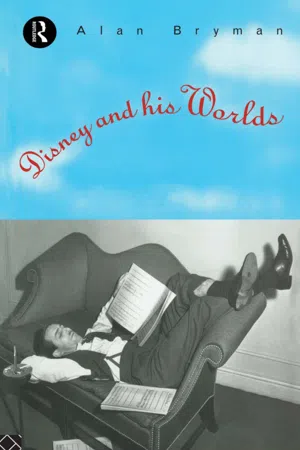
Disney & His Worlds
About this book
This work provides an overview of the Disney organization, in particular the theme parks and their significance for contemporary culture. The author examines topics such as Walt Disney's life and how his biography has been constructed, the Disney Company in the years after his death and various writings about the Disney theme parks. He raises important issues about the parks such as: whether they are harbringers of postmodernism; the significance of consumption at the parks; and the representation of past and future. The discussion of theme parks links with the presentation of Disney's biography and his organization by showing how central economic and business considerations have been in their development and how the significance of these considerations is typically marginalized in order to place an emphasis on fantasy and magic.
Information
Part I
DISNEY AND HIS ORGANIZATION
1
THE LIFE OF WALT DISNEY
What follows is a brief biography of the life of Walt Disney. This is undertaken in order to provide, along with the analysis in the next chapter of his company in the years after his death in 1966, a background to an appreciation of the Disney theme parks which are the chief focus of this book. There is no absolute necessity to undertake an examination of Walt Disney’s life, since the theme parks could logically be analysed in their own right or with little recourse to his biography. However, an examination of his life, and most especially the writings on his life, form an important backcloth to a number of observations which will be extracted in the context of the analysis of the theme parks.
In this biography and in subsequent chapters, Walt Disney will be referred to as Walt, rather than as Disney. There are two reasons for this, aside from parsimony. First, ‘Disney’ is often used to refer to the Walt Disney Company (formerly Walt Disney Productions) and in some writings it is not always obvious which is meant. Second, the biography of Walt Disney is also the biography of Roy O.Disney, his brother and business partner from Walt’s arrival in Hollywood in the 1920s onwards. Stanley (1993) has noted that biographies often subsume the biographies of other people, albeit in shorter form. Nowhere is this a more appropriate observation than in the case of Walt Disney’s biography, where the figure of his brother looms extremely large. Roy Disney will be referred to as Roy. ‘Disney’ will be used to refer to the company that Walt and Roy created.
In the next section, Walt’s life will be presented in largely neutral terms in order to allow a number of points to be made about the biography which will be presented. Most of these basic facts are well known and can be found in a number of standard works on which the following account is based. Probably the best of the ‘factual’ accounts is Thomas’s (1976) biography, which strongly influenced the present résumé, but a more detailed discussion of the sources of Walt’s biography will follow.
THE LIFE OF WALT DISNEY: A FACTUAL ACCOUNT
Walter Elias Disney was born in Chicago on 5 December 1901 to Elias and Flora Disney. Elias Disney, both before and after Walt’s birth, was a serially unsuccessful businessman who was continually seeking to improve his and his family’s lot by moving on, both geographically and from business to business. Walt was their fourth son and he was followed by their only daughter, Ruth, in 1903. Roy was the third child and was born in 1893. Elias and Flora were unhappy about bringing Walt and the other children up in the disorder of a modern city, and they moved in 1906 to a farm in Marceline, Missouri, which many writers have viewed as the inspiration for the Main Street, USA attraction in Disneyland (e.g. Francaviglia, 1981). It was here that Walt spent his formative years and it is often regarded as the source of the interest in animals which was to be so evident in his animated cartoons. Most biographers depict him as not a strong school pupil, who tended to concentrate on his interests, like the movie house. The family left Marceline in 1910, after Elias was forced to sell the farm following financial problems and illness. Elias is depicted by many of Walt’s biographers as a hard, humourless taskmaster who regularly beat his sons, and at around this time the two eldest sons deserted him. The family moved to Kansas City, Missouri, where Walt and Roy delivered newspapers for their father who had taken out a distributorship. Roy left home in 1912 to help his uncle on a farm. Walt’s record at school continued to be undistinguished and he is often described as letting his attention wander too much. During these years, Walt’s interest in drawing developed but was frowned on by his father who saw it as a frivolous activity. Walt remained close to Roy, who periodically returned to see him. In his mid-teens, Walt developed an interest in gags used by burlesque comedians and others and kept a file of them; he also took a correspondence course in art, which his father was prepared to pay for because Walt contributed to the family finances by working in a jelly factory. Walt joined the Red Cross Ambulance Corps at the end of the war and was sent to France for a year.
On his return in 1919, Walt sought work as a cartoonist in Kansas City, and eventually was employed at a commercial art studio where he met and became friendly with another recently hired cartoonist, Ubbe Iwwerks (who later shortened his name to Ub Iwerks). Walt’s job was short-lived and he teamed up with Iwerks to go into business. But Walt soon got a job as a cartoonist with the Kansas City Film Ad Company. Iwerks followed him shortly afterwards when their company went bankrupt in 1920. Although Iwerks is recognized as a brilliant draughtsman, he was a shy, diffident person, and it is generally reckoned that his personal traits contributed to a lack of ability at selling or generating interest in their products. At Film Ad, Walt began working on moving cartoons in the form of short advertising films. The method that he used was crude and Walt was dissatisfied with these films. He began to study animation and to experiment on his own at night. He found an outlet for his experiments in the Newman Laugh-O-Grams, which were brief cartoons based on simple gags made for the Newman Theater. In order to develop his experimental work further, Walt left his job and incorporated Laugh-O-Gram Films. Iwerks joined him, as did a number of other animators, and together they began work on fairy-tales. But the enterprise ran into difficulties and the cartoonists, including Iwerks, gradually left. At one point, Walt was telephoned by a local dentist who was interested in commissioning a film for the promotion of dental hygiene. When the dentist asked Walt to come over to finalize the deal, Walt had to admit that he did not have the $1.50 to recover his shoes from the local cobbler. The dentist not only came to Walt to hand over $500 for the deal, but also gave him the cobbler’s fee. Walt then began work on Alice’s Wonderland, in which a child was placed against a cartoon background, but this stream of activity also went bankrupt. In 1923, Walt decided he was getting nowhere and left for Hollywood to work in the movies with just $40 in his pocket.
Having failed to get a number of jobs, Walt was encouraged by Roy, who was living in Los Angeles at the time, to go back into cartoons. Roy managed to secure some financial backing and a distributor, Margaret Winkler, who had been sent Alice’s Wonderland, expressed interest in the work and provided further financial backing. A series of Alice adventures began. Walt moved into offices whose front window bore the inscription ‘Disney Bros. Studio’, and in February 1924 he hired his first animator. By May 1924, the series was complete, although profit margins for each cartoon had deteriorated, due to the rising costs of making technical improvements. Walt decided to cease work on drawing and to concentrate on story-lines, and he persuaded Iwerks to join him. The Alice series then re-started. During this period Walt’s romance began with one of the women working at the Studio—Lillian Bounds—whom he married in July 1925. Roy continued to oversee the business side of the Studio. Negotiations with their distributor became increasingly difficult when Margaret Winkler retired following her marriage to Charles Mintz, who took over the running of the company. However, in 1926, on the strength of a new agreement with Mintz, the brothers moved into a new studio premises on Hyperion Avenue close to downtown Los Angeles, but it was by then known as the Walt Disney Studio. Thomas (1976) suggests that the name-change occurred because Walt felt that the association of the studio with a single name would both appeal more to audiences and give it a stronger identity.
By the end of 1926, the Alice series had exhausted the range of possibilities open to it. The head of Universal Pictures had suggested to Mintz that he would like a cartoon series based on a rabbit. Following Mintz’s encouragement, Walt began work on Oswald the Lucky Rabbit, but the initial offerings were not well received by the distributor. The cartoons were revised (in particular, improvements in quality and comedy situations) and the series began to receive great plaudits. Merchandise bearing Oswald’s name and image appeared but the Disney s received no income or fee for their use. When the initial contract for the Oswalds came to an end, Walt took Lillian to New York to negotiate a new contract. Due to the success of Oswald, Walt and Roy fully expected to be able to secure better fees for their work. Instead, Walt was offered a much-reduced fee coupled with the threat that, if he did not sign, Mintz would sign all of the Disneys’ animators. Moreover, the rights to using the Oswald name and character belonged to Universal so Walt had no further claim to it. Walt declined and on the train journey home he dreamed up a cartoon character based on a mouse named Mortimer. Lillian disliked the name and suggested the name Mickey.
Walt and Roy saw through their remaining contractual obligations to produce Oswalds, but worked with Iwerks, who had remained loyal, on developing Mickey Mouse secretly at night (since they did not want the animators who had been signed by Mintz to know about the new character). Most writers agree that it was almost certainly Iwerks who developed and drew Mickey. Walt generated little interest in the first Mickey shorts, but at around the same time sound came to Hollywood. Walt felt that he needed not just to add sound, but that it should be fully synchronized with the action. Walt searched out a number of sound systems until he found what he felt was the best—Cinephone, a system owned by Pat Powers, which was based on a number of pirated designs. Walt applied Cinephone to Steamboat Willie, a Mickey Mouse animated cartoon short, and after some difficulty getting it shown, managed to secure a position on the bill of the Colony Theater, New York, on 18 November 1928. The cartoon was a sensational success and many distributors vied for a contract, but Walt’s insistence on owning the films and on controlling character merchandising deterred most of them. Powers, however, entered into a contract with Walt to promote and sell future Mickey cartoons, so that he could promote his Cinephone system, in return for 10 per cent of gross receipts and a fee for the use of Cinephone. Roy felt that the contract gave too much away to Powers.
In order to build up the Mickey Mouse series, many new animators were hired. At the same time, Walt worked on a nonMickey cartoon, The Skeleton Dance, which was to be the first of the Silly Symphonies series. This cartoon gave him and the Studio greater opportunity to experiment with their art. Mickey Mouse became a great success in 1929 but the cost of each new short escalated as Walt sought to improve quality. However, receipts seemed to have dried up. Walt hired a lawyer, Gunther Lessing, who had once advised Pancho Villa, and went to Powers to confront him about the lack of income. Powers refused to show them the books detailing receipts from the Mickeys but still tried to get them to sign a further deal. Powers felt that Walt could be convinced to sign when he played his trump card—he had a telegram showing that Iwerks had agreed to work with Powers to produce a cartoon series. Although shaken by this news, Walt refused to sign. Iwerks developed a number of series on his own, such as Flip the Frog, but these did not develop into major characters and his attempts to strike out on his own largely failed. In 1940 Iwerks returned to Disney, where he stayed for the rest of his working life, playing a major role in developing a number of technological innovations.
In February 1930, Walt signed an agreement with Columbia to distribute the cartoons. Columbia also agreed to buy the Disneys out of their contract with Powers. The following year Walt suffered a breakdown from running what was still a hand-tomouth operation, due to the rising costs of animation. Their financial problems would have been worse were it not for merchandising. Initially, agreements to use manufactured items with Mickey on them were haphazard but in February 1930 they signed a licensing agreement with the George Borgfeldt Company of New York. The Disneys were not entirely satisfied with Borgfeldt’s efforts and in July 1932, following overtures made to them by Kay Kamen, who offered a greater emphasis on quality and a wider range of products, a new deal was signed with Kamen, with whom the Disneys enjoyed a highly successful relationship until his death in 1949.
Shortly after leaving Columbia and striking a new deal with United Artists, Walt decided to improve the quality of the Studio’s output with colour. Despite Roy’s reservations, Walt struck a deal with Technicolor for the exclusive use for two years of its new three-strip colour system. Walt felt that colour would give a great boost to the Silly Symphonies series and he used it for a short that was already in production, Flowers and Trees, which became the first cartoon to receive an award from the Academy of Motion Picture Arts and Sciences and was a huge success when it opened in July 1932. At around this time, Walt decided that the quality of cartoons could be enhanced by providing more training for his staff. This began in 1931, and from November 1932, classes in the Studio itself were conducted. A further boost to Walt’s and the Studio’s reputation was The Three Little Pigs, which was a great success for a number of reasons: its catchy tunes; its apparently optimistic message about the work ethic in the midst of the Great Depression; and most importantly, its investment of the three pigs with clear, identifiable personalities that brought animation to new heights.
By 1934 the staff had grown from six in 1928 to 187. During the early 1930s, the Studio’s stable of characters grew, as Pluto, Donald Duck and Goofy gradually emerged in their own right. But by around 1934 Walt came to the view that he needed to make a feature film. One of the main reasons was that it was becoming increasingly difficult to combine the growing costs of animation, due to improvements stemming from sound, colour and technique, with the inherently limited returns that could accrue from shorts. Roy had very great reservations about the project but Walt went ahead and decided that Snow White and the Seven Dwarfs would provide a suitable story for treatment. The biographies and reminiscences about Walt invariably tell of an occasion shortly after his decision to make Snow White when he called many of the top animators to a late-night session at which he delivered a spell-binding narrative of the story and characters that he had envisioned. The Studio continued to make shorts after the decision was taken but the feature film was the source of everyone’s enthusiasm. Walt allocated the main animators to specific tasks according to his perception of each of their strengths. The film received much adverse advance publicity and was dubbed ‘Disney’s folly’, because of its escalating costs and because many commentators doubted the capacity of audiences to sit through a long animated cartoon. At one point it was apparent that the film needed further financing and Walt was persuaded to give a presentation to their bankers, Bank of America, so that they could see what they would be loaning the money for. After the showing and as he was leaving, the Bank’s taciturn representative turned to Walt and said: ‘That thing is going to make a hatful of money.’ When it opened on 21 December 1937 it was an immense critical success, and subsequently an immense commercial success, earning $8 million on its initial release.
Largely as a result of Snow White’s success, Walt realised that feature film production had to become the Studio’s main focus, and soon afterwards work began on Pinnochio, Fantasia, and Bambi. In order to accomplish this level of production effort, the Studio clearly needed to expand, but since the existing Hyperion buildings limited the extent to which much further expansion would be possible, the brothers decided to build a new studio. In the summer of 1938, they placed a deposit for a new purposebuilt studio in Burbank. In effect, the new studio building would consume the bulk of the profits from Snow White. The move was completed in May 1940, by which time the Studio had about 1,100 employees. The Studio’s financial position began to deteriorate around the beginning of World War II. Both Fantasia and Pinnochio performed poorly at the box office and produced sizeable losses, the former especially so, since they had proved very costly to produce. Also, Disney’s European market had all but dried up as a result of the war. Walt and Roy tried to redeem the situation by producing two cheap feature films: The Reluctant Dragon (which included some live action) and Dumbo. The latter provided a much-needed injection of money at a time when so much was being spent on the new studio. Even so, the Studio was heavily in debt and was forced to issue shares to the public in April 1940, a move to which the brothers had always been opposed.
There is little doubt that the camaraderie that existed in the Hyperion studio was dissipated after the move to the large, rather antiseptic studio at Burbank and this almost certainly contributed to a lengthy strike at the Studio which began on 29 May 1941. The strike is a fascinating event, not least because most commentators agree that the work atmosphere was never the same again after the strike and because it pushed Walt’s politics into a decidedly rightward direction, since he saw it as a product of the work of communists. It is also said that Walt never again felt the same about the bulk of those who worked for the company. Most biographers depict the strike as the product of a jurisdictional dispute as a result of the efforts by the Screen Cartoonists Guild, under the leadership of Herb Sorrell, to unionize the Studio. Walt refused to recognize the Guild and tried to appeal directly to his staff by outlining all that he and Roy had done in creating the company and its current parlous financial state. This was to no avail and the strike lasted nine weeks with approximately half the staff joining it. Walt seems to have become increasingly intransigent and vehement in his condemnation of the strikers, the Guild and the organizers. Indeed, it seemed that the only way that the strike could be settled would be to get Walt out of the way, and that is exactly what happened. Just at the point that both sides were becoming more and more obdurate, Walt received an invitation to go on a goodwill tour of South America, which would offer the opportunity for making films and developing ideas. He accepted, and the strike was settled by conciliators in his absence. The settlement was largely unfavourable to the Studio.
In December 1941, the Studio was commandeered by the US army and Walt spent the rest of the war making films to help the US war effort and health films for the State Department. During this period the company continued to experience financial setbacks. Victory Through Air Power lost $436,000 and the response to Bambi was disappointing, while Saludos Amigos, a product of the South America trip, fared quite well. By the end of the war, Walt Disney Productions was deeply in debt to Bank of America. Work began slowly on a number of cartoon shorts and then on feature films, including Make Mine Music and Song of the South, both of which included a great deal of live action in order to keep costs down. These films were moderately successful, but also constituted an important transitional point between the days when the company was (with the exception of The Reluctant Dragon) purely a cartoon studio and a period in which the company diversified gradually into non-cartoon films. One strand in this trend was the hiring of a couple who had experience of making travel and educational films to spend a year filming wild-life in Alaska, a project to which Roy was opposed. The result was Seal Island, a half-hour film which was well received. However, various other immediate post-war offerings were not well received by critics or the box office. The second strand of the shift away from cartoons was Treasure Island, a live-action adventure film which was made in England to secure access to millions of dollars in revenue that the company had built up, but which had been frozen. This film, along with Cinderella and Beaver Valley, another true-life short, greatly improved the company’s financial position in 1950. It also marked the beginning of a period which continues to today, in which the balance of film production shifted away from cartoons to live-action adventures. This trend occurred side-by-side with a sharp decline in the number of cartoon shorts produced.
In 1951 Alice in Wonderland was neither a critical nor a financial success. Walt and his company were still in a situation where the company’s position could be substantially affected by a single success or failure. In 1953 the company’s fortunes were consolidated by Peter Pan and The Living Desert. The latter marked an important turning-point for the company: because of their distributor’s lack of interest in this true-life feature film, Roy formed Disney’s own distribution channel, called Buena Vista, which thereafter distributed all their films.
Some time in the late 1940s, Walt had become interested in the idea of an amusement park in which the cartoon characters would figure strongly, but which would also be a tribute to Ame...
Table of contents
- Cover Page
- Title Page
- Copyright Page
- Preface
- Part I Disney and His Organization
- Part II The Disney Theme Parks
- Notes
- Bibliography
Trusted by 375,005 students
Access to over 1.5 million titles for a fair monthly price.
Study more efficiently using our study tools.
Frequently asked questions
Yes, you can cancel anytime from the Subscription tab in your account settings on the Perlego website. Your subscription will stay active until the end of your current billing period. Learn how to cancel your subscription
No, books cannot be downloaded as external files, such as PDFs, for use outside of Perlego. However, you can download books within the Perlego app for offline reading on mobile or tablet. Learn how to download books offline
Perlego offers two plans: Essential and Complete
- Essential is ideal for learners and professionals who enjoy exploring a wide range of subjects. Access the Essential Library with 800,000+ trusted titles and best-sellers across business, personal growth, and the humanities. Includes unlimited reading time and Standard Read Aloud voice.
- Complete: Perfect for advanced learners and researchers needing full, unrestricted access. Unlock 1.5M+ books across hundreds of subjects, including academic and specialized titles. The Complete Plan also includes advanced features like Premium Read Aloud and Research Assistant.
We are an online textbook subscription service, where you can get access to an entire online library for less than the price of a single book per month. With over 1.5 million books across 990+ topics, we’ve got you covered! Learn about our mission
Look out for the read-aloud symbol on your next book to see if you can listen to it. The read-aloud tool reads text aloud for you, highlighting the text as it is being read. You can pause it, speed it up and slow it down. Learn more about Read Aloud
Yes! You can use the Perlego app on both iOS and Android devices to read anytime, anywhere — even offline. Perfect for commutes or when you’re on the go.
Please note we cannot support devices running on iOS 13 and Android 7 or earlier. Learn more about using the app
Please note we cannot support devices running on iOS 13 and Android 7 or earlier. Learn more about using the app
Yes, you can access Disney & His Worlds by Alan Bryman in PDF and/or ePUB format, as well as other popular books in Ciencias sociales & Historia empresarial. We have over 1.5 million books available in our catalogue for you to explore.