eBook - ePub
Building Energy Management Systems
An Application to Heating, Natural Ventilation, Lighting and Occupant Satisfaction
- 544 pages
- English
- ePUB (mobile friendly)
- Available on iOS & Android
eBook - ePub
Building Energy Management Systems
An Application to Heating, Natural Ventilation, Lighting and Occupant Satisfaction
About this book
Energy management systems are used to monitor building temperature inside and outside buildings and control the boilers and coolers. Energy efficiency is a major cost issue for commerce and industry and of growing importance on university syllabuses. Fully revised and updated, this text considers new developments in the control of low energy and HVAC systems and contains two new chapters.
Written for practising engineers (essential for control engineers) and energy managers in addition to being essential reading for under/postgraduate courses in building services and environmental engineering.
Information
1
An introduction to BEMSs
Building energy management systems (BEMSs) are now an established part of modern buildings, although their potential has yet to be fully realized in practice. However, as computer and communication technology advance inexorably, so the contribution of BEMSs will increase. With the power of microprocessors doubling every 18 months (sometimes known as Moore’s law [1]), the potential is great. Although BEMSs advanced with the developments in microprocessors, the current rapid advances of communications and networks will shape the increased use of BEMSs.
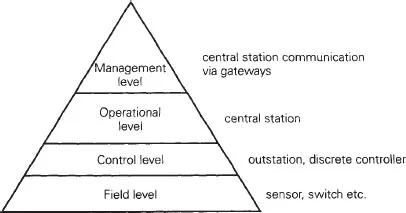
The exact nature of BEMS, BMS, EMS and BAS is also becoming less easy to define as even small components, such as switches and radiator valves, can have small chips attached to them so that they can be linked into a communication and control bus. Figure 1.1 shows the different levels of a BEMS from the field device, which is becoming more intelligent, to the head-end management PC.
Fig. 1.1 The levels of control in a BEMS.
1.1 Intelligent buildings
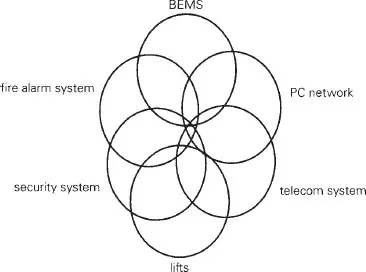
Intelligence is a much misused word but here it is used to imply that a microprocessor is incorporated in the intelligent device. However, it is also applied to buildings, where again there is no simple definition. One definition is a building that provides a productive and cost-effective environment through optimization of its four basic elements: structure, services and management and the interrelationships between them [2, 3]. Figure 1.2 gives an indication of the interaction of the microprocessor-controlled systems that can exist in an intelligent building, such as the PC network with its server, or the security system with its PC head end. The more these system circles overlap, i.e. the more common the sharing of bus systems and intercommunications, the more intelligent the building becomes.
Fig. 1.2 The potential overlap of microprocessor-based systems.
1.2 The development of BEMSs
Building energy management systems have developed alongside, and been a result of the microelectronics and computing revolution of recent years. This is because BEMSs are simply microcomputer systems used for controlling and monitoring building services plant. BEMSs have also benefited from the knowledge and technology in the application of computer control to manufacturing and the process industry.
The earliest ancestor of the BEMS was the hard-wired, central system. It first appeared in the 1960s and was employed in large buildings [4]. The system was basically an extension of the conventional control wires to a central console, with dials, indicator lights and a chart recorder, which enabled an operator at the console to monitor distant plant and see temperatures displayed. No computers or microelectronics were involved, and it relied on the operator to change control settings and times [5].
These hard-wired systems were then improved with the telephone technology of the day to enable individual items of plant to be switched, via data-gathering panels local to the plant, into a central multicore trunk cable running around the building from the central console. This switching, or multiplexing, saved on cabling by using the same trunk cable for a number of data-gathering panels.
With the rapid advances of microelectronics, and hundreds of transistor devices being integrated onto one large-scale integrated (LSI) chip of silicon, area about 5 mm2, the first computer-based monitoring and control systems emerged. These early BEMSs were centralized energy management systems and they first appeared in the 1970s [6], having been developed in the United States. The central station was based on a minicomputer, which contained all the computing power or ‘intelligence’ in the system, with ‘dumb’ or unintelligent outstations, which were boxes or cabinets for relays and connections to sensors and actuators, similar to the earlier data-gathering panels. The term ‘intelligent’ is used because the central station (the minicomputer) had the ability to calculate and make decisions using the data it received from the outstations.
The systems were very expensive, so they were only viable for large sites such as prestige air-conditioned headquarters [7]. Although they related initially to the control and monitoring of HVAC plant and were therefore energy management systems, they were also capable of controlling the lighting and the lifts and monitoring the security and fire alarms. (In the United Kingdom, regulatory decisions meant that security and fire alarms were rarely linked to BEMSs.) In fact, the systems were considered as building management systems to help in the management of large and complex sites, without specifically saving energy. These early building energy management sytems were actually in existance before the energy crisis of 1973/74.
Although these early BEMSs were capable of monitoring and controlling fire and security systems, they rarely did, as dedicated systems were used for the potentially life-saving fire detection devices and also the security devices. There are still problems in integrating all systems such as fire alarm systems and security systems into BEMSs today, mostly due to the different and disparate disciplines and standards, rather than the technology, and also the different manufacturing companies involved.
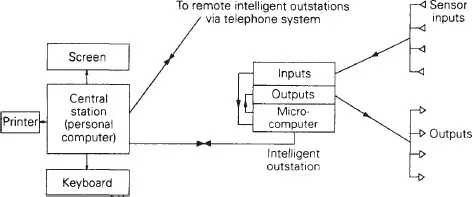
Since about 1980 the rapid development of LSI and VLSI (very large scale integration) led to thousands of devices being put on a chip (for the Pentium chip it is now millions of transistors). Hence microcomputers, or personal computers (PCs), became as powerful, perhaps more powerful than the previous minicomputer. And the outstations, small microcomputers themselves, or more correctly, they contain microprocessor chips (see later), have gained considerably in processing power, giving them ‘intelligence’ (Fig. 1.3). This enables them to operate on their own, or to become standalone outstations, dependent only on the central station for a small proportion of their operating time. These outstations have considerably more control functions than the older, dumb outstations, which tended to have more of a monitoring role. Indeed, each intelligent outstation can control a small building on its own, and it is economic to install these intelligent outstations in small and medium-sized buildings.
Fig. 1.3 A microprocessor-based BEMS with intelligent outstations.
The cost of a BEMS system can best be judged using cost per point (a point is an input or an output, e.g. a temperature input to the outstation or a control signal output to a valve) or cost per floor area. However, the buyer must beware of the implications of marginal costing [8] and a loss-leader pricing policy to gain entry to an organization in the hope that the system will later be expanded, when the vendor will hope to recoup its profit [9].
Table 1.1 shows the cost of a BEMS at 1998 prices for the basic shell and core elements of a building (i.e. the central plant and distribution duct and pipework without the final units, such as fan coil units or variable air volume (VAV) boxes, that in a speculative office building will be put in later during the fit-out). Note that the cost of the BEMS central station, or head-end supervisor, the outstations and the software engineering is only 13% of the total cost. Table 1.2 considers the additional cost for a category A fit-out with ‘intelligent’ outstations at each fan coil unit subsequently fitted [10]. Alternative costs are included for simple fan coil unit control if the outstations are to be omitted.
Table 1.1 Shell and core for a speculative office [10]
| Cost per item (£) | Cost (£) | GIA (£m−2) | NLA (£m−2) | Per cent | |
| Head-end supervisor | 2 800 | 2 800 | 0.28 | 0.37 | 2 |
| DDC outstations (1 × 32 point and 2 × 72 point outstation) | 15 000 | 15 000 | 1.5 | 2 | 8 |
| Motor control panels (average of 80 points per panel) | 12 500 | 25 000 | 2.5 | 3.33 | 14 |
| 90 Loose controls (sensors and valves) | 14 400 | 1.44 | 1.92 | 8 | |
| Power wiring (SWA cable, clipped to dedicated tray) | 57 600 | 5.76 | 7.68 | 32 | |
| Control wiring (dedicated containment) | 160 | 32 000 | 3.2 | 4.27 | 18 |
| Allowance for network wiring | 2 700 | 2 700 | 0.27 | 0.36 | 1 |
| Allowance for commissioning | 4 500 | 0.45 | 0.6 | 2 | |
| Allowance for software engineering | 5 000 | 0.5 | 0.67 | 3 | |
| Allowance for design, organization costs and site management | 21 000 | 2.1 | 2.8 | 12 | |
| Total | 180 000 | 18 | 24 | 100 | |
| Cost per point | 1022.7 | 0.1 | 0.14 |
GIA=gross internal floor area
NLA=net lettable floor area
Table 1.2 Costs of BEMS for fitted-out building (with fan coil units)
| Category A fit-out | Cost per item (£) | Cost (£) | GIA (£m−2) | NLA (£m−2) | Percentage of total |
| 220 Fan coil unit intelligent controllers | 115 | 25 300 | 2.53 | 3.37 | 32 |
| Fan coil controls (440 four-port valves, 220 flying-lead return air temperature sensors) | 25 000 | 2.5 | 3.33 | 31 | |
| Allowance for control wiring (screened beldan type, dedicated containment) | 3 000 | 0.3 | 0.4 | 4 | |
| Network wiring (twin-twisted screened beldan type, dedicated containment) | 15 400 | 1.54 | 2.05 | 19 | |
| Allowance for commissioning | 4 500 | 0.45 | 0.6 | 5 | |
| Allowance for software engineering | 800 | 0.08 | 0.11 | 1 | |
| Allowance for design, organization costs and site management | 6 000 | 0.6 | 0.8 | 8 | |
| Total | 80 000 | 8 | 10.66 | 100 |
GIA=gross internal floor area
NLA=net lettable floor area
Airside control of the fan coil, using dampers (), will save £70 per u...
Table of contents
- Cover
- Halftitle
- Title
- Copyright
- Contents
- Foreword
- Preface
- Preface to the first edition
- 1. An introduction to BEMSs
- 2. The outstation
- 3. The BEMS central station
- 4. Sensors and their responses
- 5. Basic and fuzzy logic control
- 6. PID three-term direct digital control
- 7. Building heat loss and heating
- 8. Compensation
- 9. Optimizer control
- 10. Control of air conditioning
- 11. Natural ventilation and its control
- 12. Low-energy air conditioning and lighting control
- 13. Network analysis
- 14. Monitoring and targeting
- Index
Trusted by 375,005 students
Access to over 1.5 million titles for a fair monthly price.
Study more efficiently using our study tools.
Frequently asked questions
Yes, you can cancel anytime from the Subscription tab in your account settings on the Perlego website. Your subscription will stay active until the end of your current billing period. Learn how to cancel your subscription
No, books cannot be downloaded as external files, such as PDFs, for use outside of Perlego. However, you can download books within the Perlego app for offline reading on mobile or tablet. Learn how to download books offline
Perlego offers two plans: Essential and Complete
- Essential is ideal for learners and professionals who enjoy exploring a wide range of subjects. Access the Essential Library with 800,000+ trusted titles and best-sellers across business, personal growth, and the humanities. Includes unlimited reading time and Standard Read Aloud voice.
- Complete: Perfect for advanced learners and researchers needing full, unrestricted access. Unlock 1.5M+ books across hundreds of subjects, including academic and specialized titles. The Complete Plan also includes advanced features like Premium Read Aloud and Research Assistant.
We are an online textbook subscription service, where you can get access to an entire online library for less than the price of a single book per month. With over 1.5 million books across 990+ topics, we’ve got you covered! Learn about our mission
Look out for the read-aloud symbol on your next book to see if you can listen to it. The read-aloud tool reads text aloud for you, highlighting the text as it is being read. You can pause it, speed it up and slow it down. Learn more about Read Aloud
Yes! You can use the Perlego app on both iOS and Android devices to read anytime, anywhere — even offline. Perfect for commutes or when you’re on the go.
Please note we cannot support devices running on iOS 13 and Android 7 or earlier. Learn more about using the app
Please note we cannot support devices running on iOS 13 and Android 7 or earlier. Learn more about using the app
Yes, you can access Building Energy Management Systems by Geoff Levermore in PDF and/or ePUB format, as well as other popular books in Technology & Engineering & Architecture General. We have over 1.5 million books available in our catalogue for you to explore.